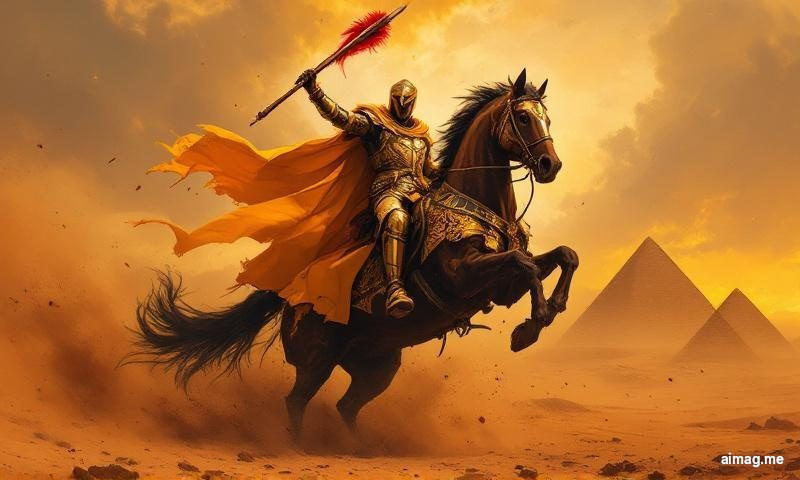
He is already moving. That is the first thing you notice — not the armor etched with salamanders, not the pyramids rising like teeth from the desert behind him, not even the tall wooden wand he raises like a battle standard or a torch. What you see first is the horse in mid-leap, all four hooves off the ground, and the knight leaning into the charge as though slowing down were a kind of death. His visor is open. He faces whatever is coming without the comfort of a shield or the caution of a closed helmet. His yellow cloak billows behind him like a trailing flame, and beneath it the red plumes on his helmet stream backward as if the wind itself is trying to catch up. The desert landscape offers nothing — no shade, no water, no city on the horizon — but the knight does not seem to have noticed. He is not riding toward something he can see. He is riding because riding is what fire does when you give it legs.
That is the Knight of Wands — fire given a body, passion given a direction, and the question that hangs over every adventure: when does boldness become recklessness?
In short: The Knight of Wands means bold action, passionate pursuit, and fire in motion — the most impulsive and charismatic energy in the deck. Upright, it signals adventure, travel, fearless initiative, and the person who acts before the room finishes deliberating. Reversed, it warns of recklessness, scattered projects, frustration from blocked momentum, or charm weaponized into manipulation. His question is whether your speed has a destination.
Knight of Wands at a Glance
| Attribute | Detail |
|---|---|
| Court Rank | Knight (Adventurer) |
| Suit | Wands |
| Element | Fire of Fire |
| Keywords (Upright) | action, adventure, boldness, passion, impulsiveness, confidence, travel, fearlessness, charisma |
| Keywords (Reversed) | recklessness, haste, scattered energy, delays, frustration, burnout, anger, arrogance |
| Yes / No | Yes |
What Does the Knight of Wands Mean?
The four Knights of the tarot are the suit's engines of motion. Where the Pages study and wonder, the Knights act — and the nature of their action is defined by their element. The Knight of Cups rides toward feeling with romantic devotion. The Knight of Pentacles advances methodically, one careful hoofbeat at a time. The Knight of Swords charges with intellectual ferocity, slicing through opposition with the speed of a conclusion already reached. But the Knight of Wands does not ride toward anything as specific as a feeling, a goal, or an argument. He rides toward the horizon itself — toward the next thing, the unknown thing, the thing that has not happened yet but vibrates with the promise of happening. His destination is movement.
This is the second stage in the court card evolution of the Wands suit. The Page of Wands held the wand and studied it with the wide-eyed curiosity of someone who has just discovered that the world contains fire. The Knight grabbed that same wand, mounted a horse, and left. Where the Page asked "what is this?", the Knight asks "where can this take me?" The Queen of Wands will eventually transform this raw energy into sustained mastery, and the King will channel it into authority and vision. But the Knight is not interested in mastery or authority. He is interested in velocity.
Arthur Edward Waite, in The Pictorial Key to the Tarot (1911), described the Knight of Wands as representing "departure, absence, flight, emigration" — and then, in a characteristically Waite-like turn, added that the card could also signify "a dark young man, friendly." The contradiction is revealing. The Knight of Wands is both the energy of leaving and the charisma that makes people wish he would stay. He is the friend who always has a new plan, a new country, a new obsession — the one whose enthusiasm is so genuine and so infectious that you find yourself packing your bag before you have asked where you are going.
Rachel Pollack, in Seventy-Eight Degrees of Wisdom (1980), reads the Knight of Wands as "the most fiery of all the court cards" — fire of fire, passion operating on pure passion, without the moderating influence of water, earth, or air. She notes that this intensity is both his gift and his limitation. The Knight does not plan. He does not strategize. He does not weigh consequences. He acts, and the action itself generates meaning. This is exhilarating when the direction is right and catastrophic when it is wrong — and the Knight rarely pauses long enough to determine which case applies.
There is an archetype here — the eternal youth, the brilliant charmer who is endlessly energetic, perpetually beginning things and rarely finishing them. He lives in the future, in possibility, in the next adventure. The shadow of this archetype is the rigid, cautious old figure who has forgotten how to dream — and the Knight of Wands exists precisely in the tension between these poles. He is the cure for stagnation and the cause of instability. Sometimes in the same afternoon.
Personality research identifies a temperament type driven by the need for varied, novel, and intense experiences — people who thrive on uncertainty and wilt under routine. The Knight of Wands is this temperament made visible: the adrenaline seeker, the serial entrepreneur, the traveler who books the flight before reading about the destination. In moderation, this trait produces explorers, innovators, and leaders who are willing to act when others are still deliberating. In excess, it produces burnout, broken promises, and the peculiar loneliness of someone who has been everywhere but stayed nowhere.

Knight of Wands Reversed
When the Knight of Wands appears reversed, the fire does not disappear — it turns destructive. The confidence that was charming at full gallop becomes arrogance at a standstill. The impulsiveness that created adventure now creates chaos. Energy without direction is just heat, and the reversed Knight of Wands runs hot in all the wrong ways: reckless decisions, scattered projects, promises made in the rush of enthusiasm and abandoned when the next shiny thing appears.
Sometimes the reversal signals frustration rather than recklessness — the Knight who wants desperately to move but is blocked. Delays, obstacles, plans that keep falling apart before they launch. The horse rears but cannot run. The wand is raised but points at nothing. This is the particular agony of a fire temperament trapped in circumstances that require patience, diplomacy, or sustained effort — three things the Knight of Wands does not naturally possess.
At its most difficult, the reversed Knight points to anger, aggression, or the kind of charismatic domination that confuses intensity with intimacy. The open visor becomes a challenge rather than an invitation. The gallop becomes a stampede. The charm weaponizes into manipulation. If this describes someone in your life, the card is not advising you to match their fire. It is advising you to step out of the path.
In its gentlest form, the reversed Knight simply says: slow down. Not stop — the Knight of Wands cannot stop and remain himself — but slow enough to notice whether the direction you are charging in actually leads somewhere worth arriving.
Knight of Wands in Love and Relationships
Upright
The Knight of Wands in a love reading is unmistakable: passion that moves fast and burns bright. This is not the slow courtship of candlelit dinners and carefully worded texts. This is spontaneity, intensity, the person who shows up at your door with two plane tickets and no apology for the late hour. There is enormous chemistry here — the kind that makes you feel more alive than you have felt in months — but there is also a warning embedded in the thrill. The Knight of Wands is better at beginnings than he is at staying.
For those already in a relationship, this card signals a surge of renewed passion — a spontaneous trip, an unexpected spark, the return of the excitement that routine had quietly buried. It can also represent a partner who is restless, itching for novelty, needing something new to chase. The question is not whether the fire is real. The fire is always real with the Knight of Wands. The question is whether it can be sustained once the initial gallop slows to a trot.
For singles, expect someone bold, probably a fire sign or a fire temperament — someone who approaches romance the way they approach everything else: directly, passionately, and with a slight disregard for consequences. Enjoy the ride. Just remember that a knight, by definition, is traveling through.
Reversed
Reversed in love, the Knight of Wands indicates relationships that burn too hot and flame out, partners who promise the world and deliver a postcard, or your own tendency to leap into romantic situations before checking whether the other person is even on the same horse. Commitment phobia lives here — not because the Knight does not feel deeply, but because depth requires staying, and staying requires tolerating the moment when the fire settles into coals. The reversed Knight mistakes the settling for dying and moves on before discovering that coals are warmer than sparks.
Swept off your feet? Try a free AI reading →
Knight of Wands in Career and Finances
Upright
In career readings, the Knight of Wands signals bold professional moves — the leap to a new industry, the pitch that lands because your conviction is infectious, the decision to stop planning and start doing. This card favors entrepreneurs, freelancers, salespeople, performers, and anyone whose career depends on charisma, energy, and the willingness to take risks. It is less favorable for roles requiring patience, meticulous detail, or years of incremental progress — not because it opposes those qualities, but because it simply does not notice them.
Financially, the Knight of Wands is not a card of careful investment. It is a card of bold financial action — the risky bet that pays off because timing and confidence aligned, or the impulsive purchase that turns out to be exactly right. The Knight trusts his instincts with money the way he trusts them with everything else. When his instincts are good, the results are spectacular. When they are not, the credit card statement is painful.
Reversed
Reversed in career, the Knight of Wands warns of professional recklessness — quitting before having a plan, alienating colleagues with impatience, starting projects with enormous energy and abandoning them when the excitement fades. It can also signal a frustrating period of stagnation: the entrepreneur whose funding keeps falling through, the creative whose pitches keep being rejected, the professional who knows they need to move but cannot find the opening. The reversal often suggests that the problem is not lack of energy but lack of strategy. Fire without a furnace is just wildfire.
Knight of Wands in Personal Growth
Time perspective research identifies what psychologists call "present hedonists" — people who live intensely in the current moment, driven by sensation and experience, with relatively little orientation toward the future. The Knight of Wands is the tarot's portrait of this orientation at its most magnificent. He is not irresponsible because he has weighed future consequences and dismissed them. He is irresponsible because the future, for him, is an abstraction — the only thing that is real is the wand in his hand, the wind in his face, and the ground disappearing under his horse. When this orientation works, it produces flow states, peak experiences, and the kind of spontaneous joy that more cautious people spend their entire lives trying to recapture. When it does not work, it produces a trail of unfinished business and bewildered people left holding plane tickets for trips that were never taken.
The growth edge for the Knight of Wands archetype is not learning to be more cautious — caution is someone else's medicine. It is learning that fire does not have to mean fast. A blacksmith's forge burns as hot as a wildfire but it burns with purpose, with containment, with the patience to hold metal in flame until it becomes a blade. The Knight's challenge is not to extinguish his fire but to discover that a sustained burn can accomplish what a thousand spontaneous sparks cannot.
A practical exercise for anyone who recognizes the Knight of Wands in themselves: take one project — just one — that you have started and not finished, and commit to completing it before beginning anything new. Not because finishing is more virtuous than starting, but because the Knight of Wands has never experienced what lies on the other side of sustained effort, and that territory contains rewards that speed alone cannot reach. The Ten of Wands waits at the end of every Wands journey, carrying its burden — but the view from the top of that hill is worth the climb.
Knight of Wands Combinations
- Knight of Wands + The Chariot — Unstoppable momentum. The Chariot provides the discipline and direction that the Knight sometimes lacks. Together they create movement that is both passionate and controlled — fire on rails. If you have been hesitating about a bold move, this pairing says the path is clear and the speed is right.
- Knight of Wands + The Lovers — A passionate romantic encounter that demands a choice. The Knight's impulsive energy meets the Lovers' requirement for conscious decision. This is not a fling — or rather, it begins as one and then asks you to decide whether it becomes something more. The fire is real; the question is whether you choose it deliberately.
- Knight of Wands + Eight of Wands — Pure velocity. Everything accelerates. Travel, communication, progress — all at a pace that leaves no room for second thoughts. This is the combination of the road trip that changes your life, the message that arrives at exactly the right moment, the momentum that cannot be faked or forced because it is genuinely earned.
- Knight of Wands + Four of Cups — Restlessness meets apathy. The Knight wants to charge but the Four of Cups refuses to be impressed. This tension often signals that external adventures are being used to avoid an internal reckoning. The real journey is not the one requiring a passport.
- Knight of Wands + Knight of Pentacles — Fire meets earth. The impulsive adventurer sits across from the methodical planner, and neither understands the other. Yet this is one of the most productive tensions in the deck: the Knight of Wands provides the vision and the Knight of Pentacles provides the follow-through. Together they accomplish what neither could alone.
Frequently Asked Questions
Is the Knight of Wands a positive card?
Generally yes — emphatically so. The Knight of Wands represents courage, charisma, and the willingness to act that most people only fantasize about. He is a card of genuine passion and real forward motion. The caveat is that his energy, undirected, can cause as much damage as it creates progress. The surrounding cards determine whether the Knight is riding toward triumph or riding toward a cliff. But even at his most reckless, he reminds you that movement is preferable to paralysis.
Does the Knight of Wands represent a person?
Often, yes. The Knight of Wands frequently appears as someone in the querent's life — typically a young or young-spirited person (any gender) with fire-sign energy: bold, enthusiastic, possibly impulsive, almost certainly charismatic. They are the friend who talks you into the adventure, the colleague who launches three projects simultaneously, the lover who arrives like a windstorm and leaves you breathless. The card can also represent a part of yourself — the inner adventurer who is demanding to be heard.
What does the Knight of Wands mean for travel?
It is the strongest travel indicator among the court cards. The Knight of Wands literally depicts a journey in progress, and in practical readings it frequently signals actual travel — particularly the spontaneous, adventurous kind. A road trip rather than a cruise. A backpacking expedition rather than a resort vacation. If you have been considering a trip, this card says book it. If you have not been considering one, it suggests that your life could use the perspective that only new geography provides.
What is the yes or no answer for the Knight of Wands?
Yes — and quickly. The Knight of Wands does not deliberate. He does not make pro-and-con lists. He reads the situation with his gut and acts. As a yes-or-no card, he is a strong affirmative, particularly for questions about taking action, pursuing opportunities, making changes, or following passion. The only caution: his "yes" comes with velocity, so be prepared for things to move faster than you expected once you say it.
The horse is mid-leap, all four hooves suspended above the desert floor, and the knight does not look down. His visor is open because closing it would mean seeing less of the world, and seeing less of the world is a price he will never agree to pay. The pyramids behind him are ancient and immovable — monuments to civilizations that planned and measured and calculated for centuries — and he has ridden past them in an afternoon without turning his head. This is not disrespect. It is simply a different relationship with time. The pyramids will be there tomorrow. The Knight of Wands is only interested in what is here now, in this moment, in the wind and the fire and the ground disappearing beneath him. He is not asking whether you can keep up. He is asking whether you are willing to find out.