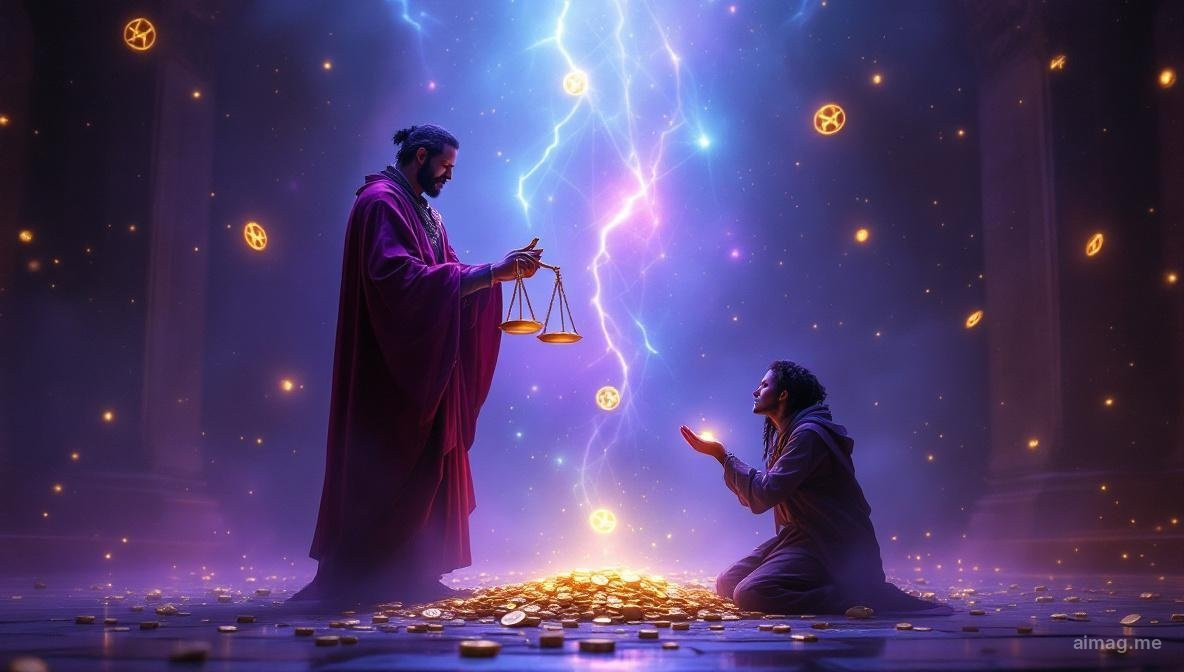
A merchant stands in fine robes — red and purple, the colors of wealth and station — holding a perfectly balanced set of golden scales in his left hand while his right hand drops coins into the upturned palms of two figures kneeling at his feet. Six pentacles float in the air around the scene, distributed between giver and receivers in an arrangement that looks generous but feels more complicated than generosity alone can explain.
Look at the kneeling figures. Their clothes are worn. Their posture is supplicant. They receive with open hands and bowed heads. Now look at the merchant. His expression is not warm. It is measured, precise, almost clinical — the face of someone who is calculating fairness, not expressing love. The scales in his left hand are not decorative. He is weighing something. And the coins falling from his right hand are not gifts. They are disbursements.
The Six of Pentacles is the card of generosity — but it is also, unavoidably, the card of power. Whoever holds the scales holds the power, and the act of giving, however kind, always creates a dynamic between the one who has and the ones who need.
In short: The Six of Pentacles depicts a merchant with balanced scales distributing coins to kneeling figures, representing generosity that is inseparable from power dynamics. The card asks you to examine both sides of every exchange: the giver who must resist using kindness as leverage, and the receiver who navigates the vulnerability of needing what someone else has. Life places everyone in both roles, and the card measures how gracefully you occupy yours.
Six of Pentacles at a Glance
| Attribute | Detail |
|---|---|
| Number | 6 |
| Suit | Pentacles (Coins, Disks) |
| Element | Earth |
| Keywords (Upright) | generosity, charity, sharing wealth, balance of giving and receiving, power dynamics |
| Keywords (Reversed) | strings attached, one-sided generosity, debt, inequality, charity as control |
| Yes / No | Yes |

What Does the Six of Pentacles Mean?
Sixes in tarot represent harmony, balance, and resolution after the conflict of the Fives. The Six of Cups resolved emotional disruption through nostalgic connection. The Six of Pentacles resolves material disruption — the poverty of the Five of Pentacles — through the redistribution of resources. Someone who has enough shares with those who do not. The imbalance is corrected. Harmony returns.
But the Six of Pentacles is the most psychologically complex of all the Sixes because it refuses to let generosity be simple. The scales are in the scene. Balance is being measured. And the positions of the three figures — one standing, two kneeling — make it impossible to ignore the power differential inherent in every act of giving.
Arthur Edward Waite, in The Pictorial Key to the Tarot (1911), described the Six of Pentacles as "a person of considerable means distributing gifts" and associated it with "gratification, attention, and present prosperity." His reading is correct on the surface: the card does represent sharing, generosity, and material flow. But Waite was characteristically uninterested in the psychology beneath the surface — the way giving can be an expression of genuine compassion or a tool of control, and sometimes both at once.
Rachel Pollack, in Seventy-Eight Degrees of Wisdom (1980), addresses what Waite avoided. She notes that the card always positions you on one side or the other — you are either the giver or the receiver — and both positions carry psychological weight. The giver holds power and must resist the temptation to use generosity as leverage. The receiver experiences gratitude but also the complex shame of needing what someone else has. Neither position is comfortable. Neither is avoidable. Life places everyone in both roles, and the Six of Pentacles asks how gracefully you occupy whichever one you are in right now.
Carl Jung would recognize the Six of Pentacles as an expression of the "persona" — the social mask we wear in public. The merchant's generosity is visible, public, measured by scales for all to see. But the motivation behind the generosity — whether it comes from genuine compassion, social obligation, guilt, or the desire for control — is hidden. The card does not judge the merchant's motives. It simply acknowledges that motives exist, and that the act of giving is never as straightforward as it appears.
In readings, I find the Six of Pentacles appears when the question of giving and receiving is actively present. You may be in a position to help someone. Someone may be offering to help you. A financial transaction is occurring that has emotional dimensions beyond the money. The card asks: what is the real exchange here? What flows alongside the coins — gratitude, obligation, power, love, control?
Justice also holds scales, but her scales weigh truth and consequence, abstract moral principle. The Six of Pentacles' scales weigh material resources — money, time, attention, help — and the question they raise is not "what is right?" but "what is fair, and who decides?"

Six of Pentacles Reversed
Reversed, the Six of Pentacles exposes the shadow side of generosity. The scales tip. The exchange becomes unequal, manipulative, or transactional in ways that were hidden when the card was upright.
Generosity with strings attached is the primary reversal. The merchant still gives, but the gift comes with conditions — spoken or unspoken expectations of loyalty, gratitude, or returned favors. "I helped you, so you owe me." This is the gift that is actually a loan, the charity that is actually leverage, the generosity that is actually a purchase of obligation.
One-sided exchanges — always giving and never receiving, or always receiving and never contributing — create the relational imbalance this reversal describes. The person who exhausts themselves through constant giving without allowing themselves to receive. The person who takes without reciprocating, creating a dynamic of dependence that serves no one's growth.
Financial exploitation — underpaying, overcharging, or extracting value under the guise of generosity — is the material manifestation. The employer who calls low wages "an opportunity." The landlord who calls minimal maintenance "a favor." The Six reversed strips the veil from transactions that were never as generous as they appeared.
Six of Pentacles in Love and Relationships
Upright
In a love reading, the Six of Pentacles indicates a relationship where generosity is present but power dynamics need attention. One partner may be contributing more — financially, emotionally, logistically — and the question is whether this imbalance is temporary and acknowledged or chronic and invisible.
If you are single, the Six may indicate that someone generous is entering your life, or that you are being called to be more generous in how you approach potential connections. The card also asks: are you comfortable receiving? Can you accept care, attention, and material kindness without the reflexive need to immediately repay?
For existing relationships, the Six asks whether both partners are comfortable in their current roles. Is the giver giving from abundance or from obligation? Is the receiver receiving with gratitude or with resentment? The healthiest relationships cycle between both positions — sometimes you hold the coins, sometimes you extend your hands.
Reversed
Reversed in love, the Six of Pentacles signals a relationship where generosity has become controlling, where one person's giving creates an unhealthy power dynamic, or where the exchange between partners is so unbalanced that resentment is building on both sides.
Wondering about balance in your relationship? Try a free AI reading →
Six of Pentacles in Career and Finances
Upright
In career readings, the Six of Pentacles often signals a positive financial exchange — a raise, a bonus, a helpful mentor, a colleague sharing resources, or an institution providing support. If you are the one in a position of authority, the card encourages fair compensation, equitable resource distribution, and genuine mentorship.
Financially, the Six is generally positive — money flowing to you, or flowing from you in ways that feel fair and balanced. Charitable giving, smart investments in others, or receiving financial assistance are all represented. The card favors exchanges where both parties feel the balance is just.
Reversed
Reversed in career and finances, the Six warns of unfair compensation, workplace power dynamics being exploited through financial leverage, or charity that creates dependence rather than empowerment. The question to ask is: does this exchange genuinely help, or does it keep someone in a position of need?
Six of Pentacles in Personal Growth
The Six of Pentacles teaches that giving and receiving are both skills that require practice, awareness, and humility. Most people are more comfortable in one role than the other. The chronic giver who cannot accept help. The chronic receiver who has never experienced the vulnerability of offering. Both are incomplete.
Marcel Mauss, in The Gift (1925), demonstrated that in every human society, the act of giving creates social bonds, obligations, and power structures. No gift is "free" in the sociological sense — every exchange carries invisible weight. The Six of Pentacles is not cynical about this. It simply asks you to be honest about the dynamics of your own giving and receiving, to recognize the power you hold when you give and the vulnerability you accept when you receive.
A practical exercise: this week, practice occupying whichever position you usually avoid. If you are a chronic giver, ask someone for help — real help, not token assistance. If you are a chronic receiver, find a way to give that does not depend on having money — offer your time, your skill, your attention, your presence. The Six of Pentacles is not about the coins. It is about the flow.
The Empress gives from nature's overflow — endlessly, abundantly, without calculation. The Six of Pentacles gives from human calculation — carefully, measuredly, with scales. Neither is wrong. But the Empress does not keep score, and the Six's merchant does. The question is which model your generosity most resembles, and whether that is the model you want.
Six of Pentacles Combinations
- Six of Pentacles + The Empress — Abundant generosity without strings. The giving flows naturally and nourishes both giver and receiver. A genuinely fertile exchange of resources, time, or love.
- Six of Pentacles + The Devil — Generosity used as a chain. The gift creates bondage rather than freedom. Examine whether what you are giving or receiving comes with invisible shackles.
- Six of Pentacles + Five of Pentacles — Help arrives for those in need. The lit window is found. The door opens. The transition from hardship to recovery happens through someone else's generosity.
- Six of Pentacles + Four of Pentacles — The internal conflict between hoarding and sharing. The Four grips while the Six extends. The cards together suggest that letting go of some control would benefit everyone, including you.
- Six of Pentacles + Justice — Fair exchange in its purest form. Debts repaid, wages earned, resources distributed according to genuine merit and need. The scales of both cards balance simultaneously.
Frequently Asked Questions
Am I the giver or the receiver in the Six of Pentacles?
Both, across time. The card appears when you are currently occupying one position — and the surrounding cards usually clarify which. If you are in a position of relative abundance (financial, emotional, experiential), you are likely the merchant. If you are in a period of need, you are likely one of the kneeling figures. Neither role is permanent. The card teaches that everyone cycles between both.
Does the Six of Pentacles indicate receiving money?
Often, yes — particularly if surrounded by positive cards. The Six can represent gifts, raises, loans, inheritances, charitable support, or any situation where material resources flow toward you from someone who has more. The quality of the exchange — whether it is freely given, conditionally offered, or transactionally calculated — depends on the surrounding cards.
Is the Six of Pentacles about charity?
In part, but "charity" is too simple. The card encompasses all forms of material exchange where the positions are unequal — mentorship, patronage, aid, loans, gifts, alms. The psychological dimension is as important as the financial one: every exchange carries invisible weight, and the card asks you to be honest about the dynamics of power and obligation in your own exchanges.
What is the yes or no answer for the Six of Pentacles?
Yes, with a note about balance. The Six of Pentacles affirms that resources will flow, help will arrive, and the exchange will occur — but the quality of the exchange depends on the awareness and honesty both parties bring to it. The yes comes with the condition that the scales stay balanced.
The merchant stands with his scales, the coins fall from his open hand, and the kneeling figures receive with open palms. The scene looks like generosity. It might be generosity. The only way to know is to look at the scales, check the balance, and ask the question no one in the card is asking: what does this exchange really cost, and who is really paying? If you are ready to explore the dynamics of giving and receiving in your own life, the reading table offers its own kind of balance. Try a free AI-powered reading at aimag.me/reading