New Year's Eve is the only night when everyone simultaneously plays the same game: we pretend the boundary between 23:59 and 00:00 changes something. And somehow — it does. Not because time resets, but because the collective agreement that "now is a fresh start" creates a real psychological gap you can drop an intention into. The question is: which intention? If it is the same resolution list you write every year — gym, books, less scrolling — you already know how this ends.
John Norcross's research (University of Scranton, tracking outcomes since 1989) is unambiguous: roughly 80 percent of resolutions fail by the second week of February. Not because people lack discipline — because goal-based resolutions skip the foundational question: who do I want to become?
Nimm dir einen Moment, um über das Gelesene nachzudenken. Was passt zu deiner aktuellen Situation?
Tarot is not a New Year's planner. It is a mirror. On New Year's Eve, when champagne fizzes and midnight approaches, a mirror may be exactly what you need more than another list.
Why Goals Are Not Enough — The Psychology Resolutions Miss
Peter Gollwitzer at New York University spent three decades studying what makes people move from intention to action. His 1999 paper in American Psychologist introduced implementation intentions:
- Goal: "I will exercise more."
- Implementation intention: "When my alarm rings at 6:30 on Monday, I put on my running shoes and go out for 20 minutes."
A goal says what. An implementation intention says when, where, and how. People who formed implementation intentions followed through 2 to 3 times more often. But there is a deeper layer.
Gabriele Oettingen, Gollwitzer's collaborator, developed the WOOP method: Wish, Outcome, Obstacle, Plan. Her research (Rethinking Positive Thinking, 2014) revealed something counterintuitive: merely visualizing a positive future lowers motivation to act. The brain registers the reward and loses the drive. WOOP requires that after imagining the outcome, you confront the internal obstacle — not lack of time, but the feeling that makes you hit snooze every Monday.
James Clear (Atomic Habits) reframed the structure: real change begins not with goals but with identity. "I want to run" is a goal. "I am a runner" is an identity. A goal can be abandoned after a bad day. An identity generates behaviors automatically.
This is where tarot enters. The cards do not ask "what do you want to achieve?" They ask "who are you right now — and who are you becoming?" An identity question, not a task list.
New Year's Eve as Threshold Ritual
Anthropologists call it liminality — suspension between what was and what will be. Victor Turner described threshold rituals as moments when normal structures dissolve and something becomes possible that has no chance on an ordinary Tuesday. New Year's Eve is the last widely shared threshold ritual in the secular world. At 23:50 you are in the old year. At 00:10, the new one. That twenty-minute crack is a moment when identity is fluid.
You do not have to believe this mystically. Katherine Milkman's "fresh start effect" (Wharton, 2014) confirms that temporal landmarks genuinely increase motivation by creating separation between the "old self" and "new self." A tarot reading at midnight gives that separation content — not as promises, but as a question directed at yourself.

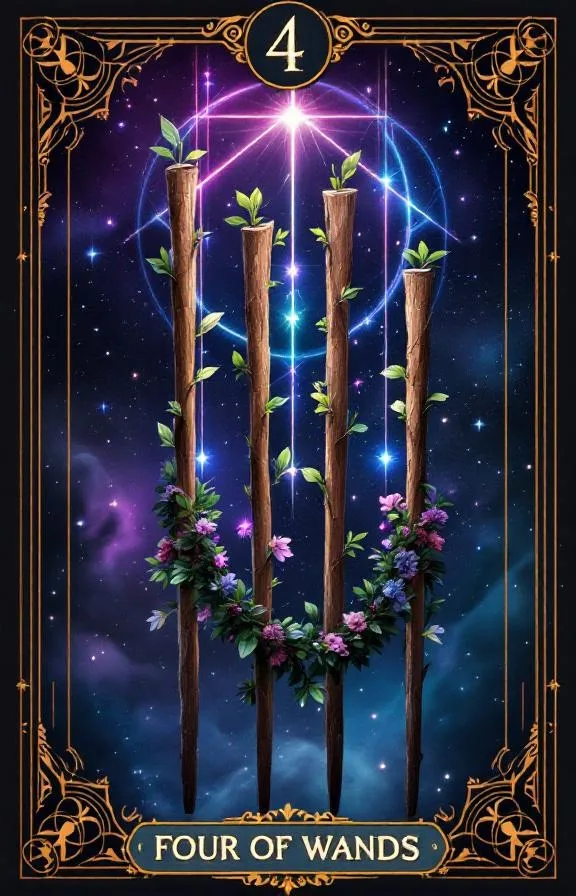
The Midnight Spread — 4 Cards for the Last Night of the Year
Designed for New Year's Eve — ideally between 23:00 and 00:30, when threshold energy peaks. You do not need silence or solitude. Pull cards at a table full of people, between toasts. Liminality requires presence, not ceremony.
| Position | Question | What it means |
|---|---|---|
| 1 | What am I leaving in the old year? | A pattern, habit, belief, or version of yourself that has served its purpose. Death here means a transformation that already happened but you have not yet acknowledged. |
| 2 | What am I taking with me? | Your strength — what the past year gave you, even if it was difficult. This card shows what you built. |
| 3 | My intention — who am I becoming? | NOT a goal. An identity intention. The Star means your intention concerns hope and renewal. The Wheel of Fortune means you are becoming someone who works with change instead of resisting it. |
| 4 | First step — what do I do tomorrow? | One concrete action for January 1st. Not "be better." More like: "I will write three sentences about who I want to be." The card points toward the direction. |
How to Read It
Before shuffling, ask yourself: "What do I actually want to know about myself at the threshold of this new year?" Let the question hang. Shuffle.
Position 1 is the hardest — it demands honesty. Most people know what they should leave behind, but attachment is stronger than knowledge. The shadow work approach is useful here: letting go is a process, not a one-time act.
Position 2 is the anchor. People focus on what they want to change and forget what they already have. The new year does not start from zero.
Position 3 is the spread's heart. Apply Clear's framework: not a goal, but an identity. The Emperor means your intention concerns structure and boundaries. Not "I will get organized" but "I am becoming someone who creates order."
Position 4 is WOOP in one card. Intention without action is fantasy. Knight of Swords? Your first step is intellectual — write, read, talk to someone wise. Two of Cups? Relational — call someone you have lost touch with.
What New Year's Eve Will Not Change
No spread of cards and no midnight toast will change your life. What changes it is what you do on January 2nd, January 15th, March 3rd. Phillippa Lally (UCL, 2010) found that forming a new habit takes 66 days on average — not the mythical 21.
The Midnight Spread is a starting point. If you know the general approach to New Year tarot readings, this spread adds what those lack: time. Not "the new year" as abstraction — this specific night, this moment with a glass in one hand and a card in the other.
Tarot for self-reflection works all year — but on New Year's Eve, when everyone looks forward simultaneously, the mirror reflects more sharply. Not because the cards have power. Because you have the question.
At midnight, when fireworks explode and the people around you shout the new year into existence, you have maybe ten seconds when nobody is looking at you. Glance at the cards you pulled earlier that evening and say one sentence — not a resolution, but an intention. "I am becoming someone who..." and whatever the card showed you. That is not magic. It is psychology dressed in symbolism humanity has tested for five hundred years. And if the difference between a resolution that dies in February and an intention that survives the year is that the intention starts with "who am I" instead of "what do I want to achieve" — it is worth spending New Year's Eve asking the right question.