Chemistry is the most overused and least understood word in relationships. People say "we have chemistry" and mean anything from physical attraction to the sense that conversation flows easily. But real compatibility — the kind that determines whether two people can build something that lasts — operates on layers that first-date chemistry cannot access.
A tarot compatibility spread does not tell you whether someone is "your person." It does something more useful: it makes visible the specific dimensions of connection between you and another person — where you align, where you clash, and where the friction is productive versus destructive. The spread works whether you are in the first month of knowing someone or the fifteenth year.
In short: The six-card Constellation Spread maps compatibility across six dimensions: each person's energy, the attraction, the friction, the shared value, and the growth edge. Rather than giving a yes-or-no verdict, it reveals whether your differences generate curiosity or contempt and whether the connection has the raw material for something lasting.
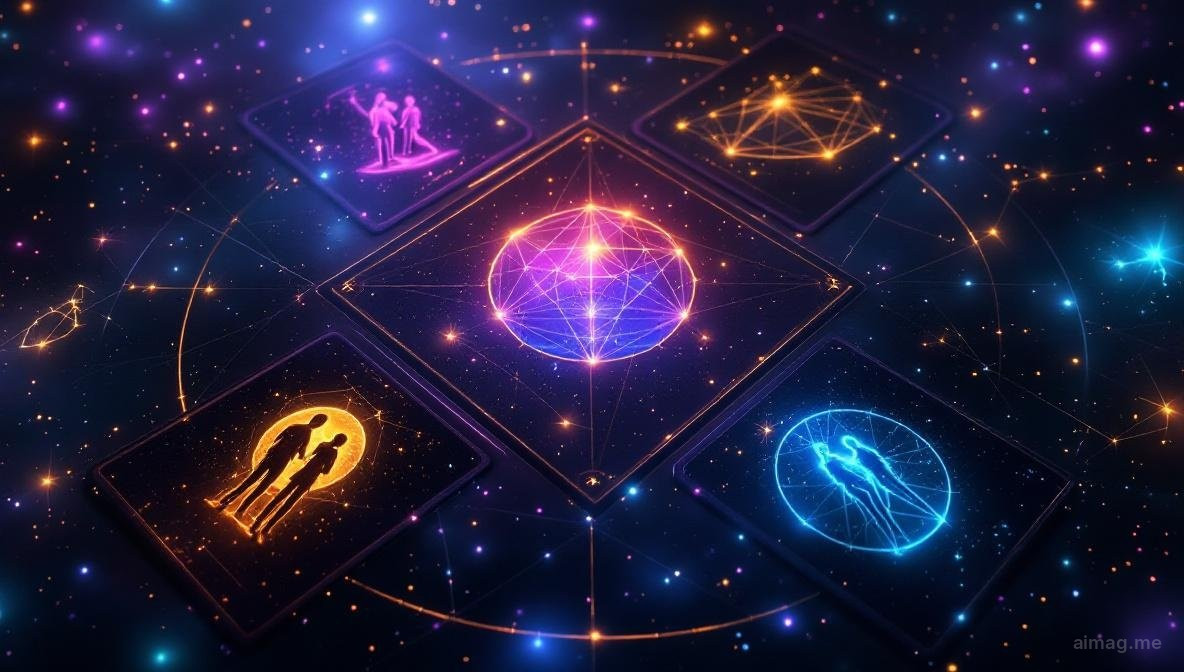
The Constellation Spread (6 Cards)
I call this the Constellation Spread because real compatibility is not a single line between two points — it is a pattern of connections, some bright and obvious, some faint and discovered only over time.
| Position | Meaning |
|---|---|
| 1 | Your energy in this connection — what you bring |
| 2 | Their energy in this connection — what they bring |
| 3 | The attraction — what draws you together |
| 4 | The friction — where you clash |
| 5 | The shared value — what you both care about (even if you express it differently) |
| 6 | The growth edge — what this connection asks you both to learn |
Layout: Place cards 1 and 2 on opposite sides of the table. Card 3 goes between them, slightly above center. Card 4 goes between them, slightly below center. Card 5 sits directly between cards 3 and 4 — the center point. Card 6 goes above the entire arrangement.
How to Read It
Positions 1 and 2: The Two Energies
Start by reading these two cards as a pair. You are not reading two people in isolation — you are reading how each person shows up in this specific connection. The same person might appear as the Knight of Cups in one relationship and the Five of Swords in another, because different relationships activate different parts of us.
Look for:
- Elemental harmony. Two Water cards (Cups) suggest deep emotional resonance. Fire (Wands) and Air (Swords) often have intellectual electricity. Earth (Pentacles) and Water create stable nurturing. Fire and Water is the most volatile combination — passion that can either warm or scald.
- Energy balance. A Major Arcana card opposite a Minor Arcana card suggests an imbalance in how much weight each person carries in the connection. Neither is wrong, but the asymmetry is worth examining.
- Court card dynamics. Two Kings suggest a power negotiation. A King and a Page suggest a mentor-student dynamic that may or may not be conscious. Two Queens suggest parallel sovereignty — respect but also potential competition for authority.
Position 3: The Attraction
This is the card most people want to see — and the most commonly misread. Position 3 does not show whether the attraction is good. It shows what the attraction is.
The Devil in this position does not mean the relationship is toxic. It means the attraction is operating through intensity, magnetism, compulsion — the kind of pull that bypasses rational evaluation. Whether that is dangerous or simply passionate depends entirely on what shows up in Positions 4 and 5.
The Emperor suggests attraction through structure, reliability, safety. Less romantic on paper, but the couples who last thirty years often describe their initial attraction in these terms: "I felt safe with them immediately."
The Two of Cups here is the clearest signal of genuine mutual recognition — two people who see each other clearly and are drawn to what they actually see, not to a projection or a fantasy.
Position 4: The Friction
Every real relationship has friction. The question is whether the friction is the kind that creates fire (generative) or the kind that creates wounds (destructive).
Generative friction examples:
- The Tower — this connection will challenge your comfortable illusions. Uncomfortable but potentially transformative.
- Seven of Wands — you will have to defend your boundaries. The relationship strengthens by forcing you to know where you stand.
- Five of Wands — creative conflict. You disagree in ways that push both of you toward better ideas.
Destructive friction examples:
- Ten of Swords — recurring emotional devastation. One or both people keep getting flattened.
- The Moon — chronic confusion, gaslighting dynamics, or inability to see each other clearly.
- Five of Cups — persistent disappointment. The relationship keeps failing to meet expectations that are never directly stated.

Position 5: The Shared Value
This is the most underappreciated position in the spread and often the most revealing. Shared values are the bedrock of lasting compatibility — more important than shared interests, shared humor, or shared attraction.
When The Hierophant appears here, both people value tradition, structure, or a shared moral framework — even if they practice it differently. A couple where one is traditionally religious and the other is deeply spiritual but unaffiliated can share Hierophant energy because both organize their lives around something larger than themselves.
The Star in this position suggests shared idealism — both people believe in something better, both carry hope as a conscious choice rather than naive optimism.
Eight of Pentacles here means both people value craft, discipline, the long game. These are the couples who build businesses together, train for marathons together, or simply share the conviction that anything worth having requires sustained work.
When this position is empty of obvious resonance — when the card feels random or irrelevant — it is worth asking whether the connection has a shared foundation at all, or whether it is running entirely on attraction and habit.
Position 6: The Growth Edge
This card answers the question that mature relationships learn to ask: what is this connection trying to teach us?
The growth edge is not always comfortable. Death here means the relationship requires both people to let go of old versions of themselves. The Hermit suggests the connection needs more solitude and independence than either person is comfortable giving. Temperance asks for patience and balance in a dynamic that has been running on extremes.
The most powerful readings are the ones where Position 6 directly addresses the tension between Positions 3 and 4 — where the growth edge is the specific work of transforming the friction into something generative.
When to Use This Spread
Early connection. Within the first three months, when the chemistry is still producing static and you cannot tell whether what you feel is recognition or projection. The spread helps separate genuine resonance from wishful thinking.
Crossroads moments. Before moving in together, before getting engaged, before having the "where is this going" conversation. The spread gives you a map before you enter the territory.
Recurring conflict. When the same fight keeps happening in a different costume, this spread can reveal the underlying dynamic that neither person has named — often located in the gap between Positions 4 and 5.
Curiosity about a new attraction. You have met someone. The pull is strong. But you have been pulled before and it did not end well. The spread helps you see what is actually happening rather than what you hope is happening.
Compatibility Is Not Sameness
One of the most common misreadings of a compatibility spread is the assumption that matching cards mean good compatibility and contrasting cards mean trouble. The opposite is often true.
Two people who bring identical energy to a connection may feel initially comfortable but eventually stagnant. Two Knights of Pentacles create a stable but potentially airless partnership. Two Queens of Wands produce magnetic energy but may compete for the spotlight.
The most enduring compatibility often shows up as complementary rather than identical — energies that are different but complete each other. Fire and Earth. Swords and Cups. Structure and spontaneity. The key is whether the differences generate curiosity ("show me how you see the world") or contempt ("why can't you be more like me").
Frequently Asked Questions
Can I do this spread about someone I have not met yet?
No. The spread reads the dynamic between two specific energies. Without a real person and real interactions, you are reading your fantasy of them, which tells you about yourself but nothing about compatibility. For that kind of self-reflection, try the Honest Mirror spread instead.
What if Positions 3 and 4 show the same card type?
If both attraction and friction live in the same suit (say, both Cups), the relationship operates primarily in one dimension — emotional, in this case. That is not a problem, but it does mean other dimensions (practical, intellectual, spiritual) may need conscious attention.
How does this differ from the relationship tarot spread?
The relationship tarot spread maps the dynamics of an established connection — its foundation, current state, and what each person needs. This compatibility spread is specifically designed to read the chemistry between two people — the attraction-friction-values triangle that determines whether a connection has the raw material for something lasting.
Compatibility is not a binary. It is not a yes-or-no question, and any spread that claims to answer "are we compatible?" with a single card is oversimplifying something that deserves more respect. What the Constellation Spread offers is a map of six dimensions that matter — your energy, their energy, the pull, the push, the shared ground, and the invitation to grow. Read together, these six cards show you not whether this person is right for you, but what "right" would actually require from both of you. That is a harder question and a more honest one. And honest questions are the only kind worth asking when another person's heart is involved.