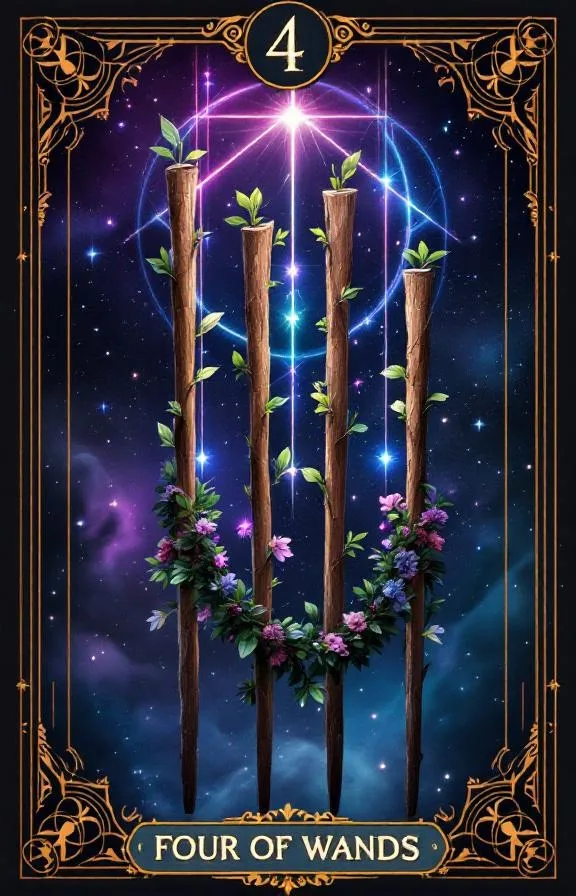
Every year on May 25, something quietly remarkable happens across dozens of countries: people pull a deck of illustrated cards from a shelf, sit down, and ask themselves a question they have been avoiding. They do not gather in temples. Most of them sit at kitchen tables, on park benches, on commuter trains. What they share is a willingness to look at symbolic imagery and notice what it stirs — which, six centuries into this practice, turns out to be the whole point.
In short: World Tarot Day, celebrated every May 25 since 2003, is not about mysticism or fortune-telling. It is an annual invitation to engage with a 600-year-old symbolic system that activates well-documented psychological mechanisms — projection, narrative construction, and emotional processing. Whether you have been reading cards for decades or have never touched a deck, the day offers a structured moment for the kind of self-examination that modern life rarely makes space for.
How World Tarot Day began
World Tarot Day was established in 2003 by Den Elder, a tarot author and educator who wanted to create a single day each year dedicated to celebrating the practice — not as occultism, but as a living tradition of symbolic literacy. Elder chose May 25 partly because the date falls in late spring in the Northern Hemisphere, a period associated with growth and emergence.
Nimm dir einen Moment, um über das Gelesene nachzudenken. Was passt zu deiner aktuellen Situation?
The idea was straightforward: on this day, readers around the world would do a reading, share their experiences, teach someone new, or simply reflect on what tarot means to them. There were no bylaws, no membership fees, no official organization. The "holiday" spread entirely through community adoption — tarot shops, online forums, local meetup groups, and eventually social media channels.
What makes this grassroots origin interesting is what it reveals about the human need for shared symbolic practice. Anthropologist Victor Turner documented that humans are creatures of ritual — we mark transitions, we create communal moments around shared symbols. World Tarot Day functions as exactly this kind of marker: a day when private reflective practice becomes briefly visible and collective.
Six centuries of survival: the psychological case
Tarot cards first appeared in northern Italy around the 1440s as a parlor game called tarocchi. For three hundred years, that is all they were — a trick-taking card game. The shift toward reflection began in the late 18th century, but the real transformation happened in the 20th century when Carl Jung's framework gave the practice a language that did not require supernatural belief.
Jung's concept of archetypes — universal symbolic patterns embedded in the collective unconscious — mapped almost perfectly onto the Major Arcana. The Fool as new beginnings. The Tower as sudden, necessary collapse. The High Priestess as intuitive knowledge below the surface of rational thought. Jung himself never wrote extensively about tarot, but his intellectual descendants recognized that the deck functioned as a portable catalog of the psyche's recurring themes.
This is why tarot survived when palmistry charts, phrenology maps, and alchemical tables faded into historical curiosity. Tarot maps onto something real: the way human minds process experience through narrative and image. Cognitive psychologist Jerome Bruner argued that humans organize knowledge in two modes — the paradigmatic (logical) and the narrative (image-driven). Tarot speaks fluently in the second, which is precisely the mode that surfaces when we face uncertainty, grief, or decision.

From parlor game to therapeutic tool
The trajectory of tarot across six centuries follows a recognizable pattern: the gradual formalization of an intuitive practice into a structured reflective framework.
In the early 20th century, the Rider-Waite-Smith deck (1909) made every card visually interpretable — not just the 22 Major Arcana, but all 56 Minor Arcana. This was the inflection point. Anyone could look at a card and respond to its imagery without occult training.
By the 1970s, psychotherapists began experimenting with tarot as a projective tool — similar in function to Rorschach inkblots or the Thematic Apperception Test (TAT). Present an ambiguous symbolic image, then observe what the client projects onto it. What a person sees in the Three of Swords is not in the card; it is in the person.
James Pennebaker's research on expressive writing offers a useful parallel. Pennebaker demonstrated that constructing a coherent narrative around difficult experiences produces measurable benefits: reduced anxiety, improved immune function, greater emotional clarity. A tarot reading does something structurally similar — it prompts you to build a narrative using symbolic vocabulary that bypasses the ego's usual defenses.
This is the Modern Mirror philosophy that guides our approach at aimag.me: the cards do not know your future. Your reaction to them reveals your present. You do not learn about the mirror by studying it. You learn about yourself by looking into it.
The Tarot Birthday Spread: a 5-card celebration
World Tarot Day deserves its own spread — think of it as a birthday reading for your relationship with the cards.
How to use it: Shuffle while holding one question: What does my practice of self-reflection need right now? Draw five cards, place them left to right.
| Position | Name | Question it explores |
|---|---|---|
| 1 | The Root | What first drew you to symbolic self-reflection? |
| 2 | The Growth | How has your capacity for self-examination developed? |
| 3 | The Bloom | What insight is ready to emerge right now? |
| 4 | The Seed | What new area of self-knowledge may be worth exploring? |
| 5 | The Garden | How can your practice connect you more deeply with others? |
The botanical metaphor is deliberate. This spread treats self-reflection as something organic — it has roots, it grows, it blooms, and it exists within a larger ecosystem of relationships. Card 5 is especially relevant on World Tarot Day, when the practice briefly steps out of private space and into shared celebration.
If you would like to try a digital version, our reading tool offers AI-assisted interpretation grounded in psychological frameworks rather than prediction.
Five ways to celebrate (no candles required)
You do not need a ceremony to mark World Tarot Day. Five approaches grounded in reflective practice:
1. Journal with your favorite card. Pull the card you feel most drawn to — not randomly, deliberately. Set a ten-minute timer and write about why it resonates. What does it mirror in your current life? This is the kind of focused free-writing that Pennebaker's research validates as psychologically beneficial.
2. Do a reading for someone who has never had one. Explaining what the cards represent forces you to articulate knowledge that may have remained intuitive and unexamined.
3. Try a spread you have never used. If you always read three-card spreads, try the Celtic Cross. If you have never explored shadow work through tarot, this is a good day to start.
4. Revisit your first reading. If you remember the cards from your very first reading, pull them out and reflect on how your relationship with those symbols has changed. The cards are the same; you are not.
5. Explore the archetypes that run your life. World Tarot Day is an ideal moment to examine which archetypal patterns you have been unconsciously living out — and whether they still serve you.
Tarot as shared language
One of the most underappreciated aspects of tarot is its function as shared symbolic vocabulary. When you tell a friend "I feel like I am in a Tower moment," you communicate something precise that would take paragraphs in literal language. The Tower is not just a card — it is a compressed narrative about sudden disruption that strips away what was no longer structurally sound.
This shared language is what World Tarot Day celebrates at its core. Not mystical powers. Not fortune-telling. The fact that 600 years after Italian aristocrats first played tarocchi, millions of people still find that 78 symbolic images articulate aspects of human experience that ordinary language struggles to reach.
Joseph Campbell observed that myths persist not because people believe them literally, but because they encode psychological truths that remain relevant across centuries and cultures. Tarot works on the same principle. The Fool's willingness to step into the unknown does not change because the century changes. The Hermit's withdrawal into solitude for clarity does not expire. These are permanent features of the human psychological landscape.
Your mirror is waiting
Whether May 25 finds you drawing your ten-thousandth card or your first, the invitation is the same: sit with a symbolic image, notice what it brings up, and take that noticing seriously. That is all tarot has ever asked.
If you are ready to explore, our AI-assisted reading tool offers structured reflection through a psychological lens — no supernatural claims, just the same archetypal imagery that has been helping humans examine their inner lives since the Renaissance.
Happy World Tarot Day.