Four wands stand upright in the earth, forming the corners of something that is not quite a building and not quite a doorway — it is a threshold made visible. Garlands of flowers, grapes, and greenery drape between them, transforming four planted sticks into a ceremonial archway, a canopy, a chuppah. Two figures in bright clothing hold bouquets aloft beneath it, their postures open and exuberant, mid-celebration, mid-dance, mid-arrival. Behind them rises a grand castle or walled estate, its turrets catching the light of a bright unclouded sky, its gates flung wide open. More figures are visible in the background, also celebrating. The entire scene radiates the particular quality of joy that only arrives when something private — effort, patience, quiet work done out of sight — becomes public, witnessed, shared.
This is the card of the moment when what you have built finally becomes real to other people. Not because it was not real before. Because now it is also theirs.
In short: The Four of Wands is the tarot's celebration card — garland-draped wands forming a canopy, joyful figures raising bouquets, a castle with open gates behind them. It represents milestones reached, homecomings, communal joy, and the earned moment when private effort becomes shared recognition. Reversed, the celebration is delayed or feels hollow: something needs addressing before the joy can land.
Four of Wands at a Glance
| Attribute | Detail |
|---|---|
| Number | 4 |
| Suit | Wands |
| Element | Fire |
| Keywords (Upright) | celebration, harmony, homecoming, community, milestones, joy, stability |
| Keywords (Reversed) | lack of harmony, instability, cancelled celebrations, feeling unwelcome, transition |
| Yes / No | Yes |

What Does the Four of Wands Mean?
The number four, in tarot numerology, represents the first point of true stability. Two is polarity. Three is creation. Four is the structure that creation builds so it can endure. In the Wands suit — governed by fire, passion, ambition, creative will — the energy of the previous three cards has been volatile: the spark of the Ace of Wands, the restless vision of the Two, the first horizon-scanning of the Three of Wands. The Four is where fire, for the first time in the suit, holds still long enough to be celebrated. Not extinguished. Stabilized. The flame has become a hearth.
Arthur Edward Waite, in The Pictorial Key to the Tarot (1911), described this card's meaning as "country life, haven of refuge, a species of domestic harvest-home." That last phrase is worth pausing over. A harvest-home is not the harvest itself — it is the celebration that follows the harvest. The labor is already done. The grain is already in. What the Four of Wands depicts is the moment when effort becomes occasion, when private achievement becomes communal joy. Rachel Pollack, in Seventy-Eight Degrees of Wisdom (1980), notes that the garland-draped canopy transforms the wands from tools of will into pillars of a sanctuary — the fire element has been tamed enough to build something people can stand inside.
The open gates of the castle behind the figures are psychologically precise. They face toward us, toward the celebration, as if the structure itself is participating. The castle here represents the integrated psyche — the secure internal structure from which authentic living proceeds. Its gates are open because the Four of Wands describes a moment when the inner and outer worlds are aligned. What you feel inside matches what is happening outside. No performance. No strain of pretending to be happy about something that does not actually make you happy. The joy is congruent. That is why the card feels so different from surface-level positivity — it is not telling you to cheer up. It is showing you what it looks like when the cheering is real.
Compare this with The Sun, the deck's other great card of uncomplicated joy. The Sun radiates individual wholeness — a child on a white horse, naked and luminous, needing nothing from anyone. The Four of Wands' joy is communal. It requires witnesses. Not because it is performative but because certain kinds of happiness — the housewarming, the wedding, the graduation, the homecoming — exist specifically in the space between people. They are milestones that only become milestones when they are shared. The Emperor builds structures for power and order; the Four of Wands builds a structure for celebration. Both use the number four's stability, but to radically different ends.
The two figures beneath the canopy are sometimes read as a couple, but that is not the only reading and probably not the primary one. They are celebrants — any two people whose shared effort or shared presence has created the conditions for this moment. The bouquets they hold are lifted toward the sky, toward the open air, toward something beyond themselves. This is not inward joy. It is outward, upward, extended. The card says: what you have made is good, and the world knows it, and you are allowed — fully, without reservation — to feel that.

Four of Wands Reversed
Reversed, the Four of Wands does not become a disaster. It becomes a celebration that has not quite materialized, or one whose warmth has been complicated by something under the surface. The garlands are still there. The wands are still standing. But something is off — the gates of the castle feel less open, the figures less synchronized, the joy less congruent.
The most common expression is a milestone that has been delayed, disrupted, or met with unexpected ambivalence. A wedding that keeps being postponed. A housewarming where the hosts feel like strangers in their own space. A homecoming where the person returning realizes they no longer quite belong. The structure is present — the relationship, the home, the career achievement — but the feeling of celebration cannot quite land. There is a gap between what should be joyful and what actually is, and that gap is what the reversal illuminates.
Sometimes the Four of Wands reversed points to inner celebration rather than outer. The milestone is real, the achievement is genuine, but for whatever reason — timing, circumstance, the people around you not understanding its significance — the recognition must come from within. That is not a lesser form of celebration. It is simply a more private one. The reversed Four of Wands asks: can you honor what you have built even if nobody throws you a party for it?
Four of Wands in Love and Relationships
Upright
In love readings, the Four of Wands is one of the deck's most unambiguously joyful cards. It speaks of relationships that have reached a point worth celebrating — an engagement, a wedding, moving in together, a significant anniversary, or simply the moment when two people realize that what they have built together is solid, good, and publicly recognizable as such. The canopy of garlands is not a cage. It is a shelter. The difference matters: the Four of Wands describes a relationship that creates safety without creating confinement.
For those in established partnerships, this card often appears when the relationship is entering a phase of communal visibility — introducing a partner to family, hosting friends together for the first time, building a shared home. The open gates of the castle are the open doors of the life you are constructing together, inviting others in. For singles, the Four of Wands can indicate a social event, gathering, or homecoming that becomes the setting for a meaningful connection. The card says: go where the celebration is. That is where you will find what you are looking for.
Reversed
Reversed in love, the Four of Wands suggests tension in the domestic sphere or a sense of instability in what should feel settled. A couple may be struggling with a shared living situation, feeling out of sync about family events, or experiencing the particular discomfort of a milestone that was supposed to feel better than it does. It is not a breakup card — it is a "something needs to be addressed before the celebration can be real" card. The foundation is there. The garlands need rehanging.
Ready to celebrate love? Try a free AI reading →
Four of Wands in Career and Finances
Upright
Professionally, the Four of Wands signals a milestone achieved. A project completed and recognized. A promotion that comes with genuine appreciation rather than just a title change. A team effort that produced something worth celebrating — the launch, the opening, the deal closed, the approval granted. This is not the beginning of the work (that was the Ace) or the planning of it (the Two and Three). This is the moment when the work is done well enough to warrant pausing and acknowledging it.
In financial terms, the Four of Wands often indicates stability — not sudden wealth but the satisfying solidity of having built something that holds. A home purchase. A savings goal reached. A business that has moved from fragile to established. The four wands planted in the ground are foundations, and in the financial domain, foundations mean security that can be built upon further.
Reversed
Reversed in career, the card may indicate a project that was completed but not celebrated, or a workplace lacking the communal spirit that makes effort feel meaningful. You did the work. Nobody noticed, or the recognition felt hollow. It can also signal instability in a work situation that appeared settled — restructuring, relocation, a team that is no longer cohesive. Financially, it may suggest a delayed closing, an uncertain housing situation, or a period where material stability feels more precarious than it should.
Four of Wands in Personal Growth
The Four of Wands asks a question that personal development culture often overlooks: do you know how to celebrate? Not perform celebration. Not post about it. Not check the milestone off a list and immediately begin the next one. But actually stop, look at what you have built, feel the specific weight of having built it, and let that feeling be sufficient for the length of one evening, one weekend, one breath.
There is a psychological phenomenon that researchers call the "arrival fallacy" — the assumption that reaching a goal will produce lasting happiness, followed by the deflating discovery that it does not. The Four of Wands is not about the arrival fallacy. It is about the genuine capacity for joy that exists in the space between one effort and the next, if you allow yourself to occupy that space rather than rushing through it. Brene Brown, in The Gifts of Imperfection (2010), writes about the difficulty many people have with "foreboding joy" — the inability to feel happiness without immediately bracing for its loss. The Four of Wands is the antidote to foreboding joy. It says: this moment is real. You are allowed to be in it.
The exercise the card suggests is simple but surprisingly difficult. Identify something you have achieved — something concrete, something that required effort — and create a ritual of recognition for it. Not a reward (that is transactional). A celebration (that is relational). Invite someone. Mark the occasion. Let the gates stand open. The Ten of Cups describes the emotional fulfillment of a life fully lived; the Four of Wands is smaller than that, more specific: it is a single moment of earned joy, and learning to inhabit such moments fully is one of the quieter arts of being human.
Four of Wands Combinations
- Four of Wands + The Lovers — A deeply significant romantic milestone. This combination speaks of unions that are both chosen and celebrated — an engagement, a wedding, a commitment made visible and witnessed. The joy here is not casual; it carries the weight of a decision that changes the shape of a life.
- Four of Wands + Ten of Pentacles — Generational celebration. A family milestone — a home that will shelter more than one generation, a business passed forward, a gathering where the whole lineage is present. Material stability meets communal warmth in its most enduring form.
- Four of Wands + The Sun — Pure, uncomplicated happiness. Two of the deck's most positive cards together create a moment of absolute, unqualified joy. Whatever is being celebrated is real, whole, and completely free of shadow. This is the reading where you stop worrying.
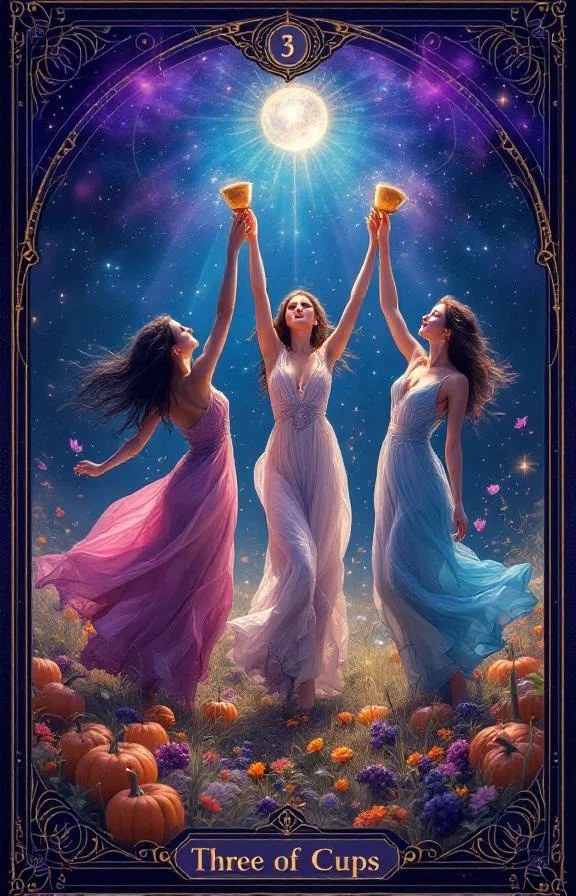
- Four of Wands + Three of Cups — The celebration intensifies and becomes deeply social. Friends, community, shared laughter, raised glasses. This is the housewarming party, the reunion, the moment when the milestone becomes a story that will be retold. The joy is relational and multiplied by the number of people sharing it.
- Four of Wands + Ace of Wands — A celebration that sparks something new. The milestone is real but it is also a launchpad — the energy generated by acknowledging what has been built ignites the next creative impulse. One fire lights another.
Frequently Asked Questions
Does the Four of Wands mean marriage?
It can, and frequently does — the garland-draped canopy in the RWS image has unmistakable wedding-ceremony resonance. But it is not exclusively a marriage card. The Four of Wands represents any significant milestone celebrated communally: a housewarming, a homecoming, a graduation, a family reunion, the completion of a major project. What makes it "wedding-like" is the quality of public joy, of crossing a threshold together with witnesses. If marriage is the question you are asking, this card is one of the strongest affirmatives in the deck.
Is the Four of Wands always positive?
Upright, it is one of the most reliably positive cards in the tarot — not because it ignores complexity but because it depicts a genuine moment of earned joy, which is inherently positive. Reversed, it carries more nuance: delayed celebrations, domestic tension, or the inability to feel the joy that circumstances warrant. Even reversed, however, it is not a card of disaster. It is a card of joy that has not yet fully arrived or has been temporarily disrupted.
What does the Four of Wands mean for home and family?
This is one of the card's primary domains. The castle with open gates, the canopy, the communal celebration — all speak directly to home, belonging, and the particular satisfaction of a domestic foundation well built. It often appears when someone is purchasing a home, renovating, hosting family, or creating the conditions for a shared life. The message is warmth, welcome, and stability.
What is the yes or no answer for the Four of Wands?
Yes — clearly and warmly. The Four of Wands is an affirmative card. Its energy is expansive, celebratory, and forward-moving. Whatever you are asking about is likely to proceed well, to be met with support and recognition, and to arrive at a place worth celebrating. If the question involves home, family, partnership, or any form of communal milestone, the yes is emphatic.
The gates are open. The garlands are hung. The people you care about are gathered, and the thing you built is standing, solid and real and recognized, and this is the moment you are allowed to stop building and simply be inside what you have made. Try a free AI-powered reading at aimag.me/reading and find out what milestone is waiting for you beneath the canopy.