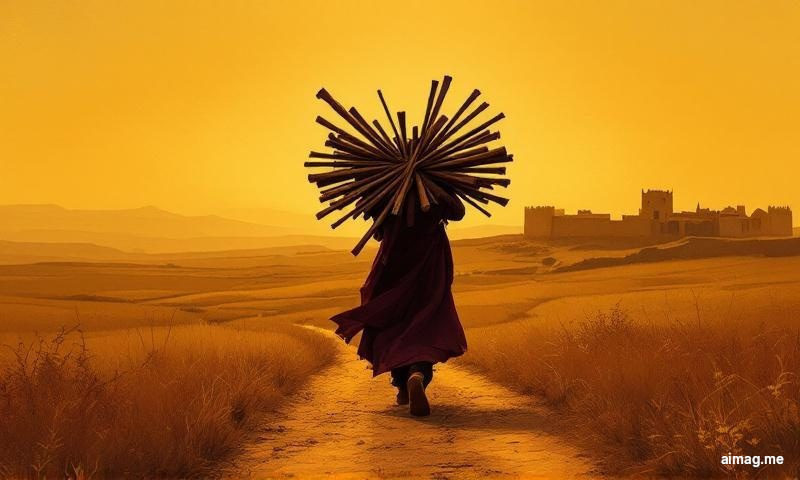
A figure walks toward a town that is almost close enough to touch. His arms are wrapped around ten tall wooden wands bundled together, and the bundle is enormous — it fills the entire frame of his vision, blocking everything ahead. He cannot see where he is going. His back is curved under the weight, shoulders hunched forward, each step deliberate and labored. The wands obscure the road, the town, the sky. The landscape is flat, almost gentle in its simplicity — there is no mountain to climb, no river to cross, just a short stretch of open ground between where he is and where he needs to be. And yet the distance feels infinite because of what he is carrying. Each wand was picked up individually, one at a time, each one manageable alone. Together they are crushing him.
This is the essential cruelty of the Ten of Wands: every single wand was once a victory. Each one represents a project accepted, a responsibility shouldered, an ambition lit like a candle. The first wand was the Ace — pure creative fire, thrilling possibility. By the time we reach the Ten, that fire has not gone out. It has multiplied. Ten fires burn simultaneously, and the person tending them all cannot see past the flames. The card does not show failure. It shows the specific kind of suffering that only comes from succeeding too many times without ever putting anything down.
In short: The Ten of Wands means burden from overcommitment — carrying so many responsibilities that your own achievements block your view of the finish line. Upright, it signals exhaustion, obligation, and the paradox of success becoming its own prison. Reversed, it points to delegation, burnout recovery, or the breakdown that forces you to finally set something down. The town is close, but you must lighten the load to reach it.
Ten of Wands at a Glance
| Attribute | Detail |
|---|---|
| Number | 10 |
| Suit | Wands |
| Element | Fire |
| Keywords (Upright) | burden, responsibility, overcommitment, hard work, stress, duty, obligation, near completion |
| Keywords (Reversed) | release, delegation, breakdown, learning to say no, lightening the load, burnout recovery |
| Yes / No | No |
What Does the Ten of Wands Mean?
Tens in tarot mark the end of a cycle — the point where a suit's energy reaches its maximum expression and, in doing so, reveals both its greatest gift and its final cost. The Ten of Cups shows emotional fulfillment so complete it becomes a rainbow arching over a family: the gift of love fulfilled, the cost of nothing left to yearn for. The Ten of Pentacles shows material wealth accumulated across generations: the gift of legacy, the cost of tradition's weight. The Ten of Swords shows mental anguish pushed to its absolute limit — ten blades in a back, dawn breaking on the horizon: the gift of a bottom that can only be followed by rising, the cost of getting there. The Ten of Wands shows fire — will, ambition, creative drive — carried to its breaking point. Every flame still burns. The person carrying them all is the one being consumed.
Arthur Edward Waite, in The Pictorial Key to the Tarot (1911), described the card simply: "A man oppressed by the weight of the ten staves which he is carrying." He noted that the figure approaches a town, suggesting the journey is nearly over. Rachel Pollack, in Seventy-Eight Degrees of Wisdom (1980), read the card as a portrait of someone who has taken on more than is humanly sustainable — not because they were forced to, but because they could not stop saying yes. Each wand was freely accepted. That is what makes the burden so personal: no one did this to you. You did it to yourself. One yes at a time.
The Nine of Wands — the card immediately before — shows a wounded defender who has survived eight battles and stands ready, warily, for a ninth. The Nine is about resilience, about guarding what you have built. The Ten is what happens when that guard never stands down. The defender keeps fighting, keeps building, keeps accumulating victories and responsibilities until the sheer mass of everything he has won becomes the thing that is defeating him. The town is right there. The finish line is visible. But he cannot see it because his own achievements are blocking the view.
What comes next is the Page of Wands — the suit starting over with fresh eyes and a single wand held lightly, a young figure staring at it with fascination rather than exhaustion. The journey from Ten back to Page is the journey of putting things down. Of remembering what fire felt like before it became obligation. The Ten must die — must release, must delegate, must simply stop — before the Page can be reborn.
There is a psychological phenomenon called enantiodromia: the tendency of any extreme to flip into its opposite. The Ten of Wands is fire at that tipping point. Ambition so intense it becomes paralysis. Productivity so relentless it becomes its own form of avoidance. The workaholic who cannot stop working is not driven by love of work but by terror of what happens when the work stops and there is nothing left but the self, sitting quietly, unburdened and undefended.

Ten of Wands Reversed
Reversed, the Ten of Wands shows the moment of release — or the moment when release is refused and the collapse becomes total. The interpretation depends on whether the querent is ready to let go.
In its most hopeful reading, the reversed Ten of Wands is a burden being set down. The figure straightens his back. The wands fall or are carefully leaned against a wall. Delegation happens — not as failure but as wisdom. Tasks are redistributed. Projects are completed or consciously abandoned. The word "no" is spoken, perhaps for the first time, and the sky that was hidden behind ten tall staves becomes suddenly, overwhelmingly visible. This is the card of burnout recovery, of a therapist's gentle question: "What would happen if you stopped?"
In its darker reading, the reversed Ten is the breakdown that happens when the load is carried past the point of structural failure. The figure does not put the wands down — they fall. He collapses. The overcommitment that was unsustainable in the upright position becomes an actual crisis: health failure, emotional breakdown, the resignation letter written not from choice but from necessity. The modern concept of burnout rests on three dimensions: exhaustion, cynicism, and reduced efficacy. The reversed Ten of Wands can manifest as any or all three — the body giving out, the meaning draining away, the quality of work declining precisely because there is too much of it.
A third reading is subtler: the inability to delegate. The reversed Ten sometimes shows someone who knows they are carrying too much but cannot let go. Every wand feels essential. Every project feels like it would fail without their personal attention. This is not strength but a specific kind of anxiety — the belief that the world will collapse if you stop holding it up. It rarely collapses. But the fear of collapse keeps the wands locked in your arms.
Ten of Wands in Love and Relationships
Upright
In love readings, the Ten of Wands signals a relationship that has become more obligation than joy. One or both partners carry a disproportionate share of the emotional labor — the logistics, the compromise, the daily maintenance of a shared life that has somehow become a second job. The love may still be there beneath the weight, but it is buried under responsibilities: children, finances, extended family, the accumulated expectations that pile up over years of partnership. The card often appears for people who feel like they are carrying the relationship alone while their partner watches.
It can also indicate a person who brings external burdens into the relationship — the workaholic who is physically present but emotionally carrying ten projects home every evening, the caretaker so consumed by obligations outside the partnership that there is nothing left over for the person they love. The Ten of Wands in love asks: which of these burdens are truly yours, and which ones have you picked up because you believed no one else would?
Reversed
Reversed in love, the Ten of Wands is the exhale. The conversation finally happens: "I cannot do this alone anymore." Responsibilities are renegotiated. Boundaries are drawn — not as walls but as architecture, creating rooms where each person can breathe. The reversed Ten in love often marks the moment a couple moves from silent resentment to honest redistribution. It is not glamorous, but it is the work that saves relationships.
In its harder form, the reversed Ten is the relationship that broke under the weight. Too much for too long, no delegation possible, and the collapse was the only release available. Sometimes putting the wands down means putting the relationship down too.
Carrying too much? Try a free AI reading →
Ten of Wands in Career and Finances
Upright
The Ten of Wands in career readings is immediately recognizable to anyone who has felt their job expand until it consumed every waking hour. It is the employee doing the work of three people after layoffs. The entrepreneur who started with passion and discovered that passion comes with invoicing, marketing, customer service, bookkeeping, and a hundred other wands they never planned to carry. The manager promoted because of excellence in one role, now responsible for an entire department of roles they never trained for.
Financially, the Ten suggests income may be present but is offset by the unsustainable cost of earning it — the high salary that requires seventy-hour weeks, the freelance income that comes from never turning down a client. The money is flowing but the human cost is not accounted for. The card asks a financial question that spreadsheets cannot answer: what is your hourly rate if you count the hours honestly?
Reversed
Reversed in career, the Ten of Wands signals the beginning of structural change. The resignation, the role redefinition, the honest conversation with a manager about workload. Sometimes it appears when a person finally hires help — an assistant, a contractor, a partner who can take on some of the wands. The reversed Ten in career is the professional equivalent of learning that delegation is not weakness but survival.
In its negative form, it is the professional collapse: burnout leave, forced sabbatical, the project that fails not from lack of effort but from excess of it. Too many spinning plates eventually hit the floor simultaneously.
Ten of Wands in Personal Growth
Burnout research consistently shows that burnout is not primarily caused by too much work but by a mismatch between the person and the work environment across six dimensions: workload, control, reward, community, fairness, and values. The Ten of Wands is typically read as a workload problem — too many wands — but the deeper issue is often control. The figure carries ten wands but appears to have no choice in the matter. He does not stop. He does not set wands down. He does not ask for help. The loss of agency — the feeling that the burden is compulsory — is what transforms hard work into suffering.
Then there is the paradox of choice: in a world with unlimited options, the very act of choosing becomes paralyzing, and every yes carries the phantom weight of every no that was not spoken. The Ten of Wands is this paradox enacted in fire — every creative possibility accepted, every ambition pursued, every invitation to do more answered with "sure, I can handle one more." The figure cannot put the wands down because he chose each one, and putting any of them down feels like admitting that a choice was wrong. Sunk cost fallacy, applied to commitments rather than money. I have already invested so much in carrying this wand that I cannot stop now.
A practical exercise: list every ongoing commitment in your life — professional, personal, creative, social. Every project, every obligation, every recurring responsibility. Now sort them into three categories. Category one: things that would collapse without you and that you genuinely care about. Category two: things that would survive without you but that you enjoy enough to keep. Category three: things that would survive without you and that you continue doing only out of habit, guilt, or the belief that stopping would make you a bad person. The Ten of Wands lives in category three. That is where you set wands down.
The Strength card shows a different relationship with fire — a woman gently opening a lion's jaws, mastering enormous energy not through force but through patience and self-knowledge. The Ten of Wands is what happens when Strength's gentle mastery is replaced by brute endurance. The fire is not tamed; it is wrestled. And wrestling ten fires simultaneously is a fight that no amount of determination can win.
Ten of Wands Combinations
- Ten of Wands + The World — The final push before completion. The burden is real and immense, but the finish line is not just visible — it is the ultimate finish line. Every wand carried will be worth it when the cycle closes. Hold on. The integration promised by The World requires the last measure of effort the Ten demands. This is not the time to quit.
- Ten of Wands + Four of Swords — A direct command to rest. The burden has been carried long enough and the body or mind is signaling that collapse is imminent. The Four of Swords does not suggest rest as optional — it insists on it. Put the wands down. Lie down. The recovery is not laziness; it is medicine.
- Ten of Wands + Two of Wands — The person carrying ten wands needs to remember what it felt like to hold just two and look out over the world with possibility rather than obligation. The Two invites strategic thinking — not about how to carry more, but about which wands to keep and which to release. Planning, not enduring.
- Ten of Wands + The Devil — The burden is self-imposed and the chains are voluntary, but the figure has forgotten this. The combination reveals a pattern of overcommitment that has become addictive — the identity built around being the one who carries everything, the martyr complex that disguises itself as reliability. The first step is recognizing that the chains can be removed.
- Ten of Wands + Ace of Wands — A powerful reminder of origins. Every one of those ten crushing wands began as the Ace — a single flame held with excitement and wonder. The Ace next to the Ten says: the fire is still alive inside the burden. Clear the load, find the original spark, and begin again with the wisdom of someone who now knows that not every flame needs to be carried simultaneously.
Frequently Asked Questions
Is the Ten of Wands a yes or no card?
No. The Ten of Wands indicates that the current path, while not doomed, is carrying too much weight to move forward efficiently. The burden outweighs the benefit. If the question is "should I take on this new commitment," the answer is a clear no — you are already carrying more than is sustainable. If the question is "will this work out," the answer is conditional: it might, but only if you find a way to lighten the load first.
What is the difference between the Ten of Wands and the Nine of Wands?
The Nine of Wands is about resilience under pressure — the wounded defender who refuses to fall. It carries hope: you have survived this much and you can survive what is coming. The Ten of Wands has moved past resilience into overload. The defender has won so many battles that the trophies themselves have become the enemy. The Nine asks "can you keep going?" The Ten answers "you have kept going too long."
Does the Ten of Wands mean I should quit?
Not necessarily quit — but definitely reassess. The card is not about abandonment; it is about discernment. The figure in the image is not dropping the wands — he is still carrying them all toward the town. The Ten asks which of those wands are truly necessary for the final stretch and which were picked up out of habit, ego, or inability to say no. Quitting everything is not the answer. Quitting the right things is.
Can the Ten of Wands be positive?
Yes, in a specific way: it confirms that you are close to completion. The town is right there. The journey is nearly done. The burden is real but temporary. If you can identify which wands to keep and which to release — or simply endure the final stretch with clear eyes — the Ten of Wands marks the moment just before the load is set down and the relief washes through. Every ending carries a weight. The Ten acknowledges that weight honestly rather than pretending it does not exist.
The figure walks toward the town. It is right there — close enough that if he could see past the wands he would count the windows in the nearest house, notice the smoke rising from a chimney, perhaps hear voices carrying across the flat ground. But he cannot see any of it. The ten wands he holds are pressed against his chest and face like a wooden wall he built himself, one stick at a time, each one added with the best of intentions. He remembers the first wand. It burned like a promise. He remembers the second, the third — each one a new ambition, a new project, a new "yes" spoken with genuine enthusiasm. He does not remember exactly when the weight became unsustainable. There was no single moment. There was only the slow accumulation of fire until fire became weight and weight became the only thing he knew.
If you are carrying more than you can see past — try a free AI-powered reading at aimag.me/reading. The town is closer than you think. But you may need to set something down to find the door.