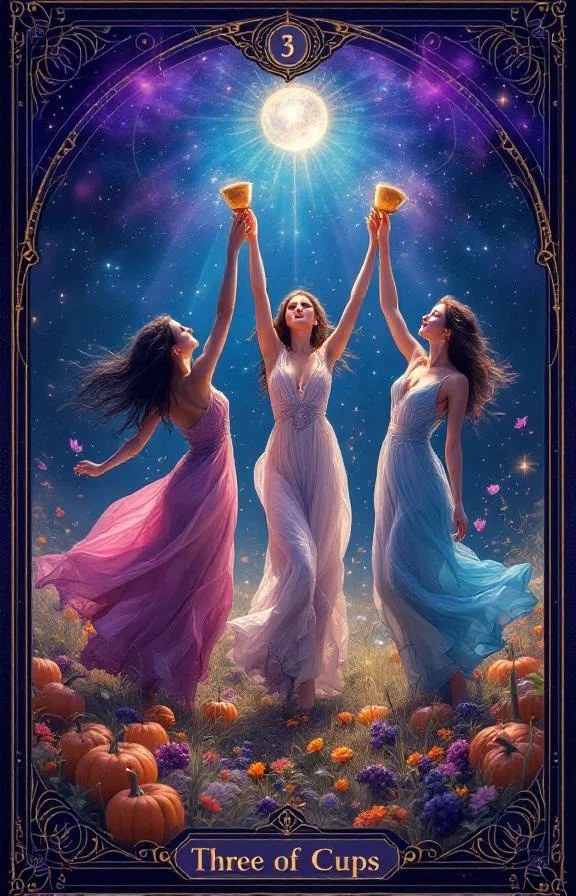
There is a particular quality to the Three of Cups that is easy to underestimate — because it looks simple. Three women dancing, cups raised, harvest piled at their feet, faces turned toward each other in obvious delight. No drama. No symbolism requiring a decoder ring. Just joy, shared between people who genuinely like each other. But here is what the card is actually saying, beneath that warmth: belonging is not decorative. Community is not a bonus you receive when the real work is done. The Three of Cups argues, quietly but firmly, that the ability to celebrate with others — to be present in shared happiness without competition or reservation — is one of the more demanding spiritual tasks there is. It looks like a party. It is actually a practice.
In short: The Three of Cups is the card of genuine belonging and shared celebration, where three women raise their cups amid harvest abundance. It signals community, creative collaboration, and the kind of joy that requires others to exist. Reversed, it warns of overindulgence, social exclusion, gossip, or isolation from the community you actually need.
Three of Cups at a Glance
| Attribute | Detail |
|---|---|
| Number | 3 |
| Suit | Cups |
| Element | Water |
| Keywords (Upright) | celebration, friendship, creativity, community, joy |
| Keywords (Reversed) | overindulgence, gossip, isolation, exclusion |
| Yes / No | Yes |

What Does the Three of Cups Mean?
The Three of Cups arrives at a critical point in the Cups sequence. The Ace of Cups opened the emotional channel — that raw, overwhelming rush of feeling that arrives unbidden. The Two of Cups shaped that energy into connection between two people, a bond made conscious and mutual. Now the Three expands the circle. It asks: can the intimacy that exists between two people survive opening outward to include more? Can joy be shared without diluting it?
The answer this card gives is an unambiguous yes — and then it shows you what that looks like.
In the Rider-Waite-Smith image, designed under Arthur Edward Waite's direction and published in The Pictorial Key to the Tarot (1911), three women stand in a garden surrounded by abundance — pumpkins, grapes, flowers, the visual vocabulary of harvest. Their cups are raised not in a toast to any single thing but in acknowledgment of the whole: of the season, of each other, of the simple fact of being here together. They are not facing forward toward the viewer. They are facing each other. That distinction matters. This is not a performance of celebration for an audience. It is celebration that is complete in itself, between people who need no witness other than one another.
The number three carries significant weight in symbolic traditions. Three is the number of synthesis: thesis plus antithesis produces something genuinely new. In the Cups suit, the Three represents the synthesis of the raw emotional opening (Ace) and the intimate mirroring (Two) into something that moves beyond the dyad — into community, creativity, and collaborative joy. Rachel Pollack, in Seventy-Eight Degrees of Wisdom (1980), notes that the Three of Cups carries the energy of celebration specifically because three is the first number that cannot be reduced to simple opposition. You cannot "take sides" between three people the way you can between two. Three requires a different kind of relating — more fluid, more generous, less binary.
I've noticed in readings that this card often appears at moments when people have been isolated — by circumstance, by grief, by the demands of a long project or a difficult relationship — and are being asked to remember that they have people. Not acquaintances. People. The kind who will actually show up, who remember what you like, who make you louder and funnier and more yourself simply by being in the room with you.
The psychological depth of the Three of Cups connects to what psychologist Abraham Maslow identified as "belongingness" — one of the fundamental human needs that sits above basic safety but below self-actualization. Not belonging in the sense of conformity, but belonging as genuine membership: the experience of being known, included, and wanted. The Three of Cups is the moment that need gets met — and the relief of it, when it happens, is not small.
The Sun and the Three of Cups share a quality that sets them apart from most cards in the deck: they are genuinely, straightforwardly positive without requiring qualifications. Both celebrate. Both generate rather than consume energy. The difference is that The Sun is an inner experience — the light radiating from within the self — while the Three of Cups is irreducibly social. Its joy requires others. That is not a weakness. That is the entire point.
There is also a creative dimension here that readings often miss. The three figures are not just celebrating a harvest that happened to them — they contributed to it. The fruits at their feet represent collective creative work. The Empress, with her connection to fertility and creative abundance, presides over this kind of generative energy. Three of Cups celebrations are often the result of something built together, something that none of the participants could have created alone.

The Three of Cups Reversed
Reversed, the Three of Cups does not become a card of misery — it becomes a card of distortion. The same energies that made the upright card so warm can curdle when they go wrong.
Overindulgence is the most literal reversal meaning. The celebration continues past the point of joy into something that has stopped feeling good. The gathering that was nourishing has become numbing. The cups that were raised in genuine happiness are now raised out of habit, or social pressure, or the need to not be the person who says "I think we've had enough." In my experience, this reversal appears for people who are using social activity as an avoidance strategy — staying constantly busy, constantly surrounded, precisely because being alone would mean having to feel something they're not ready to feel.
The darker reversal is exclusion. The warmth of the upright Three depends entirely on who is inside the circle. When those same bonds become cliquishness — when the joy of belonging transforms into the pleasure of gatekeeping — the Three of Cups reversed shows you what community looks like when it turns poisonous. Gossip. Social maneuvering. The group that defines itself primarily by who is not allowed in.
Isolation is the third face of this reversal. Sometimes the card reversed simply indicates that the community and celebration you need are not currently available to you. That is not a moral judgment. Sometimes life contracts, friendships shift, circumstances separate people who were once close. The reversed Three of Cups in this context is asking: what would it take to open the circle again?

The Three of Cups in Love & Relationships
Upright
In a love reading, the Three of Cups signals something that might initially seem strange: relationships thrive when they exist within a larger community of support. The card is not about a romantic relationship in isolation — it is about a partnership that has friends around it, that participates in something beyond its own internal dynamics.
For couples, the Three of Cups suggests a period of genuine social joy — shared celebrations, gatherings with people you both love, moments where your relationship is visible to others in a warm and natural way. This card often precedes or follows significant celebrations: engagements, pregnancies announced to friends, milestones acknowledged by the people who matter.
For singles, this card suggests that the path to romantic connection runs directly through your social world right now. Not online profiles or deliberate searching, but genuine participation in the communities you love. Someone may already be in your circle. Look up from your cup and see who is raising theirs.
One client I remember drew this card when they were convinced their single status was permanent. They had withdrawn from social life, feeling that there was nothing to celebrate. The Three of Cups insisted otherwise. They forced themselves to attend a friend's birthday gathering. They met someone there. Not through effort or strategy — through the simple act of showing up.
Reversed
Reversed in love, the Three of Cups can indicate that a third-party situation is destabilizing a primary relationship. Not necessarily infidelity — sometimes the "third" is an ex who hasn't fully exited, or a social group that one partner belongs to that excludes the other, or an imbalance where one person's friends have become the only social world the couple inhabits.
It can also suggest that overindulgence — in alcohol, in social validation, in the high of constant stimulation — is substituting for genuine intimacy. The party is easier than the quiet conversation. The group is less frightening than being truly known by one person.
Ready to explore what the Three of Cups reveals about your love life? Get your free AI tarot reading →
The Three of Cups in Career & Finances
Upright
The Three of Cups in a career context is the card of collaboration. Whatever you are working on is better for having other people involved — and this is not a moment to resist that. The solo approach has its place, but right now the project, the team, the creative endeavor benefits from more voices, more hands, more celebration of what is already being built together.
This card frequently appears around team achievements, group projects reaching milestones, creative partnerships bearing fruit, or professional communities offering opportunities through personal connection. Networking carries the Three of Cups' energy when it is genuine — when you actually like the people you are connecting with, when the exchange is mutual, when the room you are in feels like a gathering rather than a transaction.
Financially, the Three of Cups suggests abundance through connection — income from collaborative projects, opportunities arriving through friends or community ties, financial situations that improve specifically because of who you know and who knows you.
Reversed
Reversed in career, this card warns of workplace dynamics going sour. The team that was collaborative has developed cliques. The project that was a creative partnership has become competitive. Gossip, exclusion, and social maneuvering are consuming energy that should be going toward actual work. Someone may be missing out on opportunities because they are outside an informal inner circle.
It can also indicate professional overindulgence — too many after-work celebrations, too much socializing, not enough actual follow-through. The cups are raised, the toasts are made, but the harvest is not getting planted.
The Three of Cups in Personal Growth
The Three of Cups, at its psychological core, asks a question that most people never consciously examine: do you actually allow yourself to be celebrated? Not just appreciated in a quiet, private way — but openly acknowledged, included, lifted up by the people around you?
Carl Jung, writing about the social dimension of individuation in The Development of Personality (1954), noted that genuine selfhood is not achieved in isolation. The fully developed person does not retreat from community but brings their authentic self into relationship with others — and the quality of those relationships reflects, and in turn shapes, the quality of the inner life. The Three of Cups represents this dynamic made visible: when you are genuinely yourself, you attract genuine community; when you are in genuine community, you become more genuinely yourself.
The practice the card invites is simple but not easy. Allow the circle to include you. Do not stand at the edges of your own life's celebrations, mentally cataloguing what's imperfect, calculating when it will end, waiting for the catch. When something good is happening — be in it. Raise the cup. Meet the eyes of the people across from you. The harvest is real. So is the company.
Three of Cups Combinations
- Three of Cups + The Sun — One of the most joyful pairings in the deck. Shared happiness that is also deeply personal, community celebration that simultaneously affirms individual flourishing. This combination suggests a genuinely wonderful moment that should not be hurried past.
- Three of Cups + Ace of Cups — A new emotional beginning arrives through community or is celebrated by the people in your life. Love, creative inspiration, or emotional renewal that is witnessed and supported rather than private.
- Three of Cups + Two of Cups — A deep one-on-one connection expanding into a wider social world. A couple coming out, a partnership becoming visible, a private bond ready to be shared with others.
- Three of Cups + The Empress — Creative abundance in full expression. A project or creative endeavor reaching fruition, celebrated by the community that helped it grow. This combination often appears around births, artistic openings, or significant completions.
- Three of Cups + Ten of Cups — Complete emotional fulfillment at both the communal and the family/intimate level. Happiness that extends across all the relationships in your life simultaneously. Rare and significant.
Frequently Asked Questions
Is the Three of Cups always about parties and social events?
Not literally. While the card's imagery involves celebration, its meaning is about the quality of connection rather than specific activities. It can appear around any experience of genuine belonging, creative collaboration, or communal joy — which might look like a celebration, a close conversation with two trusted friends, or a creative project coming together with others. The party is a metaphor. The belonging is the point.
What does the Three of Cups mean for someone who is introverted?
The card does not require large gatherings or extroverted social performance. For introverts, the Three of Cups speaks to the small, deep circle of people who genuinely restore rather than drain you. It is about quality of connection, not quantity. Three women dancing represents not a crowd but a specific intimacy — the kind that happens with people you fully trust.
Does the Three of Cups indicate pregnancy?
Traditionally, yes — the Three of Cups has long been associated with pregnancy announcements, fertility, and the expansion of family. The harvest imagery and the three figures connect symbolically to new life entering a community. In modern readings, it more broadly indicates creative or emotional abundance, but the pregnancy association remains common and worth noting when the context is relevant.
What does the Three of Cups mean as a yes or no card?
The Three of Cups is a Yes card. It carries positive, expansive, celebratory energy — an indication that the situation you are asking about is moving toward a good outcome, particularly one that involves other people or is strengthened by community support.
Somewhere in your life right now there are people who would raise a cup for you — if you let them. The Three of Cups is not asking you to perform happiness or pretend you have more community than you do. It is asking you to notice what is already there. Try a free AI-powered reading at aimag.me/reading and see where the celebration is waiting for you.