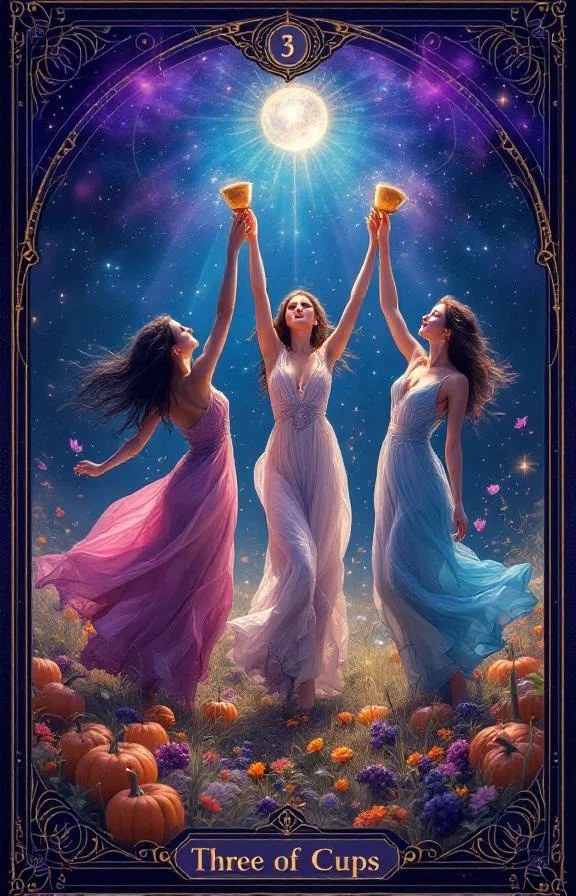
Reading tarot alone about your relationship and reading tarot with your partner are fundamentally different experiences. The solo reading is a conversation between you and the cards about your perception. The couples reading is a conversation between two people, mediated by the cards, about the actual space between them.
The second version is scarier. It is also more useful — by a significant margin.
Here is why most couples never try it, and how to do it well if you decide to.
In short: A couples tarot reading works best when both people draw and interpret cards together rather than one reading for the other. The four-card Mirror Table Spread has each person draw what they bring and what they need, revealing unspoken tensions before they become resentments. Ground rules like no "you" statements and a pause option keep the reading safe from becoming ammunition.
Why Couples Readings Go Wrong
The three most common failure modes:
1. One person is the reader, the other is the subject. This creates a power dynamic where one person interprets and the other receives — essentially a therapy session without a therapist's training. Both people need to be co-readers, both interpreting, both responding.
2. Someone draws The Tower and panics. Hard cards in a couples reading feel personal in a way they do not in a solo reading, because the other person is watching your reaction. The temptation to perform calmness or to spiral into anxiety is strong.
3. The reading becomes ammunition. "See? The Five of Swords — I told you that you were being combative." Using cards as evidence in a pre-existing argument defeats the purpose entirely.
All three failure modes share a common root: the reading is being used to prove something rather than discover something. The solution is structural — set up the reading so that proof-seeking becomes difficult and discovery becomes natural.
Ground Rules (Read These Together Before Starting)
-
Both people interpret every card. When a card is turned over, both people say what they see. Not what they think it means for the relationship — what they literally see in the image first, then what it reminds them of. The psychologist John Gottman calls this "turning toward" — attending to your partner's inner world with genuine curiosity.
-
No "you" statements about the cards. Instead of "that card means you are being distant," try "that card makes me think about distance — I wonder what kind of distance it is pointing to." The shift from accusation to inquiry changes everything.
-
Either person can call a pause. If a card or interpretation triggers something that feels too charged, either person can say "I need a minute" and the reading pauses. No explanation required.
-
What happens in the reading stays in the reading. The cards are not ammunition for future arguments. If your partner is vulnerable enough to say "that card reminds me that I have been checked out lately," that admission is not available for retrieval during Thursday's fight about the dishes.
-
End with appreciation. Whatever the cards showed, the last thing both people say is one thing they appreciate about the other person in this moment. Not generic — specific.
The Mirror Table Spread (4 Cards, 2 Readers)
This spread is designed specifically for two people reading together. Each person draws two cards.
| Who draws | Position | Meaning |
|---|---|---|
| Person A | 1 | What I am bringing to us right now |
| Person B | 2 | What I am bringing to us right now |
| Person A | 3 | What I need from us right now |
| Person B | 4 | What I need from us right now |
Process:
- Shuffle together. Literally — both people handle the deck, one shuffles then passes to the other.
- Person A draws card 1, places it face-down.
- Person B draws card 2, places it face-down.
- Person A draws card 3, places it face-down.
- Person B draws card 4, places it face-down.
- Turn over cards 1 and 2 together. Both people respond to both cards.
- Turn over cards 3 and 4 together. Both people respond to both cards.
The face-down step matters. It creates a moment of commitment — you have drawn the card, you cannot un-draw it, but you have a breath before you see what it says.
Reading the pairs:
Cards 1 and 2 show the current energies in the relationship. Are they complementary or competing? If Person A drew The Emperor and Person B drew The High Priestess, the relationship currently holds both structure and intuition — different but potentially balanced. If both drew Swords cards, the relationship is operating in its intellectual dimension — thinking, analysing, possibly overthinking.
Cards 3 and 4 are the most revealing. Needs that are spoken become negotiable. Needs that remain unspoken become resentments. If Person A needs stability (Four of Pentacles) and Person B needs adventure (Knight of Wands), you have not discovered a problem — you have discovered a tension that, named, can be navigated. Unnamed, it would have shown up as recurring arguments about weekend plans.

Handling Hard Cards Together
When The Tower appears in a couples reading, there are three common reactions:
- Silence (both people are afraid to say what they see)
- Deflection ("Oh that is probably about work, not us")
- Catastrophising ("See, the cards say we are doomed")
All three are avoidance strategies. Here is what to do instead:
Name the elephant. "That is a hard card. I notice I feel [anxious / defensive / curious] seeing it. What do you feel?" Starting with your own reaction rather than an interpretation of the card gives your partner space to have their own response rather than reacting to yours.
Ask what the card is protecting you from seeing. The Tower does not predict destruction — it reveals that something built on a false foundation is becoming unsustainable. In a couples reading, this might mean: a polite fiction you have both been maintaining, a conversation you have been avoiding, or a truth that both of you know but neither has said out loud.
Remember that the card is not the relationship. One card in a four-card spread is 25% of the picture. The other three cards provide context. A Tower next to The Star tells a completely different story than a Tower next to the Ten of Swords.
When to Do a Couples Reading
Monthly check-ins. The most sustainable rhythm. Not when something is wrong — when things are normal. The reading creates a container for the subtle shifts that accumulate between check-ins.
Before major transitions. Moving in together. Changing jobs. Having a child. Starting a business together. The reading surfaces the unspoken expectations that make transitions harder than they need to be.
After repair. When you have come through a difficult period and want to understand what happened and what you both learned, a couples reading can be a closing ritual — a way of marking "we went through that and we are still here."
Never during active conflict. If you are currently fighting, put the cards away. The reading requires curiosity, and conflict produces defensiveness. Do the reading when you can both approach it with genuine openness.
The Difference It Makes
In ten years of observing people use tarot in relationships, the consistent pattern is this: couples who read together develop a shared symbolic vocabulary. "I am feeling very Five of Cups today" becomes shorthand for "I am grieving something I cannot quite name yet." "This feels like a Tower moment" becomes code for "something we have been avoiding is about to become unavoidable."
This shared language does something remarkable — it creates distance between the emotion and the person experiencing it. You are not being difficult. You are having a Five of Swords moment. The card holds the feeling long enough for both people to look at it together rather than at each other. Side by side, not face to face. That shift — from accusation to shared observation — is what turns conflict into curiosity.
For more relationship reading approaches, including solo spreads for when you need to understand your own patterns first, explore our complete relationship tarot spread guide.
The bravest thing two people in a relationship can do is sit down together, draw cards, and say out loud what they see — knowing that the other person is seeing it too. It is a small act of radical transparency in a culture that teaches us to manage our partners' perceptions rather than trust them with our truth. The cards do not save relationships. But they create moments where honesty becomes easier, where vulnerability feels contained enough to risk, and where two people can look at the space between them and say, for once, what they actually see.