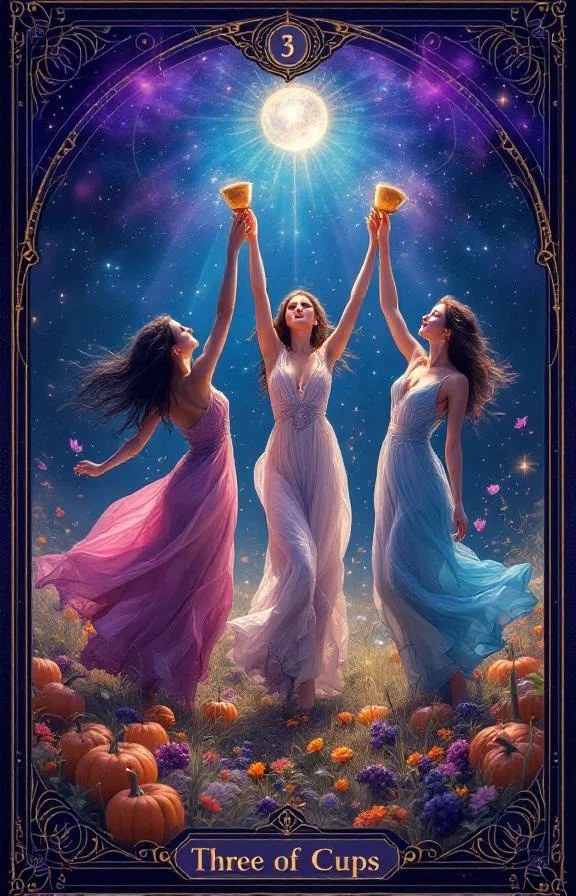
Every October, a quarter of the population puts on a mask and calls it fun. More interesting than it sounds. Across cultures and centuries, the end of October has been a time when people give themselves permission to play with darkness, death, and the uncanny. The Celtic Samhain, Catholic All Hallows' Eve, Mexican Dia de los Muertos — all share one structural idea. During this narrow window, the boundary between the living and the dead becomes permeable. The veil, as tradition puts it, grows thin.
You do not need to believe in veils, spirits, or an afterlife for this metaphor to pack a punch. Because the most significant boundary that loosens at Halloween is not between this world and the next. It is between your conscious mind and everything you have shoved beneath it.
In short: Halloween tarot readings work because the cultural permission to engage with darkness lowers your psychological defenses, making shadow work easier. Three spreads — a five-card Shadow Self layout, a four-card Ancestor spread, and a three-card Fear Inventory — use cards like Death, The Devil, and The Moon to surface what you have buried, inherited, or been afraid to face.
The Psychology of Spooky Season
There is a reason people feel different in late October. It is not the pumpkin spice.
Terror Management Theory (TMT) emerged from a pattern spotted across hundreds of experiments: when people are reminded of their own mortality, their behavior shifts in measurable ways. Some become more rigid, clinging harder to cultural worldviews that promise symbolic immortality. But others — particularly people with higher self-esteem and reflective capacity — respond to mortality reminders by becoming more authentic. They drop pretenses. They get honest about what they actually want. They stop performing the version of themselves that keeps everyone else comfortable.
Halloween is a season-long mortality reminder wrapped in candy and cobwebs. Skeletons in front yards. Coffin decorations at the pharmacy. Children dressed as ghosts. For most of the year, Western culture works hard to keep death invisible, sanitized, clinical. October reverses that. And the research says this reversal — this temporary exposure to death as a theme — can activate a deeper honesty in people who engage with it rather than run.
This is why Halloween tarot readings hit differently. Not because the veil between worlds is literally thinner. Because the cultural veil between comfort and confrontation has been temporarily lowered, and the human mind, given permission to look at the dark stuff, will actually do it.
Why Cultural Permission Matters
Decades of research on expressive writing show that people who engage with difficult emotions through structured exercises — even fifteen minutes a day — show measurable gains in immune function, emotional regulation, and overall well-being. But there is a catch: the exercise has to feel safe. People need permission to go there. Without that permission, defenses stay up and the hard material stays locked away.
Halloween gives that permission. The costumes, the decorations, the whole cultural atmosphere says: tonight, we play with the dark. When you sit down with a tarot deck on Halloween night, surrounded by candles and October air, you are operating inside a cultural context that explicitly invites engagement with shadow material. The psychological defenses that normally say "not now, too scary, think about something else" are temporarily off-duty. Everything around you is already scary on purpose.
This is not a minor point. Most people avoid shadow work not because they lack courage but because nothing in their ordinary environment signals that it is safe or appropriate to look at what they have pushed away. Halloween builds that signal. It constructs an entire aesthetic around the idea that confronting darkness is not only acceptable but fun.
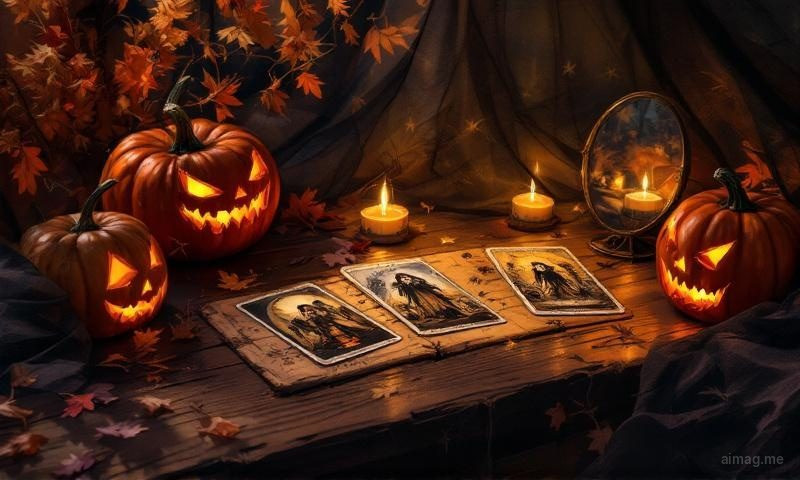
The Five Cards That Own October
Some cards belong to Halloween the way some songs belong to summer. These carry death, shadow, fear, and solitude as their native language, and they are not the cards most people want to see in a reading. In October, though, they become invitations rather than threats.
Death — the obvious one, and the most misunderstood. Death does not mean dying. It means something has ended and the refusal to acknowledge that ending is causing more pain than the ending itself. On Halloween, Death asks: what are you still carrying that stopped being alive months ago?
The Devil — the card of chains you could remove if you realized you were the one holding the key. Addictions, compulsions, comfortable prisons. The Devil at Halloween is a mirror held up to the thing you keep choosing that you know is not good for you. The horns and darkness fit the season. The message is entirely psychological: you are not trapped. You are attached.
The Moon — fear itself, particularly the kind that lives in uncertainty and ambiguity. The Moon does not reveal what is in the dark. It shows you that you are afraid of the dark, and that your fear is warping your perception. On Halloween, when darkness is everywhere and celebrated, The Moon loses some of its menace and becomes navigable.
The Tower — structures collapsing, beliefs shattering, the sudden exposure of something less solid than you thought. Terrifying in a Tuesday afternoon reading. On Halloween, when you are already braced for a jolt, The Tower lands almost cathartic. Fine. Show me what's falling apart. I'm ready.
The Hermit — the quiet one in the lineup, but arguably the most relevant. The Hermit walks into the darkness carrying their own light. Not running from the dark, not pretending it is not there, but choosing to enter it deliberately and alone, with inner wisdom as the only lantern. That is the energy of a Halloween tarot reading at its best.
Spread 1: The Shadow Self Spread (5 Cards)
Built on the Jungian concept of the Shadow: the parts of yourself you have disowned, repressed, or refused to acknowledge because they do not fit the image you show the world. Halloween, with its masks and costumes, is the perfect time to look at what is behind your own.
| Position | Card | Question |
|---|---|---|
| 1 | The Mask | What do I show the world? |
| 2 | The Shield | What does this mask protect? |
| 3 | The Shadow | What hides behind the mask? |
| 4 | The Want | What does my shadow need from me? |
| 5 | The Integration | How do both sides come together? |
How to read it: Position 1 is your persona — the curated version you present daily. Not necessarily false, but edited. Position 2 reveals why you maintain this particular mask. What vulnerability or wound does it cover? Position 3 is the shadow itself: the trait, desire, or emotion you have exiled from your public self. Position 4 is often the surprising one. The shadow does not want to destroy you. It wants something — usually recognition, integration, or expression. Position 5 shows what it looks like when you stop splitting yourself into acceptable and unacceptable halves.
Strong cards here: Death in Position 3 (the shadow is an ending you have not processed). The Devil in Position 2 (you are protecting an attachment, not a wound). The Moon in Position 4 (the shadow wants you to stop being afraid of ambiguity). The Star in Position 5 (integration brings genuine hope, not just relief).
This spread pairs naturally with the deeper work described in shadow work with tarot.
Spread 2: The Ancestor Spread (4 Cards)
Whether you believe the dead can communicate through tarot or you read "ancestors" as shorthand for inherited patterns, family conditioning, and the stories that shaped you before you were old enough to choose them — this spread works either way. It asks: what did I receive from those who came before me, and what do I do with it now?
| Position | Card | Question |
|---|---|---|
| 1 | The Inheritance | What was passed down to me? |
| 2 | The Gift | What part of this inheritance serves me? |
| 3 | The Weight | What part do I need to release? |
| 4 | The Gratitude | What do I carry forward with thanks? |
How to read it: Position 1 is broad. Could be a family trait, a belief system, a behavioral pattern, an emotional tendency, or a specific wound handed down through generations. Position 2 narrows the focus to what genuinely helps you. Not everything you inherited is baggage. Some of it is strength, resilience, or hard-won wisdom you did not earn but can still use. Position 3 is the part that needs to stop with you. The anxiety your mother carried. The silence your father learned from his father. The belief that love must be earned through suffering. Position 4 completes the cycle — a deliberate act of choosing what to keep and honoring where it came from.
When to do it: Ideally Halloween night or the days right around it. If you have a photo of an ancestor or a family heirloom, placing it near your reading space adds emotional weight. Not because the object holds supernatural power, but because it anchors your attention to the specific people and patterns you are investigating.
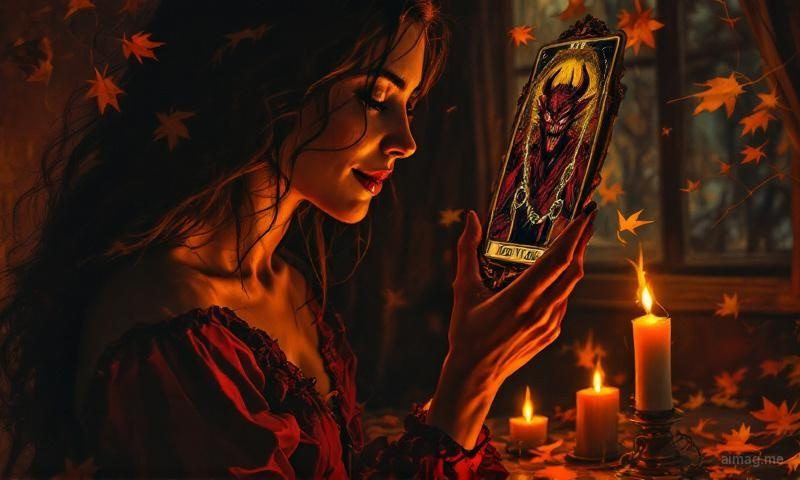
Spread 3: The Fear Inventory (3 Cards)
The simplest spread here. For many people, the most powerful. Three cards. Three questions. Ten minutes of genuine honesty about what scares you and what that fear is actually doing.
| Position | Card | Question |
|---|---|---|
| 1 | The Fear | What is my biggest fear right now? |
| 2 | The Protection | What is this fear protecting me from? |
| 3 | The Courage | What does bravery look like in this situation? |
How to read it: Position 1 names the thing. Not the surface fear — not "spiders" or "public speaking" — but the real one. The fear of being truly seen. The fear that you are not enough. The fear that the person you love does not love you back. The card here often catches people off guard, because the unconscious mind knows things the conscious mind is still negotiating with.
Position 2 is the insight that changes everything. Fear is not random. It is protective. Every fear you carry guards against a perceived threat — often one that was real at an earlier point in your life but may not be real anymore. This card shows you what your fear thinks it is saving you from. Once you see that, you can decide whether the protection is still necessary or whether it has quietly become a cage.
Position 3 is not about fearlessness. Fearlessness is a fantasy. Courage is acting while afraid, and this card shows what that looks like in your specific situation. A conversation you need to have. A boundary you need to draw. A leap you need to take without waiting for certainty that will never come.
Why Halloween sharpens this: During the rest of the year, pulling three cards about your deepest fear feels heavy. Almost clinical. On Halloween, it feels like exactly the right activity for the night. The cultural context reframes fear-confrontation from "therapy homework" to "seasonal ritual," and that reframe makes people more willing to go deep.
How to Set Up a Halloween Reading
Atmosphere matters. Not because candles have magical properties, but because environment shapes psychological state. Basic environmental psychology — and you can use it deliberately.
Lighting: Low and warm. Candles if you have them, a dim lamp if you do not. Bright overhead lighting activates task-mode thinking. Dim, warm lighting encourages reflective, inward states. You want the second.
Sound: Silence works. So does ambient music without lyrics. The goal is removing the auditory cues of ordinary life — notifications, traffic, television — that keep you anchored in surface-level processing.
Time: After dark. Not because darkness holds mystical significance, but because nighttime naturally shifts the brain toward more reflective, sometimes more emotionally honest processing. There is a reason people have their deepest conversations late at night.
Company: Alone or with one or two people you trust completely. Halloween readings can work as group activities, but only if everyone present is willing to be genuine. A reading done for performance stays on the surface. A reading done in earnest, even with others watching, can be genuinely transformative.
Before you begin: Three slow breaths. Not because breathing is magical — because it activates the parasympathetic nervous system, lowers cortisol, and shifts your physiology from alert mode to receptive mode. Then state your intention aloud, even if you feel foolish. "I want to see what I have been avoiding." "I want to understand what I inherited." "I want to know what I am afraid of." Saying it aloud makes it real in a way that thinking it does not.
The Veil Is You
The tradition says the veil between worlds is thinnest at Samhain. The psychology says the veil between your conscious and unconscious mind is thinnest when cultural conditions give you permission to engage with the material you usually avoid. Both descriptions point at the same experience: a temporary opening, a window of honesty, a moment when the things you have pushed down become accessible.
You do not have to believe in spirits to use that opening. You do not need the supernatural to recognize that October — with its darkness and its skeletons and its explicit invitation to play with fear — creates a psychological environment unusually favorable for self-examination. The archetypes you carry become more visible when the culture around you is actively engaging with archetypal imagery. The shadows become easier to face when everyone around you is celebrating the dark.
A Halloween tarot reading is not fortune-telling. It is not communing with the dead — unless you want it to be, in which case the ritual has value regardless of whether the dead are listening. It is a structured exercise in looking at the parts of yourself that the rest of the year keeps hidden. The cards do not know it is Halloween. But you do. And that knowledge, that cultural permission, that seasonal willingness to sit with what is uncomfortable, is the only veil that needs to be thin.
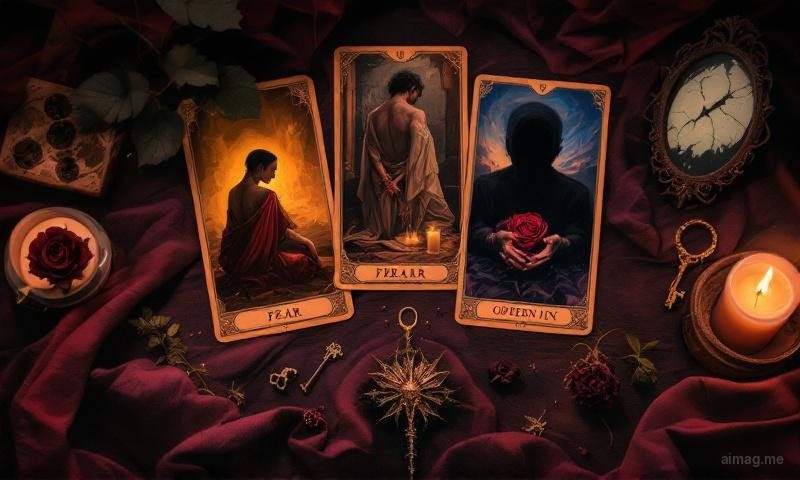
Frequently Asked Questions
Can I do a Halloween tarot reading if I do not celebrate Halloween?
Yes. These spreads work any time you want to engage with shadow material, fear, or inherited patterns. Halloween just provides a cultural context that makes the work feel more natural and less clinical. If late October does not resonate, pick any time that feels liminal or transitional: a birthday, a solstice, a new moon, the anniversary of a significant change.
Do I need a special deck for Halloween readings?
No. Any standard 78-card tarot deck works. Some people enjoy darker-themed decks in October for the aesthetic, and if that helps you get into the right headspace, go for it. A standard Rider-Waite-Smith deck does exactly the same work. The power sits in the questions, not the illustrations.
What if I pull a card that genuinely scares me?
Good. That reaction is data. The cards that scare you are pointing at the material that most needs your attention. Sit with the discomfort for a moment before reacting. Ask yourself: what specifically about this card disturbs me? The answer usually reveals the exact fear, pattern, or truth the reading is trying to surface. If the fear feels overwhelming rather than productive, stop the reading, ground yourself, and come back to it later or talk it through with someone you trust.
Is it okay to do these spreads for someone else?
Yes, with their consent and genuine willingness to engage. Reading for someone who treats it as a party trick will produce party-trick results. Reading for someone who actually wants to explore their shadow, fears, or inherited patterns can be one of the most meaningful things you do together on Halloween night. Create a safe space, ask before interpreting, and let them lead the conversation about what the cards mean to them.
Halloween is the one night of the year when the entire culture agrees to look at the dark. Costumes, horror films, ghost stories, haunted houses — all of it is practice for the more personal confrontation that most people avoid the other 364 days. A tarot deck, three to five cards, a few candles, and an honest question is all it takes to turn that cultural opening into something genuinely useful. Not because the cards are magic. Not because the veil is real. Because you are real, and the parts of you that hide in the dark are real, and sometimes all it takes to face them is a season that says it is okay to look.