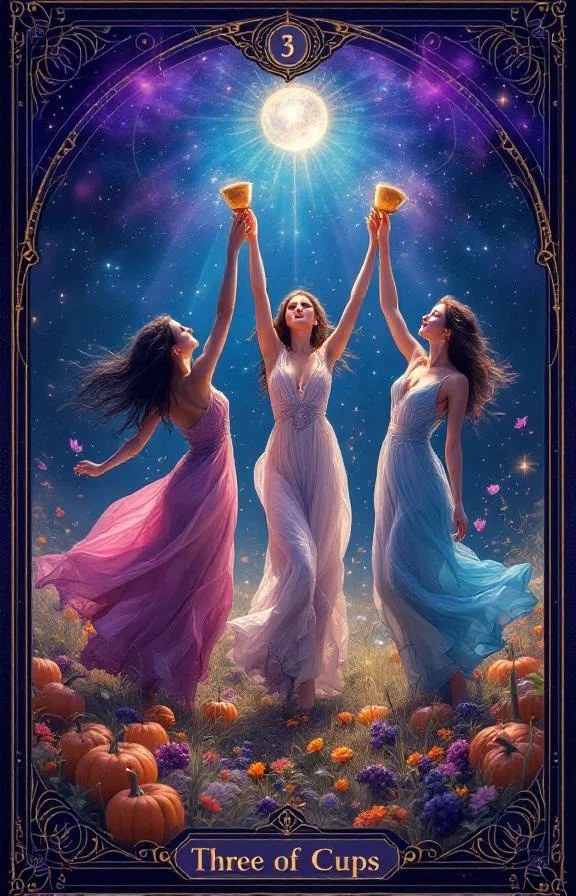
You are holding a deck of seventy-eight cards, and you have no idea what to do with them. Or maybe you have not bought the deck yet and you are trying to figure out whether this is something that could actually be useful, or whether it is just an aesthetically pleasing form of self-deception. Both are reasonable starting points. This guide will take you from zero to your first reading, and it will do so without requiring you to believe anything supernatural. What tarot asks of you is not faith — it is attention.
In short: Reading tarot cards means choosing a focused question, drawing one or more cards, reacting to the imagery before consulting meanings, and applying what surfaces to your situation. The 78-card deck divides into Major Arcana for deep life themes and four Minor Arcana suits for everyday domains. No memorization is needed to start; your gut response to the image is the most valuable data in any reading.
What Tarot Actually Is (and What It Is Not)
Tarot is not fortune-telling. This is the single most important thing to understand before you touch a card, because the fortune-telling frame will ruin every reading you do. If you sit down expecting the cards to predict whether you will get the job, marry the person, or move to the city, you will be perpetually disappointed — not because tarot fails, but because you are asking it to do something it was never designed for.
What tarot actually is: a structured reflection tool that uses symbolic images to surface thoughts, feelings, and patterns your conscious mind has not yet articulated. Carl Jung, who spent decades studying symbolic systems, described a concept he called synchronicity — meaningful coincidence. Not magic, but the observation that when you interact with a symbolic system in a state of genuine inquiry, what surfaces tends to be precisely what you need to see. The card you draw is not "sent" to you. But your reaction to it — the flinch, the recognition, the resistance — is authentic information about your inner state.
Think of it this way: a tarot card is a psychological Rorschach test with richer content. The inkblot asks "what do you see?" The tarot card asks the same question, but provides a detailed scene — a figure walking away from eight cups, a woman holding a lion's jaw, a tower struck by lightning — that gives your unconscious mind specific material to respond to. Your interpretation is the data. The card is the prompt.
This is why two people can draw the same card for the same question and interpret it differently. They are not wrong. They are reading different inner states through the same symbolic lens. Ellen Langer's research on mindfulness — which she defines as the simple act of paying attention to what you normally overlook — suggests that this kind of structured attention to your own reactions is one of the most reliable ways to access information your habitual thinking patterns filter out. Tarot is a mindfulness practice in disguise.
The Deck: 78 Cards, Four Suits, Two Arcana
A standard tarot deck has seventy-eight cards divided into two groups.
The Major Arcana (22 cards) — these are the heavy-hitters. The Fool, The Magician, The High Priestess, The Empress, The Emperor, The Hierophant, The Lovers, The Chariot, Strength, The Hermit, Wheel of Fortune, Justice, The Hanged Man, Death, Temperance, The Devil, The Tower, The Star, The Moon, The Sun, Judgement, and The World. Each represents a major life theme or archetypal experience. When a Major Arcana card appears in a reading, it signals that something significant is in play — a core psychological pattern, a major transition, or a fundamental truth about your current situation.
The Minor Arcana (56 cards) — divided into four suits, each with cards numbered Ace through Ten plus four court cards (Page, Knight, Queen, King):
- Cups — emotions, relationships, intuition, the inner world. Cups cards tell you what you are feeling, even when you think you are thinking.
- Pentacles — material reality, work, money, body, health. Pentacles cards ground the reading in practical, tangible concerns.
- Swords — thoughts, communication, conflict, truth. Swords cards reveal your mental patterns — both the sharp clarity and the self-inflicted wounds.
- Wands — energy, passion, ambition, creativity. Wands cards point to what drives you, what excites you, and what is burning out.
You do not need to memorize all seventy-eight meanings before your first reading. In fact, trying to memorize meanings is one of the most common mistakes beginners make. The meanings will develop organically as you read. What matters now is understanding the system's architecture: Major Arcana = big themes; Cups = feelings; Pentacles = practical life; Swords = thinking; Wands = energy and drive.
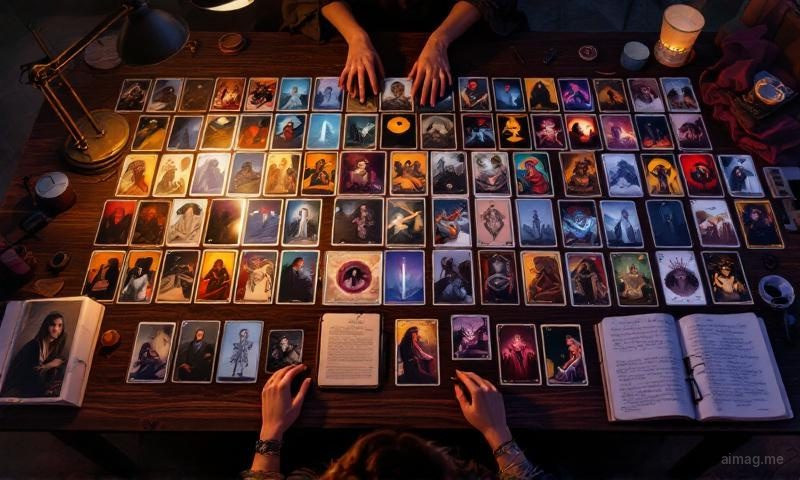
Your First Reading: Step by Step
Here is how to do your first tarot reading. No candles required, no special rituals, no invocations. Just you, the cards, and a genuine question.
Step 1: Choose a question. Not "what is going to happen to me" but something specific and personal. Good first questions: "What do I need to understand about my current situation at work?" or "What is the most important thing I am not seeing in this relationship?" or "What should I focus on this week?" The question should be open-ended (not yes-or-no for your first reading) and about yourself (not about what someone else is thinking or feeling).
Step 2: Shuffle. There is no correct way to shuffle tarot cards. Overhand shuffle, riffle shuffle, spread them on a table and swirl them — whatever feels natural. The point of shuffling is not to "charge" the cards. It is to create a moment of transition between ordinary activity and focused attention. Shuffle until you feel ready to stop. That feeling is your signal.
Step 3: Draw. For your first reading, pull a single card. Place it face-up in front of you. Look at it before you reach for any guidebook.
Step 4: React first, interpret second. Before you read the "official" meaning, spend thirty seconds with the image. What do you notice? What is the figure doing? What colors stand out? How does the image make you feel? Your first, unfiltered reaction to the card is often more accurate than any textbook interpretation. If the card makes you uncomfortable, that discomfort is information. If it makes you feel relieved, that relief is information.
Step 5: Read the meaning. Now look up the card's traditional meaning — in the guidebook that came with your deck, or in a dedicated card meaning guide. Notice where the traditional meaning aligns with your initial reaction, and where it surprises you. Both alignments and surprises are valuable.
Step 6: Apply it. How does this card answer your question? Not in a predictive sense — in a reflective sense. If you asked "what do I need to understand about work?" and drew The Hermit, the card is not predicting you will be fired or promoted. It is suggesting that your current work situation calls for reflection, solitude, and stepping back from the noise of other people's opinions to find your own assessment.
That is it. Your first reading. One question, one card, five minutes. Everything else builds from this foundation.
Three Spreads Every Beginner Should Know
Once you are comfortable with single-card draws, these three spreads will serve you for months before you need anything more complex.
The Single Card Daily Draw
Not technically a "spread," but it is the most valuable practice in tarot and the one you should do every morning for at least a month.
| Position | Meaning |
|---|---|
| 1 | The energy, theme, or lesson of the day |
Pull one card each morning. Do not try to predict your day. Instead, use the card as a lens — something to notice throughout the day. If you pull the Five of Wands, watch for moments of competition or scattered energy. If you pull the Six of Cups, notice when nostalgia or memories surface. At night, reflect on how the card connected to your actual experience. This practice trains your symbolic thinking faster than any study method.
The Three-Card Spread
The workhorse of tarot reading. Three cards, multiple possible frameworks.
| Position | Framework 1 | Framework 2 | Framework 3 |
|---|---|---|---|
| 1 | Past | Situation | Mind |
| 2 | Present | Challenge | Heart |
| 3 | Future | Advice | Action |
Choose the framework that fits your question. Relationship question? Use Situation/Challenge/Advice. Self-reflection? Use Mind/Heart/Action. Wondering how you got here? Use Past/Present/Future. The three-card spread is remarkably flexible because three positions are enough to create a narrative without overwhelming a beginner. For more detail on this spread, see our dedicated three-card tarot spread guide.
The Five-Card Cross
For when three cards are not enough but ten feel like too many.
| Position | Meaning |
|---|---|
| 1 (center) | The present situation — where you are right now |
| 2 (left) | The recent past — what led to this moment |
| 3 (right) | The near future — where current energy is heading |
| 4 (below) | The foundation — the underlying dynamic you may not be aware of |
| 5 (above) | The potential — the best possible outcome if you act consciously |
Lay these in a cross pattern: card 1 in the center, card 2 to the left, card 3 to the right, card 4 below, card 5 above. This spread adds depth by including what is below the surface (Position 4) and what is possible (Position 5) — two dimensions the three-card spread does not explicitly address. When you are ready for an even more detailed layout, the Celtic Cross expands this structure to ten cards.
How to Interpret Cards (Without Memorizing 78 Meanings)
Here is the secret experienced readers rarely tell beginners: nobody has seventy-eight definitions memorized and retrieves them mechanically. Skilled readers work with a system of symbolic keys that allow them to interpret any card in any context. Here are those keys.
Numbers tell a story. Aces are beginnings — raw potential, the spark. Twos are choices and partnerships. Threes are growth and first results. Fours are stability (sometimes stagnation). Fives are conflict and disruption. Sixes are harmony and resolution. Sevens are inner challenge and strategy. Eights are movement and mastery. Nines are near-completion and culmination. Tens are endings that are also beginnings. Learn the number meanings, and you already know the rough contour of forty cards.
Suits tell you the domain. If the number tells you what is happening, the suit tells you where. A Five of Cups is conflict in the emotional world — grief, disappointment, spilled feelings. A Five of Swords is conflict in the mental world — arguments, harsh truths, winning at a cost. A Five of Pentacles is conflict in the material world — financial hardship, feeling left out in the cold. Same number, different territory.
Colors carry meaning. In most traditional decks, red signals passion and action, blue signals intuition and emotion, yellow signals intellect and joy, green signals growth and nature, gray or black signals the unknown or the unconscious. When a card is dominated by one color, that color is amplifying the card's message.
Body language speaks. Look at what the figures are doing. Are they moving or still? Looking forward or backward? Alone or in a group? Arms open or crossed? Holding something or letting go? The body language of tarot figures is designed to communicate before you read a single word of interpretation.
Your gut is data. When you turn over a card and feel something — anything — before your thinking mind kicks in, that feeling is the most valuable piece of information in the reading. It is your unconscious mind recognizing something the card is showing you. Do not dismiss it as "just a feeling." In a tarot reading, feelings are facts.
Common Mistakes Beginners Make
Yes-or-no thinking. Tarot is a nuanced system being forced through a binary filter when you reduce every reading to "is this good or bad?" The Death card is not bad — it means transformation and the end of something that has run its course. The Ten of Cups is not automatically good if the question is "should I stay in a relationship that looks perfect on the outside but feels empty?" Learn to read the full message, not just the valence. If you do need a binary answer, we have a dedicated yes-or-no tarot guide that explains how to adapt the system for that purpose.
Reading when emotional. If you are in the middle of a panic about a relationship, the worst time to do a reading about that relationship is right now. Your emotional state will color every interpretation so heavily that you will only see what you fear or what you hope — never what the card is actually showing you. Wait until you can approach the question with genuine curiosity rather than desperate need. A reading done in calm is worth ten readings done in crisis.
Asking the same question repeatedly. If you do not like the answer, doing another reading will not change reality — it will only produce confusion. The first reading is almost always the most accurate because your question was freshest and your interference was lowest. If you drew a card you did not want to see, sit with it. The card you resist is usually the card you most need.
Ignoring cards you do not understand. When a card's meaning is not immediately obvious, beginners tend to skip it or force an interpretation that does not feel right. Instead, write it down and come back to it in a few days. Often, the card's meaning becomes clear only after the situation it was addressing has developed further. Tarot sometimes speaks ahead of your ability to understand.
Over-relying on guidebooks. Guidebooks provide a starting point, not an endpoint. If you read the book meaning and it does not resonate with the image you see and the question you asked, trust your reading over the book. The guidebook was written generically. Your reading is specific to your situation, your question, and your life. Both are valid, but yours takes precedence.
Making tarot a substitute for action. Tarot is a tool for understanding, not a replacement for doing. If every reading tells you to have the difficult conversation, set the boundary, or leave the situation — and you do another reading instead of acting — you are using tarot as a sophisticated procrastination device. The cards clarify. You act.
When to Use AI vs. Reading Alone
AI-powered tarot reading is a recent development, and it is worth understanding what it adds and what it cannot replace.
What AI does well: An AI interpreter can provide context you might not have — connections between cards, symbolic details you missed, psychological frameworks that illuminate the spread's message. It can also help beginners who feel stuck staring at cards they do not recognize, offering a starting point for interpretation that you can then accept, modify, or reject based on your own response.
What AI cannot do: It cannot feel what you feel when you turn over a card. It cannot know the specific context of your life that makes the Eight of Cups about your job rather than your relationship. It cannot replicate the moment of recognition when a card names something you have been carrying silently.
The best approach: Use AI as a conversation partner, not an oracle. Pull your cards, form your own first impressions, then see what the AI interpretation adds. Where the AI's reading resonates, take it in. Where it misses, trust your own reading. Over time, you will develop a personal relationship with the cards that no AI can replicate — but AI can accelerate the learning curve by providing interpretive frameworks you would otherwise need years of reading to develop.
The goal is not to depend on AI interpretation forever. It is to use it as training wheels that come off naturally as your own interpretive confidence grows. A reading that is half your intuition and half AI insight is more valuable than either one alone.
Frequently Asked Questions
Do I need a special deck to start?
No. The Rider-Waite-Smith deck is the most commonly recommended for beginners because its images are rich, detailed, and designed to be intuitively readable. But any deck whose artwork speaks to you will work. The most important quality in a tarot deck is that you want to look at it. If the images leave you cold, you will not engage with them deeply enough for meaningful readings. Visit a shop, look at a few decks, and choose the one whose art makes you want to pick it up. That instinct is reliable.
How long does it take to learn tarot?
You can do a meaningful reading on your first day. You can feel comfortable with the Major Arcana in a month of daily practice. A working knowledge of all seventy-eight cards typically develops over three to six months of regular use. True fluency — the ability to read any spread for any question and produce genuine insight — takes a year or more. But this is not a timeline to rush. The learning itself is the practice, and each stage provides value from the start.
Can I read tarot for myself, or only for others?
You can absolutely read for yourself, and you should — self-reading is the most common and arguably the most valuable form of tarot practice. The only caution is the emotional bias mentioned above: when you are deeply invested in a particular outcome, your interpretations will skew toward what you want or fear rather than what the cards are showing. For high-stakes personal questions, consider having someone else read for you, or use an AI reading to get an interpretation that is not filtered through your emotional investment.
Is tarot dangerous or connected to the occult?
Tarot cards are printed paper. They have no inherent power to summon, influence, or connect to anything. The power in a tarot reading comes from the reader's attention and the symbolic richness of the images — the same psychological mechanism that makes poetry, art, and mythology meaningful. Whether you approach tarot as a spiritual practice or a purely psychological tool is entirely your choice, and both approaches produce genuine insight. What tarot requires is attention, honesty, and a willingness to see what you normally overlook. Those qualities are not dangerous. They are the definition of awareness.
Every expert reader was once exactly where you are now — holding a deck of unfamiliar images and wondering whether any of this actually works. It does, but not the way most people expect. It does not predict your future. It does not channel external wisdom. What it does is give you a structured, symbolic language for the conversation you most need to have — the one with yourself. The cards are mirrors. Your interpretation is the reading. And the only way to learn is to start: one card, one question, one honest look at what the image stirs in you. Everything else follows from that.