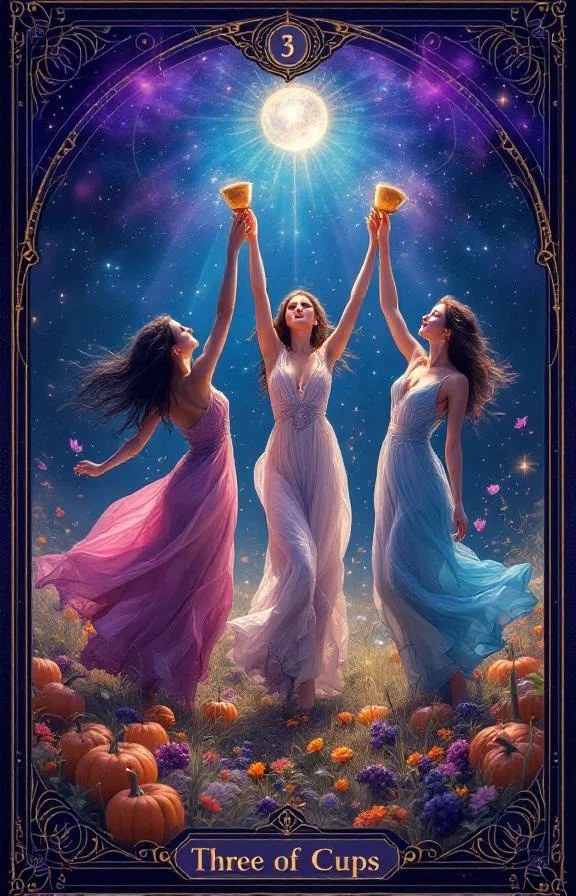
In short: AI tarot does not predict your future. It combines Jungian archetypes and symbolic imagery with modern language models to create a structured mirror for self-reflection. The cards activate your own pattern-recognition and projective psychology, surfacing what is already on your mind through a 78-card symbolic vocabulary that humans have used for centuries.
When the Ancient Meets the Algorithmic
There's a moment — right after you draw a tarot card — when something shifts. You weren't expecting The Tower, and yet there it is. Lightning strikes a crumbling structure. Figures fall. Everything you thought was stable, overturned.
 And then something curious happens: you start thinking about your own life.
Not because the card is magic. Not because the universe whispered something through a shuffled deck. But because your mind found a mirror, and mirrors have always been humanity's most powerful tools for understanding.
This article is about why that happens — and why combining an ancient symbolic system with modern AI creates something genuinely useful for self-reflection.
The Psychology of Symbolic Thinking
Carl Jung spent decades studying what he called the collective unconscious — a shared reservoir of symbols, myths, and archetypes that transcend culture and time. The Major Arcana of the tarot maps almost perfectly onto Jung's archetypes: The Fool as the beginning of individuation, The Hermit as the introspective sage, Death as transformation rather than ending.
 When you look at a tarot card, you're not reading the future. You're reading yourself through a symbolic language that humans have used for centuries.
This is where AI enters the picture — not as a fortune teller, but as a translator.
Jung's Archetypes and Why They Persist
What makes the Jungian framework so enduring is not that Jung invented these patterns — it's that he documented something already present in human culture across every civilization. The Hero's Journey, the Wise Old Man, the Shadow, the Anima and Animus: these are not constructs of one psychologist's imagination. They are recurring structures that appear in mythology, folklore, dream symbolism, and — notably — in the 78 cards of the tarot's historical development.
The concept of individuation — Jung's term for the lifelong process of psychological integration — requires engaging with all parts of the self, including the parts we'd rather not see. Tarot, in this context, functions as a structured invitation to encounter whichever archetype is most relevant to your present moment.
This is not prediction. It is pattern illumination.
Lacan's Mirror Stage and the Self-Reflection Paradox
Before we can understand why the mirror metaphor runs so deep, it's worth spending a moment with Jacques Lacan's mirror stage — one of psychoanalysis's most influential and counterintuitive ideas.
 He proposed that between six and eighteen months of age, an infant first recognizes their reflection in a mirror. This is a foundational moment: for the first time, the child sees themselves as a unified whole from the outside. The image in the mirror becomes the template for identity formation.
But here is the twist he identified: the mirror image is always a misrepresentation. The reflection appears more coherent, more stable, and more complete than the fragmented experience of being inside a body. The gap between the image we project outward and the complexity we experience internally is the site of much psychological tension throughout our lives.
What does this have to do with tarot? When you encounter a symbolic image — a card, an archetype, a piece of art — you engage in a similar process. You see something outside yourself and recognize aspects of your own experience in it. But what you recognize is shaped — importantly — by which parts of yourself you're currently ready to see.
The cards, like Lacan's mirror, don't reflect you neutrally. They reflect you selectively, based on what your current psychological state is prepared to encounter.
What AI Actually Does With Your Cards
Modern language models don't predict your destiny. They do something far more interesting: they find patterns in meaning.
When you ask a question like "What should I focus on in my career?" and draw the Three of Pentacles, an AI interpreter does several things:
- Contextual mapping — It connects your question's domain (career) with the card's traditional symbolism (collaboration, craftsmanship, skill-building)
- Pattern synthesis — It weaves together the card's visual elements, positional meaning in the spread, and your specific question into a coherent narrative
- Reflective framing — Instead of saying "you will get a promotion," it offers something like: "Consider where collaboration might unlock the next level of your work"
The difference is essential. One is superstition. The other is structured self-reflection. No crystal balls required.
How Language Models Handle Symbolic Ambiguity
There's a specific reason AI works well with tarot's symbolic vocabulary: both language models and tarot decks operate through associative networks rather than linear logic.
A large language model has been trained on an enormous range of human writing about psychology, mythology, symbolism, and experience. When it encounters "The Star card + question about burnout," it doesn't look up a fixed answer — it synthesizes associations from that vast network into something contextually relevant.
Tarot's symbolic system works similarly. Each card carries a web of meaning: colors, figures, numerological resonance, elemental correspondence, mythological echoes. No single interpretation is final. The meaning is always a negotiation between the card's symbolic vocabulary and the question being asked.
This makes AI a particularly well-suited interpreter — not because it knows the "correct" meaning, but because it can hold many associative threads simultaneously and surface the ones most relevant to your specific context.
Why Random Still Matters
"But the cards are random!" — Yes. That's the point.
Psychologists have a term for this: apophenia, the tendency to perceive meaningful connections between unrelated things. In most contexts, this is a cognitive bias to be avoided. But in therapeutic and reflective contexts, it's a feature, not a bug.
When a random card lands in front of you, your mind immediately begins the work of connecting it to your life. This process — the search for relevance — is itself the value. You're not being told anything. You're discovering what's already on your mind.
The randomness of the draw creates what psychologists call a "projective surface" — like a Rorschach inkblot, but with centuries of symbolic richness layered in.
The Creativity of Constrained Randomness
There's a principle from creative practice worth noting here: constraints generate creativity. Ask someone to write a story about anything, and they may stare at the page. Give them a random image and say "tell me about this," and the story begins.
Tarot works on the same principle. The random draw is a constraint that activates your interpretive capacity. It gives your reflective mind something to work against, which paradoxically allows more to surface than an open-ended "what's on your mind?" ever could.
This is why the practice is different from simple journaling — though journaling is excellent on its own. The card adds structure, unexpectedness, and symbolic vocabulary all at once.
Active Imagination: Jung's Tool for Dialogue With the Unconscious
Jung developed a technique called active imagination as a way of engaging with unconscious material without the passivity of dream interpretation. In active imagination, you enter a semi-meditative state and allow unconscious images, figures, and narratives to emerge — then engage with them consciously.
The method is deceptively simple: you begin with an image (often from a dream, but it can be any strong symbolic image), hold your attention on it without forcing it, and allow the image to develop, change, or speak. You're not analyzing the image from a distance. You're in dialogue with it.
Tarot cards are natural entry points for this process. Unlike a blank page, they provide a rich visual starting point — a specific figure in a specific scene with specific symbolic objects. This specificity helps anchor the attention and prevent the mind from drifting into pure fantasy.
Try this: The next time you draw a card that feels significant, try Jung's active imagination approach. Hold the image in your mind with relaxed attention. Let the scene breathe. Imagine yourself stepping into it. What happens? What does the central figure say to you, or what do you say to them? Write down what emerges before you read any interpretation.
This is not fortune-telling. It is structured access to your own creative and associative unconscious — one of the most powerful self-knowledge tools available.
The AI Advantage: No Ego, No Agenda
Human tarot readers are wonderful, but they come with human limitations: projection, confirmation bias, ego, the desire to please. An AI interpreter has none of these.
It won't tell you what you want to hear. It won't project its own issues onto your reading. It will consistently provide thoughtful, balanced interpretations grounded in the symbolic tradition of tarot and informed by psychological frameworks.
This doesn't make AI "better" than human readers — it makes it different. Think of it as having access to a tireless research assistant who has studied every tarot tradition, every Jungian archetype, and every reflective framework, and can synthesize them in seconds.
What Human Readers Offer That AI Cannot
It's worth being honest about the other side of this comparison. Human readers bring genuine empathy, live attunement to your emotional state, and the kind of intuitive leaps that come from one nervous system resonating with another. A skilled human reader might notice that your voice dropped when you described the situation, or that you hesitated before asking your question — and bring those observations into the reading.
AI cannot do this. It works only from what you give it in text.
What AI offers in exchange is consistency, depth of symbolic knowledge, and the absence of any human agenda. These are genuinely different kinds of value. The ideal might be to use both at different times — an AI practice for regular reflection, and a human reader for significant life moments where that live resonance matters.
Building a Practice, Not a Dependency
The most important thing about using AI tarot isn't any single reading — it's the practice itself.
Regular self-reflection is one of the most well-supported practices in positive psychology. Journaling, meditation, therapy — they all share a common thread: creating space to examine your thoughts, feelings, and patterns.
AI tarot adds another dimension: symbolic vocabulary. Instead of staring at a blank journal page, you have 78 cards worth of imagery, metaphor, and archetype to spark your reflection.
Here's how to build a meaningful practice:
- Ask real questions — Not "will I win the lottery?" but "What am I not seeing about my current situation?"
- Sit with discomfort — If a card makes you uneasy, that's information. What specifically bothers you about it?
- Track patterns — Over time, notice which cards appear frequently. What might that say about your current focus?
- Write it down — The interpretation is the beginning, not the end. Journal about what resonated and why.
The First Mirror Exercise
Here is a concrete starting practice, designed to introduce you to the reflective dimension of tarot reading before you develop any interpretation habits:
The First Mirror Exercise:
- Before you begin, take three slow breaths and bring to mind a situation in your life that feels unresolved or unclear.
- Draw one card — or, if you're using aimag.me, request a single card reading.
- Before reading any interpretation, write three words for what you see in the card's imagery.
- Write one sentence completing this prompt: "This card makes me think of ___."
- Now read the interpretation. Underline or note anything that resonates strongly — positively or negatively.
- Write one sentence completing this prompt: "What I didn't want to notice about my situation is ___."
That last sentence is where the mirror shows you something true.
The entire exercise takes about ten minutes. Done regularly — weekly is a good rhythm — it builds a growing record of your own reflective patterns over time.
How AI Tarot Differs From Every Other Self-Reflection Tool
Journaling asks you to generate the content yourself. Meditation asks you to observe the content of your mind with less judgment. Therapy asks you to engage with a trained other. All of these are valuable. AI tarot is different from all of them in one specific way.
It gives you structured symbolic prompts that you did not choose consciously. The element of surprise — you don't know which card you'll draw — activates the projective mechanism in a way that purely self-generated content cannot. This is the same reason a good therapist asks unexpected questions rather than just reflecting your own words back to you.
The APA Dictionary of Psychology defines projection as "the process of ascribing one's own attitudes, feelings, or suppositions to others." In the context of tarot, this mechanism is not a flaw to be corrected — it is the instrument of insight. The card becomes the "other" onto which you project, and what you project reveals what is present and active in you right now.
What a Consistent Reflection Practice Actually Changes
People who maintain a regular journaling practice over months often report a shift that is difficult to articulate at first: they start to notice their own patterns in real time, not just in retrospect. The journal creates a kind of externalized memory of the self — a record of emotional weather, recurring concerns, and the subtle ways that circumstances that appear different on the surface are actually the same theme returning in new clothing.
A tarot practice, when maintained with intention, does something similar. The symbolic vocabulary of the 78 cards becomes a shared language between you and your own internal life. Over time, you may find that when you encounter The Hermit, you don't just think about the card's traditional meaning — you think about all the times that card has appeared for you, what it was touching then, and what it might be touching now.
This accumulated personal meaning is something no single reading can create. It is the product of time, repetition, and honest attention.
Positive psychology research on self-reflection consistently finds that the benefit is not in any single moment of insight — it is in the habit of creating space for insight to occur. The insight itself is less the point than the orientation of mind that regular practice cultivates: curious rather than defensive, observant rather than reactive, willing to sit with questions rather than requiring immediate answers.
This is the practice that "The Modern Mirror" is designed to support. Not a single dramatic revelation, but the steady, accumulating self-knowledge that comes from regularly asking: What does this reflect back to me today?
The Mirror Metaphor
We named our editorial voice "The Modern Mirror" because that's exactly what this technology offers: a mirror.
Not a crystal ball. Not a prophecy machine. A mirror — enhanced by ancient symbolic wisdom and powered by modern AI — that helps you see yourself more clearly.
The cards don't know your future. But they might help you understand your present. And understanding your present is the first step to shaping whatever comes next.
The mirror has always worked this way. From the still pools that ancient people gazed into, to the polished silver mirrors of the Renaissance, to the glass mirrors we stand before every morning — the act of looking at a reflection has never been purely about surface information. It has always been about the gap between the image we present and the person we are discovering ourselves to be.
AI tarot is the latest iteration of a very old human technology: using external symbols to see internal truths.
Ready to look in the mirror? Start a free reading and discover what the cards reflect back to you.
Related Reading
- Shadow work: what your discomfort with a card reveals — when a card triggers a strong reaction, that response is data worth examining
- The projection effect: why you see yourself in the cards — the cognitive science behind why tarot functions as a self-reflection tool
- Archetypes you live by: Major Arcana as a map of the psyche — how Jung's 22 archetypal stages map onto the Fool's Journey
- AI as therapist's notebook: technology for deeper self-understanding — what AI-assisted reflection can and cannot do, and how to use it well