The Rider-Waite and Thoth are the two most influential tarot decks ever created, and they differ in almost every way that matters — art, naming, numbering, philosophical framework, and interpretive approach. Choosing between them is not a matter of which is "better" but which matches how your mind processes symbolic information. This guide maps every significant difference so you can make an informed choice.
In short: The Rider-Waite (1909) uses scenic illustrations accessible to beginners, follows Christian mystical symbolism, and numbers Strength as VIII. The Thoth (1944) uses abstract, layered art, follows Thelemic philosophy, renames several Major Arcana, and numbers Lust (Strength) as XI. The Rider-Waite invites narrative interpretation; the Thoth demands associative, non-linear reading.
The creators: two radically different visions
Understanding these decks requires understanding the people who made them. They came from the same esoteric tradition — the Hermetic Order of the Golden Dawn — but took that tradition in opposite directions.
Rider-Waite-Smith (1909)
The deck commonly called "Rider-Waite" was a collaboration between Arthur Edward Waite, a scholarly Christian mystic, and Pamela Colman Smith, the artist who actually created every image. The deck is more accurately called Rider-Waite-Smith (RWS) to credit Smith's essential contribution — a correction that has gained traction in recent decades as art historians have recovered her largely erased role.
Waite was a member of the Golden Dawn who gravitated toward Christian mysticism, Kabbalah, and the Rosicrucian tradition. His approach to tarot was scholarly, systematic, and deliberately accessible. He wanted to create a deck that communicated esoteric principles through visual storytelling — images that a person with no occult training could look at and intuitively understand.
Pamela Colman Smith — known as "Pixie" — was a mixed-race artist, writer, and theatrical set designer with synesthetic perception (she saw colors when she heard music). Her artistic background in theater and illustration gave the RWS deck its distinctive quality: every card tells a story. Figures have expressions, postures, and contexts. Backgrounds contain narrative details. Even the Minor Arcana — which in older decks showed only abstract arrangements of suit symbols — received fully illustrated scenes depicting human situations.

This was revolutionary. Before Smith's illustrations, Minor Arcana cards looked like playing cards — three cups arranged on a card, five swords in a pattern. Smith gave each number card a human scene: the Three of Swords became a heart pierced by three blades in a rainstorm, the Five of Pentacles became two impoverished figures trudging through snow past a lit church window. These images made the cards readable by anyone, not just initiated occultists.
Thoth (1944)
The Thoth deck was created by Aleister Crowley, the most controversial figure in Western esotericism, and painted by Lady Frieda Harris, a skilled artist who spent five years on the project (1938-1943), producing multiple versions of many cards before Crowley approved them.
Crowley was a Golden Dawn initiate who broke from the order and founded his own system: Thelema, built on the principle "Do what thou wilt shall be the whole of the Law." His approach to tarot was maximalist and syncretic — he embedded every card with layers of Kabbalistic, astrological, alchemical, and Thelemic correspondence, creating a deck that functions as an encyclopedia of Western esotericism compressed into 78 images.
Frieda Harris, a follower of the Rudolf Steiner tradition, brought a projective geometry and abstract art sensibility that perfectly matched Crowley's layered symbolism. The resulting images are not illustrations of scenes — they are visual compositions that embed multiple symbolic systems simultaneously. A single Thoth card might reference a Hebrew letter, a zodiac sign, an alchemical process, a Kabbalistic path, and a Thelemic principle, all rendered in abstract, almost psychedelic visual language.
The Thoth deck was not published until 1969, over twenty years after Crowley's death, making it a posthumous work that has gained influence steadily ever since.
Major Arcana: the key naming differences
The most immediately visible difference between the two decks is that several Major Arcana cards have different names. These are not cosmetic changes — each renaming reflects a fundamental philosophical disagreement.
| RWS Number | Rider-Waite-Smith | Thoth | Why it changed |
|---|---|---|---|
| 0 | The Fool | The Fool | Same name, but Thoth version is more abstract and cosmic |
| I | The Magician | The Magus | "Magus" emphasizes ceremonial magic over stage conjuring |
| II | The High Priestess | The Priestess | Dropped "High" — Thelema rejects hierarchical titles |
| V | The Hierophant | The Hierophant | Same name, but radically different imagery |
| VIII/XI | Strength | Lust | The most controversial change — see below |
| X | Wheel of Fortune | Fortune | Simplified name |
| XI/VIII | Justice | Adjustment | Reflects Thelemic concept of cosmic balance, not human law |
| XIV | Temperance | Art | Emphasizes alchemical transformation over moral virtue |
| XX | Judgement | The Aeon | Shifts from Christian Last Judgement to Thelemic new era |
| XXI | The World | The Universe | Expanded scope — cosmic rather than earthly completion |
The Strength/Lust controversy
The most debated difference between the two decks involves what the RWS calls "Strength" and the Thoth calls "Lust."
In the RWS, Strength (numbered VIII) shows a woman gently opening a lion's mouth — the classic image of courage through gentleness, inner fortitude overcoming raw force.
In the Thoth, Lust (numbered XI) shows a woman riding a multi-headed beast, ecstatically merged with its power. This is not gentleness subduing force. This is the deliberate, joyful integration of primal energy. Crowley rejected the Victorian moral framework that treated desire as something to be controlled. In his system, Lust represents the exhilarated union with one's full nature — including its animal, sexual, and aggressive dimensions.
The numbering swap (VIII and XI) between the two decks reflects a disagreement about the correct Kabbalistic correspondence. The Golden Dawn tradition placed Justice at VIII and Strength at XI. Waite reversed this, placing Strength at VIII and Justice at XI, based on his own Kabbalistic reasoning. Crowley kept the original Golden Dawn ordering but renamed both cards.
This means that if you learn tarot from one system and then switch to the other, these two cards will be in reversed positions. It is the single most common source of confusion for readers working across both decks.
Minor Arcana: scenic versus abstract
The difference in Minor Arcana is where the two decks diverge most dramatically in practical use.
Rider-Waite-Smith: Every pip card (Ace through Ten of each suit) has a fully illustrated scene depicting a human situation. The Three of Cups shows three women dancing and raising their cups in celebration. The Eight of Pentacles shows a craftsman at his bench, methodically carving coins. These scenes make the cards immediately narrative — you can look at the image and construct a story.
Thoth: The pip cards are abstract compositions of the suit symbol and associated energies. The Three of Cups is titled "Abundance" and shows three cups overflowing with lotus blossoms against a pomegranate-colored background — beautiful, symbolically rich, but without human figures or narrative context. Each pip card has a title word that conveys its core meaning: Dominion, Love, Abundance, Luxury, Disappointment, Pleasure, Debauch, Indolence, Happiness, Satiety (for the Cups suit, as example).
This difference has enormous practical implications for how you read.
With the RWS, you can read intuitively by looking at the picture. The images themselves tell you stories, suggest emotions, and depict situations you can map onto your own life. A complete beginner can look at the Five of Pentacles — two figures in the snow outside a warm church — and feel what the card means before reading a single word of interpretation.
With the Thoth, intuitive reading requires a different mode of perception. You are not reading a scene. You are responding to colors, shapes, energy patterns, and symbolic arrangements. This demands more comfort with abstract and associative thinking. The title words help — "Disappointment," "Abundance," "Strife" — but the visual experience is fundamentally different from the RWS's storytelling approach.
Court card differences
Both decks have sixteen court cards (four per suit), but they are named differently.
| Rider-Waite-Smith | Thoth |
|---|---|
| Page | Princess |
| Knight | Prince |
| Queen | Queen |
| King | Knight |
This renaming is particularly confusing because the Thoth's "Knight" corresponds to the RWS's "King" (not the RWS's "Knight"), while the Thoth's "Prince" corresponds to the RWS's "Knight." The Thoth system is based on a different elemental attribution that Crowley considered more consistent with Kabbalistic principles, but the practical result is that switching between decks requires actively remapping court card titles.
Philosophical frameworks: Christianity versus Thelema
The deepest difference between the two decks is philosophical, and it shapes everything else.
Rider-Waite-Smith is rooted in Christian mysticism. The imagery draws on Christian symbols — angels, the papal figure of The Hierophant, the Last Judgement of card XX, Eden in The Lovers. The underlying moral framework is Christian-adjacent: virtue is about self-control, compassion, and humility. The Fool's Journey through the Major Arcana follows a broadly Christian arc of innocence, fall, trial, redemption, and ultimate union with the divine.
Thoth is rooted in Thelema — Crowley's system built on the premise that each person has a True Will (a unique purpose) and that the highest moral act is to discover and enact that Will. The imagery draws on Egyptian mythology, Kabbalistic paths, astrological attributions, and alchemical processes. The moral framework is radically different from the RWS's Christianity: liberation comes not through self-control but through self-knowledge and authentic expression. The journey through the Major Arcana follows the initiate's path through progressive grades of self-realization.
Neither framework is "correct." They are different lenses for examining the same territory of human experience. The question is which lens fits your own worldview and psychological orientation.
Which deck should you use?
This is not a matter of quality. Both decks are masterworks. It is a matter of cognitive fit.
Choose Rider-Waite-Smith if:
- You are a beginner. The scenic imagery makes the learning curve dramatically gentler.
- You think in stories and narratives. The illustrated Minor Arcana support narrative reading naturally.
- You prefer structured, accessible symbolism over dense layered correspondence.
- You want a deck that works well for practical, everyday questions.
- You are drawn to a compassionate, virtue-oriented spiritual framework.
- Most tarot books and online resources reference RWS imagery.
Choose Thoth if:
- You have some foundation in tarot or esoteric study and want to go deeper.
- You think in associations, patterns, and abstract connections rather than narratives.
- You are interested in Kabbalah, astrology, alchemy, or ceremonial magic as interpretive frameworks.
- You want a deck that rewards years of study with ever-deeper layers of meaning.
- You are drawn to a liberation-oriented spiritual framework.
- You respond strongly to color, abstract art, and visual texture.
Choose both if:
- You want different tools for different types of readings.
- You enjoy seeing how the same archetypal territory is mapped by different symbolic systems.
- You are interested in the history and evolution of Western esoteric thought.
The psychological lens: structured versus associative interpretation
From a psychological perspective — setting aside all metaphysical claims — the two decks activate different cognitive modes.
The RWS engages what cognitive psychologists call narrative cognition: the mind's natural tendency to organize information into stories with characters, settings, and plots. When you see the Five of Cups figure mourning over spilled cups, your brain automatically constructs a narrative around loss, grief, and the cups that remain. This is psychologically accessible and emotionally immediate.
The Thoth engages associative cognition: the mind's capacity for non-linear pattern recognition, metaphorical thinking, and symbolic resonance. When you see the Thoth's Five of Cups (titled "Disappointment"), you are responding to color, composition, and symbolic arrangement. This mode is more demanding but can produce insights that narrative thinking misses — precisely because it does not constrain perception to a single story.
Research on creativity by psychologist Sarnoff Mednick suggests that people differ in their associative styles: some think in tight, conventional associations (useful for the RWS's narrative approach), while others think in broad, remote associations (suited to the Thoth's abstract approach). Neither is superior. They are different cognitive strategies.
If you have tried one deck and found it unsatisfying, the solution may not be more practice — it may be trying the other deck and discovering that its cognitive mode fits your mind better.
Using both in modern practice
Many experienced readers use both decks, choosing based on the nature of the question.
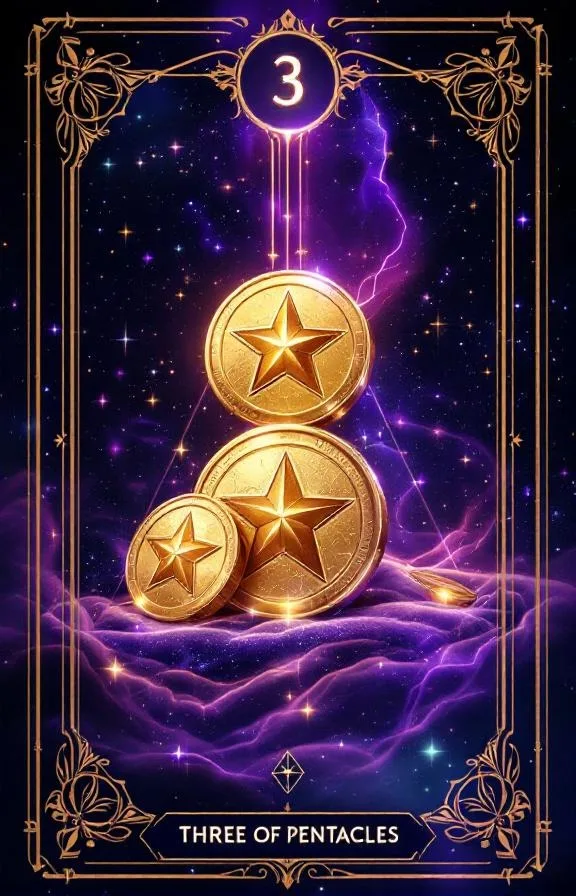
For concrete, practical questions — relationships, career decisions, daily guidance — the RWS's narrative imagery provides more directly applicable insights. When you ask "What should I focus on at work this week?" and draw the Three of Pentacles (three figures collaborating on a cathedral), the answer is visually immediate: collaboration, skilled teamwork, shared purpose.
For deep psychological or spiritual exploration — identity questions, shadow work, existential inquiry — the Thoth's layered symbolism opens more dimensions. When you ask "What am I not seeing about myself?" and draw the Thoth's Art (Temperance) — a complex alchemical image of opposites merging — the card demands and rewards extended contemplation.
Modern AI tarot readers typically work with RWS imagery because it is the most widely known system and provides the most accessible symbolic vocabulary. This is practical, not ideological — an AI interpreter using the mirror-within approach can work with either system's symbolism, but the RWS's narrative clarity translates more consistently into written interpretation.
Beyond these two: the modern deck landscape
The RWS and Thoth are the headwaters, but hundreds of contemporary decks draw from one or both traditions. Understanding which tradition a modern deck follows helps you read it effectively.
Most contemporary decks — the Modern Witch Tarot, the Light Seer's Tarot, the Wild Unknown — follow the RWS structure: scenic Minor Arcana, RWS numbering and naming conventions, narrative-oriented imagery. If you learn the RWS system, you can read these decks with minimal adjustment.
Fewer contemporary decks follow the Thoth tradition, but those that do — the Rosetta Tarot, the Tabula Mundi — maintain Crowley's naming conventions, numbering, and dense symbolic layering. These decks assume familiarity with the Thoth system.
Some modern decks, like the Marseille-tradition revivals, follow neither system, drawing instead on the pre-Golden Dawn Continental tradition. These are a separate lineage entirely.
A note on cultural context and deck evolution
Both the RWS and Thoth emerged from specific cultural moments that shaped their strengths and limitations. The RWS reflects Edwardian England — progressive for its time (Pamela Colman Smith was a woman of color working in a predominantly white male esoteric world) but inevitably embedded in early twentieth-century assumptions. The Thoth reflects the more radical, transgressive spirit of Crowley's Thelema but also Crowley's considerable personal failings and the cultural biases of the mid-twentieth century.
Modern readers benefit from engaging with these decks critically — appreciating the symbolic genius while recognizing that the cultural frameworks are products of their time. The archetypes are universal. The specific imagery through which they are rendered is historically situated.
The best approach is to learn the system thoroughly, then hold it lightly. The Celtic Cross spread works with either deck. The symbols are maps, not the territory. And the territory — your own psyche, your own questions, your own capacity for honest self-reflection — is what ultimately matters.
FAQ
Is the Rider-Waite or Thoth deck more accurate? Neither is more "accurate" because accuracy in tarot is not about the deck — it is about the reader's engagement with the symbols. The RWS is more accessible and narrative, making it easier to generate immediate, relatable interpretations. The Thoth is more layered and abstract, offering deeper symbolic density for readers willing to study its systems. "Accuracy" in tarot means the degree to which a reading generates genuine self-insight, and both decks do this effectively through different cognitive pathways.
Can I mix Rider-Waite and Thoth interpretations? Many readers do, drawing on whichever system's interpretation resonates more strongly for a given card in a given context. However, be aware of the numbering and naming differences (especially the Strength/Justice-Lust/Adjustment swap) to avoid confusion. Mixing is productive when done consciously and confusing when done accidentally.
Why do some people strongly prefer one deck over the other? Cognitive style largely explains this. Research by psychologist Sarnoff Mednick on associative thinking suggests that people differ in how they process symbolic information. Those who think in narratives and stories tend to prefer the RWS's scenic illustrations. Those who think in patterns, colors, and abstract associations tend to prefer the Thoth's compositional approach. Neither preference indicates greater skill or depth — only different cognitive orientations.
Which deck should a complete beginner start with? The Rider-Waite-Smith, for practical reasons. Its scenic Minor Arcana make initial learning much easier, and the vast majority of tarot educational resources — books, courses, online guides — reference RWS imagery. Once you are comfortable with the 78-card system, exploring the Thoth adds depth and alternative perspectives. Starting with the Thoth is possible but significantly steeper as a learning curve.
Whichever tradition speaks to you, the cards are waiting. Try a free AI tarot reading and experience how symbolic reflection works for your unique mind.