Let's get this out of the way immediately: the Death card does not mean someone is going to die. It never has. In decades of tarot practice across countless traditions and reading styles, the card numbered thirteen has never been a literal prediction of physical death. What it is — and this is simultaneously less frightening and more demanding — is the most unflinching card in the deck about the nature of change. Not gentle change. Not incremental adjustment. The kind of change that requires something to end completely before something new can begin.
That distinction — between ending and dying — is where the card lives. And it is where most of the fear around it originates, because at the psychological level, the ending of an identity, a belief system, a relationship, or a way of life can feel indistinguishable from death itself. The ego does not differentiate well between "I am ending" and "this version of me is ending." The Death card says: learn the difference. Your survival depends on it. Or rather — your growth does.
In short: The Death card does not predict physical death. It signals a complete, non-negotiable transformation where an identity, relationship, or phase of life must end so something new can emerge. The skeleton rides forward past a rising sun, and reversed, the card warns that resisting an ending already underway creates more suffering than the ending itself.
Death at a Glance
| Attribute | Detail |
|---|---|
| Number | XIII |
| Element | Water |
| Zodiac | Scorpio |
| Keywords (Upright) | transformation, endings, release, transition, rebirth |
| Keywords (Reversed) | resistance, stagnation, fear of change, incomplete endings |
| Yes / No | Maybe |

What Does the Death Card Mean?
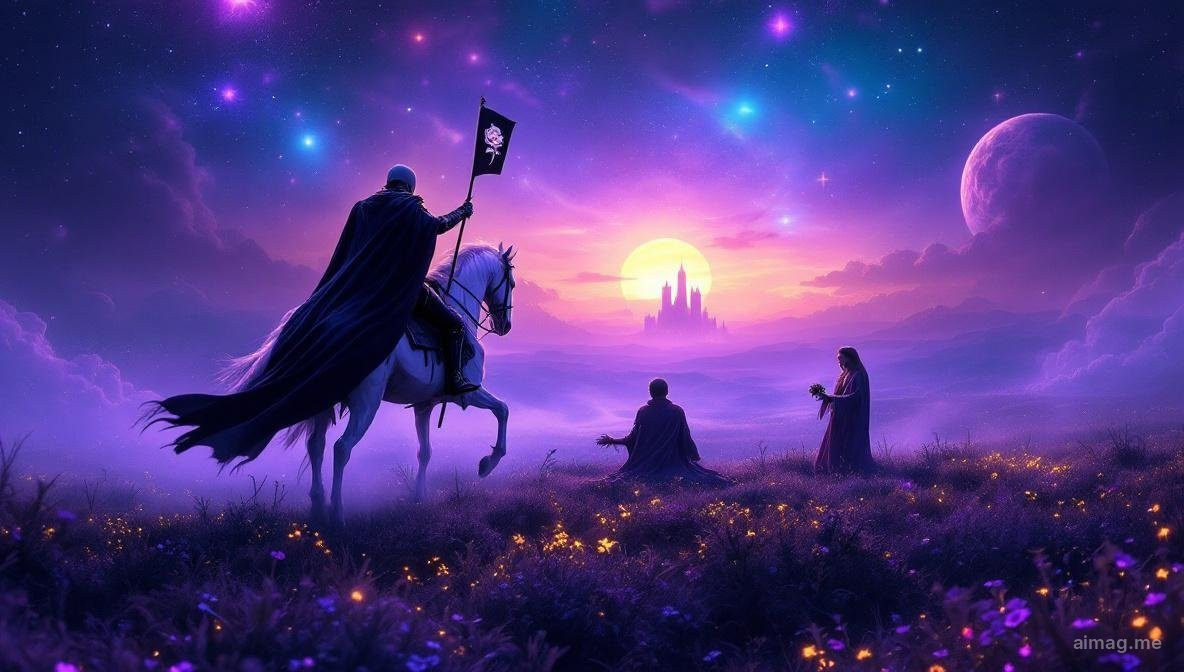
The Rider-Waite-Smith imagery is both stark and layered. An armored skeleton rides a white horse — white for purity, skeleton for the irreducible structure that remains when everything else is stripped away. The figure carries a black banner emblazoned with a white rose, the Mystic Rose, symbol of beauty and rebirth emerging from the apparent finality of death. Before the horse, figures of every age and station — a king fallen, a bishop praying, a maiden turning away, a child offering flowers — demonstrate that transformation is universal. No one is exempt. Not wealth, not piety, not innocence, not beauty. In the background, between two towers, the sun rises. It is not setting. Let that register.
The number thirteen has been culturally associated with bad luck for so long that the association feels inevitable, but it is not. In the Major Arcana's structure, thirteen is a number of radical transition — the crossing point between the first half of the Fool's Journey (identity formation) and the second half (spiritual integration). Everything that preceded Death — the structures of The Emperor, the teachings of The Hierophant, the choices of The Lovers, the mastery of Strength — must now be released. Not discarded. Released. There is a difference. What was valuable will return in a new form. What was no longer serving growth will not.
Jung called the process of psychic death and rebirth the central dynamic of individuation — the lifelong work of becoming who you actually are rather than who you were conditioned to be. In Symbols of Transformation (1912/1952), he argued that the symbols of death appearing in dreams and in cultural mythology are almost never about physical death. They are about the death of an outgrown psychic structure — a belief, a self-image, a defensive pattern — that must dissolve in order for the next stage of development to emerge. The Death card encodes this process with absolute precision: something must end. It is already ending. Your only choice is whether to participate in the ending consciously or be dragged through it unconsciously.
 Scorpio, the card's zodiac sign, understands this intuitively. Scorpio energy is not afraid of the dark — it lives there, sees there, transforms there. The scorpion, the eagle, the phoenix: Scorpio's three symbols trace the arc from survival instinct (the scorpion) through elevated perspective (the eagle) to complete rebirth (the phoenix). The Death card carries all three of these registers simultaneously. Where you are on that arc determines how the card's energy will feel — terrifying, clarifying, or liberating.
In practice I've noticed that Death appears most frequently at moments when the querent already knows, at some level, that something is over. The relationship that has been dying for months. The career path that stopped fitting years ago. The self-image that no longer matches the person in the mirror. The card does not create the ending. It names it. And in naming it, makes the transition from clinging to releasing possible.
A reading I return to often involved a woman in her early forties who drew Death in the position of "what is needed." She wept — not from fear, but from recognition. "I've been trying to resurrect something that's already dead," she said. She was talking about a marriage, but she was also talking about the version of herself that had entered it. The Death card gave her permission to stop performing resurrection and begin the slower, harder, more honest work of grieving what was lost and discovering what remained.
Death Reversed
When Death appears reversed, the transformation the card describes is not absent — it is resisted. Something is trying to end, and the querent (or the situation) is refusing to let it. This refusal can take many forms: denial, bargaining, obsessive attempts to restore what has already changed, or the quieter but equally powerful strategy of simply pretending that nothing is different when everything is.
 Rachel Pollack, in Seventy-Eight Degrees of Wisdom (1980), describes the reversed Death as "the fear of death becoming worse than death itself." The resistance to the natural ending creates a kind of living death — a stasis that is neither the old life nor the new one, a liminal space that was meant to be transited, not inhabited. The old identity is already dead; the new one cannot emerge because the remains of the old have not been buried. Everything stops. Stagnation sets in. And stagnation, paradoxically, creates far more suffering than the clean ending the card upright would have delivered.
A common pattern I see with reversed Death is the person who has already left — emotionally, psychologically, spiritually — but has not yet physically or formally departed. They are in the relationship but not in the relationship. They are at the job but not doing the job. They are living the life but not living. The reversed Death card says: the delay is not protecting you. It is prolonging the very pain you are trying to avoid.
Death in Love & Relationships
Upright
Death in a love reading almost always provokes a sharp intake of breath. Breathe out. The card is not predicting the loss of someone you love. What it is describing is the end of a phase — which, in the context of love, can mean many things, and most of them are not catastrophic.
A relationship may be transforming from one form into another: dating into commitment, comfort into depth, codependence into interdependence. An old pattern between you and your partner — a dynamic that once served a purpose but no longer does — may be dying so that something healthier can take its place. For singles, Death often marks the end of a period of romantic stagnation or the final release of an attachment to someone or something that has been preventing new love from entering.
The key quality of Death in love is finality. This is not a temporary pause (that would be The Hanged Man). This is a door closing. And while that sounds harsh, consider: some doors need to close for the right ones to open. The Death card in a love reading asks whether you are willing to let the dead thing be dead so that the living thing has room to breathe.
Reversed
Reversed Death in love often indicates a relationship that has ended in every meaningful sense but has not been formally concluded. Someone is holding on — to hope, to habit, to the fear of being alone, to the version of the relationship that existed months or years ago. The holding on is not love. It is the refusal of grief, which is a very different thing.
This reversal can also signal a pattern: someone who keeps returning to the same type of relationship, the same dynamic, the same mistake — because the old pattern has not been fully mourned and released. Until it is, it will continue to repeat. Death reversed in love is gentle but clear: let go. Not because the past was worthless, but because the past is past, and you are not.
Ready to explore what Death reveals about your love life? Get your free AI tarot reading →
Death in Career & Finances
Upright
In career contexts, Death is the card of the complete career shift — not a promotion within the same field, but a fundamental change in professional direction or identity. The old career is ending. The old role is ending. The old professional self-image is ending. What replaces it may not yet be visible, and that uncertainty is part of the card's teaching: you have to let the old thing die before the new thing can show itself.
This can also manifest as a company restructuring, a layoff, or the end of a business venture. In all cases, the card's energy is clear: do not try to resurrect what is dying. Direct your energy forward, into what is emerging, rather than backward, into what is dissolving.
Financially, Death suggests a fundamental shift in financial circumstances or financial thinking. Old investments may need to be liquidated. Old financial strategies may need to be abandoned. The card is not predicting ruin — it is predicting change, and change that is resisted becomes far more expensive than change that is embraced.
Reversed
Reversed in career, Death signals a refusal to leave a professional situation that has already expired. The job that stopped challenging you three years ago. The business model that the market has already moved past. The professional identity that you cling to because the alternative — not knowing what you are — is too frightening. The card reversed says: the fear of the unknown is keeping you in a known that is slowly suffocating you.
Financially, reversed Death may indicate debts or financial patterns that need to end but haven't. The same spending habits, the same avoidance of financial reality, the same cycle. The transformation is available. The resistance is the problem.
Death in Personal Growth
This is the card's deepest register, and the one where its power is most fully realized. Death in personal growth is the process Jung called the death of the ego — not the destruction of the ego (that would be psychosis), but its dethronement. The ego, which has spent the first half of life building structures of identity, control, and self-protection, must now be willing to dissolve those structures — not because they were wrong, but because they have been outgrown.
This is terrifying work. The ego experiences its own transformation as annihilation, because the ego cannot imagine a form of existence beyond its current one. It is like asking a caterpillar to voluntarily enter the chrysalis: from the caterpillar's perspective, this is death. From the butterfly's perspective — which the caterpillar cannot yet access — it is birth. Joseph Campbell, in The Hero with a Thousand Faces (1949), described this as the mythological threshold crossing: "the passage of the threshold is a form of self-annihilation... But here, instead of passing outward, beyond the confines of the visible world, the hero goes inward." The Death card is that threshold.
Shadow work with Death confronts the parts of your identity that need to die but that you are protecting. The outdated self-image. The story about who you are that stopped being true years ago but that you keep telling because the alternative — not knowing — feels like freefall. The grudge you carry because releasing it would mean admitting the wound has healed and you no longer have an excuse to stay small. Death asks you to identify what you are keeping alive artificially, and to consider what might grow in the space its passing would create.
Death Combinations
- Death + The Tower: Transformation is not only inevitable but sudden. This pairing carries maximum intensity — the ending will be dramatic, unmistakable, and impossible to deny. What emerges afterward, though, has extraordinary potential for authenticity.
- Death + The Sun: After the ending, joy. This is one of the most reassuring combinations possible: the transformation Death brings leads directly to clarity, vitality, and genuine happiness. The sun is already rising between the towers.
- Death + Ace of Pentacles: From the ending, a new material beginning. A new job, a new home, a new financial chapter — emerging directly from the ground cleared by Death's passage.
- Death + The Lovers: A romantic relationship or partnership is undergoing fundamental transformation. This is not a minor adjustment — it is a complete remaking of how two people relate to each other, for better or for worse.
- Death + The Hanged Man: Surrender before transformation. The pause comes first, then the ending. Together, these cards suggest that the transition will be less painful if you stop resisting and more painful if you don't.
Frequently Asked Questions
What does the Death card mean in a yes or no reading?
Death is a "maybe" in yes/no readings — but the maybe carries a specific flavor. The answer depends on whether you are willing to let something end. If the question requires a transformation or the release of an old pattern, and you are willing to undergo it, the answer leans toward yes. If you are asking whether things can stay as they are, the answer is almost certainly no.
Does the Death card mean actual death?
No. Professional tarot readers across virtually all traditions agree: the Death card does not predict physical death. It describes psychic transformation — the ending of a phase, identity, relationship, or pattern — and the rebirth that follows. The card is named Death because the process it describes feels like death to the part of you undergoing it. But feeling and reality are not the same thing.
Why is the Death card number 13?
Thirteen places Death at the exact midpoint of the Major Arcana's twenty-two-card sequence, marking the transition between the Fool's outer journey (identity formation) and inner journey (spiritual integration). The number itself carries associations with disruption and transformation across many cultures — but in the tarot's structure, it is less about superstition and more about placement: this is where the old world ends and the new one begins.
Is the Death card always about endings?
Yes — but endings are always also beginnings. The Death card's imagery includes the rising sun, the white rose of rebirth, and the fact that the skeleton rides forward, not backward. The ending is real, but it is not the card's final word. The final word is the sun between the towers: what comes after, renewed and transformed.
Something in your life is ready to transform. Try a free AI-powered reading at aimag.me/reading and discover what is ending, what is beginning, and what the sunrise looks like from here.