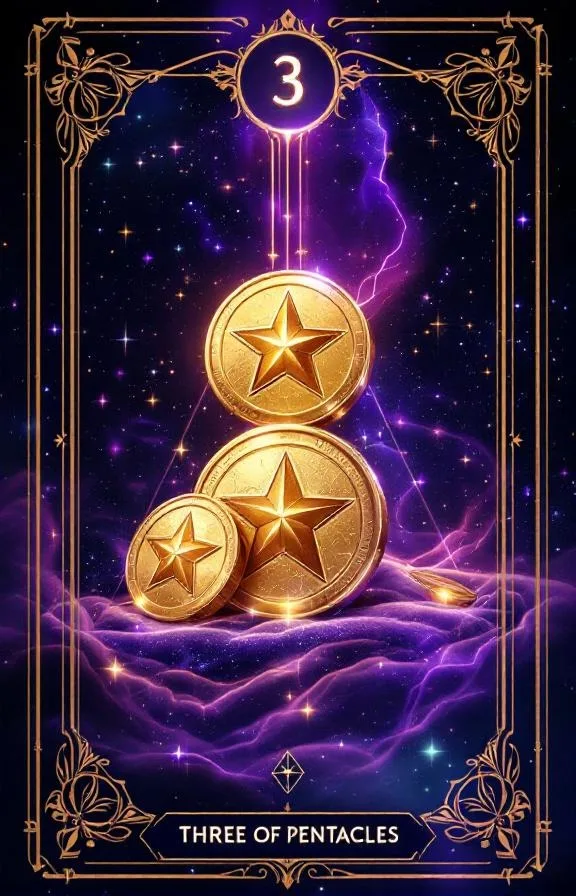
Here is what usually happens when you search for "free AI tarot reading." You find a site. It asks you to pick three cards. The cards flip over, and you get three paragraphs of text that sound vaguely profound — something about transformation, a period of change, and trusting the process. You feel mildly seen for about forty-five seconds. Then you close the tab and move on with your day, slightly suspicious that every visitor gets the same forty-five seconds of meaning.
That suspicion is often correct.
Most free AI tarot readings are not readings at all. They are random card generators paired with a lookup table of pre-written descriptions. The "AI" label is marketing decoration on a database query. Your question does not actually change the output. The cards are cosmetic. The experience is roughly equivalent to cracking open a fortune cookie with extra steps.
But here is the part that makes this interesting: a genuinely well-built free AI tarot reading can be something entirely different. When the technology is implemented with real language models, actual symbolic interpretation, and honest design, the free version is not a teaser. It is a legitimate self-reflection tool — with real limits you should understand, but also with real substance that most people underestimate.
This is a guide to knowing the difference. And yes — you can try one right now while you read.
In short: A genuine free AI tarot reading uses a language model to interpret your specific question against your specific cards in context, producing a fresh interpretation every time. The quality of the reading depends more on the quality of your question than on whether you pay. Free tiers on well-built platforms deliver real self-reflection, not a teaser designed to frustrate you into upgrading.
What a real free AI tarot reading includes
A well-designed free AI tarot reading is not a stripped-down version of the paid product. It is a complete experience at a specific scale. Here is what you should expect from one worth your time:
A genuinely random draw
The cards should be selected by a cryptographically secure random number generator — the same kind of randomness used in encryption. This matters because the psychological mechanism behind tarot depends on genuine unpredictability. If the system is rigging the draw to produce more "dramatic" cards, the entire reflective process is undermined. At aimag.me, every draw — free or paid — uses the same randomness engine. The deck is fair.
AI interpretation that actually responds to your question
This is the dividing line between a real reading and a glorified horoscope. When you type a question and draw cards, the AI should produce an interpretation that connects your specific question to the specific cards drawn, in their specific positions. Not a generic description of The Tower. An interpretation of The Tower as it relates to what you asked about, in the position it landed, in conversation with the other cards in the spread.
The technology behind this involves a large language model processing the intersection of your question, each card's symbolic network, and the positional relationships between cards. The output is generated fresh every time. Two people asking different questions and drawing the same cards will receive different readings, because the interpretation is contextual, not canned.
Card relationships, not just card descriptions
A three-card spread is not three separate readings bundled together. The cards talk to each other. The Three of Cups followed by the Hermit tells a different story than the Hermit followed by the Three of Cups. A good free reading should synthesize these relationships into a coherent narrative that flows from card to card — showing you the arc of your situation rather than three disconnected snapshots.
Reflective framing, not fortune telling
The interpretation should sound like an intelligent friend thinking alongside you, not a psychic making predictions. "Consider what this card might reveal about your current relationship with control" is useful. "You will experience a significant change in your career next month" is fiction wearing confidence as a disguise. No AI — and frankly, no human — can predict your future. What a good reading does is help you see your present more clearly, which changes how you act going forward.
Try a free reading now — ask a question that actually matters to you, and see how the interpretation responds to your specific situation.

What free typically does not include
Honesty means telling you what the walls are, not pretending they don't exist. A free tier is a complete reading at a specific scale, but there are things it does not offer — and understanding this helps you decide whether those things matter to you.
Extended or complex spreads
A free reading typically gives you a three-card spread: past-present-future, situation-challenge-advice, or a similar three-position layout. This is genuinely useful for focused questions, and the three-card spread is arguably the most versatile format in tarot. But some questions benefit from more cards — a Celtic Cross, a relationship spread, or a custom layout that lets the AI explore more dimensions of your situation.
Saved reading history
Free readings are ephemeral. You get the reading, you engage with it, but the system does not save it for you to revisit later. If you want to track patterns across readings over weeks or months — noticing which cards keep appearing, how your questions evolve, what themes recur — that requires an account with history.
Multiple daily readings
Free access typically means one reading per day. This is actually a design choice with a philosophical rationale: if you are doing five readings a day on the same question, you are not reflecting — you are seeking reassurance. The daily limit is a guardrail against compulsive use, not just a commercial restriction. That said, there are days when you genuinely have two unrelated questions that deserve space, and the free tier does not accommodate that.
Premium AI models
Free readings use a capable language model, but paid tiers may use more advanced models that produce subtler, more psychologically nuanced interpretations. The free model is not dumb — it produces genuinely useful readings. But the difference between a good model and a great one is like the difference between a competent essay and a compelling one: both communicate the information, but one does it with more precision and depth.
How to ask a better question (and why it matters more than the tier you are on)
The single most important factor in the quality of your reading is not whether you are on the free tier or the paid tier. It is the quality of your question.
This is not a platitude. The AI's interpretation is generated in response to your specific question. A vague question produces a vague reading because the model has less to work with. A precise question produces a reading with edges — something you can push back against, be surprised by, or disagree with. Being surprised by a reading is the sign that it is working.
Here is the framework that consistently produces better readings, adapted from cognitive behavioral approaches to structured self-inquiry:
Move from "Will" to "What"
"Will I find love?" asks the cards to predict an outcome you cannot control. "What am I doing that keeps me from being open to connection?" asks the cards to reflect something about your current patterns — something you can actually work with. The second question will always produce a more useful reading, on any tier.
Be specific about the domain
"What should I do?" is a question about everything, which means it is a question about nothing. "What am I not seeing about my decision to leave my job?" is specific enough that the AI can produce an interpretation that genuinely surprises you. The constraint is productive. Think of it like the difference between asking a photographer to "take a good picture" versus asking them to capture the light hitting a particular doorway at a particular time of day.
Name the tension
The most productive questions acknowledge that you are pulled in two directions. "I want to leave but I am afraid of what happens if I do — what is the fear really about?" gives the AI enough emotional texture to generate an interpretation that goes beneath the surface. You do not need to perform composure for an AI. It does not judge. It processes the question with the same equanimity regardless of how messy the honest version is.
Ask one question per reading
If your mind is holding four questions, pick the one that feels most uncomfortable. That is usually the one that needs the space. Save the others for another day — or bring them to separate readings if your tier allows it.
How to journal after a free reading for maximum value
A reading is a snapshot. What you do with it afterward determines whether it becomes a genuine catalyst for insight or just another piece of content you consumed and forgot. Here is how to extract the most value from a free reading, especially when you only get one per day:
Write down three things before you close the tab
- The first thing you noticed — which card drew your eye, which phrase in the interpretation hit you. Your immediate reaction is data. Do not edit it.
- The thing you disagreed with — where the interpretation felt wrong or off. Disagreement is as informative as resonance. What you reject reveals your assumptions.
- The question the reading raised — a good reading answers your original question obliquely and raises a new one. Write that new question down. It may become tomorrow's reading.
Revisit the reading 24 hours later
Without rereading the actual interpretation, write down what you remember. What stuck? What faded? The parts that stayed with you are the parts your mind is actively processing. The parts that vanished were intellectually interesting but not emotionally alive.
Track recurring themes manually
Even without saved history in the free tier, you can keep a simple journal — analog or digital — noting the date, your question, the cards drawn, and your one-sentence reaction. After a week or two of daily readings, you will start seeing patterns that no single reading could reveal. The significance of recurring cards is one of the most underappreciated aspects of sustained tarot practice, and it costs nothing to track.
Free vs. paid: an honest comparison
This is where most articles become advertisements. Here is an attempt to be genuinely transparent instead.
What free gives you
A real, AI-generated tarot reading — not a lookup table, not a pre-written script — that responds to your specific question and your specific cards. One reading per day. A three-card spread. A capable language model. No account required. No credit card required. No trial period that expires.
This is enough for many people. If your goal is a daily reflective practice — one question, one spread, one interpretation to sit with — the free tier is a complete tool, not a demo.
What paid tiers add
Seeker ($9.99/month) adds a more advanced AI model that produces subtler interpretations with more psychological depth. It is the same reading structure with a more sophisticated interpreter. If you find yourself consistently wanting the interpretation to go one layer deeper, this is the tier where that happens.
Mystic ($19.99/month) adds a dual-oracle system: two AI models interpret the same reading independently and their perspectives are synthesized. It also includes saved reading history, journal integration, and PDF exports. This tier is designed for people who use tarot as a sustained reflective practice — a journaling companion they return to over months.
Which one is right for you
Start with free. Seriously. If you have never done an AI tarot reading, the free tier will tell you whether this tool resonates with your way of processing. Some people find deep value in the first reading. Some people need three or four readings over a week before the practice clicks. Either way, free gives you the room to find out without any commitment.
Upgrade when — and only when — you notice yourself wanting more than the free tier provides. Not because a countdown timer pressured you. Not because a pop-up told you your reading would expire. Because you tried it, it worked, and you want it to work harder.
Start with a free reading — the only thing it costs is a genuine question.
The real question behind "free AI tarot reading"
When people search for "free AI tarot reading," they are usually asking two questions simultaneously: "Can I try this without paying?" and "Is this real?"
The answer to both is yes, with qualifications.
Yes, you can try it without paying, and the experience is not artificially degraded to make you feel incomplete. A free reading on a well-built platform is a real reading. The AI genuinely interprets your question in the context of your cards. The output is generated for you, not recycled from a template.
And yes, it is real — in the sense that it produces genuine self-reflection, not in the sense that the cards are communicating messages from a supernatural source. The mechanism is psychological, not mystical: the random cards provide a projective surface, the AI provides interpretive structure, and your mind provides the meaning. This process works. It has worked for 600 years with human readers, and it works with AI readers — differently, but genuinely.
What it is not: a replacement for therapy, a prediction engine, or a tool that will tell you what to do. It is a mirror. Mirrors do not give advice. They show you what is already there, from an angle you could not see on your own.
FAQ
Is a free AI tarot reading as accurate as a paid one?
"Accurate" is not the right frame for tarot readings, free or paid. A tarot reading is not trying to be factually correct the way a weather forecast is. The right question is whether it is useful — whether it surfaces something about your situation that you were not seeing. Free readings use a capable AI model and produce genuinely contextual interpretations. Paid tiers use more advanced models that produce more nuanced interpretations, but a well-asked question on the free tier will consistently outperform a vague question on a paid tier. The quality of your question is the primary variable, not the tier.
How many free readings can I get per day?
One per day on aimag.me. This is a deliberate design choice: a single reading that you sit with and journal about is more psychologically productive than multiple readings that you consume and forget. The limit encourages depth over breadth. If you consistently want more than one daily reading, the paid tiers offer additional capacity, but try treating the one-per-day limit as a discipline first — many people find that the constraint actually improves the practice.
Do I need to create an account for a free reading?
No. You can get a free reading without signing up, without providing an email, and without entering payment information. The reading is complete and untruncated. Creating an account is optional and adds features like saved history, but it is not required to experience a full reading.
Is my question private?
Yes. Your question is processed by the AI to generate your interpretation and is not stored, shared, or used for training. There is no human reading your questions. The AI processes your input, generates the interpretation, and that is the end of the transaction. This privacy is actually one of the advantages of AI over human readers — you can bring questions you would never ask another person, and the system responds with the same equanimity regardless of content.
You already have a question
You do. You have been carrying it while reading this article — maybe since before you opened this page. The question that brought you here was not really "how does free AI tarot work?" It was the other one. The one underneath.
You do not need to formulate it perfectly. You do not need to believe in anything. You do not need to know what tarot is or how language models work. You just need to be honest about what you are actually asking.
The free reading will give you a genuine interpretation — not a fortune, not a prediction, but a mirror. What you see in it will tell you something about where you are right now. And that is not nothing. That is, in fact, the beginning of every meaningful change: seeing where you actually stand.
Try your free reading now at aimag.me/reading — bring the real question.