Nobody sits down to do a tarot reading about healing when things are going well. You reach for these spreads when something hurts and you cannot make it stop. A relationship ended. Someone died. A part of your life that once felt solid revealed itself as hollow. Or — and this is the version nobody talks about — nothing dramatic happened at all, but you have been carrying a low-grade ache for months and you have run out of ways to explain it away.
Healing is not a straight line. Elisabeth Kubler-Ross identified this in On Death and Dying (1969) when she described the five stages of grief — denial, anger, bargaining, depression, acceptance — and then spent the rest of her career clarifying that they are not stages in a linear sequence. They are states you cycle through, revisit, skip, and sometimes inhabit all at once on a Tuesday afternoon. Grief does not follow a timeline. Neither does healing from trauma, loss, or the quieter wounds that accumulate over a lifetime of being human.
What tarot offers here is not a cure. It is a mirror. These spreads will not fix what hurts. They will help you see it with enough clarity to understand what kind of healing is actually needed — because "healing" is not one thing. Healing from a wound is different from processing grief, which is different from long-term recovery. Each requires its own approach, and each of these three spreads addresses a different phase.
In short: Three healing tarot spreads address different stages of pain: a five-card Wound and Medicine layout for naming the hurt and its remedy, a four-card Grief Processing spread for metabolizing loss, and a six-card Recovery Timeline for tracking long-term progress. Each is grounded in Judith Herman's trauma recovery model and designed for honest self-reflection, not quick comfort.
Spread 1: The Wound and Medicine Spread (5 Cards)
This is the spread you use when you can name the pain but you cannot seem to move through it. Something happened — you know what — and the wound is still open. Not bleeding, maybe, but not closed either. Raw. Sensitive to touch.
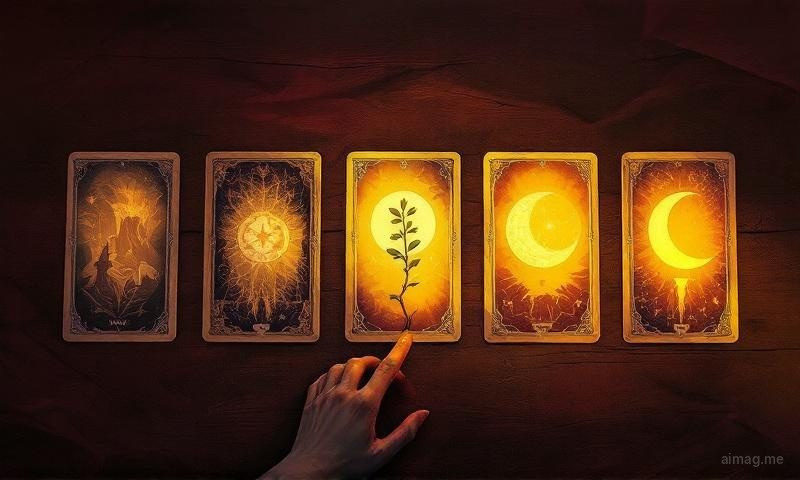
Lay five cards in a horizontal line, left to right.
| Position | Meaning |
|---|---|
| 1 | The wound — the core of what hurts |
| 2 | Its origin — where the wound actually comes from (which may surprise you) |
| 3 | How you protect it — the defense mechanism you built around the pain |
| 4 | What heals it — the medicine, whether you want to take it or not |
| 5 | Who you become — the version of yourself that exists on the other side |
How to read it: Position 1 and Position 2 are not always the same thing. This is the most important insight in this spread. You may sit down thinking the wound is a breakup. Position 1 might confirm that — the Three of Swords, heartbreak rendered in stained glass. But Position 2 might reveal something older: a Six of Pentacles reversed, suggesting the real wound is about unequal giving, about a pattern of losing yourself in generosity that leaves you depleted. The breakup triggered the wound. It did not create it.
Position 3 is where most people flinch. Your defense mechanism is not your enemy — it kept you functional when you needed it — but it is also not your friend anymore. The Four of Swords here might mean your protection is withdrawal: you went silent, pulled inward, stopped answering texts. That worked in the immediate aftermath. Six months later, it is no longer protection. It is isolation wearing a mask.
Position 4 is the medicine. I want to be direct about this: the medicine is rarely comfortable. The Nine of Swords as the healing card does not mean more suffering heals you. It means the healing requires you to face the anxiety you have been avoiding — to sit with the 3 AM thoughts instead of numbing them. The medicine is attention directed at what you have been running from.
Position 5 is not a fantasy of your healed self. It is a realistic portrait of who you are becoming through this process. Not perfect. Not unwounded. But changed in a way that includes the wound rather than pretending it did not happen. The Star here is almost unbearably hopeful: quiet renewal after devastation, faith restored not through certainty but through willingness.
When You Are Not Ready for Position 5
Here is something most tarot guides will not tell you: sometimes you should stop at Position 4. If the wound is fresh — weeks, not months — Position 5 can feel violent. Your psyche is not ready to imagine "who you become" because it is still trying to survive "what happened." There is no rule that says you must read all five cards at once. Lay them all face down. Turn over 1, 2, and 3. Sit with those for a day or a week. When you feel ready — and only then — turn over 4 and 5.
Judith Herman, in Trauma and Recovery (1992), proposed a three-stage model of trauma healing: establishing safety, reconstructing the trauma narrative, and reconnecting with ordinary life. Positions 1 through 3 correspond roughly to her first stage — understanding the wound and the defenses around it. Position 4 is the second stage: the active work. Position 5 is the third: reconnection. Herman was emphatic that you cannot rush the stages. The same applies here.
Spread 2: The Grief Processing Spread (4 Cards)
Grief is not about fixing. Grief is about metabolizing. Something was here and now it is not, and your psychological system needs to process that absence the way your body processes a shock — slowly, in waves, with periods of normalcy that feel like betrayal and periods of devastation that come without warning.
Lay four cards in a vertical column, top to bottom.
| Position | Meaning |
|---|---|
| 1 | What you lost — the true nature of the absence |
| 2 | What you still carry — the part of the loss you have not released |
| 3 | What you need to release — the specific weight that is ready to be set down |
| 4 | What remains — what survives the loss and cannot be taken from you |
How to read it: Position 1 often reveals a loss beneath the loss. You think you are grieving a person, and you are — but the card might show the Empress reversed, suggesting you are also grieving the nurturing quality that person brought into your life. The absence is not just a name. It is a function, a feeling, a way of being in the world that left when they did.
Position 2 is what you are carrying that does not belong to you anymore. Not the love — you get to keep the love. The guilt, maybe. The anger. The bargains you made with reality that reality refused to honor. The Ten of Wands in this position says: you are carrying the weight of responsibility for something that was never yours to control.
Position 3 requires honesty. It does not ask you to release the grief itself — that is not how grief works. It asks you to release one specific piece of the burden. Maybe it is a fantasy of how things should have gone. Maybe it is a conversation you keep rehearsing with someone who cannot hear it. Maybe it is the belief that if you grieve hard enough, long enough, the loss will somehow reverse itself. Position 3 names the piece you can set down without betraying your love.
Position 4 is the card of survivorship. It shows what the loss cannot reach. After everything — the absence, the carrying, the releasing — something remains that is indestructibly yours. The Ten of Cups here does not promise that everything will be fine. It says: your capacity for joy was not destroyed. It was buried. It is still there.
Spread 3: The Recovery Timeline Spread (6 Cards)
This is the long-view spread. It is not for the immediate aftermath of pain — it is for the person who has been in the healing process for a while and needs to see the arc. Where did this start? How far have I come? Where am I going?
Lay six cards in two rows of three. Top row left to right, bottom row left to right. Read them as a timeline flowing like a book — top-left first, bottom-right last.
| Position | Meaning |
|---|---|
| 1 | Where the pain lives — which part of your life it has settled into |
| 2 | What triggered it — the event or realization that activated the wound |
| 3 | What you have already survived — evidence of your resilience (whether you see it or not) |
| 4 | Your current strength — the resource you have right now, today |
| 5 | The next step — one specific action or shift that will move you forward |
| 6 | What wholeness looks like — not perfection, but integration |
How to read it: Position 1 and Position 2 are often confused by the reader. The pain may live somewhere completely different from where it started. A betrayal (Position 2) might have settled into your work life (Position 1) — you do not trust colleagues, you double-check everything, you cannot delegate. The wound migrated. Knowing where it actually lives, not just where it came from, is essential for addressing it accurately.
Position 3 is the card I have seen make people cry more than any other in a healing spread. Not because it is sad — because it is validating. It shows what you have already come through, and for people deep in the process, it is easy to forget how far they have walked. The Nine of Wands in this position is powerfully direct: you have been fighting, you are tired, but you are still standing. That is not nothing. That is almost everything.
Position 4 shows your current resource. Not future resources, not what you wish you had — what you actually have right now. It might be a person (King of Cups: an emotionally mature support figure). It might be a quality (Strength: raw, quiet endurance). It might be a situation (Four of Pentacles: financial stability that gives you a foundation to heal from). The card does not care if you think the resource is small. It is showing you what is real.
Position 5 is practical. One step. Not a twenty-step plan, not a self-improvement program, not "heal yourself in thirty days." One action. The Ace of Cups says: let yourself feel something gentle. The Eight of Pentacles says: put your hands to work on something tangible. The Knight of Swords says: seek information, talk to a professional, get the conversation started. One step.
Position 6 is the destination — but not in the way you might expect. Wholeness is not the absence of the wound. It is a state where the wound is integrated, where it becomes part of your story instead of the thing that interrupts your story. Herman's third stage: reconnection. Not with the world as it was, but with the world as it is, and with yourself as you have become.
Practical Notes on Healing Spreads
Timing matters. Do not do a healing spread in the immediate shock of a loss. Give yourself at least two weeks. Your psyche needs time to stabilize before it can meaningfully engage with symbolic reflection. During acute grief, the cards will reflect your overwhelm back at you, which is not helpful — you already know you are overwhelmed.
One spread at a time. Do not do all three back to back. The Wound and Medicine spread, the Grief spread, and the Recovery Timeline address different dimensions of healing. Pick the one that matches where you are right now. If you are not sure, start with Spread 1. It is the most diagnostic — it will help you understand the nature of the pain, and that understanding will tell you whether Spread 2 or 3 is more appropriate as a follow-up.
Write down Position 5 from each spread. Whether it is "who you become" (Spread 1), "what remains" (Spread 2), or "what wholeness looks like" (Spread 3), these final positions deserve special attention. Write them on a card. Put them where you will see them. Not as affirmations — as anchors. Reminders that the process you are in has a direction, even on the days when it feels like you are going in circles.
Repeat the spread monthly. Healing changes the reading. The Wound card that was a Ten of Swords in January might become a Five of Cups by March — still painful, but the nature of the pain has shifted from catastrophe to sadness, which is actually progress. Tracking these changes gives you evidence of movement that your emotions, which tend to insist nothing has changed, cannot deny.
Cards That Frequently Appear in Healing Readings
Three of Swords — The wound card. Heartbreak, betrayal, painful truth. If you are doing a healing spread and this card does not appear, pay attention to what appears instead. The absence of the obvious card is itself information — the pain may not be where you think it is.
The Star — Hope after devastation. This card follows The Tower in the Major Arcana sequence for a reason. It does not appear before the destruction — it appears after. Its presence in a healing spread says: you have already survived the worst part. What comes now is quiet, persistent restoration.
Four of Swords — Rest as medicine. Not avoidance, not collapse — deliberate, conscious rest. If this card appears in a healing spread, your recovery requires you to stop doing and start being. Cancel something. Lie down. Give your nervous system permission to do nothing.
The Empress — Self-nourishment. Your healing needs warmth, sensory comfort, and physical care. Cook a real meal. Sit in sunlight. Let yourself be held, literally or figuratively. The Empress does not heal through insight. She heals through tenderness.
Frequently Asked Questions
Can a tarot spread replace therapy for healing from trauma?
No. A tarot spread is a reflective tool, not a therapeutic intervention. It can help you identify patterns, name feelings, and notice shifts — all of which are genuinely useful — but it cannot replace the trained presence of a therapist, especially for complex trauma. Think of it as complementary: the spread helps you see, the therapist helps you process what you see. If you are dealing with trauma that disrupts your daily functioning, please seek professional support.
What if I pull terrifying cards in a healing spread?
A Tower or a Ten of Swords in a healing spread is not a prediction of more pain. It is reflecting pain that already exists. The cards are showing you what is already true inside you, not announcing new catastrophe. A difficult card in Position 1 (the wound) is expected — you would not be doing this spread if the wound were mild. A difficult card in Position 4 (the medicine or current strength) is more challenging but equally honest: sometimes the next step in healing is uncomfortable, and the cards will not pretend otherwise.
How long should I wait between doing the same healing spread?
Monthly is a good rhythm for ongoing healing work. More frequently during acute phases when you need to track rapid shifts. If you do the same spread twice in one week and get nearly identical cards both times, your psyche is telling you: nothing has changed yet, and doing another reading will not accelerate the process. Give it time. Healing is slow. The cards know that even when you wish they did not.
Is it okay to do a healing spread for someone else?
Yes, with consent and care. If someone asks you to read for them about their healing, approach it with the seriousness it deserves. Do not interpret Position 4 (the medicine) prescriptively — you are not their therapist. Frame it as "the cards suggest" rather than "you should." And be especially gentle with Position 5 or 6 (the outcome positions). For someone in deep pain, even a hopeful card can feel dismissive if delivered without sensitivity.
Healing does not announce its arrival. There is no morning where you wake up and the wound is gone. What happens instead is slower and stranger: one day you notice that the thought that used to stop you in your tracks only slowed you down. One day you tell the story without your throat closing. One day the absence is still there — it will always be there — but it has stopped demanding all of your attention, and in the space it freed up, something new has started growing. These spreads will not get you there faster. Nothing will. But they will show you where you are in the process, which turns the shapeless fog of "will I ever feel okay again?" into a map with a direction, a position marker, and — somewhere ahead, not visible yet but real — an end to the worst of it.