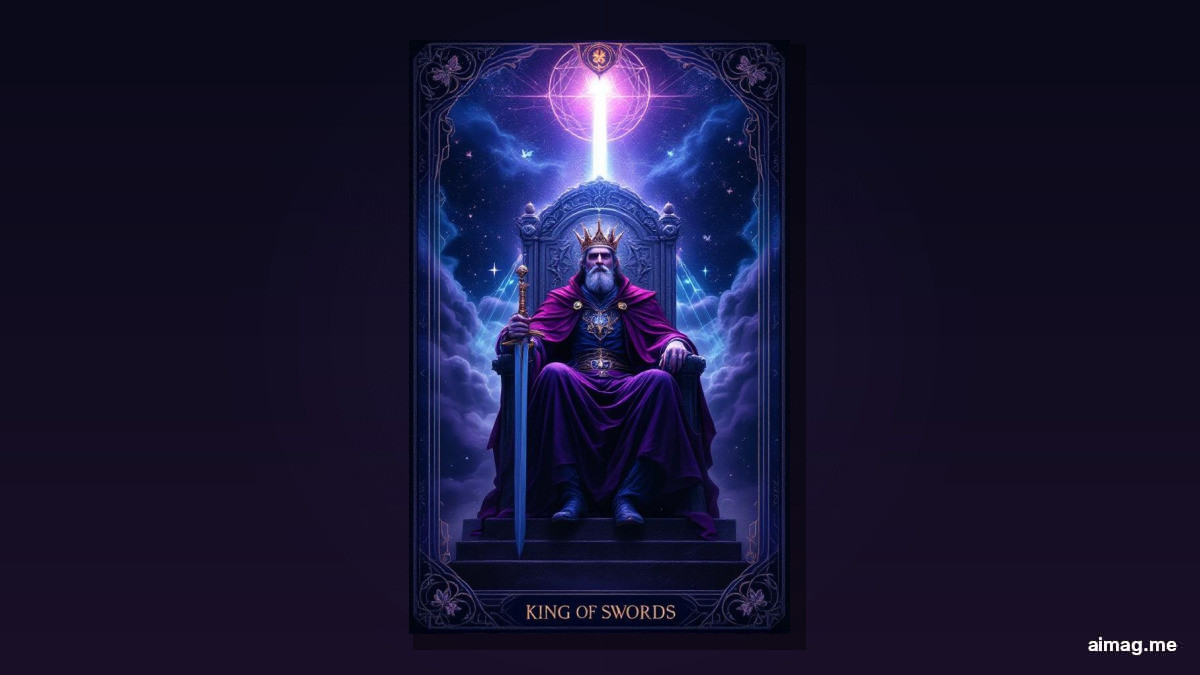
The sword is angled. Not vertical like the Queen of Swords' blade, which divides the world into true and untrue. The King's sword tilts slightly to the right, as if he has already weighed both sides of the case and is leaning toward his ruling. His left hand rests on the arm of the throne — not gripping, not gesturing, simply resting with the complete stillness of someone who does not need to move to command attention. He is wearing deep purple and blue robes over red — the colors of wisdom and authority layered over the fire of the will that drives them both. A golden crown sits squarely on his head. Behind him, the sky tells two stories at once: calm blue clarity above, churning storm clouds below, as if the King sits precisely at the boundary between chaos and order.
That boundary is the entire card.
Two birds fly in the distance behind him, the only moving things in a scene of absolute composure. The throne is carved with butterflies and sylphs — the spirits of air, the element this King has mastered. He is not the air. He is its ruler. He does not ride the wind like the Knight or test it like the Page. He determines what the wind may carry and what it must leave behind. His gaze is direct, analytical, and completely impersonal — not in the sense of indifference, but in the sense of a judge who has set aside personal feeling in order to see clearly what the evidence requires.
In short: The King of Swords is the tarot's supreme intellectual authority — a commanding figure who rules through clear thinking, ethical judgment, and the ability to separate truth from persuasion. He represents impartial analysis, fair rulings, and principled leadership. Reversed, he becomes the tyrant of reason: logic weaponized for control, gaslighting, or cold-hearted decisions made without compassion.
King of Swords at a Glance
| Attribute | Detail |
|---|---|
| Number | 14 (King) |
| Suit | Swords |
| Element | Air |
| Keywords (upright) | authority, intellect, truth, ethical judgment, clarity of mind, impartiality |
| Keywords (reversed) | tyranny, manipulation, cold-heartedness, abuse of power, intellectual dishonesty |
| Yes / No | Yes — based on logic and evidence, not sentiment |

What Does the King of Swords Mean?
The Kings in tarot represent the outward, active mastery of their suit — authority expressed, power exercised, experience projected into the world as governance. The King of Cups rules through emotional equilibrium, sitting on turbulent waters without being disturbed. The King of Pentacles rules through material mastery, surrounded by the tangible evidence of his accomplishments. The King of Swords rules through the intellect — through the authority of clear thinking, fair judgment, and the ability to see through complexity to the essential structure beneath.
This is the most cerebral figure in the entire tarot. Where other Kings balance their intellectual capacity with emotional warmth (Cups), creative passion (Wands), or material presence (Pentacles), the King of Swords leads with the mind and asks the other faculties to support it. He is not unfeeling. He has simply determined that feeling, when it enters the process of judgment, distorts the result. He feels after the decision, not during it. He allows compassion to inform the application of his ruling, not the ruling itself.
In the court card system, the King of Swords is the Air of Air — the element at its most pure and concentrated. This creates a figure of extraordinary clarity but also of extraordinary austerity. He can analyze any situation. He can identify the logical structure of any argument. He can separate truth from persuasion with surgical precision. What he finds more difficult — what the reversed King reveals as his characteristic failure — is remembering that not every human problem can be solved by analysis, and that some truths need to be held gently rather than pronounced.
The philosophical tradition of this card reaches back to Plato's Republic, where the concept of the philosopher-king — the ruler whose authority derives from wisdom rather than force or inheritance — is presented as the ideal form of governance. The King of Swords embodies this ideal: authority grounded not in strength of arms but in clarity of mind, the ability to see the good and to rule in accordance with it. Plato's philosopher-king rules not because he wants power but because he understands justice. The King of Swords holds the sword not because he enjoys wielding it but because someone must determine where the blade falls, and he trusts his judgment more than he trusts anyone else's.
That confidence — the specific, quiet certainty that the mind's assessment is correct — is both the King's greatest asset and his most dangerous blind spot. He is rarely wrong in his analysis. He is sometimes wrong about whether analysis was what the situation required.

King of Swords Reversed
Reversed, the King of Swords becomes what power theorists call the tyrant of reason — intellectual authority divorced from ethical grounding, the mind's capacity used to dominate rather than illuminate. The reversed King uses logic as a weapon. He wins every argument not because he is right but because he is more articulate, more strategic, and more willing to exploit the rhetorical weaknesses of whoever he is facing.
This reversal can manifest as gaslighting — the systematic use of intellectual authority to make someone question their own reality. The reversed King of Swords knows exactly how to reframe, redefine, and restructure a narrative so that the person on the receiving end cannot find solid ground. He does not lie, exactly. He rearranges the truth with such skill that the effect is the same.
It can also indicate cold-heartedness: the mind operating without the moderating influence of compassion, making decisions that are logically correct but humanly devastating. The executive who restructures the department with perfect efficiency and zero awareness of the lives affected. The partner who explains, with impeccable reasoning, why your feelings are incorrect.
In its milder form, the reversed King can simply indicate overthinking — analysis paralysis at the highest level, the mind so capable of seeing every angle that it cannot commit to any one direction.
King of Swords in Love
Upright: In love readings, the King of Swords represents someone who brings intellectual clarity and ethical integrity to relationships. He is reliable, honest, and consistent. He says what he means and means what he says. He does not play games, does not manipulate, and does not tolerate dishonesty in others. These are considerable virtues. They are also, sometimes, the entire offering — and relationships built solely on intellectual respect and ethical consistency can lack the warmth, spontaneity, and emotional vulnerability that sustain intimacy over time.
If this card represents a partner, expect someone who resolves conflicts through discussion rather than emotion, who values fairness in the relationship as highly as passion, and who will always treat you with respect even if the respect sometimes feels more cerebral than heartfelt.
If you are single, the King of Swords can indicate that you are approaching love with an emphasis on logic — screening potential partners for compatibility rather than chemistry, leading with your mind rather than your heart. This approach has merit. It also has limits.
Reversed: Emotional manipulation through intellectual superiority. A partner who makes you feel stupid for having feelings. Someone whose intelligence becomes a control mechanism — who uses debate skills to win domestic arguments, who reframes your emotional needs as irrational, who maintains authority in the relationship through the implicit threat of their sharper mind. The reversed King in love is the partner you cannot argue with, not because they are always right but because they never let you finish a sentence.
If your relationship dynamics feel intellectually lopsided, a personal tarot reading can help illuminate the balance of power.
King of Swords in Career
Upright: In career contexts, the King of Swords is a powerful authority figure — the leader, strategist, judge, or executive whose strength lies in analytical capability and fair judgment. This card often represents a boss, mentor, or authority figure who values competence, clear communication, and evidence-based decision-making. Under the King of Swords' leadership, the rules are clear, the standards are high, and the reasoning behind decisions is transparent.
For your own career, this card signals a period of intellectual authority — you are seeing clearly, thinking strategically, and communicating with the kind of precision that earns respect. It favors careers in law, medicine, academia, finance, engineering, and any field where rigorous thinking and ethical judgment are the primary currencies.
Reversed: Abuse of authority. A leader who uses intelligence to intimidate rather than guide. A professional environment where dissent is silenced through superior argumentation rather than addressed through fair process. The reversed King of Swords in career warns that someone in a position of power is not using that power justly — and it may be you.
King of Swords in Personal Growth
The King of Swords represents the apex of what psychologists call metacognition — the capacity to think about thinking, to observe one's own mental processes with analytical detachment, and to evaluate the quality of one's own reasoning. This is the highest function of the prefrontal cortex, the most recently evolved part of the human brain, and it is the cognitive capacity that most distinguishes adult reasoning from the more reactive processing of earlier developmental stages.
The philosopher John Rawls proposed a thought experiment he called the "veil of ignorance": imagine designing a society without knowing what position you would occupy in it. Without knowing your race, gender, economic status, or any other particular, what rules would you choose? The King of Swords embodies this capacity — the ability to step outside one's own position and evaluate a situation from a perspective of genuine impartiality. It is an extraordinarily difficult skill. It requires not the absence of bias but the awareness of it, not the suppression of feeling but the disciplined decision to set feeling aside during the process of judgment and to reintegrate it afterward.
The King's growth edge, paradoxically, is the integration of emotional intelligence. Daniel Goleman's framework identifies five components of emotional intelligence: self-awareness, self-regulation, motivation, empathy, and social skill. The King of Swords excels at the first two — he is acutely aware of his mental processes and has extraordinary self-regulation. His challenge lies in empathy and social skill, the components that require not analysis but attunement — the ability to feel what another person feels, not as a concept but as a bodily, emotional experience.
A practical exercise: the next time someone expresses an emotion that you instinctively want to analyze or correct, pause. Instead of explaining why they feel what they feel or suggesting what they should feel instead, simply reflect the emotion back: "That sounds painful" or "I can see this matters to you." No analysis. No reframing. No improvement. Just acknowledgment. The King of Swords is already expert at seeing. The growth lies in letting the other person feel seen. The King of Cups, with his emotional mastery held in perfect composure, represents what becomes possible when intellectual authority is fully married to emotional wisdom.

King of Swords Combinations
King of Swords + Justice: The most authoritative pairing for legal and ethical matters in the entire deck. Both figures hold swords. Both sit on thrones. Both embody the principle that truth is not a preference but an obligation. When these two cards appear together, the message is that a fair outcome is not only possible but being actively administered. Trust the process. The judgment will be sound.
King of Swords + The Emperor: Authority compounded. The Emperor provides structural power — the throne, the territory, the institution. The King of Swords provides intellectual legitimacy — the reasoning, the judgment, the capacity to see what the structure should serve. Together they represent governance at its most effective: power backed by wisdom, structure guided by clear thought.
King of Swords + The High Priestess: Logic meets intuition. The King of Swords trusts what can be demonstrated. The High Priestess trusts what can be felt. This pairing suggests that a situation requires both — the analytical framework and the intuitive knowing that cannot be arrived at through analysis alone. Neither the King nor the Priestess is sufficient here. The full answer lives in the space between them.
King of Swords + Five of Cups: Grief needs intellectual management. This combination often appears when someone is trying to think their way through an emotional loss — applying the King's analytical tools to the Five's raw grief. The approach is not wrong, exactly, but it may be premature. Sometimes the cups need to be mourned before the swords can sort them.
King of Swords + The Devil: The mind confronts its shadow. This powerful pairing asks whether intellectual authority is being used for liberation or control. The Devil's chains are always loose enough to remove. The King's sword could cut them. The question is whether the King sees the chains — in himself and others — or whether his intellectual certainty has become its own form of bondage.
Frequently Asked Questions
Is the King of Swords a positive card?
In contexts that call for clear thinking, fair judgment, and honest communication, it is exceptionally positive. In contexts that call for emotional warmth, vulnerability, or spontaneity, the King's energy may feel misaligned. The card is not inherently positive or negative — it is precise, and precision is either exactly what is needed or exactly what is not.
Does the King of Swords represent a specific person?
Often, yes. The King of Swords frequently represents an authority figure — a judge, lawyer, doctor, professor, executive, or any person whose influence operates primarily through intellectual competence and ethical clarity. When the King appears as a person, expect someone who is impressive, possibly intimidating, and unfailingly direct.
What makes the King of Swords different from the Queen of Swords?
The Queen of Swords perceives — she sees through things, reads the unspoken, holds her clarity inwardly before acting on it. Her wisdom is forged from personal pain. The King pronounces — he declares truth, issues rulings, and exercises authority externally. His clarity is principled rather than experiential. The Queen's sword is a scalpel. The King's is a gavel. Both cut to the truth. They arrive there by different routes.
Can the King of Swords indicate legal matters?
Yes. He is the strongest significator in the deck for legal proceedings, contracts, formal disputes, and any situation governed by rules, evidence, and institutional authority. When the King of Swords appears in a reading about a legal matter, it typically suggests that the process will be fair and that the outcome will be determined by facts rather than influence.
The King of Swords does not rule with warmth. He rules with truth, which is a harder currency but a more reliable one. His subjects do not love him in the way they might love the King of Cups or admire the King of Wands. They trust him. They trust that his assessments are honest, his judgments are fair, and his sword falls where the evidence says it should — not where power or sentiment or convenience would prefer it to fall. That kind of trust is rare and it is earned slowly, through a long accumulation of moments in which the easier path would have been to say what people wanted to hear, and this King chose instead to say what was true.
The sword is angled. The ruling is forming. If you want to understand what the King of Swords sees in your situation, a personal tarot reading can give you the clarity his blade provides.