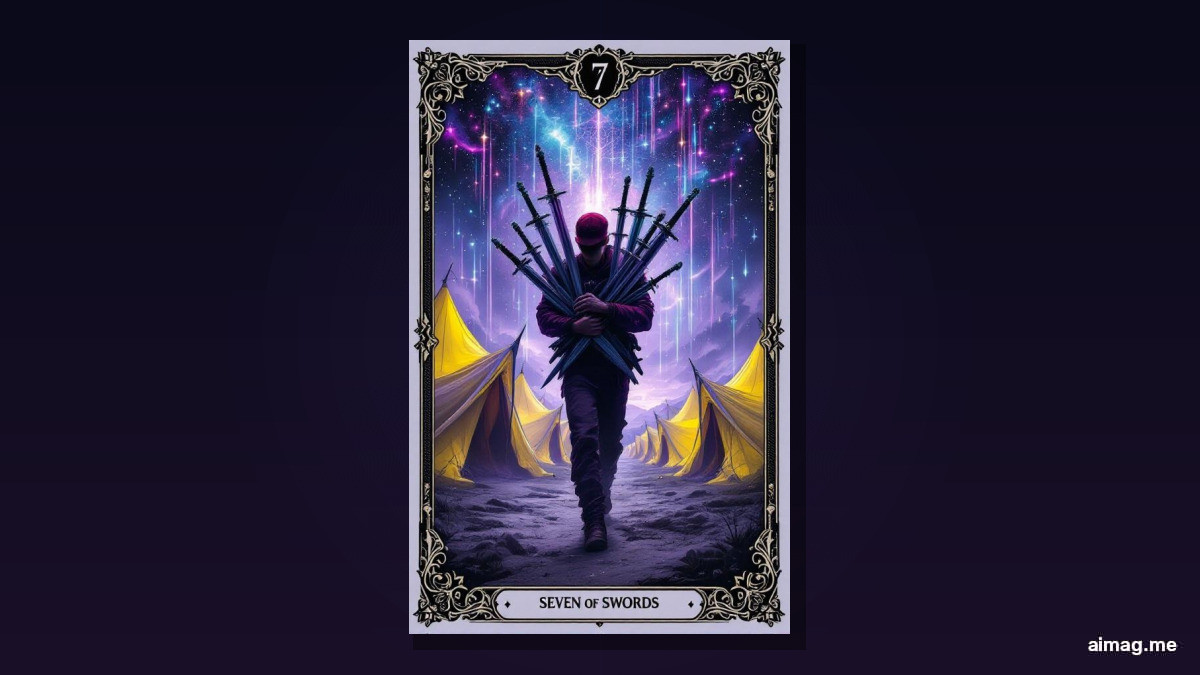
He is almost gone. Five swords bundled awkwardly in his arms — too many to carry cleanly, the blades fanning out at odd angles — and he is picking his way across the ground with the exaggerated delicacy of someone who is very aware of the noise his footsteps might make. Behind him, two swords remain planted in the earth. He could not take all seven. He did not try. He glances back over his shoulder with an expression that is difficult to read: part self-congratulation, part anxiety, the particular look of someone who has just gotten away with something and is not yet certain he has actually gotten away with it. The camp tents are yellow and cheerful in the morning light. The sky is a pale, ordinary blue. Soldiers mill around in the background. No one has noticed. Yet.
The Seven of Swords is one of the most psychologically loaded cards in the tarot. Not because it is ominous — it is not, exactly — but because it holds up a mirror to a set of behaviors most of us would rather not examine too closely. Deception. Evasion. The quiet decision to take what we want while no one is looking. But also, and this matters: strategy, cleverness, the legitimate art of working around obstacles rather than through them. The card's meaning depends almost entirely on which role you are playing in the scene.
In short: The Seven of Swords shows a figure tiptoeing away from camp with five stolen swords, leaving two behind. It represents deception, evasion, and the shadow side of cleverness — but also legitimate strategy and unconventional problem-solving. Reversed, it signals confession, getting caught, or the conscience winning the argument against concealment. The two swords left in the ground are the evidence that no deception is ever total.
Seven of Swords at a Glance
| Attribute | Detail |
|---|---|
| Number | 7 |
| Suit | Swords |
| Element | Air |
| Keywords (upright) | deception, stealth, strategy, cunning, shortcuts, evasion |
| Keywords (reversed) | confession, getting caught, conscience, returning stolen goods, accountability |
| Yes / No | No |

What Does the Seven of Swords Mean?
Sevens in tarot are testing cards. They do not offer resolution — that comes later — but they force a confrontation with something internal. The Seven of Cups tests clarity: can you tell real from imagined? The Seven of Pentacles tests patience: can you wait for what you have planted to grow? The Seven of Swords tests something subtler and more uncomfortable: intellectual integrity. When your mind is the sharpest tool in the room, can you wield it honestly?
The suit of Swords governs thought, language, truth, and conflict. Its cards are rarely comfortable. The ace cuts cleanly. The two sits in agonized stillness. The three breaks the heart. By the time we reach the seven, we are in the territory of the mind turned against itself — or against others — using its considerable cleverness in service of avoidance rather than clarity. The figure in the card is unquestionably intelligent. He has planned this. He has assessed the situation and identified what he wants and devised a method of taking it that minimizes his risk. The question the card poses is not whether he is smart. He clearly is. The question is what he is using his intelligence for.
Arthur Edward Waite, in The Pictorial Key to the Tarot (1911), gave this card a surprisingly mild description: "Design, attempt, wish, hope, confidence." He saw the figure not as a villain but as someone attempting something — someone who has a plan and is executing it. The moral valence, for Waite, was not fixed. That interpretive openness is worth preserving.
Rachel Pollack, in Seventy-Eight Degrees of Wisdom (1980), goes deeper, placing the Seven of Swords within what she calls the trickster archetype. The trickster is one of the oldest figures in world mythology — Loki in Norse tradition, Anansi in West African folklore, Hermes in the Greek pantheon. The trickster does not play by the rules. He operates in the margins, finds gaps in the system, gets what he wants through indirection and wit. He is not evil, exactly. He is necessary — the force that disrupts rigid order and reveals its hypocrisies. But the trickster is also capable of genuine harm, particularly when the cleverness becomes an end in itself rather than a means to something legitimate.
Carl Jung wrote about the trickster as a shadow figure — the part of the psyche that embodies the qualities we refuse to claim in our conscious identity. The person who believes themselves to be scrupulously honest often has a very active trickster in their shadow: the little lies told to avoid conflict, the credit quietly taken for shared work, the inconvenient facts left unmentioned. Jung argued that an unexamined shadow does not disappear. It acts. The Seven of Swords asks you to look at yours.
Notice, too, that the figure cannot carry all seven swords. He takes five and leaves two behind. Even in deception, there are limits. Even the cleverest evasion leaves evidence. The two swords planted in the ground are the part of the truth he could not take with him — they mark the scene, point to what happened, wait to be found. No theft is total. No deception is complete.

Seven of Swords Reversed
The reversed Seven of Swords is the moment the figure stops, turns around, and walks back.
Something has changed. Maybe he was caught — someone in the camp looked up at the wrong moment and the game is over. Maybe he was not caught, but the weight of what he is carrying has become heavier than the swords themselves, and the guilt or the anxiety has become unsustainable. Maybe he simply changed his mind, somewhere between the tents and the horizon, and decided that whatever he thought he was gaining was not worth what it cost him in self-respect.
The reversal almost always involves some form of return: returning what was taken, returning to the truth, returning to accountability. This can be involuntary — exposure, consequence, the sudden arrival of the situation you thought you had escaped. Or it can be voluntary, which is the more interesting case. The conscience wins. The trickster puts down the swords.
There is also a subtler meaning. Sometimes the reversed Seven of Swords indicates that a strategy is simply not working. The evasion is failing. The clever plan has a flaw. The reversal can be a practical signal as much as a moral one: the approach needs to change, not because it is wrong, but because it is not succeeding.
Either way, something becomes visible that was hidden. Often that visibility is a relief, even when it comes with consequences.
Seven of Swords in Love
Upright
In relationships, the Seven of Swords raises questions that are uncomfortable to ask and more uncomfortable to answer. Is someone in this situation being fully honest? That someone may be your partner. It may also be you.
The card can indicate active deception — infidelity kept secret, a significant truth withheld, a version of the relationship being maintained that does not match the private reality. But it more frequently points to the quieter dishonesty: the thing not said, the feeling not disclosed, the exit strategy being quietly built while the relationship continues as though it is not. The figure is not violently breaking the relationship apart. He is tiptoeing away. That distinction matters.
If you are single, the Seven of Swords can suggest that you or someone in your orbit is not being straightforward about intentions. A connection that feels slightly off, slightly too smooth, slightly evasive on questions that should be easy to answer. Trust what feels incongruous.
Reversed
Reversed in love, the Seven of Swords brings things into the open. A confession. A conversation that should have happened long ago, finally happening. The secret that was being carried, put down.
This is not always comfortable, but it is almost always necessary. Relationships that have been operating under concealment cannot fully deepen until the concealment lifts. The reversal can also indicate that the person who was being evasive — again, this may be you — has decided to re-engage honestly. The trickster sets down the swords and shows up as themselves.
Want to understand what the Seven of Swords is revealing about your relationship? Try a free AI reading →
Seven of Swords in Career
Upright
In career contexts, the Seven of Swords can point to a range of situations, not all of them negative. On the problematic end: taking credit for work that was not solely yours, cutting corners in ways that could eventually be noticed, operating in ethical gray areas, a colleague who is not playing fairly, or an environment where deception is practically the culture.
But the card can also appear when you are navigating a workplace that requires strategic thinking — knowing when to speak and when to stay quiet, managing upward, understanding that not every truth needs to be shared at every moment. The line between survival intelligence and dishonesty is real, and the Seven of Swords forces you to locate it.
In job searches or negotiations, this card sometimes indicates that a bold, unconventional approach will be more effective than the standard one. Thinking outside the expected frame. Working a system rather than waiting for the system to reward you.
Reversed
Reversed in career, the Seven of Swords suggests that concealment is failing. Something that was being kept quiet is surfacing. A shortcut that looked clean at the time has left evidence. This can be external — an audit, a reorganization, a colleague who asks the one question you were hoping they would not — or internal: the recognition that the way you have been operating is not something you can sustain.
The reversal also points toward renegotiation. A return to transparency. Sometimes it appears just before someone decides to leave a situation that has required too much compromise.
Seven of Swords in Personal Growth
The trickster archetype lives in all of us. This is not an accusation — it is a description of human psychology. The question is not whether you have a Seven of Swords shadow, but whether you have made its acquaintance.
The cleverness that makes someone a good strategist is the same cognitive capacity that makes deception possible. Intelligence can be wielded to understand a situation clearly and navigate it honestly. It can also be wielded to construct convincing narratives that serve you at the expense of others, or to avoid situations that require you to be uncomfortably honest. Robert Greene's The 48 Laws of Power reads like a manual for the Seven of Swords at its most systematic — pure strategy, pure leverage, truth as a negotiable resource. It is a useful book to read because it makes explicit what most people do implicitly, which allows you to notice it.
The shadow work the Seven of Swords asks for is specific. What are you not saying? What have you taken — credit, time, energy, emotional resources — that was not fully yours to take? What situation are you currently tiptoeing away from because facing it directly feels too costly? The two swords left in the ground are worth examining. They represent the part of the truth you could not take with you, the evidence that will eventually be found. Shadow work, as Jung described it, is not about eliminating the trickster. It is about bringing him into consciousness — understanding when the cleverness is serving genuine, legitimate ends and when it is serving avoidance. The Magician is the figure who wields intelligence in full view, powers displayed on the table, transformation accomplished through skill that does not need to hide itself. The Seven of Swords figure is The Magician with his back turned. The difference is not in the capability. It is in the willingness to be seen.
The invitation, when this card appears, is to ask: where could I be more direct? What would I have to face if I stopped tiptoeing?

Seven of Swords Combinations
-
Seven of Swords + The Moon — Deception in conditions of maximum confusion. Neither you nor anyone around you is seeing clearly, which makes the already-complicated ethics of the Seven even harder to navigate. This combination warns against any action taken in the dark — someone is not who they appear to be, possibly including you. Nothing should be decided until the light returns.
-
Seven of Swords + The Magician — Intelligence fully activated. This pairing can indicate someone using considerable skill and knowledge to operate in shadow — deception at a sophisticated level. But it can also point to the genuine resolution of the Seven: the moment when the trickster's cleverness becomes the Magician's authentic power, used openly and constructively. The question is whether the work is being done in the light or the dark.
-
Seven of Swords + Justice — Consequences arrive. Justice does not overlook the two swords left in the ground. This combination almost always indicates that an evasion is about to encounter accountability — sometimes external, sometimes internal. It is one of the cleaner card pairings in terms of meaning: you cannot tiptoe past this one.
-
Seven of Swords + The High Priestess — Secrets held deliberately and with considerable depth. The High Priestess knows what she knows and chooses when and whether to reveal it — this is a form of wisdom, not deception. Combined with the Seven, it may indicate that the concealment is serving a genuine protective function, or that knowledge is being withheld for reasons more complex than simple dishonesty. Context is everything here.
-
Seven of Swords + Eight of Swords — Evasion generating its own trap. The Seven tries to escape; the Eight finds itself bound and blindfolded. This combination suggests that the attempt to avoid a situation has created a worse constraint — the clever exit has led somewhere more enclosed than where you started. The way out is not more cleverness. It is direct engagement with what was being avoided.
Frequently Asked Questions
Is the Seven of Swords always about deception?
Not always. The card is primarily about the relationship between cleverness and ethics, and that relationship takes many forms. Strategic thinking, unconventional problem-solving, knowing when to stay quiet, working around an obstacle rather than through it — these can all show up as the Seven of Swords, and none of them require dishonesty. The card becomes specifically about deception when the strategy involves concealment at someone else's expense. Context in the reading — and honest self-examination — usually makes the distinction clear.
Does the Seven of Swords mean someone is cheating on me?
It can indicate infidelity, but it is not the only or even most common interpretation in love readings. More frequently, it points to a pattern of evasion or incomplete honesty — something important not being said, an exit being planned without communication, a version of the relationship being maintained that does not match private reality. If infidelity is a concern, the card warrants a closer look at the broader reading rather than being taken as a definitive confirmation.
What does the Seven of Swords mean as advice?
As advice, the Seven of Swords asks you to think strategically. It may be suggesting that direct confrontation is not the right approach to your current situation — that there is a smarter, less visible path to what you need. It can also be advising caution about who you trust and what you reveal. In some contexts, it is a gentle but firm suggestion to examine where you have not been fully honest and consider whether the concealment is serving you as well as you think it is.
Why does the figure leave two swords behind?
This is one of the most psychologically precise details in the card. No evasion is total. No deception takes everything. The two swords left behind represent what could not be taken — the evidence, the consequence, the part of the truth that remains visible no matter how carefully the rest was managed. In personal growth terms, they are the aspects of reality that resist being carried off into comfortable narrative. They will be there when someone looks. The question is when.
He has almost made it. The camp is behind him, the horizon ahead, five swords clutched against his chest. But the two he left behind are still standing in the earth, and the figure — caught in that glance over his shoulder — has not yet reached the horizon. The Seven of Swords does not tell you how the story ends. It catches you in the middle, in the moment between the act and the consequence, and asks: what are you carrying that was never yours, and what have you left behind that will eventually be found? Try a free AI-powered reading at aimag.me/reading and meet whatever the Seven of Swords is pointing at in your own life.