Here is something most tarot readers will not tell you: when a client asks about love and draws the same cards over and over — The Moon in the feelings position, the Eight of Cups in the outcome, the Four of Cups as the present — the repeating pattern is not random. It is not the cards choosing you. It is your nervous system choosing the cards.
More precisely, it is the part of you that learned how relationships work before you had any say in the matter — your attachment style — filtering which cards feel true, which details you notice in the imagery, and which interpretations you accept as resonant. The cards become a mirror not of your future, but of the relational blueprint you have been carrying since infancy.
This is not speculation. The connection between attachment theory and the symbolic projections people make onto ambiguous images has been studied since the 1980s. Tarot simply happens to be one of the richest projective surfaces available — and the patterns it reveals about how you love are startlingly consistent.
In short: Your attachment style filters which tarot cards resonate in love readings: anxious attachment gravitates toward The Moon and the Eight of Cups, avoidant toward The Hermit and the Four of Cups, disorganized toward The Tower and The Devil, and secure toward the Two of Cups and The Empress. The six-card Attachment Spread maps your relational blueprint from childhood roots through present triggers to what earned security could look like for you.
Attachment Theory in 90 Seconds
British psychiatrist John Bowlby (1969) proposed that humans are born with an innate need to form close emotional bonds — not as a luxury, but as a survival mechanism. A baby who stays close to a responsive caregiver survives. A baby left alone does not. This basic reality shaped the human brain over hundreds of thousands of years: we are wired for attachment the way we are wired for language.
Mary Ainsworth (1978) took Bowlby's theory and made it observable. In her famous Strange Situation experiments, she watched how toddlers responded when their mothers briefly left the room and then returned. Three distinct patterns emerged:
- Secure attachment — distress at separation, quick comfort upon return, then back to exploring
- Anxious-ambivalent attachment — intense distress, difficulty settling even when the caregiver returned, a mixture of clinging and anger
- Avoidant attachment — apparent indifference to both departure and return, a studied coolness that masked physiological stress
Later researchers added a fourth category — disorganized attachment (Main & Solomon, 1986) — for children whose responses were contradictory, approaching and retreating simultaneously, freezing mid-motion. These children typically had caregivers who were themselves frightened or frightening.
The insight that changed everything came from Hazan and Shaver (1987), who demonstrated that these childhood patterns persist into adult romantic relationships. The anxious toddler becomes the adult who reads silence as abandonment. The avoidant toddler becomes the adult who needs an exit strategy before committing. Bartholomew and Horowitz (1991) refined the model further, and Levine and Heller's Attached (2010) brought it to a wider audience.
The critical thing to understand is that attachment styles are not personality types. They are adaptive strategies — learned responses that made sense in the original environment. They can shift over time, through relationships, through therapy, through awareness. Which is where the cards come in.
Why Attachment Shows Up in Tarot Readings
When you sit with a spread and begin interpreting the cards, you are engaging in a projective process — the same psychological mechanism that drives the Rorschach test. Ambiguous images invite your unconscious to fill in the gaps. And the largest, most emotionally charged unconscious material most people carry is their relational patterning.
This is why relationship readings tend to have such striking consistency for individual readers. Your attachment style shapes which cards feel threatening, which feel aspirational, which you dismiss, and which stop you cold. It is not that The Moon means anxious attachment. It is that if you carry anxious attachment, The Moon's imagery — the uncertain path between two towers, the hidden depths beneath the surface, the howling creatures — will speak to your particular flavor of relational fear with uncanny precision.

What follows is not a rigid diagnostic system. Attachment exists on spectrums, not in boxes. But these mappings — drawn from the intersection of attachment research and the symbolic vocabulary of tarot — offer a way to notice what your readings have been trying to show you about how you connect.
Anxious Attachment — The Cards That Reach
Anxious attachment develops when caregiving was inconsistent — sometimes warm, sometimes absent, with no reliable pattern. The child learns that love is real but unpredictable, and the only strategy that works is hypervigilance: scan for signals, amplify bids for connection, never let your guard down.
In adult relationships, this shows up as the fear that love will be withdrawn without warning. The anxious partner monitors tone of voice, response times, micro-expressions. They often feel "too much" and sometimes are told as much. Sue Johnson, the founder of Emotionally Focused Therapy, describes it in Hold Me Tight (2008) as a protest response — the emotional equivalent of a fire alarm that cannot be turned off because the threat of disconnection feels existential.
The Moon — This is the signature card of anxious attachment. The Moon depicts a path between two towers, a dog and a wolf howling at a face half-hidden in the sky, a crayfish emerging from uncertain waters. Everything is visible but nothing is clear. For anxiously attached individuals, this card resonates because it captures the experience of trying to read a partner who feels unknowable — searching for certainty in a world that offers none.
Queen of Cups reversed — Upright, the Queen of Cups is emotional intelligence in full command. Reversed, she becomes emotional overwhelm — feeling everything at once, unable to distinguish between intuition and anxiety, between genuine threat signals and the echoes of old wounds. This is the anxious partner at 2 AM, rereading texts for hidden meanings.
Eight of Cups — Eight cups stand, and a cloaked figure walks away from them into the mountains. For the anxiously attached, this card often appears not as their own action but as their deepest fear: the partner leaving. The cups are full — the relationship was real, the connection existed — and still, someone chose to go. This is the abandonment wound in symbolic form.
Three of Swords — Three blades pierce a heart beneath a gray sky. There is nothing ambiguous about this image, and that is precisely why it resonates with anxious attachment. The pain is visible, acknowledged, front and center. For someone who grew up with inconsistent caregiving, the moments of clear pain were paradoxically easier to handle than the moments of uncertainty. At least when the swords are visible, you know where you stand.
Avoidant Attachment — The Cards That Withdraw
Avoidant attachment typically develops when caregiving was emotionally unavailable — not necessarily neglectful, but consistently unresponsive to emotional needs. The child learns that expressing vulnerability leads nowhere, that the safest strategy is self-reliance, and that needing someone is a liability.
In adult relationships, the avoidant partner values independence, feels suffocated by too much closeness, and tends to deactivate attachment needs through distancing — working late, maintaining emotional control, keeping options open. Levine and Heller (2010) describe the avoidant's core conflict: they genuinely desire connection but experience it as threatening to their autonomy.
The Hermit — An old figure stands alone on a mountaintop, holding a lantern. The imagery is beautiful — solitude as wisdom, introversion as strength. But The Hermit's shadow side maps precisely onto avoidant attachment: the belief that the safest place is alone, that light is something you carry for yourself, that the mountain's isolation is a choice rather than a defense. The question the card asks is: are you alone because you found something up here, or because you are afraid of what is down there?
Four of Cups — A figure sits beneath a tree, arms crossed, looking away from three cups on the ground while a fourth is offered by a hand emerging from a cloud. The avoidant attachment signature is right there in the posture: emotional offerings are present, available, even being actively extended — and the figure does not look. This is not indifference. It is the deactivation strategy in action — the learned habit of not registering what is available so that you cannot be hurt by wanting it.
Knight of Swords — The Knight charges forward on horseback, sword raised, sky storming. This card maps to the avoidant tendency to intellectualize emotions, to respond to relational conflict with logic and analysis rather than vulnerability. The Knight of Swords is all forward momentum and no pausing — which is precisely what avoidance looks like from the outside. The partner who responds to "I miss you" with a problem-solving strategy.
Seven of Swords — A figure sneaks away from a camp, carrying five swords while two remain. This card's traditional association with deception is less relevant here than its association with strategic withdrawal — taking what you need and slipping away before anyone notices. For the avoidant partner, emotional honesty feels like leaving your weapons behind. The Seven of Swords is the exit strategy, the back door, the part of you that always keeps something in reserve.
Secure Attachment — The Cards That Stay
Secure attachment develops when caregiving was consistently responsive — not perfect, but reliable enough that the child learned a fundamental truth: I can need someone and they will still be there. I can be myself and still be loved.
Securely attached adults can tolerate both intimacy and independence without one threatening the other. They can communicate needs directly, handle conflict without catastrophizing, and repair ruptures. Research consistently shows that about 50-60% of the population has a primarily secure attachment style (Mickelson, Kessler & Shaver, 1997).
The Empress — Seated in abundance, surrounded by growth, the Empress embodies nurturance that is sustainable — not desperate, not conditional, not self-depleting. She gives because she has enough. This is the secure base that Bowlby described: a person whose emotional resources are sufficiently full that closeness does not threaten depletion.
Ten of Cups — A couple stands together, arms raised, children playing nearby, a rainbow arching overhead. This is the most explicitly relational happiness card in the deck. For securely attached individuals, it is not aspirational — it is familiar. The Ten of Cups reflects what they already know to be possible: sustained, imperfect, good-enough love.
Two of Cups — Two figures face each other, each holding a cup, a caduceus rising between them. This card is about mutual recognition — the moment where two people see each other clearly and choose connection anyway. The key word is mutual. Unlike the anxious pattern (one person chasing) or the avoidant pattern (one person retreating), the Two of Cups shows a balanced exchange. Both people are present. Both people are offering something.
The Star — A figure kneels by water under a sky full of stars, pouring water into the pool and onto the earth simultaneously. The Star represents hope that is grounded — not wishful thinking, but a calm trust that things can be good. In attachment terms, this is what secure attachment actually feels like from the inside: the absence of hypervigilance, the ability to rest in connection without needing to constantly verify it.
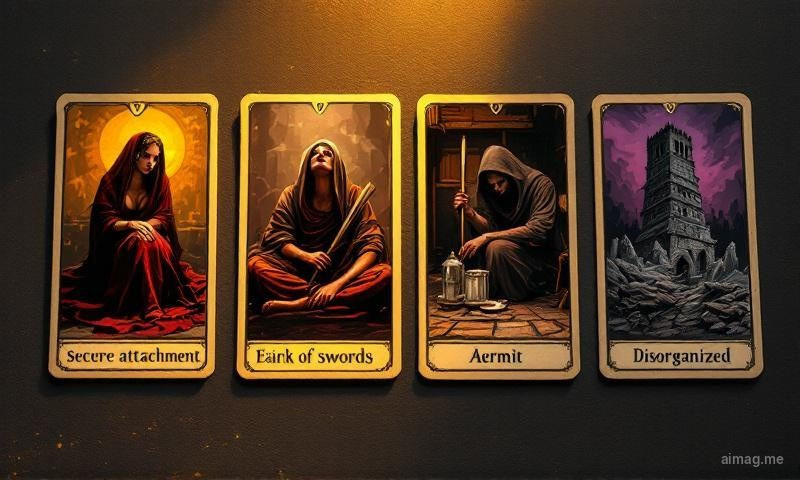
Disorganized Attachment — The Cards That Contradict
Disorganized attachment is the most complex pattern, and the most painful. It develops when the caregiver is simultaneously the source of comfort and the source of fear — in situations of abuse, severe mental illness, or unresolved trauma in the parent. The child faces an unsolvable problem: the person I need to go to for safety is the person I need to get away from.
The result is a pattern that oscillates between anxious and avoidant strategies without settling into either. Approach and retreat happen almost simultaneously. Longing and terror coexist. Adult relationships can feel like standing in two places at once.
The Tower — Lightning strikes a tower, figures fall, flames erupt. The Tower is the only Major Arcana card that depicts destruction in progress — not aftermath, not anticipation, but the actual moment of collapse. For the disorganized pattern, this card resonates because their relational experience is often one of sudden, inexplicable rupture. Safety becomes danger without transition. The Tower captures the lived reality of a nervous system trained to expect the floor to disappear.
The Devil — Two figures stand chained to a pedestal beneath a horned figure. The chains are loose — they could be removed — but the figures do not move. The Devil's relevance to disorganized attachment is in its depiction of bonds that are simultaneously binding and chosen. The person with disorganized attachment often recognizes the pattern ("I know this relationship is harmful") while feeling unable to leave ("but I cannot imagine safety anywhere else"). This is not weakness. It is the logical outcome of a system where love and danger were the same thing.
The Moon reversed — If The Moon upright is uncertainty, The Moon reversed is something more destabilizing: the moment when your own perceptions become unreliable. Am I overreacting? Was that really harmful, or am I the problem? For disorganized attachment, where the caregiving relationship itself violated the normal rules of what is safe, the reversal of The Moon captures the experience of not being able to trust your own emotional compass. This is what therapists call the collapse of the internal working model — when the map and the territory contradict each other.
The Attachment Spread — A 6-Card Layout
This spread is designed specifically for exploring attachment patterns. It is not a relationship reading in the traditional sense — it is a mirror for how you relate, regardless of whether you are currently in a partnership.
Lay six cards in two rows of three:
| Position | Card | Question |
|---|---|---|
| 1 — Root | Top left | What was the emotional climate of my earliest bonds? |
| 2 — Pattern | Top center | What relational strategy did I learn from that climate? |
| 3 — Trigger | Top right | What activates my attachment system most intensely now? |
| 4 — Protection | Bottom left | How do I defend against the vulnerability of connection? |
| 5 — Need | Bottom center | What do I actually need from a partner (or from myself)? |
| 6 — Growth | Bottom right | What would earned security look like for me? |
Positions 1-3 form the origin row — tracing the line from early experience to present triggers. Positions 4-6 form the path row — moving from defense to need to possibility.
A few notes on working with this spread:
Position 1 will often surprise you. The card that appears here is not about what happened — it is about how your nervous system encoded what happened. A card like the Ten of Cups in this position does not necessarily mean a happy childhood. It might mean that happiness was the expected performance, the surface that covered something more complicated.
Position 4 is where avoidant patterns become most visible. If you draw a card associated with independence, control, or intellectual mastery — notice whether that feels like genuine strength or like armor.
Position 6 uses the term "earned security" deliberately. Research by Roisman et al. (2002) has shown that people who begin life with insecure attachment can develop what is called earned secure attachment through later relationships, therapy, or self-awareness. The card in this position is not showing you a fantasy. It is pointing toward something achievable.
For a broader relational reading, you might pair this spread with the Relationship Tarot Spread or the Self-Discovery Tarot Spread, which examines patterns from a wider angle.
Using Readings for Attachment Awareness — Not Diagnosis
There is an important boundary here that is worth naming explicitly.
Tarot readings — even ones structured around psychological frameworks — are not diagnostic tools. Attachment theory itself, while well-supported by decades of research, was not designed as a self-assessment system. The categories are useful as lenses, not as labels. Most people carry elements of multiple attachment styles, and those patterns shift depending on context, partner, life stage, and stress level.
What tarot can do — and does remarkably well — is surface patterns that are otherwise difficult to see. The projection effect that makes cards useful as mirrors works especially powerfully with attachment material, because attachment patterns are by definition formed before conscious memory. You cannot simply remember your way to insight about them. But you can notice which cards make your chest tighten, which ones you dismiss too quickly, which spreads produce the same configuration reading after reading.
If you find that your readings consistently show the same relational themes — cards about loss and walking away, or cards about feeling stuck and uncertain — that repetition is worth paying attention to. Not because the cards are sending a message, but because your nervous system is revealing its operating instructions.
Some ways to work with this productively:
- Journal after relationship readings. Note not just which cards appeared, but how you felt about them. The emotional response is the data.
- Track recurring cards. If the Eight of Cups shows up in every love reading you do for three months, that pattern is telling you something about your attachment narrative — not about your future.
- Notice your reaction to the "secure" cards. If the Two of Cups or Ten of Cups makes you feel skeptical, uncomfortable, or dismissive rather than hopeful, that reaction itself is attachment information.
- Pair card work with learning. Read Levine and Heller's Attached or Sue Johnson's Hold Me Tight alongside your readings. The combination of intellectual framework and symbolic exploration is more powerful than either alone.
Frequently Asked Questions
Can tarot actually tell me my attachment style?
No — and that is not what this framework is for. Your attachment style is best assessed through validated instruments like the Adult Attachment Interview (George, Kaplan & Main, 1985) or the Experiences in Close Relationships questionnaire (Brennan, Clark & Shaver, 1998). What tarot can do is surface the emotional and behavioral patterns associated with your attachment orientation in a way that is experiential rather than analytical. You are not taking a test. You are watching your own reactions to symbolic material — which often reveals things a questionnaire cannot.
I pulled cards from multiple attachment categories in one reading. What does that mean?
It means you are a normal human. Attachment researchers have increasingly moved away from strict categories toward a dimensional model, recognizing that most people have a primary strategy with secondary tendencies that emerge under stress. A reading that shows The Star alongside The Moon is not confused — it is reflecting the real complexity of how secure and anxious tendencies coexist in you.
Does knowing my attachment style through tarot actually help?
Awareness is not change, but awareness is the prerequisite for change. Research on shadow work and therapeutic outcomes consistently shows that recognizing a pattern — truly seeing it, not just intellectually acknowledging it — is the first step toward shifting it. Tarot provides that recognition through image and emotion rather than through clinical language, which for many people makes the insight land differently and more deeply.
Can attachment styles change?
Yes. This is one of the most hopeful findings in attachment research. Bowlby himself believed attachment patterns could be updated through new relational experiences. The concept of "earned security" — developing secure attachment in adulthood through therapy, awareness, or a relationship with a securely attached partner — is well-documented (Roisman et al., 2002). The cards you draw today are not a life sentence. They are a snapshot of where your nervous system is right now.
The Reading That Keeps Repeating
If your love readings keep producing the same cards, the same mood, the same tight feeling in your chest — consider the possibility that the cards are not trying to predict your romantic future. They are reflecting your relational past. The patterns that Bowlby described in 1969, that Ainsworth observed in toddlers in 1978, that Hazan and Shaver found still operating in adult lovers in 1987 — those patterns are alive in you. They show up in how you interpret a glance, a silence, a text left unanswered. And they show up in how you interpret a card.
The good news — and this is not false comfort — is that what was learned can be relearned. Earned security is real. The nervous system is plastic. The blueprint you carry is not a blueprint you chose, and it is not one you are stuck with.
The cards can show you where you are. What you do with that — whether you sit with it, journal about it, bring it to therapy, or simply carry the awareness into your next conversation — is yours.
Explore your attachment patterns in a personalized AI reading at aimag.me/reading