
Here is the thing nobody warns you about: the hardest part of new parenthood is not the sleeplessness. The sleeplessness is brutal, obviously — a kind of sustained cognitive assault that would be classified as torture under the Geneva Conventions if someone did it to you on purpose. But the sleeplessness, at least, is expected. People tell you about it in advance. They say "sleep when the baby sleeps" as if that constitutes useful advice, and they laugh knowingly when you mention the 3 AM feedings. You know it is coming. You brace for it.
What nobody warns you about is the identity dissolution. The way you wake up one morning — or, more accurately, you never went to sleep — and realize you cannot locate the person you were eight weeks ago. The one who had opinions about restaurants and read books and knew what they wanted to do on a Saturday. That person has been replaced by a creature whose entire cognitive bandwidth is occupied by feeding schedules, diaper output, and a low-grade terror that something is wrong that you cannot identify. You are keeping a human alive. You are not sure you are still a person.
This is not postpartum depression, though it can coexist with it. This is the normal, predictable, and almost completely undiscussed identity restructuring that happens when a new parent collides with the reality of caregiving. And it is precisely the kind of experience that benefits from a structured reflection tool — a mirror you can look into at 3 AM when the baby is finally asleep on your chest and your mind is doing that awful thing where it races and stalls simultaneously.
That is what tarot does here. Not fortune-telling. Not predicting milestones or pediatric outcomes. Structured reflection for people who are too tired to think clearly but too stirred up to stop thinking entirely.
In short: Tarot gives new parents a ten-minute, interruptible self-reflection practice during the identity dissolution of early parenthood. Cards like The Empress, Strength, and The Moon hold the contradictions of exhaustion and love without demanding resolution, while the 3 AM Spread and Identity Anchor Spread help you locate yourself inside the overwhelming transition from person to parent.
The psychology of postpartum identity — what is actually happening to you
Daniel Stern, the developmental psychologist whose work on parent-infant interaction reshaped the field, coined the term "motherhood constellation" to describe a new psychic organization that emerges during pregnancy and intensifies dramatically after birth (Stern, 1995). Though Stern initially framed this in terms of mothers, subsequent research has shown that the constellation applies to any primary caregiver — the identity reorganization of parenthood does not require having given birth. It requires being the person who wakes up at 2 AM.
The constellation has four themes, and if you are in the first year of parenthood, you will recognize all of them with uncomfortable precision.
Life-growth. Can I keep this child alive? This is the primal theme — the one that generates the constant scanning, the hypervigilance, the inability to sleep even when the baby is sleeping because what if something happens in the next four minutes? This theme predates rational thought. It lives in the brainstem, and it does not respond to reassurance.
Primary relatedness. Can I love this child? Will this child love me? The cultural script says you will feel overwhelming love the moment you hold your baby. Many parents do. Many others feel overwhelmed or numbly functional for weeks before the emotional connection clicks. The gap between what you expected to feel and what you actually feel is one of the most common sources of shame in early parenthood.
The supporting matrix. Who will support me while I do this impossible thing? This theme surfaces every inadequacy in your support system and is where resentment begins to accumulate if it is not addressed.
Identity reorganization. Who am I now? This is the one that does the most damage when it goes unprocessed. Postpartum identity change is not additive. You do not simply add "parent" to your list of roles and continue as before. You restructure the entire list — work, friendships, your body, your creative life, your relationship with time itself. The rearrangement happens without your consent and largely without your conscious participation.
Donald Winnicott, the British pediatrician and psychoanalyst, understood this in 1953 when he introduced the concept of the "good enough" parent. The term sounds like settling. It was the opposite. Winnicott argued that the cultural demand for perfect parenting was itself damaging — that what children actually need is not a flawless caregiver but a human one who fails sometimes, repairs the failure, and in doing so teaches the child that the world is imperfect but survivable.
This matters for identity because the pursuit of perfect parenting — performing the role without error, without ambivalence — is what makes the identity dissolution so acute. If "parent" must mean "perfect," then every moment of frustration or longing for your previous self becomes evidence that you are doing it wrong. Winnicott reframes the entire experience: the ambivalence is not a problem. The grief for your previous identity is not ingratitude. It is all part of the developmental process. The question is not whether you feel these things. It is whether you have a way to process them.
Esther Perel, the psychotherapist whose work on modern relationships has reached millions, adds another layer. Perel argues that parenthood frequently triggers a crisis in the couple relationship — not because the couple was fragile, but because parenthood creates competing attachment demands the relationship was never designed to accommodate. The partner who was your primary emotional anchor now shares that role with a small person who cannot yet regulate their own emotions. One partner may feel they have lost themselves entirely while the other feels excluded from the new parent-child dyad. Both experiences are valid. Both are lonely.
Why tarot works for new parents — specifically
Tarot is a structured mirror. It takes your internal state — the formless swirl of emotion, exhaustion, love, fear, and identity confusion — and gives it a shape you can look at. For new parents, this function is unusually well-suited for three reasons.
It works in ten minutes, and it holds contradictions. New parents do not have hours for journaling or therapy sessions that require childcare. Tarot requires a flat surface, a shuffled deck, and the ability to hold a thought for about three breaths. You can do it at 3 AM with one hand, the other holding a sleeping infant against your chest. And it meets you where you are emotionally, because every card contains both gift and shadow. The Empress is creation and smothering. Strength is endurance and exhaustion. The Moon is intuition and disorientation. You can draw a card and say "this is how I feel" without having to resolve the paradox — because the card does not resolve it either. It just holds it, and being held is what exhaustion needs.
It processes without requiring articulation. When you are running on four hours of fragmented sleep, your prefrontal cortex is operating at reduced capacity. Sleep researchers call this cognitive degradation "functional impairment comparable to legal intoxication." Tarot works through images, not analysis. You look at The Moon — two towers, a winding path, a dog and wolf howling at something they cannot see — and your body recognizes the feeling before your mind can name it. The recognition happens below the threshold of articulation, which means it works even when you cannot string a coherent sentence together.
It creates a ritual of self-recovery. One of the most disorienting aspects of new parenthood is the loss of "I" in the constant demands of caregiving. You become a function — feeder, changer, holder, comforter — and the person performing those functions recedes. Sitting with a tarot deck for ten minutes is an act of self-retrieval. It says: I am still here. I still have an inner life. I am not only a caregiver — I am also a person with fears, hopes, griefs, and questions that matter independently of the baby's needs.
Five cards that speak to new parenthood
The Empress
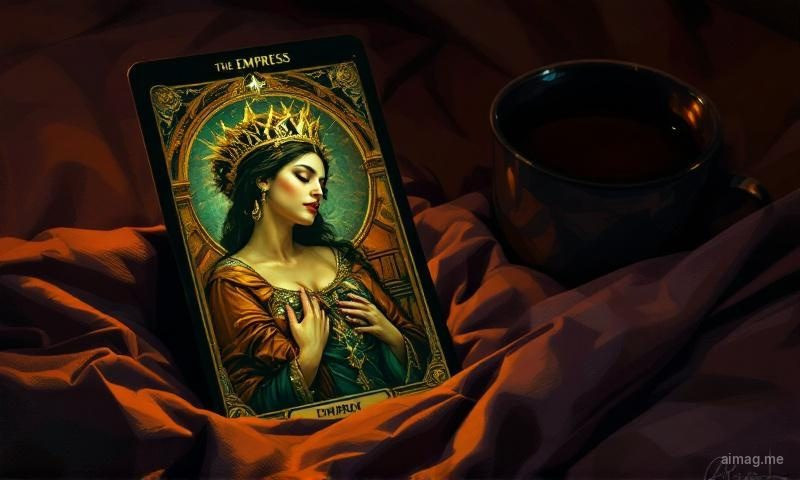
The Empress is the archetype of creation and nurturing — the abundant, generative force that sustains life. For new parents, she is the card of validation: what you are doing is creative work of the highest order, even when it feels like an endless loop of feeding and cleaning and not sleeping.
But The Empress also carries a shadow: the expectation that nurturing should be natural, effortless, instinctive. Drawing The Empress when you feel like a failure at caregiving is an invitation to examine whose standard of nurturing you are measuring yourself against — and whether that standard is even human.
Strength
Strength shows a figure gently holding open the mouth of a lion. Not overpowering it. Just holding it — with infinite patience, with soft hands, with a kind of endurance that does not look dramatic from the outside but requires everything you have.
This is the card of the fourth feeding of the night. The card of holding a screaming infant when nothing works and all that remains is your presence. Strength is not about force. It is about the capacity to continue when continuing requires more than you thought you had. The fact that you are still here, still showing up — that is the strength. It does not need to look impressive. It needs to last.
The Moon
The Moon is uncertainty, intuition, and the territory between what you know and what you fear. For new parents, this card shows up in the gap between the parenting book and the actual baby — the space where expert advice ends and your specific child begins. Some of this you will have to feel your way through, in the dark, trusting instincts you did not know you had.
The Moon also speaks to the 3 AM terrors — the catastrophic thinking that descends when the house is quiet and your mind begins generating worst-case scenarios. Drawing The Moon is a way of acknowledging the fear without feeding it. Yes, the path is dark. You are walking it anyway.
Six of Cups
The Six of Cups is the card of childhood, memory, and the past's relationship to the present. In the Rider-Waite-Smith image, a child offers a cup filled with flowers to a smaller child — an act of giving that is simple, pure, and unencumbered by adult complexity.
For new parents, the Six of Cups often surfaces the relationship with your own childhood. Becoming a parent activates every memory, pattern, and wound from the way you were parented — and forces a reckoning with what you want to repeat and what you want to do differently. This card is an invitation to examine that inheritance consciously rather than letting it operate on autopilot. What did your parents give you that you want to pass forward? What did they withhold that you want to provide? The Six of Cups does not judge the answers. It just asks the questions.
Ace of Cups
The Ace of Cups is the beginning of a new emotional chapter — a cup overflowing, a lotus blooming from the water. In the context of new parenthood, it represents the love that arrives uninvited and without proportion — the terrifying tenderness of holding your child and realizing your capacity for both love and fear has expanded beyond anything you imagined.
The cup is full, which means it can spill. The new capacity for love comes paired with a new capacity for anxiety, protectiveness, and vulnerability. You love more, which means you can be hurt more. The Ace holds both truths without pretending one cancels the other.
Two spreads for new parents
These spreads are designed for the specific conditions of new parenthood: limited time, limited cognitive capacity, and an urgent need for self-reflection that competes with an equally urgent need to sleep. They work with any deck and require no prior tarot experience.
The 3 AM Spread (3 cards)
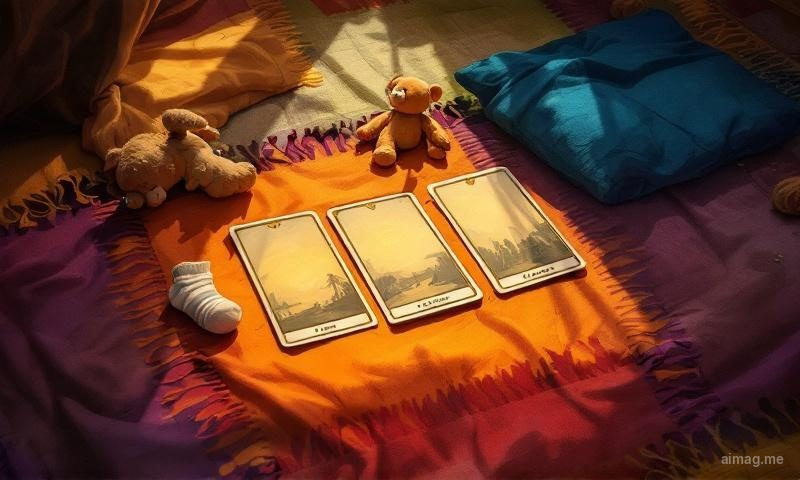
The middle of the night is when the mind does its most dangerous work — when the baby is finally asleep and your body is exhausted but your thoughts are racing. Three cards. That is all. Lay them left to right.
| Position | Meaning |
|---|---|
| 1 — What I am carrying right now | The emotional weight you are holding in this moment — the feeling that is loudest, even if you cannot name it yet |
| 2 — What I need to put down | The expectation, comparison, or fear that is adding weight without adding value — the thing you can release |
| 3 — What is holding me | The resource — internal, relational, or unseen — that is sustaining you even when you cannot feel it |
How to read it: This spread is diagnostic. Position 1 names what is happening. Position 2 gives you permission to stop carrying something you do not need. Position 3 reminds you that you are supported even when exhaustion has made the support invisible.
If you draw Strength in Position 1, it may reflect endurance that is beginning to wear thin. If The Moon appears in Position 2, it might be telling you that the uncertainty you are trying to control is not yours to resolve — that some of this you need to let be unknown. If The Empress appears in Position 3, she is reminding you that the nurturing force you are providing to your child also exists within you, for you.
Do this spread at 3 AM if you need to. Do it at 3 PM while the baby naps. Photograph the layout and date it. In six months, you will look back and see a person who was in the middle of something enormous and still found ten minutes to pay attention to their own interior life.
The Identity Anchor Spread (5 cards)
This spread is for when the identity dissolution has reached the point where you need more than a check-in — you need an anchor. Designed around Stern's identity reorganization theme, its purpose is to help you locate continuity in the middle of radical change.
Lay five cards in a cross pattern:
| Position | Placement | Meaning |
|---|---|---|
| 1 — Who I still am | Center | The core of you that parenthood has not changed — the part that persists beneath the new role |
| 2 — Who I was before | Left | The pre-parent identity — what you valued, how you spent your time, what made you feel like yourself |
| 3 — Who I am becoming | Right | The parental identity that is forming — the new capacities, instincts, and priorities emerging |
| 4 — What I am grieving | Below | The specific loss that hurts most — the freedom, the spontaneity, the relationship, the body, the career momentum, the self |
| 5 — What connects past and future | Above | The thread that runs through both versions of you — the continuity that makes this a transformation rather than an erasure |
How to read it: Position 1 is the anchor — the card that answers "who am I when everything else is stripped away?" Position 4 is the card most people avoid but most need: the explicit acknowledgment that parenthood involves grief, and that the grief is not ingratitude. You can love your child completely and still mourn the life you had before.
Position 5 is the integrative card — the one that says you were not erased but transformed. The person you are becoming carries something essential from the person you were. Finding that thread is often the moment when the identity dissolution begins to stabilize.
If The Ace of Cups appears in Position 3, it speaks to the new emotional depth that parenthood has unlocked. If The Six of Cups appears in Position 4, the grief may be connected to your own childhood — to realizing what was missing in how you were raised, and to the bittersweet work of providing your child what you did not receive.
A note for partners — and what tarot cannot do
If you are the non-birthing partner, or the one who returned to work while the other stays home, or the one who feels peripheral to the parent-child dyad — your identity transformation is real too. It is just less visible, because the culture has fewer scripts for it. Both spreads above are for you. The Identity Anchor Spread, in particular, can surface feelings the non-birthing partner often suppresses — the grief of being sidelined in the parent-child bond, the guilt of feeling jealous of your own child's claim on your partner, the disorientation of a relationship that used to be two people and is now three. Some couples find it powerful to do the spread separately and compare results. The conversation that follows often surfaces dynamics that would otherwise remain unspoken until they became arguments.
One important boundary: tarot is not a substitute for professional help. If you are experiencing symptoms of postpartum depression or anxiety — persistent hopelessness, inability to bond with your baby, intrusive thoughts of harm — a perinatal mental health professional is the right resource. Tarot is a tool for self-reflection, not clinical intervention. What it can do, within its actual scope, is give you ten minutes of structured attention to your own interior life during a period when that life is being subsumed by the needs of another person. That small act of self-attention is not nothing. It is the practice of remaining a person while becoming a parent. Winnicott would call it good enough.
FAQ
Is tarot safe to use during postpartum recovery? Tarot cards are printed cardboard with no pharmacological or mystical properties. The real question is emotional: if ambiguous imagery is currently triggering anxiety spirals, pause until your nervous system is more regulated. Otherwise, proceed freely.
My baby woke up in the middle of a reading. Can I come back to it? Yes. Mark the card positions — a phone photo works — and return when you can. The spread will still work. Tarot does not expire. It also does not mind interruptions, which makes it one of the few reflection practices genuinely compatible with newborn life.
What if I draw scary cards like The Tower or Death? New parents are understandably hypervigilant about threat signals. But The Tower is not predicting a catastrophe — it reflects the upheaval you are already living through. Death is not about dying — it is about the transformation that follows an ending. In the context of new parenthood, these cards are mirrors of the identity restructuring that is already happening. They are not warnings. They are descriptions.
Can tarot help with the relationship strain of new parenthood? It cannot fix a struggling partnership, but it can make the invisible visible. Drawing cards about your emotional state and unacknowledged griefs gives you language for conversations that otherwise remain stuck at "I'm fine." The Identity Anchor Spread done by both partners separately, then compared, is a particularly effective way to surface the dynamics Perel identifies as predictable features of the transition to parenthood.
The person you are becoming
You are in the middle of something that has no shortcut, no optimization, and no finish line. The exhaustion is real. The identity loss is real. The love — that obliterating, terrifying, world-restructuring love — is real too. And you are holding all of it simultaneously, which is harder than anyone told you it would be.
Tarot will not make this easier. But it can give you a practice — small, brief, interruptible — that reminds you that the person inside the exhaustion is still there. Still thinking. Still feeling. Still worthy of ten minutes of attention, even at 3 AM with a sleeping baby on your chest and cold coffee on the nightstand.
You do not need to be a perfect parent. You do not need to enjoy every moment of something that is genuinely exhausting. You just need to keep showing up — for the baby, for your partner, and for yourself. Winnicott called it good enough. The cards call it Strength: not the dramatic kind, but the kind that holds the lion's mouth open with soft hands, night after night, until the night becomes morning.
Try a free tarot reading and see what the cards reflect about where you are right now. No prediction. No fortune-telling. Just a mirror — for the person you were, the parent you are becoming, and the one who is learning to hold both.