The Chariot at a Glance
| Attribute | Detail |
|---|---|
| Number | VII |
| Element | Water |
| Zodiac | Cancer |
| Keywords | willpower, determination, triumph, control, ambition, direction |
| Yes / No | Yes |
In short: The Chariot represents willpower, self-mastery, and purposeful forward motion achieved not by forcing external circumstances but by integrating your own opposing inner forces. Upright, it signals determination tempered by emotional conviction. Reversed, it warns of inner fragmentation, overcontrol, or pushing forward from anxiety rather than clarity. Its Cancer-Water element reveals that the deepest drive comes from emotional commitment, not mere discipline.
What Does The Chariot Mean?
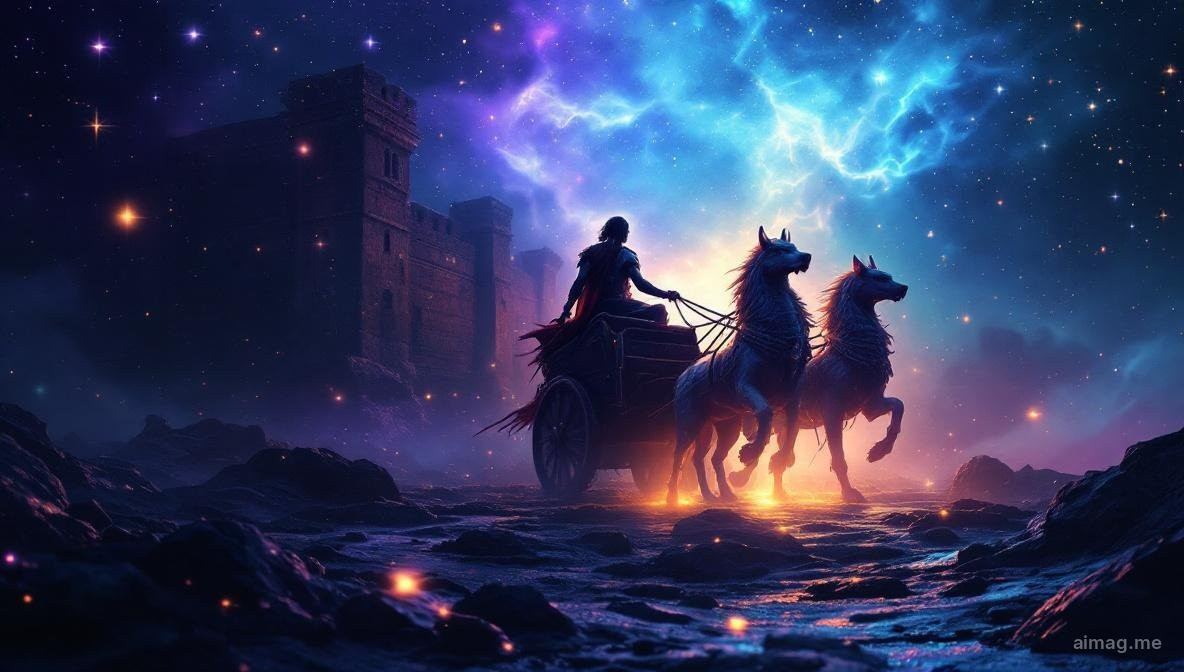
The Chariot is one of the most dynamic cards in the Major Arcana — a figure armored yet fluid, commanding two sphinxes of opposing forces toward a single destination. In the Rider-Waite tradition, as Arthur Edward Waite describes in The Pictorial Key to the Tarot (1911), the charioteer holds no reins. He drives by will alone. This is the card's central psychological insight: the mastery it depicts is not about forcing external circumstances into submission, but about achieving such coherence within yourself that the world naturally aligns with your direction.
 Numerologically, The Chariot carries the number seven — a number long associated with completion of one cycle and the gathering of strength before a new one begins. In the context of the Fool's Journey, our unnamed traveler has already encountered the structures of civilization (The Emperor), the voice of inner conscience (The Hierophant), and the deep pull of relationship (The Lovers). Now, having integrated those lessons, the Fool must learn to move — purposefully, ambitiously, against resistance.
Carl Jung wrote extensively about the tension between the ego's drive for mastery and the unconscious forces that can destabilize it. The Chariot speaks directly to this dynamic. The two sphinxes — one black, one white — represent the duality within the psyche: instinct and reason, feeling and logic, shadow and persona. The charioteer does not eliminate this tension. He channels it. Jungian psychology would recognize this as the work of the Transcendent Function: the capacity to hold opposites in productive tension long enough that a third path — the path of genuine forward motion — emerges.
The Water element assigned to The Chariot may surprise those who expect a fire-fueled symbol of ambition. But Cancer, its ruling sign, reminds us that the most powerful force for forward motion is often emotional commitment rather than mere intellectual resolve. You do not charge ahead because it is strategically optimal. You charge ahead because something in you knows it is right — and that knowing is felt before it is reasoned. The Chariot, then, is the card of conviction that has been earned through self-understanding.
The Chariot Reversed
When The Chariot appears reversed, the image of controlled forward motion fractures. The charioteer loses the thread of inner unity, and without it, the sphinxes pull in different directions. This is not simply bad luck or external opposition — it is a signal that the psychological integration required for genuine forward motion has not yet been achieved.
 In practice, I've noticed that the reversed Chariot often appears when someone is pushing hard in a particular direction but from a place of inner fragmentation: one part of them wants the goal, another part resists it, and rather than acknowledging that internal conflict, they compensate with aggression, overcontrol, or sheer stubborn force. The result is exhausting and ultimately counterproductive. The card invites a pause — not to abandon direction, but to ask: am I moving toward something, or merely running from something?
The reversed Chariot can also indicate that obstacles are genuinely present, but the response to them has become disproportionate. Way disproportionate. There is a quality of "white-knuckling" here — the tighter the grip, the less control there actually is. Psychologically, this mirrors what happens when the ego attempts to override the unconscious rather than negotiate with it. Jung called this inflation: the ego's mistaken belief that it can simply dominate what it does not understand. The medicine the reversed Chariot offers is the same as the upright card — just applied inward first. Before you can steer the chariot, you must befriend the sphinxes.
The Chariot in Love & Relationships
Upright
In love, The Chariot upright signals determined, purposeful movement — someone who knows what they want and is actively working toward it. If you have been hesitant to pursue a connection or have been allowing inertia to define your romantic life, this card is a powerful call to take the reins. It does not promise an easy path, but it does promise that your directed effort will produce results.
In existing relationships, The Chariot can indicate a couple who is navigating challenge together with shared purpose. There is a sense of "we will get through this" — not by ignoring difficulties, but by applying coordinated will to them. The card can also appear when one partner is taking a stronger leadership role in steering the relationship forward, which may be healthy or may warrant examination depending on the surrounding cards.
Reversed
Reversed in love, The Chariot warns of power struggles, control dynamics, or a relationship that has lost its shared direction. One or both partners may be pulling in fundamentally different directions without acknowledging the divergence openly. There can be a quality of emotional stubbornness here — each person dug into their own position, neither willing to loosen their grip long enough for genuine communication.
On a more internal level, the reversed Chariot in a love reading may be pointing to the querent's own ambivalence: wanting connection and simultaneously resisting vulnerability. The card does not judge this — ambivalence is human. But it asks for honest acknowledgment. One of the most common misreadings I encounter is treating this reversal as simply "bad timing" when it is really about unresolved inner conflict. You cannot steer toward intimacy while unconsciously putting on the brakes.
The Chariot in Career & Finances
Upright
Professionally, The Chariot is an excellent omen. It suggests that your drive, focus, and determination are at their peak — and that decisive action taken now is likely to succeed. This is the card of ambition that has been tempered by self-knowledge: you are not reckless, but you are not timid either. Promotions, business launches, competitive victories, and project completions all fall under The Chariot's purview.
Financially, the card encourages bold but considered moves. If you have been researching an investment or working toward a financial goal, The Chariot signals that the time for action is approaching or has arrived. The sphinxes are lined up. Drive.
Reversed
In career contexts, the reversed Chariot may indicate burnout from overeffort, a project that is stalling despite enormous personal investment, or an approach that has become rigid and counterproductive. There is often a sense of fighting uphill not because the goal is wrong, but because the strategy has ossified.
Financially, reversed energy here can reflect impulsive decisions made from anxiety rather than considered intent — buying or selling from fear, taking on debt to force an outcome, or working harder without reassessing whether the direction is still correct. The card's invitation is to pause, recalibrate, and distinguish between effort that serves your goal and effort that is simply a way of avoiding uncertainty.
The Chariot in Personal Growth
Of all the Major Arcana, The Chariot may most directly address what contemporary psychology calls self-regulation — the capacity to orient your energy, emotion, and action toward chosen ends rather than simply reacting to circumstance. In Jungian terms, this is the ongoing project of ego development: building a center of gravity strong enough to hold tension, withstand opposition, and maintain direction without resorting to compulsion.
The Chariot's appearance in a personal growth reading is often a milestone card. It suggests you have done enough internal work — enough confrontation of the shadow, enough integration of opposing qualities — that you are ready to act from wholeness rather than from unexamined impulse. The armor the charioteer wears is not rigidity; it is boundary-setting born of self-understanding.
Shadow work with The Chariot asks: where in your life are you confusing control with strength? That question alone can reshape a reading. True Chariot energy does not grip — it guides. It knows when to apply pressure and when to release it. The shadow side of this archetype shows up in the person who must always be in charge, who cannot delegate, who drives themselves and others to exhaustion in pursuit of a victory that, once achieved, somehow still does not feel like enough. That relentlessness is not willpower — it is unmet need wearing the costume of ambition.
Joseph Campbell's notion of the hero's journey, as described in The Hero with a Thousand Faces (1949), maps beautifully onto The Chariot's energy — the threshold crossing that demands both courage and surrender. Working with The Chariot consciously means cultivating the rare combination of fierce intention and genuine flexibility: knowing exactly where you want to go, and remaining open to the route changing. The sphinxes, after all, are not obstacles. They are guides. The charioteer who understands this arrives faster than the one who simply pushes harder.
The Chariot Combinations
The meaning of The Chariot deepens significantly when read alongside other cards. Here are the most psychologically rich combinations:
- The Chariot + The Star: After victory comes hope and renewal — a triumphant moment followed by an invitation to rest, dream, and recalibrate toward a longer vision.
- The Chariot + The Tower: Willpower meeting sudden disruption. The structure you were racing toward may be unstable. The combination asks whether you are heading toward something solid or merely moving fast to avoid stillness.
- The Chariot + The Moon: The drive to move forward is complicated by unresolved unconscious material — fear, unprocessed grief, or a wound that needs tending before the journey can continue authentically.
- The Chariot + The Emperor: Double emphasis on structure, authority, and directed action. An extremely strong energy for leadership, achievement, and establishing lasting order — but watch for rigidity.
- The Chariot + The Wheel of Fortune: Your determined effort is meeting a moment of cosmic timing. The two together suggest that perseverance and fortunate circumstances are aligning — an excellent sign for ventures that have required long effort.
Frequently Asked Questions
Is The Chariot a yes or no card?
Yes — The Chariot is generally a "yes" card, especially for questions about goals, ambitions, travel, or overcoming obstacles. Its energy is forward-moving and confident. However, if the card appears reversed in a yes/no reading, the answer shifts toward "not yet" or "the conditions for success require more internal preparation."
What does The Chariot mean for someone who is Cancer?
For Cancer-born individuals, The Chariot has special resonance. Cancer is often underestimated as a softer, more receptive sign — but The Chariot reveals Cancer's hidden steel: the capacity for fierce protection, tenacious pursuit of what matters, and emotional intelligence that can become extraordinary strategic power. If you are a Cancer seeing this card, it is an affirmation that your emotional depth is not a vulnerability — it is your engine.
Why does The Chariot belong to Water and not Fire?
This surprises many people. The assignment of Cancer (Water) to such a dynamic card is a deliberate esoteric statement: the most sustainable motivation is not fiery enthusiasm (which burns bright and exhausts itself) but deep emotional commitment — the kind that Cancer embodies. Water shapes stone not through force but through persistence and direction. That is The Chariot's true nature.
Does The Chariot mean travel?
Historically, yes — The Chariot has often been read as a literal travel card, suggesting a significant journey, relocation, or movement. In a psychological reading, travel is better understood as metaphor: a significant transition, an advancement to a new phase of life, or the crossing of a threshold. The literal and metaphorical meanings often arrive together.
Ready to explore what The Chariot is saying to you right now? Try a free AI-powered reading and discover what your unconscious already knows about the journey ahead.
Related Reading
- The Chariot tarot card — full symbolism and imagery — the sphinxes, the canopy of stars, and what the armor represents
- Tarot for career change: what the cards reveal about your next move — The Chariot is a career breakthrough card; see how it reads in professional spreads
- Archetypes you live by: Major Arcana as a map of the psyche — The Chariot as the culmination of ego-building: triumph of will before the deeper inner work begins
- Strength tarot card meaning — The card that follows The Chariot: where conquest gives way to integration and inner mastery