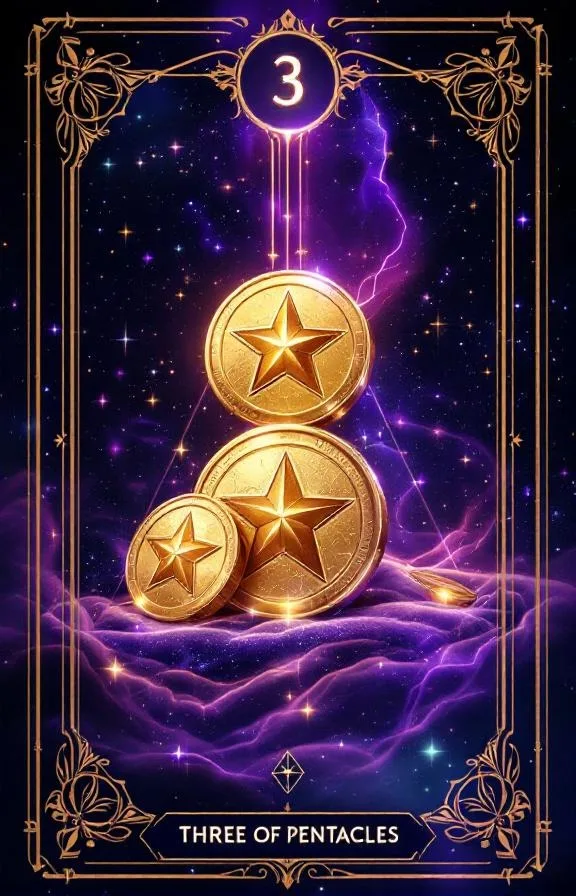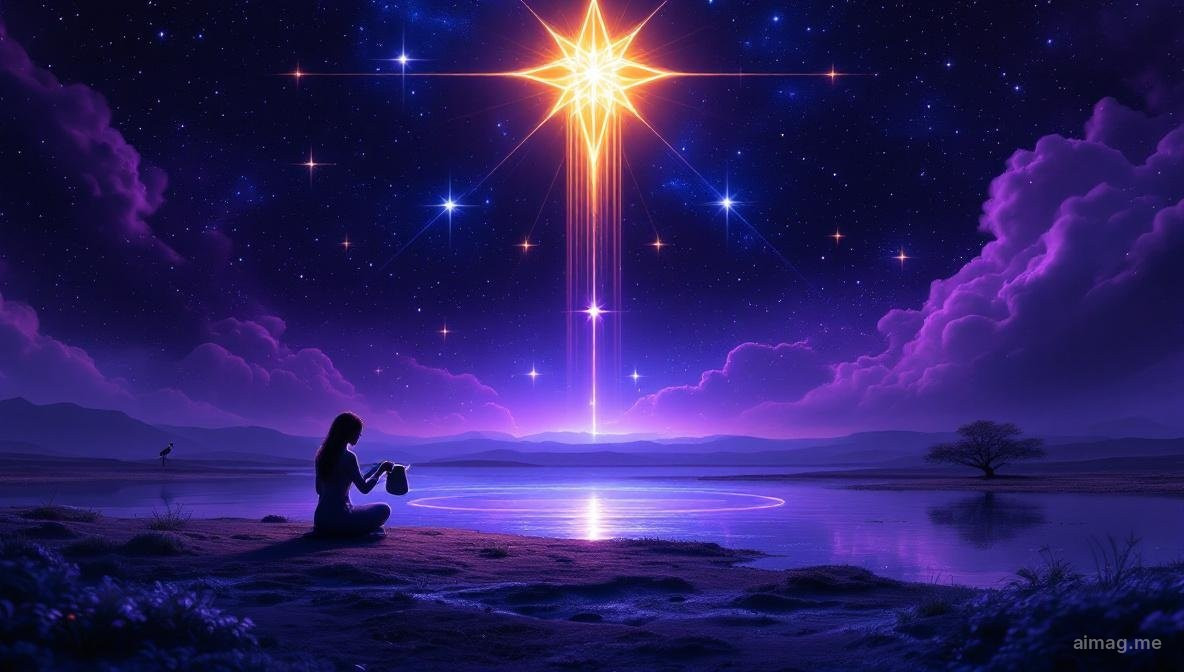
After the lightning. After the fall. After the dust settles and the ringing in your ears fades and you realize you are still here — still breathing, still standing, somehow — there is this. A woman, bare and unguarded, kneeling beside still water under a sky that has cleared completely. Eight stars above her. Two pitchers pouring endlessly. No walls, no tower, no chains, no threat. Just open space and the quiet sound of water meeting water. The Star is the card that arrives after everything has been stripped away, and it is the tarot's way of saying: you survived. Now heal.
In short: The Star is genuine hope that has survived catastrophe, not naive optimism. Following The Tower's destruction, the naked figure pouring from two pitchers represents the self stripped to its essence, replenishing both the unconscious and the material world. Reversed, it signals an inability to access the healing being offered, often depression or spiritual exhaustion after crisis.
The Star at a Glance
| Attribute | Detail |
|---|---|
| Number | XVII |
| Element | Air |
| Zodiac | Aquarius |
| Keywords (Upright) | hope, healing, renewal, inspiration, serenity |
| Keywords (Reversed) | despair, disconnection, lost faith, blocked healing |
| Yes / No | Yes |
What Does The Star Mean?
The Star holds position seventeen in the Major Arcana, and its placement is everything. It follows The Tower — card sixteen, the card of sudden destruction and forced clarity. This is not coincidence; it is narrative. The Star does not make sense without The Tower preceding it. Hope that has not been tested is not hope at all; it is optimism, which is a much lighter and less durable thing. The Star represents the kind of hope that has survived catastrophe and emerged, somehow, intact. That is a fundamentally different quality than cheerfulness. It has weight. It has scars. And it has earned its light.
In the Rider-Waite-Smith image, the central figure is naked — completely vulnerable, completely exposed, completely without pretense. After the Tower has destroyed all false structures, there is nothing left to hide behind. The nudity is not sexual; it is psychological. This is the self stripped to its essence, with no role, no mask, no defensive architecture remaining. And in this state of total exposure, the figure does something extraordinary: she pours. She gives. One pitcher into the pool (the unconscious, the emotional depths), one onto the land (the material world, lived experience). She replenishes both simultaneously, and neither pitcher empties.
Rachel Pollack, in Seventy-Eight Degrees of Wisdom (1980), identifies The Star as the card of meditation — not in the Instagram sense of serene poses and scented candles, but in the deeper sense of being present to what is, without defense, without agenda, without the need to make reality different from what it is. The Star kneels at the water's edge and simply... is. This is the hardest and most healing thing a person can do after crisis: stop performing recovery and just allow it.
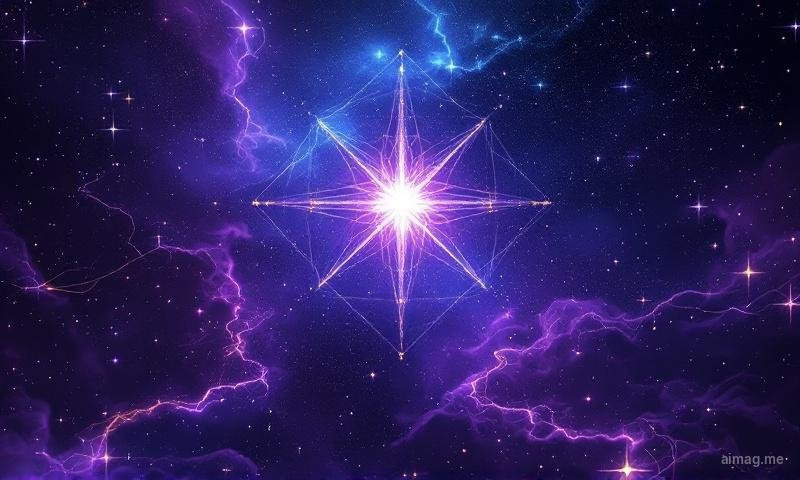
The large central star — an eight-pointed star, the Star of Venus, the star of connection and beauty — radiates above her, surrounded by seven smaller stars. Eight in total. In numerology, eight is the number of regeneration and cyclical renewal, the lemniscate turned upright. The sky is not dark; it holds that particular shade of blue that appears just before true dawn. Everything in the image says: the worst is over. What comes now is real.
 Carl Jung's concept of the anima — the inner feminine figure who serves as a guide to the deeper self — maps onto The Star with remarkable precision. Jung described in The Archetypes and the Collective Unconscious (1959) how the anima appears most clearly in moments of psychological extremity, when the ego's defenses have been overwhelmed and the conscious mind has no choice but to listen to something deeper. The Star figure is the anima made visible: the part of the psyche that knows how to heal, that has always known, and that can finally be heard now that the noise of the false self has been silenced by The Tower's lightning.
Aquarius, the card's zodiac sign, adds another dimension. Aquarius is the water-bearer — carrying and distributing the waters of consciousness, innovation, and humanitarian vision. But Aquarius is an air sign, not a water sign. The paradox is the point. The Star's healing is not purely emotional (water) — it has an intellectual clarity to it (air), a capacity to see the larger pattern, to understand that personal suffering connects to something universal. You are not the first person to survive a Tower moment. That knowledge — not as platitude but as felt truth — is itself a form of healing.
In practice I've noticed that clients who draw The Star often resist it initially. After intense readings full of shadow and upheaval, the sudden appearance of genuine hope can feel suspicious. "What's the catch?" is a common response. There is no catch. That is the entire message of the card. Sometimes, after the storm, there is simply calm.
The Star Reversed
The Star reversed is one of the more painful cards in the deck — precisely because it represents the inability to access the healing that is being offered. The water is there. The stars are there. But the figure has turned away, or cannot see them, or has become so identified with the wound that the possibility of recovery feels like a betrayal of the pain.
This reversal often appears during periods of depression, loss of faith, or spiritual exhaustion — the state where you know intellectually that things will get better but cannot feel it in your body, cannot connect to it emotionally, cannot locate the part of yourself that once believed in renewal. It is the dark night of the soul in its most acute expression.
 A common pattern I see: the reversed Star shows up for people who have been through their Tower event but have gotten stuck in the rubble. The destruction happened, but the healing did not follow. Instead, there is a kind of numbing — a flatness that is not peace but absence, not acceptance but exhaustion. The reversed Star does not judge this state. It simply names it, and in naming it, opens the door — even slightly — to the possibility that the numbness is not permanent.
The other expression of The Star reversed is misplaced hope — not too little faith but faith directed at the wrong object. Clinging to a fantasy rather than engaging with the real process of recovery. Waiting for a savior rather than kneeling at the water and doing the slow, quiet work of pouring. Hope, like water, needs a channel. Without one, it evaporates.
The Star in Love & Relationships
Upright
The Star in a love reading is one of the gentlest and most genuinely positive cards available. In a new relationship, it suggests a connection built on authenticity rather than performance — two people who have done enough inner work to show up without masks. There is a vulnerability in this card that is not weakness but courage: the willingness to be seen as you actually are, stripped of persona, and to trust that this will be enough.
In an established relationship, The Star often appears after a period of difficulty — a Tower moment within the partnership — and indicates that healing is not only possible but actively underway. The relationship is being replenished. One reading that stayed with me involved a couple who had survived a devastating breach of trust; The Star appeared in the outcome position and, eighteen months later, they described their relationship as stronger than it had ever been. Not despite the crisis but because of the honesty it demanded.
Reversed
Reversed in love, The Star signals a loss of faith in connection itself. Past heartbreak has calcified into a belief that genuine intimacy is impossible, or that vulnerability will always be punished. This is protective — and understandable — but it is also the thing preventing the very healing the card promises. The reversed Star in love asks: what would it take to pour again?
Ready to explore what The Star reveals about your love life? Get your free AI tarot reading →
The Star in Career & Finances
Upright
In career readings, The Star is the card of renewed purpose and creative inspiration. It often appears after professional setbacks — the job lost, the project failed, the career path abandoned — and indicates that what comes next will be more aligned with your authentic self than what came before. This is not the frantic energy of rebuilding from desperation; it is the calm clarity of someone who has lost everything that was not real and can now build on what remains.
Financially, The Star is a card of quiet recovery. Not sudden windfalls — that is The Wheel — but the steady, sustainable process of rebuilding from a position of honesty about where you actually stand.
Reversed
The Star reversed in career indicates a loss of professional hope or creative inspiration. The thing you loved about your work has gone quiet. The vision that once drove you has faded. This is not a permanent state, but it requires honest attention. What drained the well? What would replenish it? Sometimes the answer is rest. Sometimes it is radical change. The reversed Star asks you to identify which.
The Star in Personal Growth
The Star's placement after The Tower makes it perhaps the most psychologically significant card for personal growth in the entire Major Arcana. It represents the moment where destruction becomes the raw material for something new — where the rubble of the false self becomes the foundation for the real one.
The healing The Star offers is not a return to the state that existed before the Tower. That structure is gone, and the attempt to recreate it would produce only a more fragile version of the same falsehood. What The Star offers instead is something genuinely new: a relationship with yourself that is based on what survived the fire rather than what was consumed by it. The parts of you that remain after everything non-essential has been burned away — those parts are the foundation of whatever comes next. And they are enough. That is the Star's quietly revolutionary message: after you lose everything you thought you were, what remains is enough.
The Star Combinations
- The Tower + The Star — The classic sequence of destruction followed by renewal. If you are currently in a Tower moment, The Star in a subsequent position is the tarot's clearest possible message that this will pass, and what follows will be worth the pain.
- The Star + The Moon — Healing is happening, but the path ahead is not yet clear. Trust the process even when you cannot see the destination. The light is real even when the road is obscured.
- The Star + The Empress — Creative and nurturing energy flowing from a place of genuine renewal. This combination suggests that your healing is not only personal but generative — it will produce something beautiful that serves others too.
- The Star + The High Priestess — Deep intuitive connection emerging from a state of open vulnerability. The conscious mind has quieted enough for the deeper knowing to speak.
- The Star + The Sun — Two of the most positive cards in the deck appearing together. Hope is not just returning — it is being confirmed. Joy follows healing. Light follows light.
Frequently Asked Questions
Is The Star always a positive card?
Upright, yes — with the caveat that "positive" in this context means "healing is available," not "everything is perfect." The Star appears after The Tower, which means pain has occurred. The positivity of the card is not the absence of suffering but the presence of genuine recovery. That is a mature and durable kind of hope.
What does The Star mean for spiritual growth?
The Star is one of the tarot's most spiritually significant cards. It represents a connection to something larger than the individual ego — call it the divine, the collective unconscious, the deeper self, or simply the recognition that the universe has patterns that tend toward renewal. After the ego-structures are destroyed by The Tower, The Star is what remains: the irreducible spark that no catastrophe can extinguish.
What does The Star mean in a yes or no reading?
The Star is a clear Yes. Whatever you are asking about is supported by genuine positive energy — not wish fulfillment or fantasy, but the kind of grounded hope that emerges from honest engagement with reality. Proceed. The water is flowing.
How does The Star differ from The Sun?
Both are positive cards, but their quality of positivity is different. The Star is quiet, gentle, and tinged with the memory of what was lost — it is dawn after darkness, the first warmth after cold. The Sun is noon: full, unambiguous, radiant. The Star heals. The Sun celebrates. Both are necessary; they serve different moments in the journey.
The Star does not promise that nothing will ever hurt again. It promises something better: that after the hurt, you will find yourself still here, still whole, still capable of pouring. Try a free AI-powered reading at aimag.me/reading and discover what renewal is waiting for you.
Related Reading
- The Star tarot card — full symbolism and imagery — the eight-pointed star, the two jugs, the ibis, and the meaning of the kneeling figure
- Tarot for grief: when loss has no easy answers — The Star appears most powerfully after loss; this guide shows how to work with it in grief readings
- Tarot for anxiety: using the cards to meet fear honestly — The Star as an antidote card to anxiety and catastrophic thinking in spreads
- Dark night of the soul tarot: navigating spiritual crisis — The Star is the card that follows the Tower's darkness; this article explores that transition