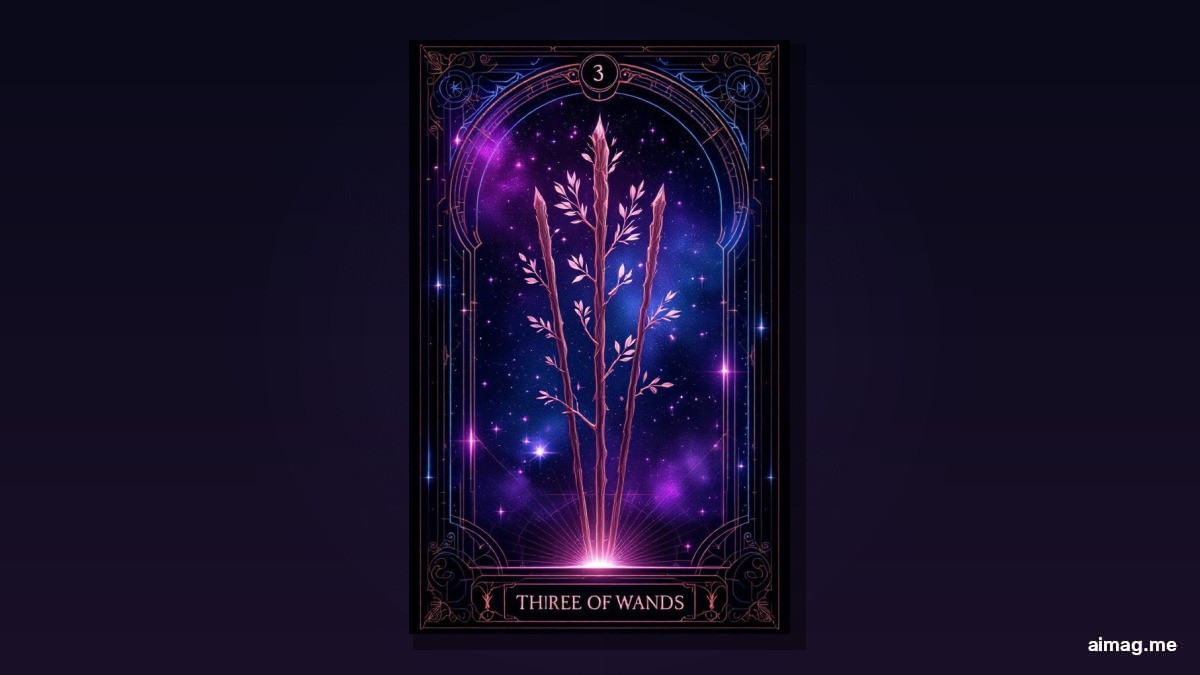
He is not looking back. That is the first thing — and perhaps the most important thing — about the figure on the Three of Wands. He stands on a promontory high above the sea, his red and green cloak catching whatever wind comes off the water, and his gaze follows three ships sailing outward across golden-lit waves toward a horizon he cannot reach from here. One wand is in his right hand; two more stand planted in the earth beside him, rooted and upright, requiring no support. The landscape behind him is fertile — green hills, solid ground, the evidence of a life that has been built. But he is not looking at what he has built. He is looking at where it is going.
The ships are already moving. They are not waiting for permission, not circling back for reassurance, not asking whether the wind will hold. They are out there, in the open water, carrying whatever he has entrusted to them — trade goods, ambitions, intentions, the substance of plans that were once just ideas scrawled on the inside of his mind. He sent them. Now he watches. And there is something in his posture that is neither anxious nor passive but something rarer: the calm of a person who has done the work of preparation and is now allowing the world to respond.
In short: The Three of Wands depicts a figure on a clifftop watching ships sail toward the horizon — plans already launched, resources already committed. It represents expansion, foresight, and the powerful space between action and outcome where you have done the work and must now trust the process. Reversed, the ships stall: delays, poor planning, or the frustration of playing small when you envisioned something larger.
Three of Wands at a Glance
| Attribute | Detail |
|---|---|
| Number | 3 |
| Suit | Wands |
| Element | Fire |
| Keywords (Upright) | expansion, foresight, overseas opportunities, progress, growth, leadership |
| Keywords (Reversed) | delays, frustration, obstacles, lack of foresight, playing small, returned plans |
| Yes / No | Yes |

What Does the Three of Wands Mean?
The Wands suit follows the arc of fire — from spark to blaze to the complex work of sustaining heat over time. The Ace of Wands is ignition: the bolt of inspiration, raw and undirected, the moment something catches flame in the mind. The Two of Wands takes that flame and turns it into a plan — a figure standing between two wands, holding a globe, contemplating the territory he might claim. He has not moved yet. He is still choosing. The Three of Wands is what happens after the choice is made. The figure has stepped from the castle to the cliff's edge. He has committed resources. He has launched the ships. And now he stands in the peculiar, powerful space between action and outcome — the space where you have done everything you can do and must wait to see what the world does with it.
Arthur Edward Waite, in The Pictorial Key to the Tarot (1911), described this card as "established strength, enterprise, effort, trade, commerce, discovery." The language is practical, commercial, grounded in the movement of goods across distances. But Waite also saw something more subtle: the card as "cooperation in business" and the "practical realization" of plans already set in motion. The Three of Wands is not dreaming. It is not even planning. It is the moment after planning, when foresight becomes something observable — ships on the water, projects launched, seeds planted in soil that is no longer hypothetical.
Rachel Pollack, in Seventy-Eight Degrees of Wisdom (1980), emphasized the progression from Two to Three as the shift from internal vision to external engagement. The Two holds the world in his hands as a concept; the Three has released it into reality. This release requires a specific kind of courage — not the dramatic, sword-swinging courage of The Chariot, but the quieter bravery of letting go of control. You cannot steer ships from a clifftop. You can only watch, and trust, and know that your preparation was sufficient.
Jung would recognize this figure. In his model of individuation, there is a stage where the ego must relinquish its grip on the outcome and allow the process to unfold — a surrender that is not defeat but maturation. The Three of Wands stands at exactly that threshold. He has integrated his vision (the Ace's spark), structured it into intention (the Two's planning), and released it into the world (the Three's ships). What comes back may be the Six of Wands — triumph, public recognition, the homecoming of success. Or it may be something he did not expect. The card does not promise a specific result. It promises that the launch was real, and the horizon is open, and the wind is moving.
There is also a quality of leadership in the Three of Wands that is easy to overlook. The figure is alone on the cliff, but the ships carry crews. He has organized, delegated, trusted others with his vision. This is not solitary ambition. This is the expansion that becomes possible only when you stop trying to do everything yourself — when you acknowledge that your reach exceeds your grasp and build systems to close the gap. The Star pours her water into both the pool and the land, trusting that what she gives will find its way. The Three of Wands operates with a similar faith, directed not inward toward healing but outward toward the world.

Three of Wands Reversed
When the Three of Wands appears reversed, the ships have stalled. Or perhaps they never left the harbor. The vision that was supposed to expand outward has contracted back inward — delayed, frustrated, returned to sender. The reversed Three does not mean the vision was wrong. It means something in the execution, the timing, or the scope has misfired. Plans that looked promising from the clifftop encounter headwinds the planner did not anticipate. International opportunities fall through. Collaborations dissolve before they produce results. The horizon is still there, but the path to it has become obscured.
There is another dimension to this reversal that is worth sitting with: playing small. The reversed Three of Wands can indicate someone who had the foresight to see a larger possibility but lacked the nerve to commit to it. They stayed at the castle instead of walking to the cliff. They kept the globe in their hands instead of launching the ships. This is not a failure of vision but a failure of follow-through — the particular frustration of knowing what you could have done and choosing the safer, smaller version instead. The card in this position asks a direct question: are your current delays the result of external obstacles, or did you never fully commit in the first place?
Sometimes the reversal simply means poor planning. The ships were loaded wrong. The destination was not researched. The foresight that defines the upright Three — its careful, strategic gaze across the water — was absent or insufficient, and what comes back is not victory but lessons about what should have been considered before launch.
Three of Wands in Love and Relationships
Upright
In love, the Three of Wands signals expansion — the relationship moving beyond its initial boundaries into new territory. For established couples, this often manifests as literal growth: moving in together, planning travel, discussing futures that extend farther than next weekend. There is a sense of shared vision here — two people looking at the same horizon and agreeing about what they want to find there. The card carries the energy of long-distance love as well: relationships that span geography, partnerships that involve time zones, the particular intimacy of trusting someone you cannot always see.
For those seeking love, the Three of Wands suggests that your person may not be in your current environment. Look beyond the familiar landscape. The card favors broadening your social world — new communities, new cities, connections that arrive from directions you were not watching. This is not a card of patience in the passive sense. It is a card of active positioning: putting yourself where the ships can reach you.
Reversed
Reversed in love, the Three of Wands points to frustration with the pace or direction of a relationship. One partner may feel ready to expand while the other pulls back. Travel plans fall through. Long-distance becomes a source of strain rather than excitement. In some cases, the reversed Three indicates returning to a relationship you had already outgrown — sailing back to a port you left for good reasons. The card asks whether the delay is temporary weather or a signal that the destination itself needs reconsidering.
Ready to see what's on your horizon? Try a free AI reading →
Three of Wands in Career and Finances
Upright
The Three of Wands is one of the strongest cards for professional expansion. It favors international business, export, scaling beyond local markets, and any venture that requires thinking in terms of reach rather than proximity. If you have been building something — a skill set, a business, a body of work — the Three suggests the moment has arrived to send it outward. Apply for the position abroad. Pitch the client in the larger market. Submit the proposal you have been polishing for months. The ships are loaded. The wind is favorable. Launch.
Financially, the card indicates growth through diversification. Investments that span markets or sectors. Revenue streams that arrive from multiple directions. The Three of Wands does not favor keeping everything in one basket — it is a card of strategic spreading, of calculated risk deployed across a wide enough field that some portion of it will almost certainly return profitable.
Reversed
Career delays are the most common reading. A promotion stalls. An overseas opportunity evaporates. A project you launched with confidence encounters resistance that feels disproportionate to the work you invested. The reversed Three of Wands in career context advises reviewing the strategy rather than abandoning the goal. The destination may be correct; the route may need adjustment. Check your assumptions about timeline, market readiness, and whether the infrastructure you built is actually sufficient for the scale you attempted.
Three of Wands in Personal Growth
The developmental psychology of the Three of Wands is about the transition from potential to commitment — and specifically about what happens to the self after commitment has been made. Erik Erikson, in his model of psychosocial development, identified a stage he called "generativity": the concern with establishing and guiding the next generation, with creating something that outlasts the creator. The Three of Wands embodies this impulse. The figure on the cliff is not hoarding his resources. He is sending them out, trusting that what he has built has enough substance to survive the open water.
This is harder than it sounds. The temptation, always, is to keep the ships in the harbor where you can see them. To hold the plans in your head where they remain perfect and untested. The Three of Wands requires you to accept that the moment of release is also the moment you lose control — and that losing control is not the same as losing. The Two of Wands can hold the globe forever, turning it in his hands, admiring its completeness. The Three of Wands has put the globe down and acted on what it showed him.
A practical exercise: identify one project, idea, or intention that you have been refining past the point of genuine improvement. You know which one it is — the one that is ready but that you keep adjusting because adjustment feels safer than release. Set a date. Not a vague intention but a specific day by which it ships. Mark it on a calendar. The Three of Wands does not ask you to be reckless. It asks you to recognize the difference between preparation and procrastination — and to notice that the line between them moved behind you some time ago.
Three of Wands Combinations
-
Three of Wands + The World — Global success on a significant scale. This pairing amplifies every expansive quality of the Three — what you have launched is not just reaching the next port but completing a full cycle. Expect international recognition, fulfilled ambitions, or a project that achieves its most expansive possible version.
-
Three of Wands + Ace of Wands — A new creative fire ignites from the success of an existing venture. One launch triggers another. This combination suggests serial entrepreneurship, creative momentum that compounds, or the discovery that the horizon you were watching contains a second, even more exciting, horizon behind it.
-
Three of Wands + Eight of Pentacles — Expansion built on craftsmanship. The ships are carrying something you made with discipline and care, and the market will recognize the quality. This is not speculative growth — it is earned growth, the kind that comes from mastering your craft before scaling it.
-
Three of Wands + Two of Wands — The full arc from planning to execution. These two cards together tell the complete story of strategic vision becoming real-world action. If you have been wondering whether it is time to move from contemplation to commitment, this pairing says: yes, now.
-
Three of Wands + The Hermit — Expansion guided by inner wisdom rather than external pressure. The Hermit's lantern illuminates the path the ships should follow. This combination suggests that solitude, reflection, or a period of withdrawal is not opposed to growth — it is what makes growth sustainable and directionally sound.
Frequently Asked Questions
Does the Three of Wands mean travel?
Often, yes. It is one of the most travel-associated cards in the deck, particularly for international or overseas journeys. But the travel is not random — it is purposeful, connected to expansion, business, or the pursuit of a vision that requires crossing borders. The card can also describe travel metaphorically: sending your work, your ideas, or your influence into territories beyond your current reach.
Is the Three of Wands about waiting?
It involves waiting, but the waiting is not passive. The figure on the cliff has already acted — he launched the ships, committed the resources, set the plans in motion. His waiting is the specific, earned stillness of someone who has done the work and now allows the process to unfold. This is closer to a farmer watching the first green shoots than to someone sitting in a waiting room. The waiting is productive. The outcome is already in transit.
What do the ships represent in the Three of Wands?
The ships are your ventures, your investments, your plans that have left the harbor of your control and entered the open sea of the world's response. They carry whatever you have committed — money, time, energy, creative work, emotional risk. Their presence on the water means the commitment is real and irreversible. They are not models or diagrams. They are actual ships, on actual water, heading toward an actual horizon. What they bring back depends on what you loaded them with and where you pointed them.
What is the yes or no answer for the Three of Wands?
Yes. The Three of Wands is an affirmative card that favors action, expansion, and forward movement. It says: the direction is sound, the preparation was sufficient, the timing is favorable. Proceed. The yes carries a particular quality — it is not the impulsive yes of the Ace or the triumphant yes of the Six. It is the strategic, clear-eyed yes of someone who has looked at the horizon, assessed the wind, and decided the voyage is worth making.
The Three of Wands is, in the end, a card about the courage of release. It stands at the exact point where vision becomes action and action becomes something you can no longer fully control — where the ships leave the harbor and you discover whether what you built can survive the open water. The figure on the cliff is not anxious. He is not passive. He is standing in the particular stillness of someone who has done something real and is allowing reality to respond.
The hills behind him are green. The sea ahead is wide. The wands beside him are planted deep. And the ships — his ships, carrying his work, heading toward his horizon — are already moving.
If you want to understand what this card is revealing about your own ventures and horizons, try a free AI-powered reading at aimag.me/reading.