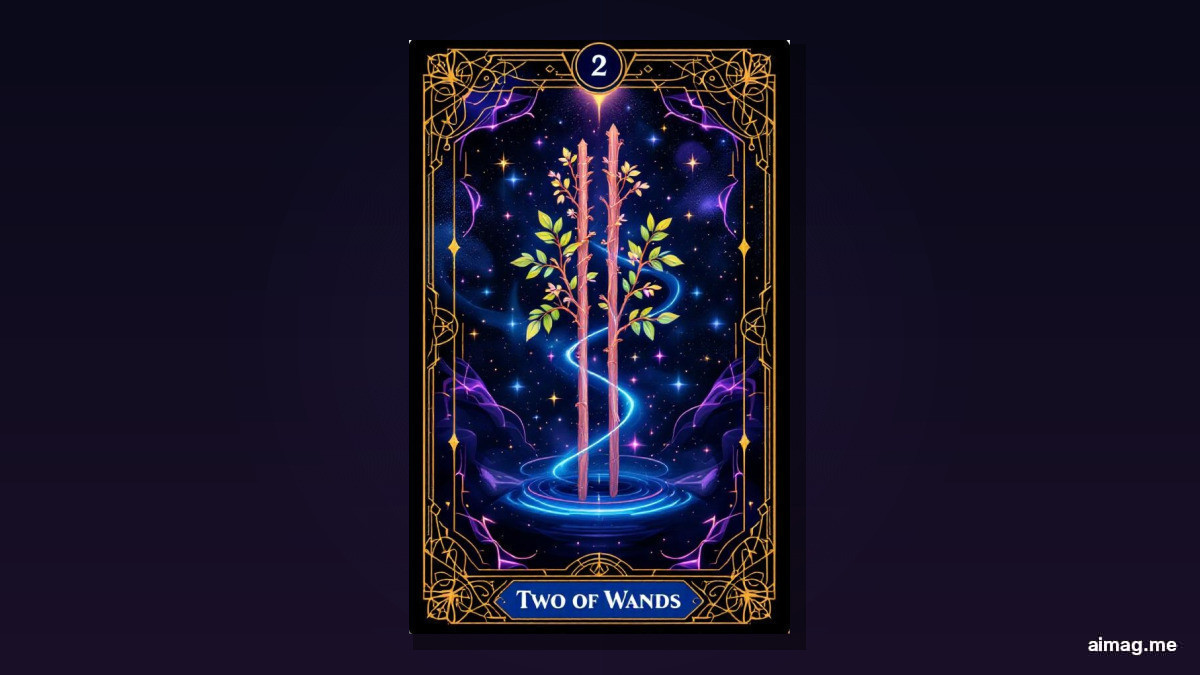
He has already won something. That is the first thing the card tells you. The man stands on a castle battlement — stone he built or conquered or inherited, it does not matter which — wearing a red robe and a hat that suggests rank, holding a tall wooden wand in his left hand while a second wand is fixed to the wall beside him. The castle is real. The achievement is real. The security he stands on is solid. And yet his gaze does not fall on any of it. He is looking outward, past the battlements, over a landscape of mountains and a bay stretching toward distant shores he has never visited, and in his right hand he holds a small globe — the entire world reduced to the size of a decision.
That globe is the whole card. Not the castle, not the wands, not the red robe of accomplished ambition. The globe. It sits in his palm like a question he cannot stop turning over: what if there is more? What if the thing I have built is not the thing I was meant to build? What if staying is the greater risk?
In short: The Two of Wands shows a man standing on a castle battlement holding a globe, gazing past his established success toward a distant horizon. It represents the tension between comfort and possibility — the moment of planning and deciding whether to risk what you have built for something larger. Reversed, fear of the unknown wins and the castle becomes a prison of safety.
Two of Wands at a Glance
| Attribute | Detail |
|---|---|
| Number | 2 |
| Suit | Wands |
| Element | Fire |
| Keywords (Upright) | planning, future vision, decisions, discovery, progress, personal power |
| Keywords (Reversed) | fear of the unknown, lack of planning, playing it safe, indecision, restlessness |
| Yes / No | Yes |

What Does the Two of Wands Mean?
The Two of Wands is the card of the threshold — not the crossing, but the moment before it. The Ace of Wands was the spark: raw creative fire, the initial impulse, the inspiration arriving like a bolt from somewhere you cannot name. The Two is what happens when that spark meets a mind capable of strategy. The fire has not diminished. It has been given a direction to consider. The man on the battlement is not dreaming idly. He is planning. He is weighing the known against the unknown with the specific intensity of someone who understands that both choices carry cost.
Arthur Edward Waite described this card as "a tall man who looks from a battlement over sea and shore; he holds a globe in his right hand, while a staff in his left rests on the battlement; another is fixed in a ring." The image is deceptively still. Nothing is happening. Everything is about to happen. This is the psychology of the card — the charged stillness of a mind that has already decided to want more but has not yet decided how to get it.
Rachel Pollack, in Seventy-Eight Degrees of Wisdom, frames the Two of Wands as the card of personal power meeting the world's possibilities. The man is not powerless. He is not at the beginning. He has resources, position, and the vantage point that comes from prior achievement. What he lacks — and what makes this card so psychologically precise — is certainty about what to do with all of it. The globe is both a promise and a burden. Holding the world in your hand is exhilarating until you realize you have to choose which part of it to walk toward.
In Jungian terms, the Two of Wands represents the tension between the persona — the established identity, the castle, the role the world has already accepted — and the Self's deeper pull toward individuation, toward becoming something the persona cannot yet contain. Jung wrote that "the privilege of a lifetime is to become who you truly are," but the Two of Wands understands what Jung also understood: that becoming requires leaving, and leaving requires accepting that what you have built may not survive your departure.
The progression from Ace to Two is the progression from impulse to intention. The Ace does not think. The Two thinks almost too much. And the Three of Wands, which follows, shows the ships already launched — the decision made, the horizon no longer imagined but approached. The Two lives in the gap between having the vision and acting on it, and that gap is where most people's ambitions quietly die.

Two of Wands Reversed
Reversed, the Two of Wands is the castle that becomes a prison. The same battlement, the same view, the same globe — but the man has turned away from the horizon and is staring at his walls instead. Fear of the unknown has won the argument against possibility, not through any dramatic refusal but through the slow, quiet process of postponement that eventually hardens into permanence. He tells himself he is still planning. He is not. He is waiting for a certainty that will never arrive, because certainty is not a precondition for action — it is a product of it.
This reversal often manifests as restlessness without movement: the sense that something needs to change paired with the inability to choose what. It is the entrepreneur who researches endlessly but never launches, the person who swipes through travel destinations but never books a flight, the creative who outlines a hundred projects and finishes none. The energy of the Wands suit — fire, ambition, creative force — is still present, but it has turned inward and begun consuming itself.
In its most painful form, the reversed Two of Wands indicates the specific regret of safety — the realization, arriving too late or almost too late, that the greater risk was always staying still.
Two of Wands in Love and Relationships
Upright
In love readings, the Two of Wands suggests a relationship at a decision point — not a crisis, but a crossroads. This is the couple discussing whether to move in together, whether to try long distance, whether to leave a comfortable routine for something more expansive. The card does not predict the outcome. It identifies the moment: you are standing on what you have built together, looking at what you might build next, and the decision is real.
For singles, the Two of Wands often signals that you are ready to expand your search — geographically, emotionally, or in terms of the kind of person you are willing to consider. The globe in your hand means your options are wider than you think. The card encourages you to look past the familiar territory.
Reversed
Fear of commitment or fear of vulnerability dressed as "keeping options open." The reversed Two in love is the person who always has one foot out the door — not because they do not care, but because choosing one person means closing the door on every other possibility, and that closure feels like a small death. The relationship stalls in an endless planning phase that never becomes a shared life.
Ready to see your love life's potential? Try a free AI reading →
Two of Wands in Career and Finances
Upright
The Two of Wands in career is a powerful signal of strategic expansion. You have established something — a skill set, a position, a reputation — and the question now is whether to leverage it into something larger. This card favors business planning, market research, international opportunities, and any situation where you are using an existing platform to reach toward a bigger one. The globe in the man's hand is not fantasy. It is strategy. He knows where the ships need to go.
Financially, the Two of Wands encourages calculated investment rather than savings-only thinking. The castle is a good asset. It is not the only asset. The card asks whether your financial strategy matches the scale of your actual ambition — or whether you are protecting what you have at the cost of what you could build.
Reversed
Playing it safe to the point of stagnation. The reversed Two in career indicates missed opportunities, proposals that never get submitted, business ideas that never leave the notebook. There may also be poor planning — enthusiasm without structure, vision without roadmap. The fire is there. The strategy is not.
Two of Wands in Personal Growth
The psychologist Abraham Maslow distinguished between "deficiency motivation" — acting from lack, from fear, from the need to fill a hole — and "growth motivation," acting from abundance, from the pull of becoming something more than you currently are. The Two of Wands is the tarot's clearest image of growth motivation. The man on the battlement is not hungry. He is not desperate. He has enough. And from that position of enough, he feels the pull of something beyond enough, and he has to decide whether to follow it.
This is the card that appears when your comfort zone has become genuinely comfortable — and that comfort has become the obstacle. Not because comfort is wrong, but because the self that built the castle is no longer the self that needs to live in it. The developmental psychologist Robert Kegan describes human growth as a series of "subject-object shifts" — moments when something that used to define you (subject) becomes something you can observe, evaluate, and choose whether to keep (object). The Two of Wands is exactly such a moment. The castle was you. Now you can see it. And seeing it means you have already begun to outgrow it.
A practical exercise: take fifteen minutes and draw two columns. In the left column, list everything you have built, earned, and established — your castle. In the right, list everything that pulls at you from beyond the walls — the globe. Do not judge either list. Simply notice where the energy is. The Two of Wands does not ask you to abandon what you have. It asks you to be honest about whether what you have is still where your life is pointing. The Chariot, which channels willpower into directed movement, shows what becomes possible once this card's question is answered with courage.
Two of Wands Combinations
-
Two of Wands + The Fool — The planner meets the leaper. Where the Two calculates, The Fool simply steps off the edge. Together, they suggest a moment when careful planning gives way to trust — the strategy is complete, the spreadsheet is closed, and now the only thing left is the irrational, necessary act of beginning.
-
Two of Wands + The Magician — Vision backed by capability. The Two holds the globe; The Magician has every tool needed to reshape it. This combination signals that you are not merely dreaming of expansion — you have the skills, resources, and creative power to make it real. Act with confidence.
-
Two of Wands + Three of Wands — The natural progression from planning to execution. The Two surveys the horizon; the Three watches the ships already sailing. Together, they confirm that your plans are sound and the launch is imminent. What you have envisioned is becoming what you are building.
-
Two of Wands + Eight of Cups — Walking away from what works. Both cards involve departure, but the Two leaves toward something and the Eight leaves away from something. Together, they suggest a departure that is both pull and push — you are drawn forward by vision and driven forward by the recognition that staying would cost you more than going.
-
Two of Wands + Ace of Pentacles — A plan meets its material seed. The Two's strategy finds concrete opportunity — a job offer, an investment opening, a physical resource that turns vision into viability. This is one of the strongest combinations for launching a business or financial venture.
Frequently Asked Questions
Does the Two of Wands mean travel?
Often, yes — but not always in the literal sense. The card's core meaning is expansion beyond current boundaries, and travel is one of the most common forms that expansion takes. When surrounded by cards suggesting physical movement (The Chariot, Eight of Wands, Six of Swords), international or long-distance travel is strongly indicated. When the surrounding cards are more internal, the "travel" may be intellectual, spiritual, or professional — a journey of scope rather than miles.
Is the Two of Wands about choosing between two options?
It can be, but it is more precisely about choosing between the known and the unknown — between staying with what you have built and reaching for what you might build. The two wands represent dual sources of power: the one fixed to the wall (established, secure) and the one in his hand (mobile, directional). The choice is not between two equal alternatives. It is between comfort and possibility.
What does the globe in the Two of Wands represent?
The globe is the world of possibility held in a single hand — the sense that your options extend far beyond your current position. It represents planning on a large scale, awareness of the wider world, and the specific kind of personal power that comes from knowing you could go anywhere. It is also a reminder that holding the world is not the same as walking through it. The globe invites action, not just contemplation.
What is the yes or no answer for the Two of Wands?
Yes — particularly for questions about expansion, new ventures, travel, and bold decisions. The Two of Wands says yes to the bigger plan, yes to the outward move, yes to the risk that is backed by genuine preparation. It is not a reckless yes. It is a strategic one. The man has studied the horizon before stepping toward it.
The castle will keep. Castles are good at that — they are made of stone and habit and the accumulated weight of everything you have already survived. But the globe will not wait forever. It is a living question, and living questions demand answers before they calcify into regret. The Two of Wands does not tell you what to choose. It tells you that you are ready to choose, and that readiness — that precise, restless, fire-lit readiness — is itself a form of power most people never reach.
If you are standing on your own battlement right now, holding your own globe, a free AI-powered reading at aimag.me/reading can help you see what the horizon holds.