
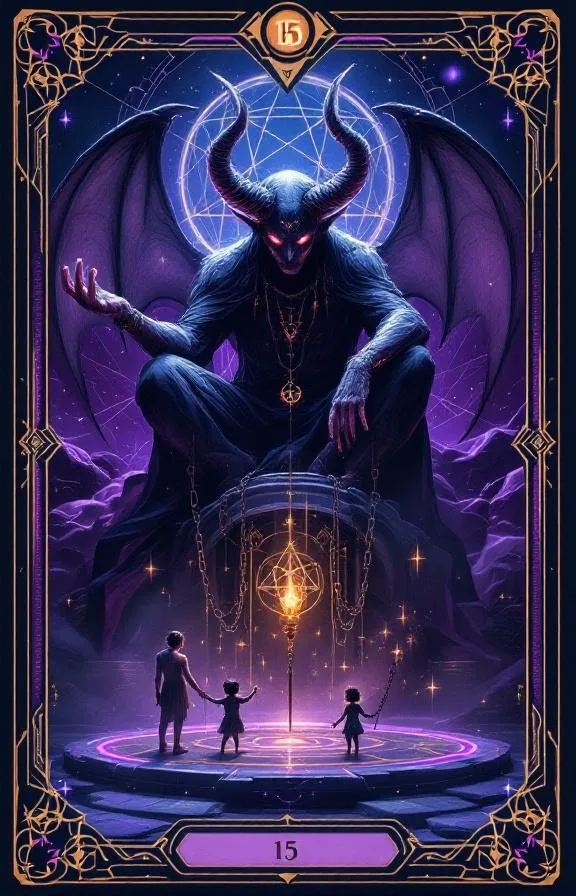
Imagine standing at an open door. The air outside is fresh, the light is inviting, and every rational part of you knows you want to walk through. But something keeps you turning back to look at the room behind you — a comfortable chair, a familiar screen, a habit that long ago stopped being pleasurable but still feels necessary. You're not locked in. The chains, if you look closely, are loose enough to slip off. And yet. That "and yet" is the entire territory of The Fool and The Devil together.
The Fool and The Devil at a Glance
| The Fool | The Devil | |
|---|---|---|
| Number | 0 | XV |
| Element | Air | Earth / Capricorn |
| Core theme | Beginnings, trust | Attachment, shadow, bondage |
Together: The tension between the freedom to begin anew and the patterns that make you repeat what you've already outgrown.
The Core Dynamic
Sigmund Freud introduced a concept he called "repetition compulsion" — the tendency to unconsciously recreate situations, relationships, and dynamics that mirror unresolved experiences from the past. A person leaves one controlling relationship and, despite consciously wanting something different, gravitates toward another. Someone quits a toxic job and finds themselves, within months, in a workplace with eerily similar dynamics. The pattern isn't random. It's the psyche's attempt to master what it hasn't yet understood, replaying the scene until the lesson finally lands.
The Devil, in psychological terms, represents exactly this mechanism. Not evil, not punishment, but the gravitational pull of patterns that have become so familiar they feel like identity. The chains depicted on the card are typically shown hanging loose — the figures could remove them, but they don't, because on some level, captivity has become more comfortable than the uncertainty of freedom. The Fool, arriving alongside The Devil, introduces something the pattern didn't account for: a genuine alternative. Not a different version of the same thing, but an actually new beginning.
This pairing creates one of the more charged dynamics in the major arcana because it forces a direct confrontation between possibility and attachment. Air opposes Earth. Lightness meets density. The Fool's trust encounters The Devil's skepticism. The question this combination raises is not whether freedom is available — it is — but whether you are willing to tolerate the discomfort of choosing it. Carl Jung argued that confronting the Shadow — those aspects of the self that have been repressed, denied, or projected onto others — is the central task of psychological maturation. The Devil is the Shadow made visible. The Fool is the self that exists on the other side of that confrontation, if you're willing to go through it rather than around it.
What makes this pairing particularly honest is that it doesn't pretend the choice is easy. The Devil's attachments — whether to substances, relationships, beliefs, or behavioral patterns — persist because they serve a function. They reduce anxiety, provide structure, offer a predictable identity. Releasing them means tolerating a period of groundlessness that The Fool embraces naturally but that most people find deeply unsettling. This combination asks whether you can sit with that discomfort long enough to discover what lies beyond it.
In Love & Relationships
For singles, The Fool and The Devil together may point toward a pattern in your romantic choices that deserves examination. Not judgment — examination. You may notice that the people you're drawn to share certain qualities, and that those qualities, while initially exciting, tend to produce the same unsatisfying dynamic. The psychologist Harville Hendrix proposed that people unconsciously seek partners who embody the traits of their early caregivers — both the nurturing and the wounding qualities — in an attempt to heal childhood relational injuries through adult love. If this resonates, The Fool's presence suggests that breaking the cycle is possible. But it requires first acknowledging the cycle honestly, which is The Devil's uncomfortable gift.
In existing relationships, this combination may surface dynamics of dependency or control that have been operating beneath the surface. This isn't necessarily dramatic — it can be as subtle as one partner consistently deferring their needs, or both partners maintaining a pattern that neither has questioned because it "works" in the functional sense. The Fool asks whether the relationship has room for genuine growth or whether both people have tacitly agreed to keep things static because change feels too risky. Honest conversation about these dynamics, perhaps with professional support, may be what The Fool's new beginning actually looks like in this context.
In Career & Finances
Professionally, The Fool and The Devil together often appear when someone is staying in a role, industry, or professional identity primarily out of fear rather than desire. Golden handcuffs — the phenomenon of remaining in an unsatisfying position because the compensation or status feels too valuable to relinquish — are a textbook Devil dynamic. The Fool doesn't deny that the sacrifice is real. Walking away from security is genuinely costly. But this pairing asks whether the cost of staying is quietly accumulating in ways you haven't fully tallied: diminished energy, growing cynicism, the slow erosion of the part of you that still wants to do work that matters.
Financially, The Devil may indicate attachments to spending patterns, debt cycles, or financial behaviors that provide short-term comfort at long-term cost. Paired with The Fool, the combination suggests that a different relationship with money is available, but it requires confronting the emotional needs that the current pattern is serving. Financial behavior is rarely purely rational — it is shaped by anxiety, identity, childhood experiences of scarcity or abundance. Addressing the pattern means addressing its roots, not just its symptoms.
The Deeper Message
In the Rider-Waite imagery, The Devil sits on a half-pedestal, a deliberate visual echo of the throne in The Emperor and the altar in The Hierophant. But where those seats represent legitimate authority, The Devil's perch is incomplete — authority assumed, not earned. The chains are loose. The bondage is consensual, even if the consent was never consciously given. Paired with The Fool, this card suggests a moment of radical honesty: you are not trapped; you are choosing to remain. And that realization, uncomfortable as it is, may be the most liberating thing you've encountered in a long time. What would you walk toward if you finally admitted that nothing is actually holding you back?
Curious what The Fool and The Devil mean for YOU? Try a free AI-powered reading and see what the cards reflect about your situation right now.