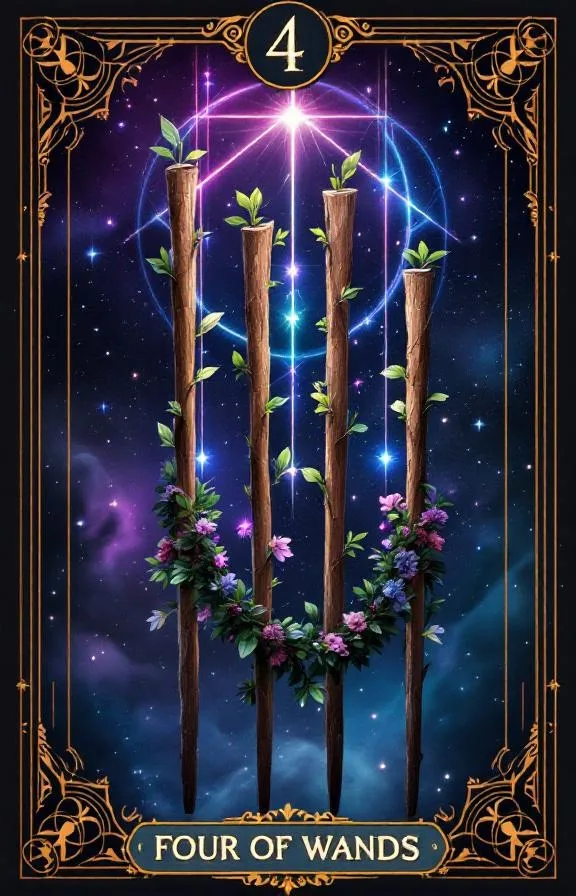
February 1st does not look like a beginning. The ground is frozen, the sky is low, nothing is visibly growing. And yet something has shifted — not on the surface, but beneath it. If you dug past the frost line, you would find roots extending, bulbs swelling, seeds beginning the molecular process that will push a green shoot toward light they cannot yet see.
The Celtic world called this moment Imbolc — roughly "in the belly" (Old Irish i mbolg). Things are growing that you cannot see yet. Imbolc falls on February 1-2, the precise midpoint between the winter solstice and the spring equinox. It is the festival of Brigid, the Celtic goddess of fire, poetry, and healing — the one who tends the flame through the darkest months so that when the thaw arrives, there is still something burning.
Tómate un momento para reflexionar sobre lo que has leído. ¿Qué resuena con tu situación actual?
The psychological parallel is exact. There are seasons in a human life when everything appears frozen, when effort seems to produce nothing. And then, without announcement, something stirs. Not a breakthrough. A stirring. A faint sign that what you planted has not died — it has been germinating in the dark.
The psychology of hope in darkness
Hope is not optimism. C. R. Snyder drew this distinction precisely in his hope theory (Handbook of Positive Psychology, 2002), defining hope as the combination of agency thinking (the belief you can initiate and sustain action toward a goal) and pathways thinking (the capacity to generate routes toward that goal when the obvious route is blocked). Optimism is a general expectation that good things will happen. Hope requires both the will and the way.
Imbolc encodes exactly this. The festival does not say "spring is coming, cheer up." It says: something is already growing. You cannot see it yet, but it is real and needs tending. The seed beneath the snow has agency (it is alive, growing) and a pathway (oriented upward, toward light). Your job is not to make it grow. Your job is to believe it is growing and to clear the path.
Martin Seligman's Learned Optimism (1990) complements this. The difference between people who recover from setbacks and those who stay stuck is explanatory style. Pessimistic style treats setbacks as permanent, pervasive, and personal. Optimistic style: temporary, specific, external. Imbolc encodes the temporary interpretation: winter is real, but not permanent. If you are in a winter of your own, Imbolc asks you to notice the snowdrops.
Brigid's flame and the sustaining fire
The Celtic figure at Imbolc's center is Brigid — goddess of hearth fire, forge fire, and poetic inspiration. All three are the same principle: something that burns steadily through darkness. The psychological equivalent is Angela Duckworth's grit (Grit, 2016): sustained effort predicts achievement more reliably than talent. The ancient Irish maintained a perpetual fire at Brigid's shrine in Kildare. The fire did not blaze. It simply did not go out. That is what Imbolc celebrates: the quiet refusal to let the flame die.
Seasonality research supports this timing. Norman Rosenthal's work on seasonal affective disorder showed that as photoperiod increases in late January, serotonin synthesis rises — in the same sub-threshold way a seed cracks underground. Kelly Rohan (University of Vermont) found that SAD patients who reframed winter as a season with purpose experienced fewer relapses than those given light therapy alone.

The Awakening Spread: 5 cards for Imbolc
Lay five cards in a gentle arc, like a crescent moon or the curve of a snowdrop bending toward the ground. The structure follows Imbolc's insight: growth is already happening, and your task is to recognize it, sustain it, and clear what blocks it.
| Position | Name | Question |
|---|---|---|
| 1 | What Sleeps Beneath the Snow | What dormant potential do I carry that has not yet broken the surface? |
| 2 | The First Green Shoot | What is the earliest sign of new growth in my life right now? |
| 3 | Brigid's Flame | What sustains me through the dark — the fire that has not gone out? |
| 4 | The Melting | What has begun to dissolve — what resistance, fear, or frozen pattern is losing its grip? |
| 5 | The Promise | What will this spring bring if I tend what is growing? |
Position 1: What Sleeps Beneath the Snow
The dormant seed — a desire, skill, or creative impulse existing in potential. The winter has not killed it; it has been protecting it, the way snow insulates the ground against deeper cold. Snyder's pathways thinking is relevant: the seed knows where it is going. The question is whether you know it is there.
Cards to watch for: The Ace of Pentacles (a material seed — a project waiting to start). The High Priestess (knowledge you have not yet acted on). The Four of Swords (the dormant thing is you — rest nearly complete).
Position 2: The First Green Shoot
If Position 1 is about what you cannot see, Position 2 is about what you can almost see. A conversation that opened a possibility. A physical sensation of returning energy. A moment of interest in something you had not thought about for months. The shoot is not the bloom — it is evidence that blooming is possible.
Cards to watch for: The Page of Wands (a spark of enthusiasm). The Star (hope regenerating after a difficult period). The Ace of Cups (an emotional opening, a softening of something that had hardened).
Position 3: Brigid's Flame
The heart of the spread. Not your goal — what keeps you moving toward the goal when it is invisible. Duckworth found that gritty people have a top-level purpose sustaining effort even when projects fail. Position 3 asks you to name it.
Cards to watch for: The Empress (creative nurturing). Strength (quiet persistence). The Nine of Pentacles (sustained investment compounding over time).
Position 4: The Melting
Winter does not end in a single day. It dissolves. This position draws on Seligman's work: the frozen pattern often corresponds to a pessimistic interpretation that felt true in the dark — "this will never change," "I am not the kind of person who succeeds." As the light returns, these explanations soften. They do not shatter. They melt.
Cards to watch for: The Tower (breaking apart to clear space). The Eight of Swords (perceived imprisonment loosening). Death (a transformation where the old form can no longer hold).
Position 5: The Promise
A conditional, not a prediction: what this spring will bring if you tend what is growing. Seeds that germinate in February can still die in March. The promise requires the sustained attention Brigid's flame represents.
Cards to watch for: The Sun (full expression of what Imbolc only hints at). The World (a cycle completing). The Three of Cups (shared celebration — the promise is not solitary).
Imbolc in the Wheel of the Year
Imbolc sits in the eight-festival Wheel as a fire festival between the winter solstice and the spring equinox. Its opposite is Lughnasadh (August 1), the first harvest. What you plant at Imbolc, you harvest at Lughnasadh. If you have been pulling seasonal spreads through the Wheel, Imbolc is where solstice threads take shape — the "seed of light within the dark" from a December reading may appear now as Position 2, the first green shoot.
The snowdrop's argument
The snowdrop is Imbolc's flower because it does not wait for spring. It pushes through snow — not because it is tougher than a rose, but because it follows a deeper calendar, one written in photoperiod and soil temperature.
Your growth follows that calendar too. The projects that matter most run on something slower than quarterly goals — the gradual accumulation of skill, the slow building of courage. Imbolc says: that process is already underway. You do not need to push harder. You need to notice what is already pushing.
Light a candle. Lay five cards. Ask what is growing beneath the snow. And then do the hardest thing Imbolc asks: trust that the answer is real, even though you cannot see it yet.
Ready to explore what stirs beneath your own winter? Try a free reading and bring the Awakening Spread to the cards. Browse our spread library for more seasonal layouts.