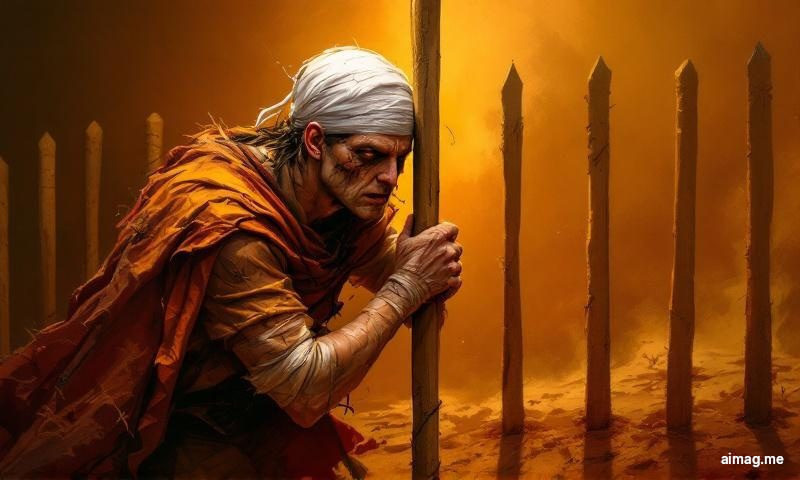
A figure stands alone, and everything about him says he has been through something. His head is bandaged. His posture is stiff — not formality, but the stiffness of someone who has been hit repeatedly and whose body has learned to brace before the mind catches up. He leans on a single wand like it is the only thing between him and the ground, and in a sense it is: his last claim on standing upright, his refusal to go down. Behind him, eight wands stand in a tight row like a fence — or a barricade — separating him from whatever already happened and whatever might still come. His eyes are turned sideways. Watching. Not resting. Not celebrating. Watching. He survived, but he does not yet believe the battle is over.
That is the Nine of Wands — the wounded warrior who will not fall, the last stand before the final challenge, the resilience that remains when everything else has been spent.
In short: The Nine of Wands means resilience after repeated hardship — the bandaged figure who refuses to fall because the finish line is closer than it feels. Upright, it signals perseverance, hard-won strength, and one last challenge before completion. Reversed, it warns of burnout, paranoia, or giving up just before the breakthrough. The card honors your scars and asks if you can stand one more time.
Nine of Wands at a Glance
| Attribute | Detail |
|---|---|
| Number | Nine (9) |
| Suit | Wands |
| Element | Fire |
| Keywords (Upright) | resilience, perseverance, last stand, courage, persistence, boundaries, vigilance |
| Keywords (Reversed) | exhaustion, paranoia, giving up too soon, burnout, defensiveness, overwhelm |
| Yes / No | Yes |
What Does the Nine of Wands Mean?
The nines in tarot sit at a particular threshold. They are the penultimate cards — the moment just before completion, when the energy of the entire journey has been spent but the finish line has not been crossed. The Nine of Cups arrives at emotional fulfillment. The Nine of Pentacles arrives at material independence. The Nine of Swords arrives at the darkest hour of mental anguish, the night terrors before dawn. And the Nine of Wands arrives at the place where fire has burned through nearly everything — fuel, body, hope — and what remains is something harder than all of those: the decision to keep standing.
Waite, in The Pictorial Key to the Tarot (1911), described the card's meanings as "strength in opposition" and noted the figure's posture of expectation, "as if awaiting an enemy." That phrase — awaiting an enemy — captures something essential. This is not active combat. The battle is not happening now. What is happening is the anticipation of the next battle, which is its own form of suffering. The figure has learned, through repeated experience, that peace does not last. So even in this quiet moment, he stands guard.
The strength in this card is specifically earned strength. Not the fresh, untested vigor of the Ace of Wands or the ambitious confidence of the Two of Wands. Strength purchased at the price of exhaustion, doubt, and pain. The wands behind the figure are not decoration — they represent challenges already faced, obstacles already overcome, blows already absorbed. Each wand is a scar and a trophy at the same time.

Jung would have recognized in this image what he called the wounded healer — the figure whose authority comes not from invulnerability but from having been broken and rebuilt. In Jungian psychology, the wound is not a defect to hide but a source of power. The bandage on the figure's head is the visible mark of his initiation: tested by fire, not consumed. His vigilance, while exhausting, is also earned wisdom. He knows what can hurt him because he has already been hurt.
Research on grit — the sustained combination of passion and perseverance toward long-term goals — offers a modern lens. The single strongest predictor of achievement across domains is not talent, intelligence, or resources, but the willingness to persist through difficulty when the initial excitement has burned off. The Nine of Wands is grit in its most honest form: not the glamorous determination of the beginning, but the battered, bandaged determination of someone who has been knocked down eight times and is preparing, with whatever energy remains, to face the ninth.
The journey from the Eight of Wands — swift movement, arrows flying through clear sky — to the Nine is the journey from momentum to endurance. The Eight was speed. The Nine is the wall you hit after the speed. And the Ten of Wands that follows will bring the full weight of accumulated burden — but first, here at the Nine, the question is simpler and more urgent: can you stand one more time?
Nine of Wands Reversed
When the Nine of Wands appears reversed, the warrior's legs give out. The resilience that defined the upright card collapses into exhaustion, paranoia, or the quiet surrender of someone who has been fighting too long. Bandage still there, wands still standing behind — but the figure can no longer hold himself up against them. He has hit the limit of what willpower alone can sustain.
The most common expression is burnout — not the dramatic collapse of a crisis, but the slow erosion of someone locked in a defensive posture so long that the defense itself has become the source of suffering. The hypervigilance that once protected now imprisons. Every sound is a threat. Every silence is a prelude to a threat. The body has forgotten how to rest because the mind has forgotten that rest is safe.
Sometimes the reversed Nine signals giving up too soon — walking away from the fight at the exact moment when one more effort would have broken through. The cruel irony: the finish line may be closer than it looks. But the figure is too exhausted, too conditioned by prior failures, to believe anything good waits on the other side of one more struggle. The walls built for protection have become a prison. The wands that once stood for strength now feel like bars.
At its gentlest, the reversal carries a message about knowing when to stop defending and start healing. Not every battle must be fought. Not every boundary must be a barricade. Sometimes the bravest thing the wounded warrior can do is set down the wand, remove the bandage, and admit he needs help — not because he failed, but because no one was ever meant to stand guard alone forever.
Nine of Wands in Love and Relationships
Upright
In love readings, the Nine of Wands speaks to the person who has been hurt before and carries that knowledge into every new connection. The heart with scar tissue — still beating, still capable of love, but cautious in a way that only deep wounding produces. If you are in a relationship, the card may point to a period of tension you are weathering together, a trial testing the bond's durability. It says: the difficulty is real, but so is your capacity to endure it. The relationship has been through something, and it is still standing.
For singles, the Nine of Wands often shows up when someone has built emotional walls after heartbreak. The defenses are understandable — built for survival. But the card asks whether the walls that once protected you now prevent the very connection you want. The figure looks over his shoulder at what already happened instead of forward at what might still come. At some point, the wand must shift from a weapon to a walking stick — from defense to movement.
Reversed
Reversed in love, the Nine of Wands signals emotional exhaustion — the relationship that has weathered so many conflicts that one or both partners have stopped believing repair is possible. It can point to someone so armored from past trauma that genuine intimacy cannot get through. The wound healed badly; the scar became a wall. Sometimes the reversal says someone needs to leave a situation they have been enduring out of stubbornness rather than love — confusing persistence with purpose, endurance with devotion.
Weary but still standing? Try a free AI reading →
Nine of Wands in Career and Finances
Upright
In career readings, the Nine of Wands belongs to the professional who has survived restructuring, rejection, failed projects, or toxic environments — and is still at work Monday morning. The persistence required to build something meaningful in a professional world that rarely rewards effort in a straight line. You may be exhausted, questioning whether this career, this project, this company is worth the fight — but the card says you are closer to your goal than you feel. The challenges have not destroyed your capacity. They have refined it.
Financially, the Nine of Wands points to a period of holding on through difficulty — not thriving, but surviving well enough to reach the other side. Not a card of abundance. A card of endurance, of protecting what you have built even when the cost of protection runs high. Budget conservatively. Guard your resources. The pressure will ease, but not yet.
Reversed
Reversed in career, the Nine of Wands warns of professional burnout — the point where perseverance becomes self-destruction. Working through illness, ignoring boundaries, defending a position that costs more than it returns. The reversal asks whether you are fighting for something worth winning or simply fighting because you have forgotten how to stop. Sometimes the most strategic move is retreat. Regroup, recover, return with the clarity that exhaustion destroys.
Nine of Wands in Personal Growth
Martin Seligman's work on learned helplessness showed that organisms exposed to repeated, uncontrollable adversity often stop trying — even when conditions change and escape becomes possible. The Nine of Wands is the card of the person who has not reached that point. Despite the bandages, despite the weariness, despite every reason to stop, this figure still stands. He has not learned helplessness. He has learned its opposite: that suffering does not require surrender.
But there is a shadow the card does not hide. The figure's vigilance is also hypervigilance. His boundaries are also walls. The "fight" response to chronic stress — the pattern of meeting every challenge with confrontation, treating every situation as a threat — can become as limiting as the helplessness it replaced. The Nine of Wands asks you to examine your defenses with the same courage that built them. Are you standing guard because the danger is real, or because standing guard has become your identity? Is the wand a tool, or a habit?
A practical exercise: identify three situations in your current life where you are maintaining a defensive posture. For each one, ask two questions. First: is the threat still active, or am I defending against a memory? Second: what would it feel like to set down this particular wand — not abandon it, but rest it against the wall and see what happens when your hands are free? The Nine of Wands honors the fighter. But it also whispers that the fight is almost over, and the person you become after the battle may need different skills than the ones that got you through it.
Nine of Wands Combinations
- Nine of Wands + Strength — Resilience amplified by inner mastery. The Nine endures through willpower; Strength adds patience, compassion, and the quiet authority of someone who tames their own fear. Together: you will not only survive — you will do it with grace.
- Nine of Wands + The Tower — The wall you have been defending may come down regardless. The Tower shatters what the Nine tries to protect. Not necessarily destruction — possibly the forcible removal of defenses you no longer need. Painful, but liberating.
- Nine of Wands + Four of Swords — The rest the warrior refuses to take is now demanded by the deck itself. Stop guarding. Lie down. Recover. The battle will wait for you — but your body and mind will not wait forever.
- Nine of Wands + The Star — Hope after endurance. The Star's healing light falls on the warrior's bandaged head. After everything, something gentle and restorative is approaching. One of the most beautiful pairings for recovery — the promise that vulnerability, after so much defense, will be rewarded.
- Nine of Wands + Ten of Wands — A warning: the persistence of the Nine is about to become the burden of the Ten. What you carry by choice now will soon feel like obligation. Before crossing into the Ten, decide which wands are truly yours — and set the rest down.
Frequently Asked Questions
Is the Nine of Wands a positive card?
Yes, though its positivity is hard-won. The card does not promise ease or joy — it promises endurance, and the deep, scarred strength that comes from surviving what would have broken someone less stubborn. Positive the way a soldier's homecoming is positive: relief and pride braided with exhaustion and the memory of what it cost to get here.
What does the Nine of Wands mean for challenges?
The challenges are real but so is your capacity to withstand them. You have been tested before and you did not break. The Nine of Wands says one more challenge may come — possibly the hardest yet — but you have the resources, the experience, and the sheer stubborn will to meet it. The battle is not over. Neither are you.
Does the Nine of Wands indicate past trauma?
Frequently, yes. The bandaged figure is not merely cautious — he is wounded, and the wound shapes everything about how he engages with the present. In personal readings, this card often appears for people carrying the weight of past emotional or psychological injuries. It acknowledges the trauma without diminishing the strength it took to survive.
What is the yes or no answer for the Nine of Wands?
Yes — but brace for one more obstacle before you reach your goal. The Nine of Wands is affirmative, especially for questions about persistence and whether the struggle is worth continuing. The answer is yes, keep going, but go with your eyes open and your defenses ready. The final push requires everything you have left.
He stands because he has forgotten how to do anything else, and that is both his strength and his sorrow. The bandage on his head is old enough that he has stopped noticing it. The wand he leans on has become an extension of his body, a third leg, a refusal made physical. Behind him, eight wands stand in their silent row like witnesses to everything that brought him here — every blow absorbed, every setback survived, every night he considered lying down and did not. The Nine of Wands does not ask whether you are strong. It already knows. It asks a harder question: when the last challenge comes — and it will — will you remember that the point of standing is not merely to endure, but to eventually walk forward, unbandaged, into whatever waits on the other side?