The blank page is not empty. It is full — overfull, actually — with every judgment you have ever absorbed about your own creative worth. Every workshop leader who circled a weakness in red ink. Every polite silence after you shared something you cared about. Every comparison to someone more talented, more prolific, more effortlessly brilliant. When you sit down to create and nothing comes, the problem is not that the well is dry. The problem is that the well is guarded.
Creative block is not the absence of ideas. It is the presence of fear wearing the costume of emptiness.
This distinction matters, because the cure for emptiness is inspiration — more input, more galleries, more books. And the cure for fear is something else entirely. It is permission. The willingness to make something that is not good yet, to follow an impulse that does not make logical sense, to fail in front of yourself before you have any guarantee of success.
Tarot cards are, among other things, an extraordinarily efficient permission machine. They provide what every blocked creator needs and few can give themselves: a starting point that is not their own idea, a structure that removes the tyranny of infinite choice, and a symbolic language that speaks directly to the unconscious mind where creative impulses originate. This article explores why that works, what psychology says about creative flow and blockage, and offers two tarot spreads designed for anyone who makes things and is currently stuck.
In short: Creative block is fear disguised as emptiness, and tarot bypasses it by shifting the creative act from generation to interpretation. Cards like the Ace of Wands, The Star, and the Page of Wands speak directly to the artistic cycle of spark, crisis, and recovery, while the Creative Well and Block Breaker spreads give stuck makers a concrete way back into the work.
The psychology of creative block
Rollo May, the existential psychologist whose 1975 work The Courage to Create remains one of the most honest books ever written about the artistic process, argued that creativity requires a specific form of bravery that is distinct from physical or moral courage. He called it the courage of encounter — the willingness to fully meet an experience, an idea, or an image without knowing in advance what will happen. "Creativity," May wrote, "requires the courage to let go of certainties." The blank canvas, the empty document, the silent instrument — these demand exactly this. They ask you to step forward without a map.
The trouble is that the brain's threat-detection system does not distinguish between physical danger and ego threat. When you sit down to write or paint or compose and the stakes feel high — when your identity as a creative person is on the line — your amygdala responds as if something genuinely dangerous is happening. The result is the same freeze response that would protect you from a predator: avoidance, procrastination, the sudden compelling need to reorganize your desk or do literally anything other than the creative work in front of you.
Julia Cameron, whose 1992 book The Artist's Way has been rehabilitating blocked creators for over three decades, calls this internal resistance the Censor — a voice that interrupts every creative impulse with a critique: That's been done before. You're not talented enough. Who do you think you are? Cameron's insight was that the Censor is not the voice of reason. It is the voice of a specific kind of fear — the fear of being seen, being wrong, being mediocre. And it cannot be argued with, because it does not operate on logic. It operates on shame.
This is where tarot becomes interesting. Tarot cards bypass the Censor entirely. They do not ask you to generate an idea from scratch — they present you with an image, a symbol, an archetype, and ask you to respond. The creative impulse shifts from generation (terrifying, because it can be judged) to interpretation (safer, because you are responding to something external). It is the difference between "write something brilliant" and "look at this image and tell me what you see." The second prompt is almost impossible to fail at, and this lowered threshold is what makes tarot genuinely useful as a creative tool.
Flow, randomness, and the creative unconscious
Mihaly Csikszentmihalyi, who coined the term "flow" and expanded it in Creativity: Flow and the Psychology of Discovery and Invention (1996), identified several conditions necessary for entering a flow state — that feeling of being fully absorbed in a task where time dissolves and effort becomes effortless. Among the most important: clear goals, immediate feedback, and a balance between the difficulty of the task and the skill of the person attempting it.
Creative block violates all three conditions. When you are blocked, you do not have clear goals — you have a vague, pressurized sense that you should be making something. You do not have immediate feedback — you have silence. And the perceived difficulty of the task wildly exceeds any sense of your own skill.
Tarot addresses each of these failures. A single card provides a clear, bounded goal: respond to this image, this symbol, this archetype. Interpreting provides immediate feedback — you can see whether the symbol resonates, whether it sparks an association. And because the task is interpretation rather than invention, the difficulty drops to a level where engagement becomes possible.
There is something else. Csikszentmihalyi found that highly creative people across domains shared a paradoxical trait: they were simultaneously rigorous and playful, disciplined and open to chance. They maintained firm structures within which they allowed randomness to operate. The jazz musician who knows the chord changes but improvises over them. The painter who prepares a canvas methodically but lets the first brushstroke go where it wants.
Tarot provides exactly this combination. The structure is the spread — the number of cards, their positions, the question you bring. The randomness is the shuffle. You set up the conditions, and then you let chance speak. Making art is, at its core, building a framework and then surrendering to what emerges within it.
Five cards every creative person should understand
You do not need to memorize seventy-eight cards to use tarot for creative work. Five cards speak directly to the artistic experience, and understanding them gives you a vocabulary for the specific struggles and breakthroughs of the creative life.
The Ace of Wands — the spark
The Ace of Wands is raw creative energy in its most primal form — a hand emerging from a cloud, holding a living branch that is still sprouting leaves. This is the moment before execution, when an idea arrives with such force that your whole body responds to it. The excitement in your chest when you see the thing you want to make, clearly, for the first time.
When this card appears in a creative reading, it is telling you that the energy is available. The spark is real. It is not asking you to evaluate the idea for commercial viability or artistic merit. It is asking you to grab the branch before it disappears back into the cloud.
The shadow of the Ace of Wands is the tendency to feel the spark and then immediately begin talking yourself out of it. The Censor — Cameron's term — specializes in murdering Ace of Wands energy. The card is a reminder that the first job of the creator is to notice the spark and follow it, not to assess it.
The Magician — mastery of tools
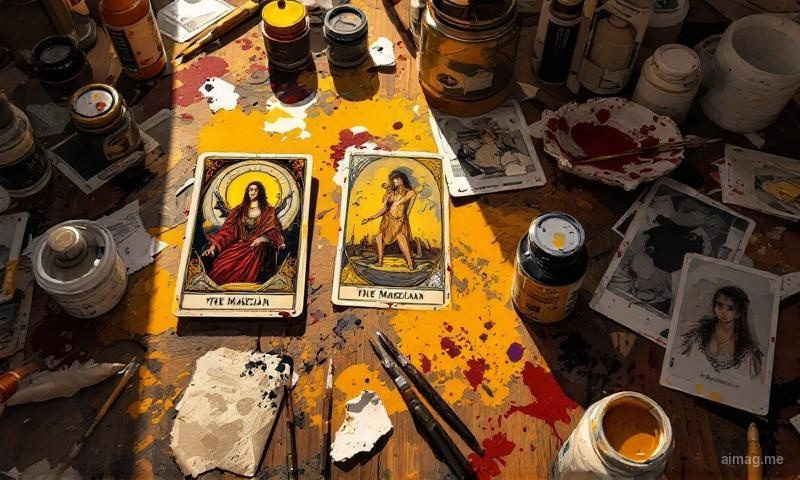
The Magician stands at a table with four implements — one from each suit — and one hand raised toward the sky, the other pointing to the ground. This is the figure who knows how to channel raw inspiration into finished form. The Magician is technique, craft, practice — the ten thousand hours made visible.
For creators, The Magician is a card about the relationship between skill and inspiration. It says: you have the tools. You have spent time learning them. Now trust them. The blocked creator often forgets that they have built genuine ability over years of practice. The Magician is the reminder. You are not starting from zero. You are standing at a table full of instruments you already know how to use.
The Star — inspiration after crisis
The Star comes immediately after The Tower in the major arcana — which is to say, it comes after everything has fallen apart. A figure kneels by water, pouring from two vessels, under a sky full of stars. This is not the bright, aggressive energy of the Ace. This is quieter. This is the kind of inspiration that arrives only after you have stopped trying so hard. After the crisis. After the failure. After the project you poured yourself into did not work and you are sitting in the rubble wondering if you should bother trying again.
The Star says yes. But it says yes gently. It does not promise fireworks. It promises a slow, steady return of hope and creative vision — the kind that comes from being honest about what went wrong and choosing to keep going anyway. For any creative person who has been through a period of burnout or deep discouragement, The Star is the most important card in the deck.
The Page of Wands — playful experimentation
The Page of Wands holds their wand like it is the first time they have ever seen one, studying it with curiosity rather than expertise. This is beginner's mind applied to creativity — the willingness to experiment without expectations, to play without purpose, to try something you have never tried before and be genuinely bad at it.
Pages in tarot represent the earliest stage of engagement with an element. The Page of Wands is creative energy in its most unrefined, unselfconscious form. Children have this energy naturally — they draw and paint and build without any concern about whether the result is good. Adults have to recover it deliberately, and doing so often feels irresponsible, because the culture teaches us that creative work should be purposeful and productive.
The Page of Wands is permission to waste materials. To make a mess. To follow curiosity into a dead end and enjoy the walk.
The Seven of Cups — too many ideas, not enough commitment
The Seven of Cups shows a figure confronted with seven cups floating in clouds, each containing a different vision — treasure, a dragon, a castle, a wreath, a veiled figure, a snake, a glowing face. It is the card of overwhelm, of having so many ideas that you cannot commit to any of them.
This is the opposite of the stereotypical creative block, but it is just as paralyzing. The person with twenty projects started and none finished. The artist whose studio is full of half-completed canvases. The writer with forty documents, each containing the first paragraph of a different story. The Seven of Cups says: the problem is not a lack of inspiration. It is a refusal to choose — because choosing one vision means abandoning six others, and that feels like loss.
When this card appears, it is asking you to pick one cup. Not the best cup. Not the most commercially viable cup. Just one. And commit to it long enough to see whether it has substance or is another cloud.
Two spreads for creative work
The Creative Well Spread (5 Cards)
This spread is designed for the moment when you feel fundamentally disconnected from your creative energy — not just blocked on a specific project, but dried up at the source. It maps the underground terrain of your creative life and shows you where the water still flows.
| Position | Meaning |
|---|---|
| 1: The Source | What originally drew you to creative work — your foundational drive |
| 2: The Block | What is currently standing between you and your creative energy |
| 3: The Underground River | Creative energy that is still flowing, but in hidden or unrecognized forms |
| 4: The Offering | What you need to give up to access your creativity again |
| 5: The First Cup | The single next creative act that will begin to restore the flow |
How to read it: Start with Position 1, because reconnecting with your original motivation is often the most powerful thing you can do when blocked. Why did you start making things in the first place? Not for career reasons, not for recognition — before all of that. The card here points you back to that first impulse.
Position 2 names the block directly. It might be fear (The Moon), perfectionism (The Emperor), exhaustion (Ten of Wands), or comparison to others (Five of Wands). Naming it takes away some of its power.
Position 3 is often the most surprising. It shows where creativity is still happening in your life, even though you do not recognize it as such. Maybe it is how you cook, or how you solve problems at work. The underground river has not stopped. It just found a different channel.
Position 4 asks what must be released. A belief ("I should be further along by now"), a comparison ("they are so much more talented"), or a practical burden (overcommitment, perfectionism, the need for external validation).
Position 5 gives you a concrete starting point. Not a finished project — a first act. The Ace of Cups might say: start by writing about how you feel. The Three of Pentacles might say: collaborate with someone. The Page of Wands might say: play with materials you have never used before.
The Block Breaker (3 Cards)
This is a quick, tactical spread for when you are stuck on a specific project. You know what you are working on. You just cannot move it forward. Three cards, three minutes, one shift in perspective.
| Position | Meaning |
|---|---|
| 1: What you are forcing | The approach that is not working — the door you keep pushing that opens the other way |
| 2: What you are ignoring | The insight, emotion, or direction you have been avoiding because it scares you or does not fit your plan |
| 3: The way through | The specific shift — in approach, mindset, or method — that will break the block |
How to read it: Position 1 almost always reveals something you already know but have not admitted. You know the opening is not working. You know the color palette is wrong. You know the project has changed shape and you are still trying to force it into its original outline. This card makes the denial visible.
Position 2 is where the gold is. The thing you are avoiding is usually the thing your creative work most needs. The personal truth you do not want to include. The risky structural choice you have been too cautious to try. Whatever scares you in Position 2 is almost certainly the key.
Position 3 is not a solution — it is a direction. Read it as a verb, not a noun. The Chariot: drive forward without consensus. The Hermit: withdraw and listen to yourself. The Wheel of Fortune: stop trying to control the outcome and let the work surprise you.
How to use tarot cards as creative prompts
Beyond formal spreads, individual tarot cards function as remarkably effective creative prompts. Here are four methods that work across disciplines:
The Image Response. Draw a card and respond to it directly in your medium. A painter paints the scene they see. A writer writes from the perspective of a figure in the card. A musician composes what the card sounds like. The constraint of responding to a specific image is liberating because it removes the burden of originality — you are translating, not inventing.
The Archetypal Character. Draw a card and let it define a character. The Queen of Swords becomes someone who speaks truth with surgical precision, who has earned their clarity through grief. The Five of Pentacles becomes a figure living through scarcity, standing outside a lit window. Tarot archetypes contain contradiction — every card has a light meaning and a shadow meaning — and real characters live in the space between.
The Daily Creative Pull. Each morning, draw a card with the question: "What creative impulse wants my attention today?" Follow the card's energy for fifteen minutes. The Four of Swords might mean rest — lying on the floor listening to music, letting ideas recombine without effort. The Knight of Wands might mean speed — writing or sketching as fast as you can, outrunning the Censor before it can form words.
The Obstacle Dialogue. When you are stuck, draw a single card and ask: "What is this block trying to protect me from?" The block is rarely malicious — it is a defense mechanism protecting you from vulnerability or the grief of making something that does not match your internal vision. Understanding the block's purpose often dissolves it more effectively than fighting through it.
The courage to create badly
There is a final psychological truth about creativity that tarot understands implicitly: the only way to make something good is to be willing to make something bad first.
Rollo May argued that creativity and anxiety are inseparable — that the willingness to create is always accompanied by the risk of failure, and that the anxiety is not something to overcome before creating but something to carry while creating. "We cannot escape anxiety," he wrote. "We can only go through it."
Tarot normalizes this by being fundamentally nonjudgmental. The cards do not care whether your painting is good. They do not evaluate your manuscript's commercial potential. They present images and invite response, and every response is valid. This absence of judgment is precisely what the blocked creator needs — not more pressure to produce something excellent, but permission to produce something at all.
Cameron calls this "filling the well" — exposing yourself to input (images, music, walks, conversations) without any obligation to produce output. Tarot is well-filling in concentrated form. A single card contains a scene, a color palette, a narrative, and an emotional tone. Looking at it fills the well. Responding to it is the first water drawn up.
If you are creatively blocked right now: do not try to fix it. Do not buy another course or set another deadline. Instead, take out a deck — any deck — and draw three cards. Lay them face up. Look at them for two minutes without doing anything.
Then ask yourself: what do I see? And follow whatever comes.
Frequently asked questions
Can tarot really help with creative block, or is it just a distraction?
Research on creative cognition shows that structured randomness — introducing unexpected elements into a problem-solving process — increases creative output. A 2012 study by Simone Ritter and colleagues at Radboud University found that unusual experiences enhanced cognitive flexibility, a core component of creative thinking. Tarot provides structured randomness in a psychologically resonant form. It is not a distraction from the creative process. It is a different entry point into the same process.
Which tarot deck is best for creative work?
The deck that visually excites you. Choose a deck whose art style makes you want to look at the cards. The Rider-Waite-Smith is useful because its imagery is rich in narrative detail — every card tells a story you can respond to. But decks with more abstract or contemporary art can prompt different kinds of creative response. The right deck is the one that makes you curious.
How often should I use tarot for creative practice?
Daily if you want to build a habit, weekly if you want a deeper check-in. Cameron recommends daily morning pages — three pages of longhand writing done first thing in the morning — and a daily card pull pairs naturally with that practice. Draw a card, then write your morning pages in response to it. The combination is remarkably effective at clearing the internal channel between unconscious impulse and conscious expression.
What if I draw a "negative" card when I am already struggling creatively?
There are no negative cards in a creative context. The Tower — total destruction of a structure — might be exactly what your stalled project needs. Death — complete transformation — might be telling you that the creative identity you are clinging to has served its purpose and something new is ready to emerge. The Ten of Swords — absolute ending — might be permission to abandon a project that was never going to work and start something you actually care about. In creativity, as in shadow work, the cards that frighten you most often carry the most useful information.
Your next creative act
If the creative well feels dry, you do not need more inspiration. You need a different way in. Try a reading and ask the cards what your creative block is trying to protect you from. The answer is rarely what you expect — and that unexpected angle is often exactly where the next piece of work begins.