Tarot for entrepreneurs is not about predicting which startup will succeed or which stock will rise. It is a structured decision-making framework that uses symbolic imagery to surface assumptions, challenge blind spots, and stress-test business thinking before real money is on the line. Think of it as a cognitive tool, not a crystal ball.
In short: Tarot for entrepreneurs means using card reading as a structured reflection exercise that activates lateral thinking, exposes hidden assumptions in business decisions, and provides a symbolic vocabulary for discussing risk, timing, and strategy — grounded in decision science, not mysticism.
Why rational business people are turning to tarot
The idea of a founder pulling tarot cards before a board meeting sounds absurd — until you understand what is actually happening cognitively.
Gary Klein, the psychologist who pioneered naturalistic decision-making research, spent decades studying how experts actually make decisions under uncertainty. His finding was counterintuitive: the best decision-makers do not weigh options analytically in the moment. They pattern-match against internalized mental models, then stress-test those models by imagining how things could go wrong.
This is exactly what a well-designed tarot reading facilitates. When an entrepreneur draws The Tower for a question about market expansion, the card does not predict that the expansion will fail. It provides a concrete visual prompt to consider: what would catastrophic disruption look like here? What am I not seeing? Where is my plan structurally vulnerable?
Daniel Kahneman, Nobel laureate in economics, called a version of this the pre-mortem technique — imagining that a project has already failed and working backward to identify why. A tarot card depicting sudden upheaval does the same cognitive work, but with a visual and symbolic richness that engages associative thinking more effectively than a blank whiteboard.

Saras Sarasvathy's research on effectuation theory at the University of Virginia revealed another relevant insight. She studied how serial entrepreneurs actually think, and found that expert founders do not start with fixed goals and work toward them (causal reasoning). Instead, they start with available means — who they are, what they know, whom they know — and create possibilities from those means. This is remarkably close to how tarot works: you start with the cards you draw (your available symbolic resources) and construct meaning from what is present, not from a predetermined template.
Tarot, used intelligently, is structured effectuation for your inner strategic conversation.
Five cards every entrepreneur should understand
Not every card in the 78-card deck speaks directly to business contexts. But several cards map so precisely onto entrepreneurial challenges that they function as a miniature MBA in symbolic form.
The Magician — resourcefulness and execution
The Magician stands at a table with every tool available: a cup, a sword, a wand, a pentacle. One hand points to the sky, the other to the ground. The message is integration — the ability to take abstract vision and manifest it in concrete reality.
For entrepreneurs, The Magician represents the core competency that separates founders from dreamers: execution. Not just having the idea, but having the resourcefulness to turn constraints into advantages. When this card appears in a business reading, the question it asks is direct: do you actually have the skills and resources to execute on this vision right now, or are you romanticizing a plan you cannot yet deliver?
The Magician also raises a shadow question about manipulation versus genuine value creation. Every entrepreneur faces this tension. The card invites honest examination of whether your persuasion is backed by substance.
Three of Pentacles — partnerships and collaboration
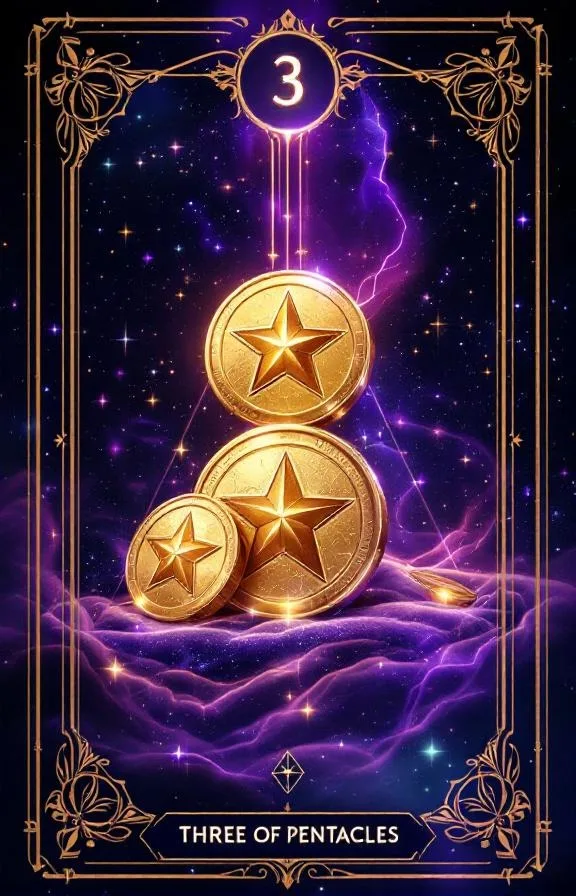
The Three of Pentacles depicts three figures working together in a cathedral: an architect, a monk, and a stonemason. It is the card of skilled collaboration — the moment when different competencies align around a shared project.
In business contexts, this card asks: who are you building with, and does each person bring genuine and distinct expertise? Too many startups fail not from bad ideas but from team composition problems — founders with overlapping skills, partnerships built on friendship rather than complementary capability, or an unwillingness to bring in expertise that challenges the founder's assumptions.
When the Three of Pentacles appears, examine your team honestly. The cathedral in the image is not built by one person.
Seven of Pentacles — patience, ROI, and strategic waiting
A farmer leans on a hoe, looking at seven pentacles growing on a vine. The harvest is not ready. The card is about the uncomfortable period between planting and reaping — the valley of death, in startup terms.
This card addresses what venture capitalists call the J-curve: the period where investment is high, returns are negative, and the temptation to either quit or pivot prematurely is intense. The Seven of Pentacles does not promise that the harvest will come. It asks whether you have the runway and the psychological stamina to wait for it.
For entrepreneurs evaluating whether to stay the course or pivot, this card crystallizes the core question: is this a patience problem or a product problem? The answer changes everything, and the card forces you to sit with the uncertainty long enough to distinguish between the two.
Knight of Wands — bold moves and calculated risks
The Knight of Wands rides forward at full gallop, wand raised, landscape blurring behind him. This is the card of momentum, conviction, and the willingness to move fast with incomplete information.
Every entrepreneur recognizes this energy. It is the decision to launch before the product is perfect, to enter a market before the timing is provably right, to bet on speed over certainty. The Knight of Wands validates this instinct — but with a caveat embedded in every Knight card: knights are not kings. They embody energy without maturity. The card asks whether your boldness is strategic courage or impulsive reactivity.
Reid Hoffman's famous advice to "jump off a cliff and build the airplane on the way down" is Knight of Wands energy. The card's presence in a reading invites you to check whether you actually have the engineering skills to build that airplane.
Ten of Pentacles — long-term vision and legacy
The Ten of Pentacles shows an established family in a prosperous courtyard, a patriarch surrounded by generations. Ten pentacles are arranged in the pattern of the Kabbalistic Tree of Life. This is not about getting rich. It is about building something that outlasts you.
For entrepreneurs, this card challenges the exit-obsessed mindset. Are you building to flip, or building to last? Both are legitimate strategies, but confusing them leads to architectural decisions that undermine your actual goal. The Ten of Pentacles asks what you want this business to look like in ten years — and whether your current decisions serve that timeline or sabotage it.
The Business Decision Spread — a 4-card framework
Standard tarot spreads are designed for personal reflection. Business decisions require a different structure. This four-card spread maps directly onto the key dimensions of entrepreneurial decision-making.
- Current Position — Where does the business actually stand right now? Not where you hope it stands, not what your pitch deck says. The honest baseline.
- Hidden Variable — What factor are you not seeing or not weighing heavily enough? This position uses the card's symbolism to surface blind spots — the competitor you are ignoring, the market shift you are rationalizing away, the team issue you are avoiding.
- Strategic Move — What action does the situation call for? Not what you want to do, but what the current landscape actually requires. This card often challenges the founder's preferred strategy.
- Outcome Trajectory — Where does this path lead if you follow it? Not a prediction, but a projection — a way of extending current patterns forward and asking whether you like what you see.
Lay the four cards in a horizontal line. Read them left to right as a narrative. The power of this spread is that it imposes a structure on business thinking that most founders skip: starting with honest assessment before jumping to strategy.
Use this spread before major decisions — funding rounds, pivots, partnerships, product launches. Not because the cards know the answer, but because the structured reflection surfaces thinking that unstructured rumination misses.
Pre-mortem with cards: a practical exercise
Kahneman's pre-mortem technique gains a new dimension when combined with tarot. Here is how to run it.
- State your decision clearly. Write it down. "I am going to raise a Series A in Q3." "I am going to hire a co-founder from outside my network." "I am going to enter the European market."
- Draw three cards. These represent three distinct failure modes — three reasons the decision could go wrong.
- For each card, ask: What kind of failure does this symbolism represent? If I drew The Moon, what hidden or deceptive element might undermine this plan? If I drew the Five of Pentacles, what resource scarcity could I face that I am not currently planning for?
- Write down the failure narratives. Be specific. "The Moon in position two suggests that my understanding of the European regulatory landscape is less clear than I think, and a compliance issue could delay launch by six months."
- Evaluate whether your plan addresses these failure modes. If it does not, adjust before committing.
This is not fortune-telling. It is structured scenario planning using visual prompts to activate thinking patterns that purely analytical approaches miss. Klein's research consistently shows that experts who imagine concrete failure scenarios make better decisions than those who only analyze probabilities.
The psychology of why this works for business minds
Three mechanisms explain why tarot is effective for entrepreneurial thinking, and none of them are mystical.
Defamiliarization. Russian literary theorist Viktor Shklovsky coined this term for the process of making the familiar strange. Entrepreneurs suffer from a specific cognitive trap: they know their business so well that they stop seeing it clearly. A tarot card introduces a genuinely unexpected symbolic frame that forces fresh perception. When you are asked to consider your market strategy through the lens of the Seven of Swords (strategy, stealth, possibly self-deception), you see angles that your usual analytical frameworks filter out.
Bisociative thinking. Arthur Koestler's theory of creativity describes how breakthrough ideas emerge from the collision of two previously unconnected frames of reference. A tarot reading forces exactly this collision: the frame of your business problem meets the frame of mythic symbolism, and the intersection produces insights that neither frame generates alone.
Embodied cognition. The physical act of shuffling cards, laying them out, and looking at images activates different neural pathways than staring at a spreadsheet. Research on embodied cognition shows that physical engagement with a decision process produces different — and often better — thinking than purely abstract analysis. The tactile ritual of a card reading is not decorative. It is functionally relevant.
What tarot cannot do for your business
Intellectual honesty requires acknowledging limits. Tarot cannot predict market movements, competitor behavior, or economic conditions. It cannot replace financial modeling, customer research, or legal due diligence. Anyone who tells you otherwise is selling something you should not buy.
Tarot also cannot make decisions for you. A career-focused tarot spread provides a framework for reflection, not a directive. If you find yourself using card readings to avoid the discomfort of actually deciding, the tool has become a crutch rather than a catalyst.
The value of tarot for entrepreneurs is specifically and only this: it provides a structured, visual, psychologically grounded process for examining your own thinking about business decisions. It surfaces what you already know but have not yet articulated. It challenges assumptions you did not know you were making.
That is not nothing. In fact, for the decisions that matter most — the ones where data is ambiguous, stakes are high, and your own cognitive biases are most dangerous — it might be exactly the tool your decision-making process is missing.
Using AI tarot for business reflection
Modern AI-powered tarot readings add a dimension that traditional card reading cannot match: the AI interpreter can draw on patterns from thousands of business, psychological, and strategic frameworks simultaneously, synthesizing them through the lens of whatever cards appear.
This does not make the AI smarter than a human reader. It makes the AI a different kind of thinking partner — one that can connect your business question to symbolic patterns you might not have encountered, and frame reflections that draw on cognitive science, strategy theory, and mythic symbolism in a single interpretation.
For founders who would never sit across from a tarot reader but spend hours journaling or talking through decisions with advisors, an AI reading offers a structured alternative. The three-card spread takes less than five minutes and consistently surfaces at least one angle the founder had not considered.
FAQ
Can tarot actually help with business decisions? Yes, but not through prediction. Tarot functions as a structured reflection tool that uses symbolic imagery to activate lateral thinking. Research by Gary Klein on naturalistic decision-making shows that expert decision-makers benefit most from techniques that challenge their existing mental models — which is precisely what a well-designed tarot reading does. The value is in the thinking process, not in the cards themselves.
Is tarot for entrepreneurs just another form of confirmation bias? It can be, if used poorly. The key safeguard is treating cards as challenges rather than affirmations. When you draw a favorable card, the productive question is not "great, this confirms my plan" but "what would need to be true for this positive outcome to actually happen?" Used this way, tarot actively counters confirmation bias rather than reinforcing it.
How often should an entrepreneur use tarot for business reflection? A daily single-card draw works well as a brief morning reflection practice — two minutes to consider one symbolic prompt before the workday begins. The Business Decision Spread is best reserved for significant decisions: fundraising, hiring, pivots, market entry. Overuse dilutes the tool's effectiveness. Weekly strategic reflection with a three-card spread is a reasonable middle ground.
Do successful entrepreneurs actually use tarot? Some do, though most do not discuss it publicly due to stigma. What is more relevant is that many successful entrepreneurs use analogous practices — scenario planning, pre-mortem exercises, journaling, coaching conversations — that function through the same cognitive mechanisms as tarot: structured reflection, assumption surfacing, and perspective-shifting. Tarot simply packages these mechanisms in a visual, symbolic format.
Ready to bring structured reflection into your decision-making? Try a free AI tarot reading and see what your cards reveal about the question you are sitting with right now.