Ciertas cartas del tarot han estado asociadas con el embarazo y la fertilidad durante siglos — La Emperatriz, el As de Copas, El Sol, el Paje de Copas, entre otras. Pero ninguna carta del tarot puede confirmar ni predecir un embarazo. Lo que estas cartas hacen en realidad es mucho más útil: reflejan tu relación psicológica con la creación, la maternidad y la profunda transformación de identidad que implica convertirse en padre o madre.
En resumen: Las cartas del tarot asociadas al embarazo, como La Emperatriz y el As de Copas, no predicen el embarazo. Reflejan tus sentimientos sobre la creación, la fertilidad y el cambio de identidad que supone la maternidad — ayudándote a explorar lo que esta posibilidad significa para ti psicológicamente, tanto si deseas, temes o estás procesando la realidad de una nueva vida.
Por qué la gente busca cartas de embarazo
Esta búsqueda surge de tres lugares muy distintos, y entender cuál te corresponde cambia la manera de interpretar las cartas:
Deseas quedarte embarazada. Las cartas se convierten en un recipiente para el deseo, la ansiedad y ese duelo particular de querer algo que no puedes controlar del todo. Cada Emperatriz en una tirada se convierte en una señal. Cada copa vacía, en una decepción. Buscar cartas de embarazo es buscar tranquilidad.
Sospechas que puedes estar embarazada. Le estás pidiendo a las cartas que realicen una función que no pueden realizar — la función de un test de embarazo. Si crees que puedes estar embarazada, hazte una prueba. Las cartas no pueden decirte lo que puede decirte un dispositivo médico de diez euros.
Estás procesando la realidad o la posibilidad de la maternidad. Aquí es donde el tarot resulta genuinamente útil. La transición a la maternidad es uno de los cambios de identidad más profundos que puede vivir un ser humano, y la complejidad psicológica de ese cambio es exactamente el tipo de material que el tarot maneja bien.
Daniel Stern, el psicólogo del desarrollo cuyo trabajo revolucionó nuestra comprensión de las relaciones tempranas entre padres e hijos, acuñó el término "constelación de la maternidad" para describir la organización psicológica completamente nueva que emerge durante el embarazo y la maternidad temprana. No es simplemente añadir "padre" o "madre" a tu identidad existente. Es una reorganización fundamental de tus prioridades, miedos, relaciones y sentido de ti mismo.
Las cartas del tarot asociadas al embarazo reflejan esta reorganización — no el evento biológico, sino la transformación psicológica.
Las 7 cartas vinculadas tradicionalmente al embarazo
1. La Emperatriz — el arquetipo de la creación
La Emperatriz es la carta de embarazo más universalmente citada, y con razón. Está sentada en un jardín exuberante, coronada de estrellas, rodeada de abundancia y crecimiento. Es Venus encarnada — creatividad, fertilidad, sensualidad y el poder generativo de la naturaleza misma.

Pero La Emperatriz no es solo — ni siquiera principalmente — sobre el embarazo biológico. Representa la fertilidad creativa en su sentido más amplio: la capacidad de traer algo nuevo al mundo, ya sea ese algo un hijo, un proyecto, una relación o una nueva fase de identidad.
Cuando La Emperatriz aparece en una tirada sobre el embarazo, pregúntate: ¿Qué estoy creando? La respuesta puede ser un bebé. También puede ser un negocio, un hogar, una versión de ti mismo que antes no existía. La Emperatriz no discrimina entre formas de creación. Las bendice a todas por igual.
En una tirada de tres cartas sobre fertilidad, La Emperatriz en la posición "presente" suele reflejar a alguien que ya está en proceso de creación — lo sepa o no todavía.
2. As de Copas — el comienzo de la plenitud emocional
El As de Copas es una mano que emerge de una nube ofreciendo un cáliz dorado que desborda de agua. Cinco corrientes fluyen de él. Una paloma desciende portando una hostia. Es la carta de los comienzos emocionales — el primer despertar de un nuevo sentimiento, un nuevo amor, una nueva capacidad de conexión.
En contextos de embarazo, el As de Copas representa el inicio emocional de la maternidad — ese momento en que la idea abstracta de tener un hijo se convierte en realidad sentida. Para algunas personas esto ocurre en la concepción, para otras en la primera ecografía, para otras en el parto, y para algunas no hasta semanas o meses después de que llegue el bebé. El As no especifica cuándo. Señala que un nuevo canal emocional está abriéndose.
Esta carta también aparece con frecuencia en tiradas sobre el deseo de fertilidad — el anhelo de tener un hijo, la apertura del corazón hacia alguien que todavía no existe. Ese deseo es en sí mismo un evento psicológico, y el As de Copas le hace espacio.
3. El Sol — alegría, vitalidad y el niño interior
La carta del Sol muestra a un niño desnudo montando un caballo blanco bajo un sol brillante, rodeado de girasoles. Es la carta más positiva del mazo — alegría pura, vitalidad, claridad y celebración.
En tiradas de embarazo, El Sol se interpreta a menudo como la señal más esperanzadora. Pero conviene ser cuidadoso con esta interpretación. El Sol no promete embarazo. Lo que refleja es la energía de la alegría sin complicaciones y la nueva vida — el estado psicológico en el que la creación se siente natural, bienvenida y sostenida.
El niño desnudo de la carta es significativo. En la psicología junguiana, el arquetipo del Niño Divino representa los nuevos comienzos, el potencial y el yo esencial antes de aprender a protegerse. Cuando El Sol aparece en una tirada sobre la maternidad, puede estar apuntando no solo hacia un hijo literal, sino hacia la emergencia de algo inocente y vital dentro de ti — un regreso a la apertura, la maravilla y la presencia sin defensas.
4. Paje de Copas — nueva posibilidad emocional
El Paje de Copas está junto al mar, mirando con curiosidad a un pez que emerge de una copa dorada. Es la carta de las noticias emocionales inesperadas — un mensaje del inconsciente, una sorpresa que llega a través del sentimiento antes que de la lógica.
En contextos de embarazo, el Paje de Copas es la carta del "embarazo sorpresa" — no porque prediga sorpresas, sino porque representa la experiencia psicológica de encontrarse con algo que no habías planeado, algo que emerge desde las profundidades y exige una respuesta. El pez de la copa es el inconsciente entregando un mensaje que tu mente racional no esperaba.
Esta carta también resuena con la experiencia de descubrir sentimientos sobre la maternidad que te sorprenden. La persona que siempre dijo que no quería tener hijos y de repente siente atracción hacia la maternidad. La persona que planeó meticulosamente un embarazo y queda desconcertada por la ambivalencia cuando realmente ocurre. El Paje de Copas sostiene estas sorpresas sin juzgarlas.
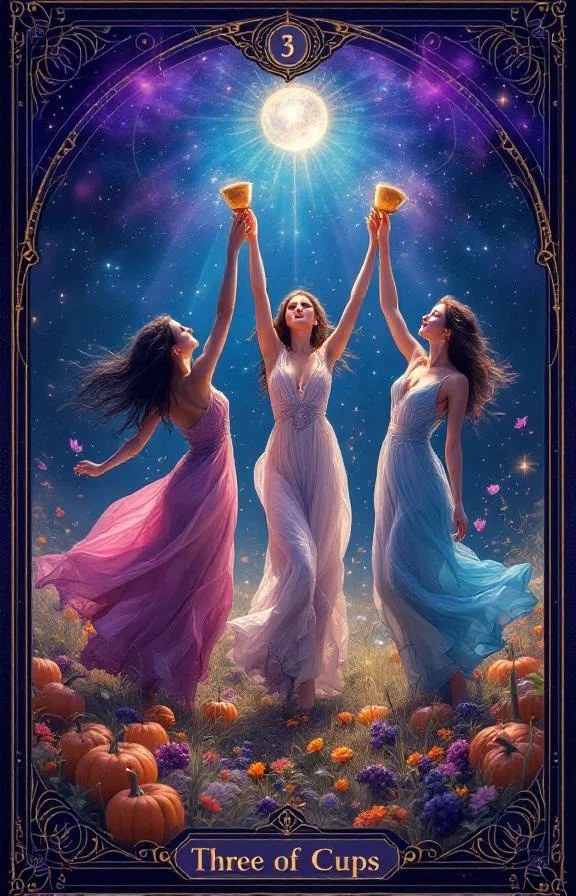
5. Tres de Copas — celebración y comunidad
Tres figuras bailan juntas, levantando sus copas en celebración. Es la carta de la alegría compartida, la comunidad y el tipo de felicidad que necesita testigos. En contextos de embarazo, el Tres de Copas representa la dimensión comunitaria de la maternidad — el baby shower, la emoción de la familia, la forma en que un embarazo se convierte en un evento compartido que se extiende mucho más allá de las dos personas que lo han creado.
Pero esta carta también tiene una sombra en las tiradas de embarazo. No todos los embarazos son recibidos con celebración. Algunos embarazos son secretos, complicados, no deseados o motivo de duelo. Si el Tres de Copas aparece invertido en una tirada de embarazo, puede reflejar la ausencia de apoyo comunitario — la sensación de afrontar esta transformación en soledad.
6. Nueve de Oros — autosuficiencia antes del cambio
El Nueve de Oros muestra a una figura solitaria en un jardín exuberante, rodeada de la abundancia que ha cultivado por sí misma. Un halcón descansa en su mano enguantada. Es la carta de la independencia conseguida — la persona que ha construido una vida estable y hermosa según sus propios términos.
En tiradas de embarazo, el Nueve de Oros representa la preparación — no la preparación biológica, sino la psicológica y práctica. Pregunta: ¿Has construido los cimientos que pueden sostener esto? Un hogar estable, seguridad económica, madurez emocional, una red de apoyo — el Nueve de Oros refleja la preparación que hace que la transición a la maternidad sea sostenible en lugar de desestabilizadora.
Cuando esta carta aparece junto a La Emperatriz, la tirada sugiere que la creación está respaldada por una base sólida. Cuando aparece invertida, puede señalar que los cimientos necesitan más trabajo antes de que la transformación de la maternidad se sienta segura.
7. As de Oros — nuevos comienzos materiales
El As de Oros es una mano que ofrece una moneda de oro a través de la puerta de un jardín. Representa una nueva realidad material — un comienzo tangible, algo que existe en el mundo físico y no solo en la imaginación.
En contextos de embarazo, esta carta representa el momento en que la maternidad deja de ser hipotética y se vuelve real. El test positivo. La primera visita médica. El cuarto del bebé siendo preparado. Es la carta de la manifestación — de la posibilidad abstracta convirtiéndose en hecho concreto.
Combinaciones de cartas que cambian las tiradas de embarazo
Una sola carta te dice una cosa. Las combinaciones te cuentan la historia entre las cosas. En las tiradas de embarazo, ciertas parejas cambian la conversación de manera drástica.
La Emperatriz + La Muerte es la combinación que asusta a la gente innecesariamente. No señala peligro. Señala la completitud de la transformación que supone la maternidad — creación y muerte del antiguo yo llegando juntas, que es exactamente lo que hace la maternidad. Esta combinación aparece a menudo en personas al borde de decidir si quieren ser madres o padres, porque la decisión implica simultáneamente crear algo y soltar algo.
As de Copas + Cinco de Copas merece atención honesta. El nuevo comienzo emocional junto al duelo y la pérdida puede reflejar la complicada realidad del embarazo después de un aborto — o la ambivalencia de un embarazo no planeado donde coexisten alegría y duelo. No toda respuesta emocional ante un embarazo es sencilla. Esta combinación honra la complejidad que las tiradas más simples aplanan.
Paje de Copas + La Torre aparece a menudo en personas cuya noticia del embarazo genuinamente trastocó sus planes. El mensaje sorpresa del inconsciente se encuentra con el derrumbe de la estructura existente. La Torre aquí no es un castigo — es un reflejo honesto de lo completamente que una nueva vida reorganiza una existente.
El Sol + Nueve de Oros es la combinación más silenciosamente reconfortante: alegría y preparación juntas. No solo querer un hijo, sino haber construido la estabilidad para recibirlo. Esta pareja tiende a aparecer cuando la pregunta real de quien consulta no es "¿Ocurrirá?" sino "¿Estoy lista?" — y las cartas sugieren que los cimientos son sólidos.
La ausencia de cartas asociadas al embarazo también importa. Si preguntas específicamente sobre el embarazo y sacas el Siete de Espadas y el Cuatro de Copas, la tirada no es sobre fertilidad. Es sobre evitación y desconexión emocional. A veces las cartas responden a la pregunta que no formulaste porque esa pregunta es la que realmente necesita atención.
Lo que el tarot no puede hacer (y lo que no debería intentar)
Esta sección importa. Lo suficiente como para decirlo claramente.
El tarot no puede determinar si estás embarazada. Si sospechas un embarazo, hazte una prueba médica. Ninguna combinación de cartas en ninguna tirada sustituye la confirmación médica.
El tarot no puede predecir si te quedarás embarazada. La fertilidad es un proceso biológico complejo influenciado por docenas de factores médicos. Una tirada de tarot no tiene acceso a tu salud reproductiva.
El tarot no puede decirte si continuar un embarazo. Esta es una de las decisiones más trascendentales que puede afrontar una persona, y merece el apoyo de profesionales de la salud, personas de confianza en tu vida y — si resulta útil — un orientador o consejero profesional. Una tirada de tarot puede ayudarte a explorar tus sentimientos sobre la decisión, pero no es una herramienta para tomarla.
Lo que el tarot sí puede hacer es ofrecerte un espacio simbólico estructurado para procesar la enorme complejidad psicológica de este terreno. El deseo de tener un hijo. El miedo a la maternidad. El duelo de la infertilidad. La ambivalencia de un embarazo no planeado. La transformación de identidad que supone convertirse en padre o madre de alguien. Estos son exactamente el tipo de estados psicológicos profundos, cargados emocionalmente y no del todo conscientes que el lenguaje simbólico del tarot fue diseñado para sacar a la superficie.
La psicología de convertirse en padre o madre
La constelación de la maternidad de Stern identifica cuatro temas que dominan la psicología de la maternidad temprana:
| Tema | Pregunta psicológica | Carta del tarot que suele reflejarlo |
|---|---|---|
| Vida-crecimiento | ¿Puedo mantener a este hijo vivo y en desarrollo? | La Emperatriz |
| Relación primaria | ¿Puedo amar a este hijo, y me amará a mí? | As de Copas, Dos de Copas |
| Red de apoyo | ¿Tendré la ayuda y el apoyo que necesito? | Tres de Copas, Seis de Oros |
| Reorganización de identidad | ¿Quién soy ahora que soy padre o madre? | La Muerte, El Juicio, El Mundo |
Nótese que el último tema — la reorganización de identidad — está representado por cartas asociadas con una transformación mayor, no con las cartas vinculadas tradicionalmente al embarazo. Esto se debe a que el trabajo psicológico más profundo de la maternidad no trata sobre la fertilidad ni el nacimiento. Trata sobre la muerte de quien eras antes y la emergencia de quien estás llegando a ser.
Cuando La Muerte aparece en una tirada de embarazo, raramente señala algo alarmante. Refleja la realidad psicológica de que convertirse en padre o madre significa soltar la identidad anterior — la libertad, la espontaneidad, la centralidad de las propias necesidades — para que pueda emerger una nueva identidad. Es la carta que reconoce lo que todo padre honesto sabe: la maternidad es una pérdida además de una ganancia, y ambas merecen ser reconocidas.
Fertilidad, duelo y las cartas
Para quienes navegan la infertilidad, la pérdida gestacional o el complicado duelo de desear un hijo que no tienen, las tiradas de tarot sobre el embarazo llevan un peso emocional adicional. Una tirada que muestra La Emperatriz y el As de Copas puede sentirse como una crueldad si esas cartas representan una realidad que sigue fuera del alcance.
Si esta es tu experiencia, ten en cuenta dos cosas. Primero, las cartas están reflejando tu deseo y tu duelo — ambos reales y válidos, independientemente del resultado. Que La Emperatriz aparezca en tu tirada no significa que el embarazo esté llegando. Significa que el arquetipo creativo, nutricio y generativo está profundamente activo en tu psique. Ese arquetipo merece expresión, independientemente de si toma la forma de maternidad biológica.
Segundo, las cartas que aparecen junto a las "cartas de embarazo" importan enormemente. El Cinco de Copas (duelo y pérdida), el Tres de Espadas (desgarro emocional), la Emperatriz invertida (capacidad nutritiva agotada) — estas cartas sostienen la cara oscura del camino de la fertilidad, y su presencia en una tirada valida el dolor de ese camino de una manera que los consuelos bienintencionados ("ocurrirá cuando sea el momento") no pueden.
Una tirada de tarot de amor adaptada para la fertilidad puede ofrecer una reflexión estructurada sobre las dimensiones emocionales de este camino — no para predecir resultados, sino para honrar la complejidad de la experiencia.
Usar el tarot para explorar la maternidad conscientemente
Tanto si estás considerando la maternidad, como si estás embarazada o procesando la experiencia de la maternidad temprana, el tarot ofrece una práctica reflexiva estructurada para comprometerte con la transformación de manera consciente. Cómo hacerlo:
-
Antes de la concepción: Usa una tirada de tres cartas para explorar tus sentimientos sobre la maternidad. Pasado (tus propias experiencias de infancia que moldean tus expectativas), Presente (tu preparación y deseo actuales), Futuro (tus miedos y esperanzas sobre quién serías como padre o madre).
-
Durante el embarazo: Los cambios físicos y psicológicos del embarazo ocurren simultáneamente pero no sincrónicamente. Tu cuerpo puede estar muy por delante de tu mente, o tu mente muy por delante de tu cuerpo. Las tiradas regulares pueden ayudarte a seguir el viaje psicológico junto al físico.
-
Maternidad temprana: El período posparto es psicológicamente intenso y a menudo aislante. Una tirada de tarot es una de las pocas prácticas reflexivas que puede hacerse a las 3 de la mañana con una mano mientras la otra sostiene a un bebé. Está disponible cuando la necesitas, sin cita previa, sin canguro, sin salir de casa.
Preguntas frecuentes
¿Qué carta del tarot significa embarazo?
La Emperatriz es la carta más tradicionalmente asociada con el embarazo y la fertilidad. Sin embargo, ninguna carta del tarot confirma ni predice un embarazo. La Emperatriz representa el arquetipo de la creación y el cuidado — que puede manifestarse como maternidad biológica, proyectos creativos o cualquier forma de traer algo nuevo al mundo. Otras cartas comúnmente vinculadas al embarazo incluyen el As de Copas (nuevos comienzos emocionales), El Sol (alegría y nueva vida) y el Paje de Copas (noticias emocionales inesperadas).
¿Puede el tarot predecir si me quedaré embarazada?
No. El tarot es una herramienta reflexiva, no diagnóstica ni predictiva. No puede evaluar tu salud reproductiva, predecir resultados biológicos ni sustituir la orientación médica. Lo que el tarot sí puede hacer es ayudarte a explorar tus sentimientos sobre el embarazo — tus deseos, miedos, preparación y relación con la idea de la maternidad. Si estás intentando concebir, consulta con profesionales de la salud para orientación médica y usa el tarot como práctica complementaria de reflexión psicológica.
¿Qué significa La Emperatriz en una tirada de fertilidad?
En las tiradas de fertilidad, La Emperatriz representa tu relación con el arquetipo creativo y nutricio — tu capacidad y deseo de traer nueva vida al mundo en cualquier forma. Puede reflejar preparación, deseo profundo, duelo ante los desafíos de fertilidad o la transformación de identidad que requiere la maternidad. No promete embarazo, pero valida la profundidad y seriedad de tu compromiso con esta posibilidad.
¿Es malo sacar La Muerte en una tirada de embarazo?
No. La Muerte en una tirada de embarazo casi nunca indica daño físico. Representa la transformación psicológica que requiere la maternidad — el fin de una identidad y el comienzo de otra. Cada padre pasa por esta transformación: la muerte del yo-como-individuo y el nacimiento del yo-como-padre o madre. La Muerte en este contexto no es una advertencia. Es un reconocimiento de que esta transformación es real, significativa y merece atención consciente.
¿Qué tirada de tarot funciona mejor para preguntas sobre el embarazo?
Una tirada de tres cartas funciona bien: la primera posición para tu relación emocional actual con la idea de la maternidad, la segunda para lo que temes o estás evitando, la tercera para lo que necesita atención antes de poder seguir adelante. Evita tiradas que incluyan una posición de "resultado" o "predicción" — encuadran el embarazo como algo que las cartas pueden pronosticar en lugar de algo que estás procesando psicológicamente. Una práctica de carta diaria también puede rastrear tus sentimientos cambiantes a lo largo de semanas. Los patrones que emergen en varias tiradas a menudo revelan más que cualquier tirada individual.
¿Puede el tarot ayudar con la ansiedad por la fertilidad?
El tarot no trata la ansiedad. Eso lo hace un terapeuta. Lo que el tarot puede hacer es dar a la ansiedad por la fertilidad un lugar estructurado donde existir — un recipiente simbólico donde los miedos, esperanzas y el duelo del camino de la fertilidad pueden exteriorizarse y examinarse en lugar de circular sin fin dentro de tu cabeza. Sacar cartas y permanecer con lo que surge es una forma de reflexión estructurada que la investigación vincula al procesamiento emocional. Funciona junto al tratamiento médico y el apoyo profesional, no en lugar de ellos. Si la ansiedad por la fertilidad está afectando significativamente tu funcionamiento diario, habla con un profesional de salud mental. Si necesitas un espacio donde sentarte con la enormidad de lo que sientes a las 3 de la mañana, una lectura gratuita puede sostenerte hasta que amanezca. La sección de tarot del amor explora territorio emocional relacionado desde otro ángulo.
Las cartas asociadas al embarazo sostienen una de las transiciones más profundas de la experiencia humana — no como predicción, sino como espejo. Tanto si anhelas un hijo, como si lo estás esperando o criando, el lenguaje simbólico del tarot ofrece algo que la información médica y el consejo práctico no pueden: un espacio para sentarse con la enormidad de lo que significa crear una vida y ser transformado para siempre por esa creación.
Explora lo que la maternidad significa para tu ser más profundo. Prueba una lectura gratuita con IA y deja que las cartas reflejen tu camino.