On ne tend pas la main vers un tirage en étoile quand tout va bien. On y recourt quand on a passé assez de temps dans l'obscurité pour avoir commencé à oublier à quoi ressemble la lumière. Ce n'est pas un tirage pour la curiosité du lundi matin ou les bilans hebdomadaires. C'est un tirage pour les moments où l'on a besoin de se rappeler que la direction existe — qu'il y a encore un point à l'horizon qui mérite qu'on marche vers lui.
Viktor Frankl a survécu à Auschwitz. Pas seulement par chance ni par force physique — Frankl était un homme mince, un psychiatre, totalement impréparé au travail forcé. Il a survécu, écrivit-il plus tard dans Man's Search for Meaning (1946), parce qu'il avait maintenu un sentiment de sens même dans des conditions conçues pour l'anéantir. Il observa que les prisonniers qui survivaient le plus longtemps n'étaient pas nécessairement les plus forts ni les plus jeunes. C'étaient ceux qui avaient quelque chose pour lequel vivre — un manuscrit à terminer, une personne à retrouver, une signification que rien ne pouvait leur arracher, même quand tout le reste leur avait été pris.
Le tirage en étoile fonctionne sur le même principe. Non que votre souffrance soit comparable à celle de Frankl — évidemment non. Mais le mécanisme est identique : quand on est entouré d'obscurité, ce qui nous sauve n'est pas la disparition de cette obscurité. C'est trouver un point fixe de lumière qui donne une orientation. Une direction. Une raison de faire un pas de plus. C'est ce que ces trois mises en page sont conçues pour vous aider à trouver.
En bref : Les tirages en étoile sont conçus pour les périodes sombres où l'on a besoin de direction, pas de diagnostic. Trois mises en page s'adressent à des profondeurs différentes : une étoile à sept branches qui cartographie toutes les zones de votre vie selon le modèle PERMA de Seligman, une Étoile Directrice à cinq cartes qui nomme votre obscurité actuelle et identifie une étoile polaire digne d'être poursuivie, et une Étoile Souhaitée à trois cartes qui va droit au cœur de votre désir véritable et du blocage interne empêchant l'alignement.
Tirage 1 : L'Étoile à Sept Branches (7 cartes)
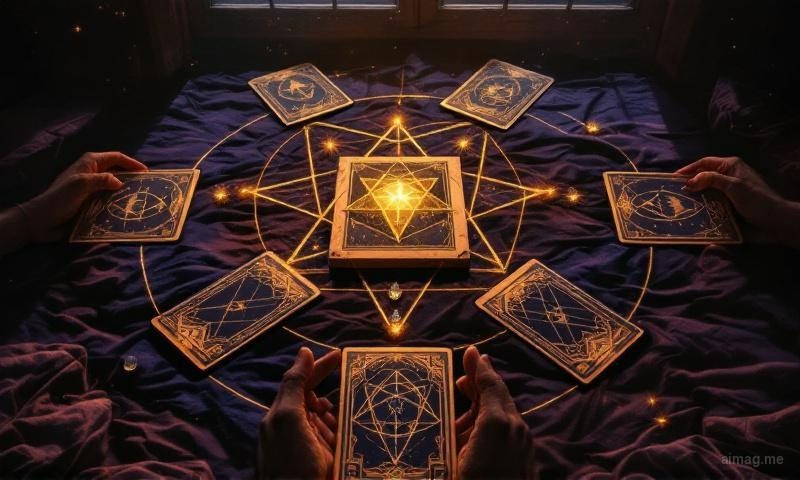
Sept cartes, une pour chaque domaine majeur de votre vie. Disposez-les en étoile à six branches avec une carte au centre — imaginez la forme d'une étoile de David, une carte à chaque pointe et une au cœur.
| Position | Domaine de vie | Signification |
|---|---|---|
| 1 | Physique | Votre corps, santé, sécurité matérielle, besoins fondamentaux |
| 2 | Émotionnel | Votre vie affective, schémas émotionnels, ce que votre cœur traverse |
| 3 | Mental | Vos pensées, croyances, les histoires que vous vous racontez |
| 4 | Relationnel | Vos liens avec les autres, amour, amitié, communauté |
| 5 | Créatif | Votre expression personnelle, projets, ce que vous construisez ou créez |
| 6 | Intuitif | Votre savoir intérieur, ce que vous pressentez sans pouvoir le prouver |
| 7 (centre) | Spirituel | Votre connexion au sens, à la finalité, au schéma plus large de votre vie |
Comment le lire : Commencez par la position 7, la carte centrale. C'est le pivot d'où tout le reste rayonne. Si L'Étoile elle-même apparaît ici — et cela arrive, plus souvent que les statistiques ne le prévoiraient, parce que l'inconscient a un sens de l'humour sombre sur ces choses — le message est direct : votre centre spirituel est intact. Quel que soit le chaos dans les positions périphériques, le cœur tient.
Lisez ensuite les six cartes environnantes comme un diagnostic. Quels domaines sont florissants ? Lesquels sont en difficulté ? Le tirage vous offre un instantané simultané de toute votre vie, déployée comme une constellation. Vous cherchez des déséquilibres. Deux ou trois positions montrant des Épées tandis que les autres montrent des Coupes et des Pentacles signifie que votre vie mentale et émotionnelle s'est séparée de votre réalité physique et matérielle. La forme en étoile vous aide à voir cela parce qu'elle place chaque domaine à égale distance du centre — aucune zone n'a de priorité structurelle, ce qui force une comparaison honnête.
Martin Seligman, le psychologue qui a essentiellement fondé le champ de la psychologie positive, a développé le modèle PERMA pour décrire en quoi consiste véritablement le bien-être humain. PERMA désigne Émotions Positives, Engagement, Relations, Sens (Meaning) et Accomplissement. L'Étoile à Sept Branches se superpose presque parfaitement à ce cadre : la position 2 (émotionnelle) couvre les Émotions Positives ; la position 5 (créative) couvre l'Engagement et l'Accomplissement ; la position 4 (relationnelle) couvre les Relations ; la position 7 (spirituelle) couvre le Sens. Ce tirage est, en effet, une évaluation PERMA rendue en symboles.
Si la position 4 (relationnelle) montre Le Neuf de Coupes — la carte de la satisfaction profonde, d'avoir ce qu'on désirait vraiment — mais que la position 3 (mentale) montre le Neuf d'Épées — anxiété sans sommeil, pensées catastrophiques — le diagnostic est précis : vos relations vous soutiennent, mais votre esprit sabote l'expérience. Vous avez la connexion. Vous n'en profitez pas parce que vos pensées ne vous le permettent pas.
Lire les espaces entre les branches
L'espace entre les cartes adjacentes compte autant que les cartes elles-mêmes. La position 1 (physique) est voisine de la position 2 (émotionnelle). Si la carte physique est le Quatre de Pentacles (se cramponner, garder les ressources, mentalité de pénurie) et la carte émotionnelle est le Cinq de Coupes (deuil, perte, incapacité à voir ce qui reste), elles se renforcent mutuellement. L'insécurité physique nourrit le deuil émotionnel, et le deuil émotionnel crée une tension physique. Le cycle vit dans l'espace entre les deux branches.
Cherchez ces schémas d'adjacence. Là où deux positions voisines racontent des histoires contradictoires — la santé physique est solide mais la vie émotionnelle s'effondre — vous avez identifié une déconnexion. Là où deux positions voisines racontent la même histoire, vous avez identifié soit un cercle vertueux (toutes deux florissantes) soit un cercle vicieux (toutes deux en difficulté). La forme en étoile rend ces connexions visibles parce que la géométrie place les domaines proches les uns des autres.
Tirage 2 : L'Étoile Directrice (5 cartes)
Cinq cartes en ligne verticale avec une carte décalée à droite en haut — comme une étoile vers laquelle on navigue. Ce tirage est spécifiquement conçu pour les périodes sombres. Pas "j'ai eu une mauvaise semaine" sombre. "J'ai perdu le sens de la direction et je ne sais plus ce que je fais" sombre.
| Position | Signification |
|---|---|
| 1 | L'obscurité actuelle — ce avec quoi vous luttez maintenant |
| 2 | Ce que vous apprenez — la connaissance que cette expérience vous impose |
| 3 | Votre force cachée — ce que vous possédez sans le voir |
| 4 | La prochaine étape — non la destination, juste la prochaine action concrète |
| 5 | Votre Étoile Polaire — la finalité plus large que cette période sert |
Comment le lire : La position 1 nomme l'obscurité. Non pour s'y complaire — mais pour la voir clairement. Frankl soutenait que la souffrance sans sens est insupportable, mais que la souffrance avec sens est endurable. Cette carte vous montre la forme de ce que vous endurez afin que les quatre cartes restantes puissent lui donner un contexte.
La position 2 est la carte la plus dérangeante du tirage. "Ce que vous apprenez" n'est pas la même chose que "ce que vous voulez apprendre." L'expérience que vous traversez vous enseigne quelque chose, que vous soyez inscrit ou non à ce cours. La Lune en cette position dit que la leçon porte sur l'illusion — apprendre à distinguer ce que vous craignez de ce qui est réellement dangereux. La Tour ici dit que la leçon porte sur la démolition — apprendre que certaines structures devaient tomber. Ni l'un ni l'autre n'est confortable. Les deux sont vrais.
La position 3 mérite une pleine minute de contemplation. Votre force cachée. Durant les périodes sombres, l'esprit se contracte. Il se concentre sur ce qui ne va pas, ce qui manque, ce qui est brisé. Cette carte interrompt cette contraction en pointant vers quelque chose qui est encore fort, encore fonctionnel, encore à vous. Le Soleil en cette position — et je l'ai vu se produire — est d'une espérance presque insoutenable. Il dit : votre vitalité essentielle est intacte. L'obscurité ne l'a pas atteinte. Vous avez plus de lumière en vous que vous ne le croyez en ce moment.
La position 4 est délibérément modeste. Non "où vous allez atterrir." Juste la prochaine étape. Une seule action. Quand tout semble accablant, l'antidote n'est pas un grand plan — c'est un seul geste concret qui démontre que vous avez encore le pouvoir de choisir. La recherche de Seligman sur la résignation acquise a montré que l'antidote au sentiment d'être piégé n'est pas la liberté mais l'agentivité — une petite action prouve qu'on a encore prise sur sa vie. La position 4 vous offre cette action.
La position 5 est l'Étoile Polaire elle-même. La finalité plus large. Ce n'est pas une destination — c'est une direction. Les étoiles ne se posent pas. Elles restent fixes pendant que vous vous déplacez vers elles. Si L'As de Coupes apparaît ici, votre Étoile Polaire est le renouveau émotionnel — non une relation ou un événement spécifique, mais la capacité au sentiment profond elle-même. Tout ce que vous traversez est, à quelque niveau, en train de vous ouvrir pour que cette capacité puisse s'élargir.
Tirage 3 : L'Étoile Souhaitée (3 cartes)
Trois cartes. Simple. Direct. Pour quand vous savez ce que vous voulez mais semblez incapable d'y accéder.
Posez trois cartes en diagonale — du bas gauche vers le haut droit — comme une étoile filante.
| Position | Signification |
|---|---|
| 1 | Le désir du cœur — ce que vous voulez vraiment au niveau le plus profond |
| 2 | Ce qui le bloque — l'obstacle interne ou externe empêchant l'alignement |
| 3 | Comment s'aligner — le changement de perspective, d'action ou de croyance qui comble l'écart |
Comment le lire : Ce tirage coupe à travers le bruit. La position 1 n'est pas "ce que vous croyez vouloir" — c'est ce que vous voulez quand vous cessez de jouer la comédie pour les autres. La carte peut vous surprendre. Vous vous êtes assis en pensant vouloir une promotion, et la carte montre le Deux de Coupes — connexion, partenariat, réciprocité émotionnelle. Votre cœur ne veut pas la promotion. Il veut la relation. La promotion était un substitut, une version socialement plus acceptable de la faim qui se cache dessous.
La position 2 nomme le blocage. Souvent, le blocage est interne. Le Cinq de Pentacles — une mentalité de pauvreté, la conviction que vous ne méritez pas ce que vous désirez. Le Huit d'Épées — emprisonnement mental, la certitude d'être piégé alors que les liens sont assez lâches pour glisser. La Grande Prêtresse renversée — déconnexion de votre propre intuition, décisions prises depuis la tête quand vos tripes connaissent déjà la réponse.
La position 3 est le pont. Non une solution magique. Un changement. Parfois minuscule — le Trois de Pentacles suggérant la collaboration, ce qui signifie que le changement consiste simplement à demander de l'aide. Parfois sismique — la Mort, ce qui signifie que le changement exige que quelque chose d'ancien meure complètement avant que la nouvelle chose puisse vivre.
La psychologie de l'espoir
Les travaux de Seligman sur la psychologie positive — en particulier le modèle PERMA publié dans Flourish (2011) — offrent un cadre pour comprendre pourquoi les tirages en étoile semblent différents des autres mises en page. La plupart des tirages de tarot traitent des problèmes : ce qui ne va pas, quoi faire, quel pourrait être le résultat. Les tirages en étoile abordent quelque chose de plus fondamental. Ils abordent le bien-être lui-même. Non l'absence de problèmes, mais la présence de sens, d'émotions positives, d'engagement et de connexion.
Ce n'est pas anodin. La recherche de Seligman a démontré que le bien-être n'est pas l'opposé de la maladie mentale — on peut être libéré de la dépression et de l'anxiété et manquer malgré tout d'un sens de la finalité, se sentir toujours désengagé de sa propre vie. Les tirages en étoile ciblent précisément cet écart. La position 7 (centre spirituel) dans l'Étoile à Sept Branches, la position 5 (Étoile Polaire) dans l'Étoile Directrice, la position 1 (désir du cœur) dans l'Étoile Souhaitée — ce sont toutes des positions centrées sur le sens. Elles demandent non pas "Qu'est-ce qui ne va pas ?" mais "Qu'est-ce qui va bien ? Qu'est-ce qui donne de la cohérence à votre vie ? Vers quoi vous déplacez-vous ?"
Frankl est arrivé à la même conclusion depuis la direction opposée. Il n'étudiait pas les gens qui s'épanouissaient. Il étudiait des personnes dans les pires conditions imaginables et a découvert que, même là, le sens était la variable qui prédisait la survie. Les prisonniers capables de répondre à "Qu'est-ce que ma vie me demande ?" résistaient. Ceux qui ne le pouvaient pas — dont le sens de la finalité avait été détruit avec leurs biens, leur liberté, leurs identités — déclinaient rapidement. La finalité n'est pas un luxe. C'est une infrastructure.
Quand utiliser chaque tirage en étoile
L'Étoile à Sept Branches : Quand vous vous sentez globalement déséquilibré sans pouvoir identifier quelle partie de votre vie en est la cause. Ce tirage est diagnostique — il cartographie les sept domaines simultanément et vous laisse trouver le déséquilibre vous-même.
L'Étoile Directrice : Quand vous êtes en crise ou en difficulté prolongée et que vous avez besoin de trouver un sens dans l'expérience. Non pour justifier la souffrance — jamais cela — mais pour en extraire quelque chose d'utilisable. Une direction. Une leçon. Une raison de continuer.
L'Étoile Souhaitée : Quand vous savez ce que vous voulez mais qu'il y a une déconnexion entre le désir et la réalité. Ce tirage identifie le blocage et vous montre le changement nécessaire pour combler l'écart.
Les cartes qui portent un poids particulier dans les tirages en étoile
L'Étoile — La carte éponyme du tirage. Dans n'importe quelle position, elle confirme que l'espoir n'est pas naïf — il est juste. Quelque chose de genuinement bon vous est accessible. En position 5 (Étoile Polaire), c'est le signal le plus fort possible : vous allez dans la bonne direction. Continuez.
La Lune — En position 1 (obscurité actuelle), La Lune dit que la difficulté n'est pas ce qu'elle paraît. Des illusions sont en jeu. La peur déforme la perception. L'obscurité est réelle, mais elle n'a pas la forme que vous croyez.
Le Soleil — En position 3 (force cachée), Le Soleil est une affirmation directe : votre vitalité n'est pas épuisée. Elle est dissimulée. L'obscurité ne l'a pas éteinte — elle l'a cachée, et il y a une différence.
Le Neuf de Coupes — En position 1 (désir du cœur, Étoile Souhaitée), cette carte montre que ce que vous voulez est l'épanouissement émotionnel — une satisfaction profonde et tranquille. Non l'excitation. Non l'accomplissement. La paix intérieure. Cette distinction compte.
L'As de Coupes — En position 5 (Étoile Polaire), l'As de Coupes pointe vers un nouveau départ émotionnel comme direction directrice. La finalité de ce que vous traversez est de vider la coupe pour qu'elle puisse être remplie de quelque chose de nouveau.
Questions fréquentes
Puis-je faire un tirage en étoile pour quelqu'un d'autre ?
Vous le pouvez, mais procédez avec soin. Les tirages en étoile — en particulier l'Étoile Directrice — traitent de territoire personnel profond : souffrance, sens, finalité, désir. Lire ces éléments pour quelqu'un d'autre demande une empathie authentique et la volonté de rester avec sa douleur sans se précipiter à le rassurer. Si vous n'y êtes pas prêt, restez avec des mises en page plus simples pour les lectures de tiers.
Et si la carte L'Étoile n'apparaît pas dans un tirage en étoile ?
Elle n'a pas besoin de le faire. L'énergie de L'Étoile est intégrée dans la structure du tirage, elle ne dépend pas de l'apparition de la carte elle-même. La forme en étoile, les significations des positions, l'accent sur l'espoir et la direction — tout cela véhicule cette énergie quelle que soit la carte spécifique qui apparaît. Si L'Étoile se montre, considérez-la comme un clin d'œil de votre inconscient. Sinon, le tirage fonctionne exactement comme prévu.
À quelle fréquence devrais-je faire un tirage en étoile ?
Pas chaque semaine. L'Étoile à Sept Branches s'utilise mieux trimestriellement — comme un bilan saisonnier de l'équilibre global de votre vie. L'Étoile Directrice est situationnelle — utilisez-la quand vous en avez besoin, ce qui peut être une fois par an ou une fois par décennie. L'Étoile Souhaitée peut être utilisée quand un désir spécifique semble bloqué, mais laissez au moins un mois à chaque lecture avant de la répéter avec la même question. Ces tirages ont besoin de temps pour se déployer.
Le tirage en étoile convient-il aux débutants ?
L'Étoile Souhaitée (3 cartes) est excellente pour les débutants — structure simple, positions claires, pertinence immédiate. L'Étoile à Sept Branches (7 cartes) est intermédiaire — les significations des positions sont intuitives, mais lire sept cartes comme une constellation demande de la pratique. Commencez par la version à trois cartes et progressez.
Les étoiles ne résolvent rien. Elles n'arrêtent pas la pluie, ni ne réchauffent le froid, ni ne nourrissent celui qui a faim. Ce qu'elles font — ce qu'elles ont toujours fait, avant même que les humains aient un langage pour les nommer — c'est vous montrer où se trouve le nord. C'est suffisant. Dans le camp de concentration de Frankl, le sens n'a pas mis fin à la souffrance. Il l'a rendue survivable. Dans la recherche de Seligman, le bien-être n'a pas effacé les problèmes de la vie. Il a donné aux gens l'architecture intérieure pour porter ces problèmes sans s'effondrer. Un tirage en étoile fait la même chose à plus petite échelle. Trois cartes, cinq cartes, sept cartes — disposées dans une forme que vos yeux reconnaissent comme pointant quelque part. Et ce quelque part n'a pas besoin d'être précis. Pas besoin d'être une coordonnée GPS ni un plan sur cinq ans. Il doit juste exister. Une direction. Un point de lumière. La connaissance stable que même dans cette obscurité particulière, il y a encore une voie — et votre inconscient, qui naviguait vers cette lumière depuis le début, est prêt à vous montrer où elle se trouve.