Three cards. That is all it takes to transform a vague feeling into a structured insight. The three-card spread is tarot's most versatile instrument — simple enough for your first reading, flexible enough for your thousandth, and capable of producing the kind of clarity that larger, more elaborate spreads sometimes bury under their own complexity.
The genius of three cards is constraint. A single card gives you a snapshot but no movement — a noun without a verb. The Celtic Cross gives you ten dimensions of movement but can overwhelm with nuance. Three cards occupy the cognitive sweet spot: enough structure to create narrative, enough economy to remain sharp.
Every three-card spread tells a story. The positions define the story's grammar — whether it moves through time, across perspectives, or between layers of a situation. Choosing the right three-card layout for your question is not a technicality. It is the single most important decision you make before the cards are drawn.
In short: The three-card tarot spread is tarot's most versatile tool — simple enough for beginners, deep enough for experienced readers. Eight layouts cover everything from past-present-future to mind-body-spirit to decision-making. Three cards hit the cognitive sweet spot: enough structure to create narrative, enough economy to stay sharp. The key skill is reading the story between cards, not each card alone.
Why Three Cards Work
Cognitive psychologist George Miller's famous 1956 paper, "The Magical Number Seven, Plus or Minus Two," established that human working memory processes information most effectively in small chunks. Three items represent the minimum viable narrative — beginning, middle, end — and the maximum simplicity before a story loses its arc.
This is not an accident. The three-card spread works because it maps onto the fundamental narrative structure of human thought: something was, something is, something will be. Or: something is known, something is hidden, something is possible. Or: mind thinks this, heart feels this, action requires this. Every three-card layout is a variation on the same deep structure — a triangle of meaning that the mind can hold, rotate, and examine from every angle without losing its shape.
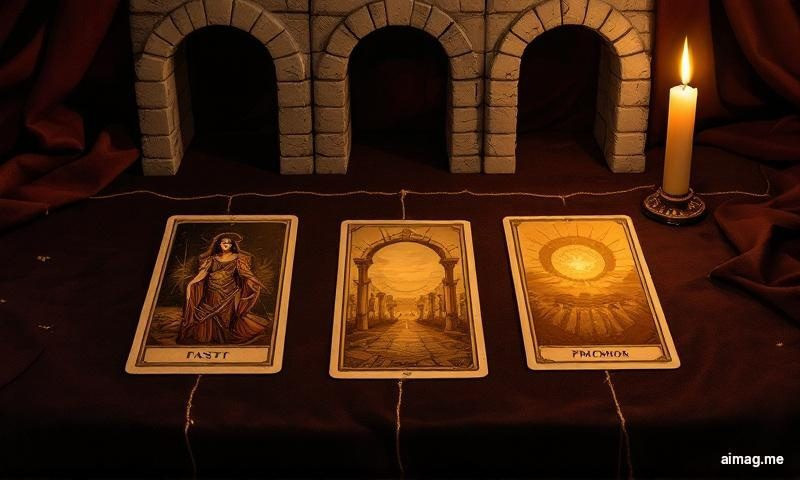
8 Three-Card Layouts
1. Past – Present – Future
The classic. The layout that most people learn first and return to most often. Position 1 reveals what has led to the current situation, Position 2 shows where you stand right now, and Position 3 indicates the direction things are heading.
Best for: General life check-ins, situations that feel stuck, questions about whether things are improving or declining.
Reading tip: Pay the most attention to the transition between cards. The story is not in any single position but in the movement from one to the next. A difficult past card followed by a hopeful present card tells a very different story than the same difficult card followed by another difficult card.
2. Situation – Challenge – Advice
A problem-solving layout. Position 1 defines the situation as it actually is (which is often different from how you think it is). Position 2 identifies the primary obstacle or challenge. Position 3 offers the spread's recommendation — what action, attitude, or perspective shift would serve you best.
Best for: When you know something is wrong but cannot articulate what. When you need practical guidance rather than philosophical insight.
3. Mind – Body – Spirit
A holistic self-assessment. Position 1 reveals your current mental state — what occupies your thoughts, the quality of your thinking. Position 2 addresses your physical reality — health, energy, material circumstances, the body's wisdom. Position 3 speaks to your spiritual or emotional center — your deeper sense of meaning, purpose, and connection.
Best for: Wellness check-ins, periods of overwhelm, the feeling that your life is out of balance without knowing which part is off-center.
4. You – The Other Person – The Relationship
A relationship diagnostic. Position 1 represents your current energy, perspective, or emotional state within the relationship. Position 2 represents the other person's energy or perspective. Position 3 represents the relationship itself — the dynamic that exists between you, which is always more than the sum of its parts.
Best for: Romantic relationships, friendships, family dynamics, professional partnerships. Any situation where two people are creating a third thing between them.
5. Option A – The Current Path – Option B
A decision-making layout. Position 1 shows the energy, consequences, and trajectory of one choice. Position 3 shows the same for the alternative. Position 2 — the center card — represents where you are right now, the point from which both paths diverge.
Best for: Binary decisions, crossroads, moments when you can clearly articulate two distinct options but cannot determine which one to choose.
Reading tip: If both options look equally appealing or equally challenging, the center card (your current position) often holds the clue. It reveals what you are bringing to the decision — the energy, bias, or need that will shape whichever path you take.
6. What I Think – What I Feel – What I Should Do
A mind-heart alignment check. Position 1 shows your rational assessment of the situation. Position 2 shows your emotional truth about it. Position 3 synthesizes both into action — what you should actually do when head and heart are considered together.
Best for: Situations where you know what you "should" do but cannot bring yourself to do it. Conflicts between logic and intuition.
7. Strengths – Weaknesses – Guidance
A personal development layout. Position 1 identifies your current strengths in relation to a situation or goal. Position 2 reveals your weaknesses, blind spots, or areas requiring growth. Position 3 offers the wisdom needed to leverage your strengths while addressing your weaknesses.
Best for: Career planning, personal growth, preparing for challenges, self-assessment before a major undertaking.
8. Morning – Afternoon – Evening
A daily guidance layout. Three cards drawn at the start of the day to preview its emotional arc. This is less about prediction and more about intention — setting a framework that helps you notice the day's themes as they unfold.
Best for: Daily practice, building tarot fluency, creating a contemplative morning ritual.
How to Read Three Cards Together
The most important skill in three-card reading is not knowing what each card means individually — it is seeing the story that emerges when they are placed side by side. Here are the connections to look for:
Elemental flow. Notice the suits. Three Wands cards suggest the situation is entirely about energy, passion, and action. A mix of Cups and Swords suggests a tension between feeling and thinking. Pentacles grounding a spread of Major Arcana cards suggests that large, transformative forces need to find practical expression.
Narrative arc. Does the story escalate or resolve? Moving from the Ten of Swords to The Star to the Ace of Cups tells a clear redemption arc: devastation to hope to new emotional beginning. Moving from The Sun to the Five of Cups to the Nine of Swords tells a descent. Name the arc and you have named the reading's core message.
The center card rules. In any three-card layout, the middle position carries the most weight. It is where past meets future, where the current state is most fully expressed, where the decision point lives. When in doubt about a reading's meaning, start with the center card and read outward.
Reversals as turning points. If one of the three cards is reversed while the others are upright (or vice versa), that card marks the pivot — the place where energy shifts, where the expected pattern breaks, where your attention should focus.
Three Cards vs. Larger Spreads
The three-card spread is not a simplified version of the Celtic Cross. It is a different instrument entirely — a scalpel rather than an MRI. Use three cards when you need precision on a specific question. Use ten cards when you need a comprehensive map of a complex situation.
A useful rule: if you can state your question in one sentence, three cards will serve you. If your question requires a paragraph to explain all its dimensions, consider a larger spread.
That said, some of the most profound readings in tarot history have been three-card readings. Constraint breeds clarity. When you have only three positions, every card must carry its full weight, and the reader must work harder to find the connections. That effort — the cognitive work of extracting maximum meaning from minimum data — is itself a form of insight.
Frequently Asked Questions
Can I do multiple three-card readings in a row?
You can, but resist the temptation to re-draw until you get cards you like. If the first reading is unclear, sit with it before pulling again. If you want to explore a second dimension of the same question, choose a different three-card layout rather than repeating the same one. Using "Past-Present-Future" followed by "Situation-Challenge-Advice" for the same question will give you six distinct angles without the pitfall of shopping for preferred answers.
Do I need to shuffle between each layout?
Yes. Each layout is a separate question, even if the topic is the same. Shuffle fully between readings to reset the deck's randomness.
What if I get all Major Arcana cards?
Three Major Arcana cards in a three-card spread is significant. It suggests that the situation involves large, archetypal forces rather than everyday concerns. The energies at play are bigger than the immediate question — you may be dealing with a life chapter rather than a life moment. Take the reading seriously and consider journaling about it.
Is the three-card spread accurate?
Accuracy in tarot is less about the spread and more about the quality of the question and the depth of interpretation. A three-card spread with a clear question and attentive reading will consistently produce more useful insight than a ten-card spread with a vague question and surface-level interpretation. The cards reflect whatever depth you bring to them.
Three cards. Past, present, future. Problem, cause, solution. Mind, heart, action. The number three appears in myths, fairy tales, religious trinities, and rhetorical structures because it is the minimum number of points required to define a plane — a surface on which meaning can be laid, examined, and understood. The three-card spread does not give you less than a larger spread. It gives you exactly enough — enough structure to think, enough space to discover, and enough constraint to keep the discovery honest.