The Tree of Life is one of the oldest diagrams of human consciousness ever drawn. Centuries before modern psychology started mapping the layers of the mind, Kabbalistic scholars were already charting them — ten stations from pure awareness down to physical reality, connected by twenty-two paths that correspond, not by accident, to the twenty-two Major Arcana. This diagram is not religious decoration. It is a working map of how consciousness organizes itself. How the abstract becomes concrete. How an idea in your head becomes an action in the world.
The Kabbalah was never purely theological. It was a practical psychology of inner transformation — a system for understanding the relationship between what you think, what you feel, what you do, and what you become. The ten Sephiroth are not divine attributes floating in some distant heaven. They are dimensions of your own experience, running right now, in every decision, every relationship, every quiet moment when you wonder whether the life you are living is the one you were meant to live.
Tarot and the Tree of Life were formally linked in the late nineteenth century, but the connection runs older than the formal scholarship. Both systems describe the same process: consciousness moving from potential to expression, from the undefined to the defined, from the spiritual to the material. When you lay tarot cards on the Tree of Life, you are not performing an esoteric ritual. You are using two symbolic languages to triangulate something that ordinary words struggle to capture — the full architecture of where you stand, psychologically and spiritually, right now.
In short: Tree of Life tarot spreads use the Kabbalistic map of ten Sephiroth to scan every dimension of your inner life, from highest aspiration down to physical reality. Three layouts cover the full ten-card map, a three-card Pillars balance check, and a five-card Path of Return for navigating personal transformation. No Kabbalah study required — the positions translate directly into psychological dimensions you already recognize.
1. The Ten Sephiroth Spread (10 Cards)
The complete map. Ten cards, ten stations, from the highest point of awareness to the ground beneath your feet. Pull this spread when you want the full picture of your inner life — not just what is happening, but how every layer of your experience connects to every other layer.
| Position | Sephirah | Meaning |
|---|---|---|
| 1 | Kether (Crown) | Your highest aspiration — the version of yourself you are growing toward |
| 2 | Chokmah (Wisdom) | Your raw creative force — what wants to be born through you |
| 3 | Binah (Understanding) | Your capacity for structure — how you give form to what you know |
| 4 | Chesed (Mercy) | Where you are generous, expansive, and open |
| 5 | Geburah (Severity) | Where you need discipline, boundaries, or cutting away |
| 6 | Tiphareth (Beauty) | Your center — the truest expression of who you are right now |
| 7 | Netzach (Victory) | Your desires, passions, and emotional drives |
| 8 | Hod (Splendor) | Your intellect, communication, and mental patterns |
| 9 | Yesod (Foundation) | Your unconscious patterns — what runs beneath awareness |
| 10 | Malkuth (Kingdom) | Your physical reality — body, finances, daily life |
How to read it: Do not read these ten cards one by one in isolation. The Tree of Life is a system of relationships. Start with Position 6, Tiphareth — your center. This is the Sun position, the card that shows the most authentic version of you at this moment. The Sun landing here means you are aligned with your core self. The Hermit here means your truest expression right now is solitary, inward, contemplative.
Then read upward. Positions 1 through 3 are the highest levels of your consciousness. Position 1 is the aspiration you may not even be able to put into words yet — the pull toward something your rational mind has not named. The Fool in Kether means your deepest aspiration is radical freedom, a willingness to step into the unknown. The World in Kether means you are reaching toward completion, integration, wholeness.
Positions 4 and 5 form a critical pair: mercy and severity, expansion and contraction. These two forces shape everything below them. If Chesed holds The Empress, your generous side is abundant and fertile. If Geburah holds The Tower, what needs to be cut away is being cut away — violently, necessarily.
Positions 7 and 8 mirror each other: passion and intellect, feeling and thinking. When these two positions clash hard — say, The Lovers in Netzach (your heart wants connection) against The Hermit in Hod (your mind wants solitude) — you have found the core tension running your current life.
Position 9, Yesod, is the unconscious foundation. This card shows what is running your life from below the surface. The High Priestess here means your unconscious is rich and active but not communicating well with your waking mind. The Moon means your unconscious patterns involve illusion or unprocessed fear.
Position 10, Malkuth, is where everything becomes real. Your body, your bank account, your daily routine, your physical health. The material world is not "lowest" in any dismissive sense — it is where everything above it lands. If every other card looks magnificent but Malkuth holds the Five of Pentacles, your spiritual growth is not yet translating into physical well-being. That gap is itself useful information.
2. The Three Pillars Spread (3 Cards)
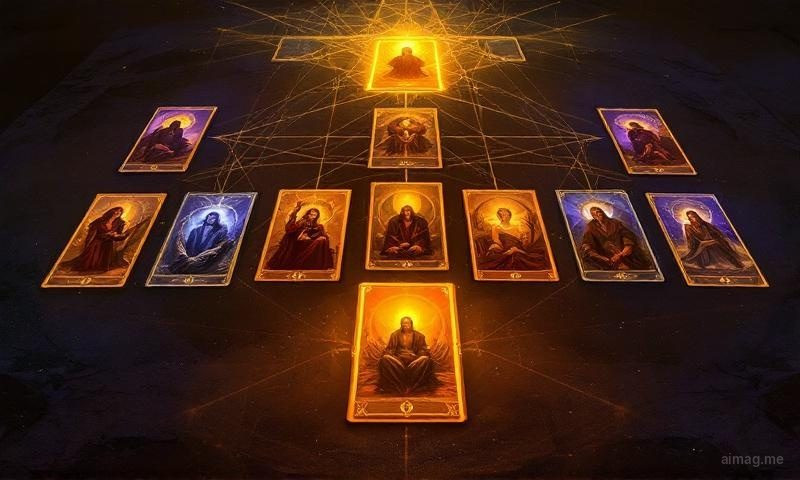
The Tree of Life organizes itself into three vertical pillars: Severity on the left, Mercy on the right, and the Middle Pillar holding the center. This three-card spread captures the essential tension between discipline and openness, with the center card as the fulcrum.
| Position | Pillar | Meaning |
|---|---|---|
| 1 | Severity (Left) | Where you need to set limits, say no, or enforce structure |
| 2 | Balance (Center) | Your point of equilibrium — what integrates both sides |
| 3 | Mercy (Right) | Where you need to be compassionate, generous, or receptive |
How to read it: Neither severity nor mercy is better. A person who is all mercy becomes permissive, boundary-less, easy to exploit. A person who is all severity becomes rigid, cold, cut off. The healthy psyche moves between them, applying each when the situation calls for it — and the center pillar represents the integrated self that can do both.
Position 1 names what needs tightening. Maybe a relationship where you have been too accommodating. A habit you need to break. A boundary you need to draw. A standard you need to enforce. The Emperor here confirms that authority and structure are what the moment demands. Justice says the severity required is about fairness — something is off-balance and the correction will feel strict but it has to happen.
Position 3 names what needs opening. Where have you been too hard? Too controlled? Too defended? The Star here says the mercy you need is hope — letting yourself believe in something again after disappointment. The Empress says the mercy is physical: rest, pleasure, sensory nourishment you have been denying yourself.
Position 2 is the linchpin. This card reveals what holds both sides together — the psychological resource that lets you be tough when toughness is needed and soft when softness is needed. Strength is the classic fit: gentle power, the ability to hold opposites without breaking. Temperance is the alchemical version: mixing two things into something neither could be alone.
This spread works particularly well during transitions — when your usual balance has shifted and you can feel yourself leaning too far one way. Three cards, three minutes, a clear diagnosis of where to adjust.
3. The Path of Return Spread (5 Cards)
Every transformative journey follows the same basic structure: departure, initiation, return. The Kabbalistic tradition describes a parallel process called the "Path of Return" — the soul's journey back up the Tree of Life, from material reality toward spiritual awareness. Not as an escape from the physical world, but as a way of living in it more consciously. More deliberately. More awake.
This five-card spread maps that journey onto whatever you are going through right now.
| Position | Stage | Meaning |
|---|---|---|
| 1 | Where You Are | Your current position — the starting ground of this journey |
| 2 | What You Are Learning | The lesson this phase of life is teaching you |
| 3 | The Test | The challenge or obstacle that will determine whether the lesson sticks |
| 4 | The Breakthrough | What becomes possible when you pass the test |
| 5 | The Destination | Where this particular journey leads — not the final stop, but the next landing |
How to read it: This spread assumes that wherever you are is not random. It is precisely where you need to be for the learning that is currently available. Not mystical optimism — just the observation, backed by developmental psychology, that growth follows a sequence and you cannot skip steps.
Position 1 grounds the reading. What is your reality right now? Not your ideal, not your plan — your actual situation. The Magician says you have considerable potential and skill at your disposal. The Eight of Cups says you are already in the process of walking away from something that stopped satisfying you.
Position 2 identifies the curriculum. What is life trying to teach you at this moment? This card tends to be the one people resist most, because the lesson is usually the exact thing they have been avoiding. Judgement says the lesson is about answering a calling you have been pretending not to hear. The Hanged Man says the lesson is surrender — letting go of the need to control the timing of your own transformation.
Position 3 is the test, and every genuine journey has one. The moment that determines whether you come back transformed or just come back. In practical terms, this is where insight has to become action — where understanding has to survive contact with reality. The Tower as the test means a dramatic disruption that strips away everything inessential. The Five of Wands means the test is competition, conflict, or the chaos of too many forces pulling you at once.
Position 4 is what opens on the other side. Not a reward in some gift-basket sense, but a new capacity — something you can do or be or feel that was not available before the difficulty. The World here promises integration and completion. The Ace of Cups promises a new emotional beginning — a capacity to feel something you had been closed off to.
Position 5 is the destination — but read it carefully. In the Kabbalistic model, every destination is also a new beginning. The Path of Return is not a line with a finish. It is a spiral. Where this particular journey takes you becomes the starting point for the next one. The Wheel of Fortune says the destination is a turning point — the cycle shifts, and new questions surface.
Choosing the Right Spread
Use the Ten Sephiroth Spread when you want the full scan — every dimension of your inner and outer life laid out in front of you. This is a yearly check-in spread, or a spread for major life transitions when you need to understand where everything stands.
Use the Three Pillars Spread when you feel out of balance. Too rigid or too permissive. Too disciplined or too scattered. Three cards, one clear diagnosis.
Use the Path of Return Spread when you are mid-journey and you know something is changing but you cannot see the full arc yet. This spread gives the narrative structure that turns confusion into a story you can actually navigate.
Tips for Tree of Life Readings
Layout matters. If you are using the Ten Sephiroth Spread, physically arrange the cards in the Tree of Life pattern rather than a line. The spatial relationships carry meaning — Chesed and Geburah face each other, Netzach and Hod mirror each other, and Tiphareth sits at the center connecting everything. Seeing this visually helps your unconscious mind grasp connections that a flat line hides.
Start with the center. Whether you are reading three cards or ten, begin with the middle card. In the Three Pillars, read Balance first. In the Ten Sephiroth, read Tiphareth first. The center orients everything else.
Skip the Kabbalah anxiety. You do not need a degree in Hebrew mysticism to read these spreads. The positions carry clear psychological meanings that work regardless of how much esoteric theory you know. The Tree of Life's power sits in its structure, not in any specific theological content — the map works because consciousness actually organizes itself this way, whether or not you use Kabbalistic language to describe it.
Journal the Tiphareth card. Whatever card falls in the center of your Tree of Life reading, write it down. Come back to it in a month. That center card is the most accurate snapshot of your authentic self at the moment of reading, and tracking how it shifts over time reveals the deeper pattern of your personal evolution.
Frequently Asked Questions
Do I need to study Kabbalah to use the Tree of Life spread?
No. The Sephiroth positions translate directly into dimensions of human experience — aspiration, creativity, structure, emotion, intellect, physicality — that you already understand on a gut level. Studying Kabbalah can add layers to the readings, but it is not a prerequisite. The map works because it describes real features of how we think, feel, and act. No specific belief system required.
Which deck works best for Tree of Life spreads?
Any deck that speaks to you. That said, decks with Kabbalistic symbolism built in — the Rider-Waite-Smith or the Thoth deck — will carry extra layers here because their creators intentionally mapped each card to a Tree of Life position. If you are working with a modern or non-traditional deck, the psychological meanings of the positions carry the reading regardless.
How often should I do a full Ten Sephiroth reading?
Quarterly or at major life transitions. The ten-card spread gives a comprehensive scan, and doing it too frequently creates noise rather than signal. The Three Pillars Spread works well as a monthly check-in, and the Path of Return fits whenever you sense you are in the middle of a significant change. Think of the Ten Sephiroth as your annual physical and the smaller spreads as your weekly pulse check.
Can I combine the Tree of Life spread with other spreads?
Absolutely. A practical approach: do a Ten Sephiroth reading to identify which area of life needs attention, then follow it with a focused spread — a Celtic Cross for a specific question that surfaced, or a Three Card Spread for a particular relationship or decision the larger reading revealed.
The Tree of Life is not a religious artifact. It is a mirror — the kind that shows you not just your face but your entire architecture, from the highest thing you aspire to down to the ground you walk on. The journey from unconsciousness to consciousness is the only journey there is. Career, relationship, health, creativity — each one is a version of it. These spreads give that journey a structure you can see, a language you can speak, and a set of positions you can return to whenever you need to remember where you stand. Your unconscious mind already knows the path. The cards help you read its map.