A Árvore da Vida é um dos mapas mais antigos da consciência humana já desenhados. Séculos antes de a psicologia moderna começar a cartografar as camadas da mente, estudiosos cabalísticos já o faziam — dez estações desde a consciência pura até a realidade física, conectadas por vinte e dois caminhos que correspondem, não por acaso, aos vinte e dois Arcanos Maiores. Esse diagrama não é ornamento religioso. É um mapa funcional de como a consciência se organiza. De como o abstrato se torna concreto. De como uma ideia na sua cabeça vira uma ação no mundo.
A Cabala nunca foi puramente teológica. Era uma psicologia prática da transformação interior — um sistema para compreender a relação entre o que você pensa, o que sente, o que faz e no que se torna. Os dez Sephiroth não são atributos divinos flutuando num céu distante. São dimensões da sua própria experiência, funcionando agora, em cada decisão, em cada relacionamento, em cada momento silencioso em que você se pergunta se a vida que está vivendo é a que deveria viver.
O tarot e a Árvore da Vida foram formalmente conectados no final do século XIX, mas a ligação é mais antiga do que o estudo formal. Ambos os sistemas descrevem o mesmo processo: a consciência movendo-se do potencial para a expressão, do indefinido para o definido, do espiritual para o material. Quando você dispõe cartas de tarot sobre a Árvore da Vida, não está realizando um ritual esotérico. Está usando duas linguagens simbólicas para triangular algo que palavras comuns têm dificuldade de capturar — a arquitetura completa de onde você está, psicológica e espiritualmente, agora.
Em resumo: As tiragens da Árvore da Vida usam o mapa cabalístico dos dez Sephiroth para examinar cada dimensão da sua vida interior, das aspirações mais elevadas até a realidade material. Três layouts cobrem o mapa completo de dez cartas, uma verificação de equilíbrio dos Três Pilares em três cartas, e o Caminho de Retorno em cinco cartas para navegar transformações pessoais. Não é preciso estudar Cabala — as posições se traduzem diretamente em dimensões psicológicas que você já reconhece.
1. A Tiragem dos Dez Sephiroth (10 Cartas)
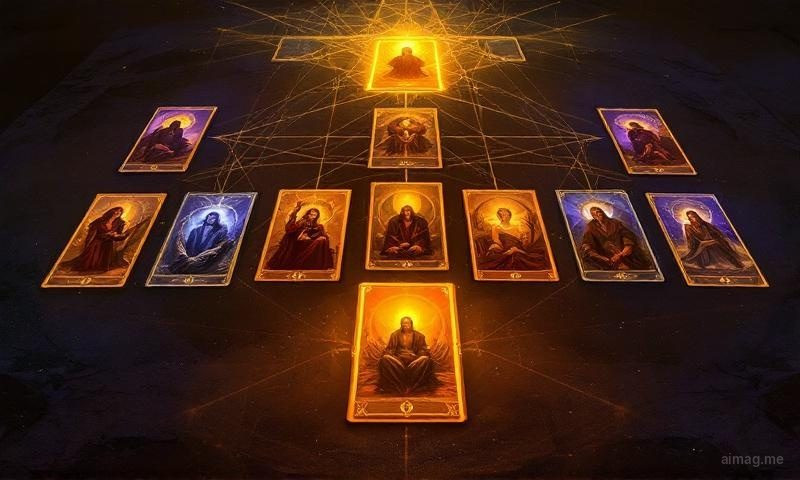
O mapa completo. Dez cartas, dez estações, do ponto mais alto da consciência até o chão sob seus pés. Use esta tiragem quando quiser o quadro inteiro da sua vida interior — não só o que está acontecendo, mas como cada camada da sua experiência se conecta a todas as outras.
| Posição | Sephirah | Significado |
|---|---|---|
| 1 | Kether (Coroa) | Sua aspiração mais elevada — a versão de si mesmo para a qual você está crescendo |
| 2 | Chokmah (Sabedoria) | Sua força criativa bruta — o que quer nascer através de você |
| 3 | Binah (Compreensão) | Sua capacidade de estrutura — como você dá forma ao que sabe |
| 4 | Chesed (Misericórdia) | Onde você é generoso, expansivo e aberto |
| 5 | Geburah (Severidade) | Onde você precisa de disciplina, limites ou cortes |
| 6 | Tiphareth (Beleza) | Seu centro — a expressão mais autêntica de quem você é agora |
| 7 | Netzach (Vitória) | Seus desejos, paixões e impulsos emocionais |
| 8 | Hod (Esplendor) | Seu intelecto, comunicação e padrões mentais |
| 9 | Yesod (Fundação) | Seus padrões inconscientes — o que opera abaixo da consciência |
| 10 | Malkuth (Reino) | Sua realidade física — corpo, finanças, vida cotidiana |
Como interpretar: Não leia essas dez cartas uma por uma em isolamento. A Árvore da Vida é um sistema de relações. Comece pela Posição 6, Tiphareth — seu centro. Esta é a posição do Sol, a carta que mostra a versão mais autêntica de você neste momento. O Sol aqui significa que você está alinhado com seu eu essencial. O Eremita aqui significa que sua expressão mais verdadeira agora é solitária, introvertida, contemplativa.
Depois leia para cima. As Posições 1 a 3 são os níveis mais elevados da sua consciência. A Posição 1 é a aspiração que você talvez ainda não consiga colocar em palavras — o chamado para algo que sua mente racional ainda não nomeou. O Louco em Kether significa que sua aspiração mais profunda é liberdade radical, disposição para entrar no desconhecido. O Mundo em Kether significa que você está se encaminhando para completude, integração, totalidade.
As Posições 4 e 5 formam um par crítico: misericórdia e severidade, expansão e contração. Essas duas forças moldam tudo abaixo delas. Se Chesed abriga A Imperatriz, seu lado generoso é abundante e fértil. Se Geburah abriga A Torre, o que precisa ser cortado está sendo cortado — com violência, com necessidade.
As Posições 7 e 8 se espelham: paixão e intelecto, sentimento e pensamento. Quando essas duas posições entram em conflito aberto — digamos, Os Enamorados em Netzach (seu coração quer conexão) contra O Eremita em Hod (sua mente quer solidão) — você encontrou a tensão central que governa sua vida atual.
A Posição 9, Yesod, é a fundação inconsciente. Essa carta mostra o que está conduzindo sua vida por baixo da superfície. A Sacerdotisa aqui significa que seu inconsciente é rico e ativo, mas não se comunica bem com sua mente desperta. A Lua significa que seus padrões inconscientes envolvem ilusão ou medo não processado.
A Posição 10, Malkuth, é onde tudo se torna real. Seu corpo, sua conta bancária, sua rotina diária, sua saúde física. O mundo material não é "o mais baixo" em nenhum sentido depreciativo — é onde tudo acima dele aterra. Se todas as outras cartas parecem magníficas, mas Malkuth abriga o Cinco de Ouros, seu crescimento espiritual ainda não está se traduzindo em bem-estar físico. Essa lacuna é, por si só, informação valiosa.
2. A Tiragem dos Três Pilares (3 Cartas)
A Árvore da Vida se organiza em três pilares verticais: Severidade à esquerda, Misericórdia à direita e o Pilar Central segurando o meio. Esta tiragem de três cartas captura a tensão essencial entre disciplina e abertura, com a carta central como eixo.
| Posição | Pilar | Significado |
|---|---|---|
| 1 | Severidade (Esquerda) | Onde você precisa estabelecer limites, dizer não ou impor estrutura |
| 2 | Equilíbrio (Centro) | Seu ponto de equilíbrio — o que integra os dois lados |
| 3 | Misericórdia (Direita) | Onde você precisa ser compassivo, generoso ou receptivo |
Como interpretar: Nem severidade nem misericórdia é melhor. Uma pessoa toda misericórdia se torna permissiva, sem limites, fácil de explorar. Uma pessoa toda severidade se torna rígida, fria, isolada. A psique saudável transita entre elas, aplicando cada uma quando a situação exige — e o pilar central representa o eu integrado que consegue fazer os dois.
A Posição 1 nomeia o que precisa ser firmado. Talvez um relacionamento onde você foi acomodado demais. Um hábito que precisa ser quebrado. Um limite que precisa ser traçado. Um padrão que precisa ser mantido. O Imperador aqui confirma que autoridade e estrutura são o que o momento pede. A Justiça diz que a severidade necessária é sobre equidade — algo está desequilibrado e a correção vai parecer severa, mas precisa acontecer.
A Posição 3 nomeia o que precisa se abrir. Onde você foi duro demais? Controlado demais? Defensivo demais? A Estrela aqui diz que a misericórdia que você precisa é esperança — deixar-se acreditar em algo de novo depois de uma decepção. A Imperatriz diz que a misericórdia é física: descanso, prazer, nutrição sensorial que você tem se negado.
A Posição 2 é o ponto crucial. Essa carta revela o que mantém os dois lados juntos — o recurso psicológico que te permite ser firme quando a firmeza é necessária e suave quando a suavidade é necessária. A Força é o encaixe clássico: poder gentil, a capacidade de segurar opostos sem quebrar. A Temperança é a versão alquímica: misturar duas coisas em algo que nenhuma poderia ser sozinha.
Esta tiragem funciona particularmente bem durante transições — quando seu equilíbrio habitual foi alterado e você sente que está se inclinando demais para um lado. Três cartas, três minutos, um diagnóstico claro de onde ajustar.
3. A Tiragem do Caminho de Retorno (5 Cartas)
Toda jornada transformadora segue a mesma estrutura básica: partida, iniciação, retorno. A tradição cabalística descreve um processo paralelo chamado "Caminho de Retorno" — a jornada da alma de volta pela Árvore da Vida, da realidade material em direção à consciência espiritual. Não como fuga do mundo físico, mas como uma forma de viver nele com mais consciência. Mais deliberação. Mais presença.
Esta tiragem de cinco cartas mapeia essa jornada sobre o que você está atravessando agora.
| Posição | Etapa | Significado |
|---|---|---|
| 1 | Onde Você Está | Sua posição atual — o ponto de partida desta jornada |
| 2 | O Que Você Está Aprendendo | A lição que esta fase da vida está ensinando |
| 3 | A Prova | O desafio ou obstáculo que determinará se a lição vai se fixar |
| 4 | O Avanço | O que se torna possível quando você passa pela prova |
| 5 | O Destino | Para onde esta jornada específica leva — não a parada final, mas o próximo pouso |
Como interpretar: Esta tiragem parte do pressuposto de que onde você está não é aleatório. É precisamente onde você precisa estar para o aprendizado atualmente disponível. Não é otimismo místico — é apenas a observação, respaldada pela psicologia do desenvolvimento, de que o crescimento segue uma sequência e você não pode pular etapas.
A Posição 1 ancora a leitura. Qual é sua realidade agora? Não seu ideal, não seu plano — sua situação de fato. O Mago diz que você tem um potencial e habilidade consideráveis à sua disposição. O Oito de Copas diz que você já está em processo de se afastar de algo que deixou de te satisfazer.
A Posição 2 identifica o currículo. O que a vida está tentando te ensinar neste momento? Essa carta tende a ser a que as pessoas mais resistem, porque a lição costuma ser exatamente o que elas têm evitado. O Julgamento diz que a lição é responder a um chamado que você tem fingido não ouvir. O Enforcado diz que a lição é rendição — soltar a necessidade de controlar o timing da sua própria transformação.
A Posição 3 é a prova, e toda jornada genuína tem uma. O momento que determina se você volta transformado ou simplesmente volta. Na prática, é onde o discernimento precisa virar ação — onde a compreensão precisa sobreviver ao contato com a realidade. A Torre como prova significa uma ruptura dramática que elimina tudo que não é essencial. O Cinco de Paus significa que a prova é competição, conflito ou o caos de forças demais te puxando ao mesmo tempo.
A Posição 4 é o que se abre do outro lado. Não uma recompensa no sentido de presente, mas uma nova capacidade — algo que você pode fazer, ser ou sentir que não estava disponível antes da dificuldade. O Mundo aqui promete integração e completude. O Ás de Copas promete um novo começo emocional — a capacidade de sentir algo para o qual você esteve fechado.
A Posição 5 é o destino — mas leia com cuidado. No modelo cabalístico, todo destino é também um novo começo. O Caminho de Retorno não é uma linha com um fim. É uma espiral. Para onde esta jornada específica te leva se torna o ponto de partida da próxima. A Roda da Fortuna diz que o destino é um ponto de virada — o ciclo muda, e novas perguntas emergem.
Escolhendo a Tiragem Certa
Use a Tiragem dos Dez Sephiroth quando quiser o exame completo — cada dimensão da sua vida interior e exterior exposta diante de você. É uma tiragem para balanço anual ou para grandes transições de vida, quando você precisa entender como tudo está.
Use a Tiragem dos Três Pilares quando sentir que está desequilibrado. Rígido demais ou permissivo demais. Disciplinado demais ou disperso demais. Três cartas, um diagnóstico claro.
Use a Tiragem do Caminho de Retorno quando estiver no meio de uma jornada e souber que algo está mudando, mas ainda não conseguir ver o arco completo. Esta tiragem oferece a estrutura narrativa que transforma confusão em uma história que você consegue navegar.
Dicas para Leituras da Árvore da Vida
O layout importa. Se estiver usando a Tiragem dos Dez Sephiroth, disponha fisicamente as cartas no padrão da Árvore da Vida, e não em linha. As relações espaciais carregam significado — Chesed e Geburah se encaram, Netzach e Hod se espelham, e Tiphareth fica no centro conectando tudo. Ver isso visualmente ajuda sua mente inconsciente a captar conexões que uma linha plana esconde.
Comece pelo centro. Seja lendo três cartas ou dez, inicie pela carta do meio. Nos Três Pilares, leia o Equilíbrio primeiro. Nos Dez Sephiroth, leia Tiphareth primeiro. O centro orienta todo o resto.
Deixe a ansiedade com a Cabala de lado. Você não precisa de um diploma em misticismo hebraico para ler estas tiragens. As posições carregam significados psicológicos claros que funcionam independentemente de quanto conhecimento esotérico você tenha. O poder da Árvore da Vida está em sua estrutura, não em qualquer conteúdo teológico específico — o mapa funciona porque a consciência realmente se organiza dessa forma, quer você use ou não a linguagem cabalística para descrevê-la.
Anote a carta de Tiphareth. Qualquer carta que cair no centro da sua leitura da Árvore da Vida, registre-a. Volte a ela em um mês. Essa carta central é o retrato mais preciso do seu eu autêntico no momento da leitura, e acompanhar como ela muda ao longo do tempo revela o padrão mais profundo da sua evolução pessoal.
Perguntas Frequentes
Preciso estudar Cabala para usar a tiragem da Árvore da Vida?
Não. As posições dos Sephiroth se traduzem diretamente em dimensões da experiência humana — aspiração, criatividade, estrutura, emoção, intelecto, fisicalidade — que você já compreende intuitivamente. Estudar Cabala pode adicionar camadas às leituras, mas não é pré-requisito. O mapa funciona porque descreve características reais de como pensamos, sentimos e agimos. Nenhum sistema de crenças específico é necessário.
Qual baralho funciona melhor para tiragens da Árvore da Vida?
Qualquer baralho que fale com você. Dito isso, baralhos com simbolismo cabalístico incorporado — o Rider-Waite-Smith ou o baralho Thoth — trarão camadas extras aqui, porque seus criadores intencionalmente mapearam cada carta a uma posição da Árvore da Vida. Se você trabalha com um baralho moderno ou não tradicional, os significados psicológicos das posições sustentam a leitura de qualquer maneira.
Com que frequência devo fazer uma leitura completa dos Dez Sephiroth?
Trimestralmente ou em grandes transições de vida. A tiragem de dez cartas oferece um exame abrangente, e fazê-la com muita frequência gera ruído em vez de sinal. A Tiragem dos Três Pilares funciona bem como verificação mensal, e o Caminho de Retorno se encaixa sempre que você percebe que está no meio de uma mudança significativa. Pense nos Dez Sephiroth como seu exame anual de saúde e nas tiragens menores como seu controle semanal de pulso.
Posso combinar a tiragem da Árvore da Vida com outras tiragens?
Com certeza. Uma abordagem prática: faça uma leitura dos Dez Sephiroth para identificar qual área da vida precisa de atenção, depois siga com uma tiragem focada — uma Cruz Celta para uma pergunta específica que surgiu, ou uma Tiragem de Três Cartas para um relacionamento ou decisão particular que a leitura maior revelou.
A Árvore da Vida não é um artefato religioso. É um espelho — o tipo que mostra não apenas seu rosto, mas toda a sua arquitetura, desde a coisa mais elevada que você aspira até o chão que você pisa. A jornada da inconsciência para a consciência é a única jornada que existe. Carreira, relacionamento, saúde, criatividade — cada uma é uma versão dela. Estas tiragens dão a essa jornada uma estrutura que você pode ver, uma linguagem que você pode falar, e um conjunto de posições às quais você pode voltar sempre que precisar lembrar onde está. Seu inconsciente já conhece o caminho. As cartas ajudam você a ler o mapa.