You already think in elements. You just do not call them that.
When you say "I am burned out," you are speaking fire language. When you say "I feel stuck," that is earth. "My head is spinning" — air. "I am drowning in feelings" — water. The four classical elements are not primitive science. They are a psychological vocabulary that predates modern therapy by millennia and remains stubbornly useful because it maps onto something real about how we experience being human.
Gaston Bachelard understood this. In The Psychoanalysis of Fire (1938), Bachelard argued that elements are not just physical substances but psychological archetypes — patterns that shape how we imagine, dream, and process experience. Fire is not merely combustion. It is ambition, desire, transformation, destruction. When your unconscious mind reaches for a fire metaphor, it is telling you something specific about the quality of your inner state. Bachelard spent his career demonstrating that each element carries a distinct emotional signature, a particular way of being in the world that you can recognize in yourself if you know where to look.
A tarot spread organized around elements gives you that place to look. Instead of asking "What is happening in my life?" — a question so broad it almost guarantees a vague answer — you ask four precise questions: How is my fire? My water? My air? My earth? The specificity changes everything.
In short: An elemental tarot spread maps fire, water, air, and earth onto your passion, emotions, thinking, and physical stability, diagnosing which psychological dimension is dominant, depleted, or in conflict. Three layouts in this guide range from a four-card check-in to a six-card conflict resolution spread, grounded in Bachelard's archetypal psychology of elements.
Spread 1: The Four Elements Check-In (4 Cards)
This is the spread I recommend starting with. Four cards, four elements, four dimensions of your current state. Think of it as a quarterly review for your psyche — except the quarters are not fiscal but elemental.
Lay four cards in a cross pattern. North, South, East, West. Each position corresponds to an element.
| Position | Direction | Element | Meaning |
|---|---|---|---|
| 1 | South | Fire | Your passion, drive, and creative energy right now |
| 2 | West | Water | Your emotional state, intuition, and relational depth |
| 3 | East | Air | Your mental clarity, communication, and thought patterns |
| 4 | North | Earth | Your physical body, finances, and material stability |
How to read it: Do not interpret each card in isolation. The power of this spread is in the comparison. Which element drew the strongest card? Which drew the weakest? The imbalance itself is the reading.
If Fire pulls the Ace of Wands — raw creative ignition — but Earth pulls the Five of Pentacles, you have a classic pattern: enormous drive with no material foundation to support it. You are all engine, no road. The reading does not tell you what to do about it. It tells you what is true, and that truth is often enough to redirect your attention.
Watch for these patterns:
- One dominant element. If your strongest card is a Major Arcana and the other three are minor numbered cards, that element is running the show. Everything else is playing support. Ask yourself: is that what I want?
- Opposing weaknesses. Fire and Water are traditionally opposed. If both are weak, you are likely in a period of disconnection — neither passionate nor emotionally present. Air and Earth opposed means your thoughts and your body are not speaking to each other.
- All elements moderate. Four mid-range cards (Fives through Sevens) suggests equilibrium — but not necessarily the good kind. Sometimes balance means stagnation. Look at whether the cards are moving (Knights, Eights) or static (Fours, Twos).
The Suit-Element Connection
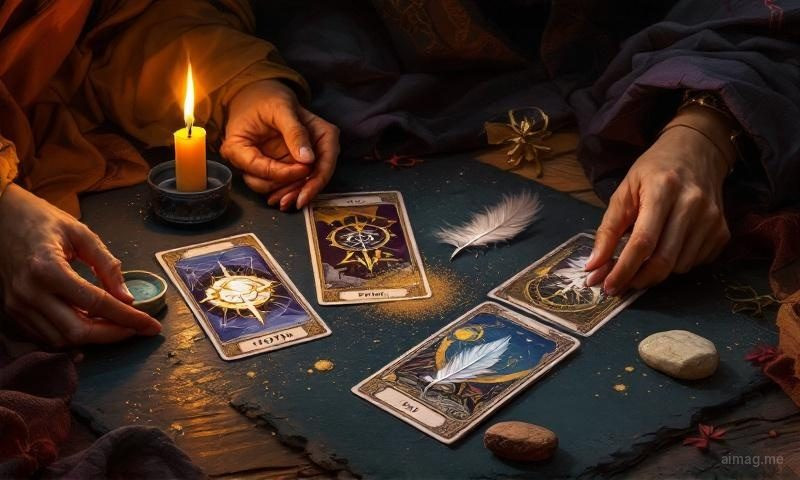
In most tarot traditions, the suits map directly to elements: Wands are Fire, Cups are Water, Swords are Air, Pentacles are Earth. This creates a beautiful possibility in the Four Elements Check-In. When you pull a card whose suit matches its elemental position — Cups in the Water position, for example — that element is speaking with a clear, undistorted voice. The message is pure.
When the suit contradicts the position — say, a Sword in the Fire position — there is tension. Your passion area is being dominated by mental energy. You are overthinking your desires instead of feeling them. That tension is not a problem. It is information.
The Ace of Cups in the Water position is a gift: emotional renewal coming from exactly where it should. The same Ace in the Fire position is more complex: emotional energy is flooding your passion center, which might mean your creative work is becoming deeply personal, or it might mean you are confusing love with ambition.
Spread 2: The Elemental Balance Spread (5 Cards)
Once you know which elements are strong and which are weak, the natural next question is: what do I do about it? This spread addresses imbalance directly.
Lay five cards in a vertical line, top to bottom.
| Position | Meaning |
|---|---|
| 1 | Your dominant element — the energy currently running strongest |
| 2 | Your weakest element — the energy most depleted or suppressed |
| 3 | What feeds the weak element — what will restore it |
| 4 | What drains the dominant element — what is taking from the strong to the point of excess |
| 5 | The integration point — how all four elements can work together right now |
How to read it: Positions 1 and 2 establish the diagnosis. If your dominant element is Air (you have been living in your head — analyzing, planning, worrying) and your weakest is Earth (your body is neglected, your finances are ignored, your physical space is chaotic), then Position 3 tells you what will bring Earth back online.
The Ace of Pentacles in Position 3 is almost too on the nose: a new material beginning. Start small. Clean one room. Open one bank statement. Cook one real meal. Earth does not need grand gestures. It needs tangible, physical, real action.
Position 4 is the uncomfortable one. It shows what is feeding your excess. If your dominant element is Fire and the draining card is the Seven of Wands, your excess drive is being fueled by defensiveness — you are not passionate, you are fighting. That distinction matters enormously.
Position 5 is the synthesis. James Hillman, the founder of archetypal psychology, insisted that the goal is never to eliminate any psychological force but to find the arrangement where all forces contribute. In Re-Visioning Psychology (1975), Hillman wrote that pathology is not the presence of difficult energies but their isolation — when one archetypal pattern dominates and the others cannot speak. Position 5 shows you the arrangement where everything gets a voice.
A Temperance card in Position 5 is the ideal outcome: conscious blending, deliberate mixing, the alchemical work of turning four separate forces into one functional whole. But even a more challenging card here — a Five of Swords, say — is useful. It tells you that integration right now requires accepting conflict, that your elements are not ready to harmonize gently and you may need to let them argue before they cooperate.
Spread 3: The Elemental Conflict Spread (6 Cards)
Sometimes balance is not the issue. Sometimes two elements within you are at war, and you can feel it. The person who desperately wants to create (Fire) but cannot stop analyzing whether the creation is good enough (Air). The person who knows what they need emotionally (Water) but whose practical responsibilities leave no room for feelings (Earth). These are elemental conflicts, and they produce specific kinds of suffering.
Lay six cards in three rows of two. Each row is a pair.
| Position | Meaning |
|---|---|
| 1 | Fire's position — what your passion, drive, or anger is saying |
| 2 | Water's position — what your emotions, intuition, or grief is saying |
| 3 | Air's position — what your intellect, logic, or anxiety is saying |
| 4 | Earth's position — what your body, finances, or practical needs are saying |
| 5 | The primary conflict — which two elements are most at odds |
| 6 | The mediator — the energy or approach that can bridge the conflict |
How to read it: Positions 1 through 4 give each element a voice. Read them as statements: "My fire says [card]. My water says [card]." Hearing them side by side often reveals the conflict before you even get to Position 5.
If Fire draws the Knight of Wands (charging forward, impatient, ready to act) and Water draws the Four of Cups (withdrawn, disengaged, refusing what is offered), the clash is visceral. Part of you is on fire to move. Part of you will not even look at the cup in front of you. They cannot both win — but they can both be heard.
Position 5 crystallizes the conflict. It does not represent a third thing; it shows the nature of the tension between the two loudest voices from Positions 1 through 4. The Two of Swords here means the conflict is a decision you are refusing to make. The Five of Wands means the conflict is active, messy, and noisy — you are already fighting yourself.
Position 6 is the mediator. It does not resolve the conflict. It provides the missing element or energy that allows the two warring parts to coexist. The Ace of Swords as mediator says: clarity will help. Name the conflict plainly. Say it out loud. The act of articulation itself can reduce the friction between competing drives.
Bachelard's Insight: Elements Dream Differently
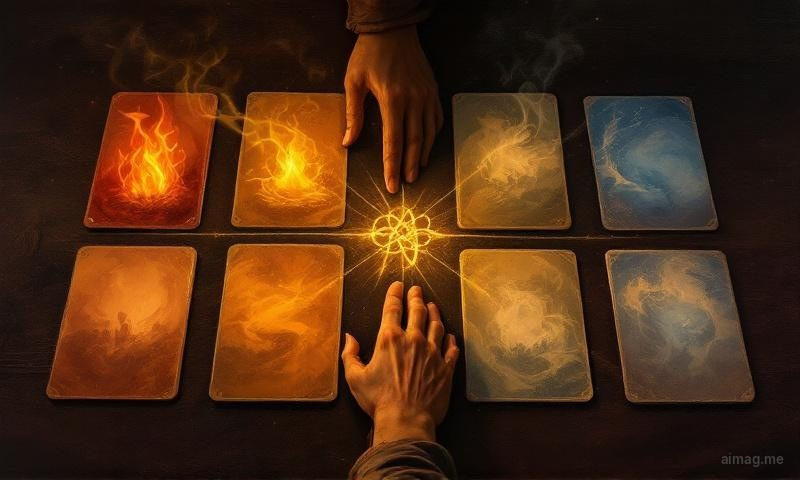
One of Bachelard's most practical observations is that each element produces a different quality of imagination. Fire dreams are sudden, explosive, consuming. Water dreams are slow, deep, dissolving. Air dreams are quick, scattered, ascending. Earth dreams are heavy, layered, persistent.
When you notice which element dominates your reading, you gain insight not just into what you are experiencing but into how you are experiencing it. A Fire-dominant reading suggests you are processing life through urgency and transformation. A Water-dominant reading suggests processing through feeling and flow. The element tells you the medium, not just the message.
This is why elemental spreads are uniquely powerful for people who feel stuck. "Stuck" is not one thing. Being stuck in Earth (inertia, heaviness, cannot move) requires a completely different intervention than being stuck in Air (overthinking, analysis paralysis, cannot decide). The elemental frame gives you the diagnosis that generic "what should I do?" questions miss.
Working With Elemental Spreads Over Time
Track your elemental readings monthly. Within three months, you will notice a pattern. Most people have one element that is chronically dominant and another that is chronically absent. That pattern is not a flaw. It is your psychological signature — the way your psyche naturally organizes itself.
Hillman would say: do not try to fix it. Try to understand it. The person who is chronically Fire-dominant is not broken. They are someone whose life force expresses primarily through passion, action, and transformation. The work is not to suppress Fire but to invite the other elements into conversation. The Ace of Cups is not meant to replace the Ace of Wands. It is meant to sit beside it.
A practical tracking method: after each elemental spread, write one line per element. "Fire: strong (Queen of Wands). Water: depleted (Five of Cups). Air: overthinking (Seven of Swords). Earth: stable (Four of Pentacles)." Over time, these four-line entries become a map of your elemental seasons. Some months you run hot. Some months you go deep. Some months you live in your head. The map does not judge. It records.
The Psychology Behind Elemental Thinking
Why does this framework work when it is technically pre-scientific? Because the human nervous system actually does operate in modes that align remarkably with elemental descriptions. The sympathetic nervous system (fight-or-flight) is Fire. The parasympathetic response (rest-and-digest) is Earth. Social engagement operates through emotional attunement — Water. Executive function, planning, and language processing happen in the prefrontal cortex — Air.
You do not need to believe the elements are literally real to find them useful as a sorting mechanism. They are a compression algorithm for complex internal states. When you say "my Water is low," you are communicating something specific, nuanced, and immediately recognizable: emotional flatness, disconnection from intuition, difficulty accessing empathy or vulnerability. Try conveying all of that without the elemental shorthand. It takes a paragraph. The element takes one word.
Frequently Asked Questions
Do I need to know which element is which suit?
The traditional mapping is Wands = Fire, Cups = Water, Swords = Air, Pentacles = Earth. Knowing this enriches your reading — especially when suit matches or contradicts elemental position — but it is not required. The cards carry meaning through their imagery and number regardless of elemental theory. If the suit-element system feels overwhelming, ignore it for now and revisit it after ten or so readings. It will click naturally.
What if all four elements seem equally weak?
That is a specific condition: elemental depletion. It usually appears during burnout, depression, or major life transitions where your old identity has collapsed and the new one has not formed yet. It is uncomfortable but not dangerous. The reading is telling you that everything needs attention — and the most practical response is to start with Earth (sleep, food, physical environment) because the body is the foundation the other elements build on.
How often should I do an elemental spread?
Monthly works well as a baseline. More frequently during times of transition or crisis, when elemental shifts happen fast. Less frequently when life is stable and your balance is consistent. The Four Elements Check-In makes an excellent seasonal ritual — four times a year, at each solstice and equinox, mapping your inner state against the turning of the outer world.
Can I combine this with other spreads?
Absolutely. An elemental spread pairs naturally with a Celtic Cross or a three-card spread. Use the elemental spread first to identify which dimension of your life needs attention, then use a more targeted spread to explore that dimension in depth. The elemental reading provides the map; the second reading provides the detail.
Four elements. Four questions. Which part of you is burning too bright, which is flowing too fast, which is spinning without landing, which has gone so still it might be stuck? You already know, somewhere below language, below conscious thought, in the body that tenses and the chest that tightens and the mind that races at 3 AM. The cards do not tell you anything your nervous system does not already know. They translate it. They lay it on a table where you can see it — Fire here, Water there, Air above, Earth below — and suddenly the vague feeling of "something is off" becomes four specific observations you can actually work with. That is not mysticism. That is self-knowledge with better formatting.