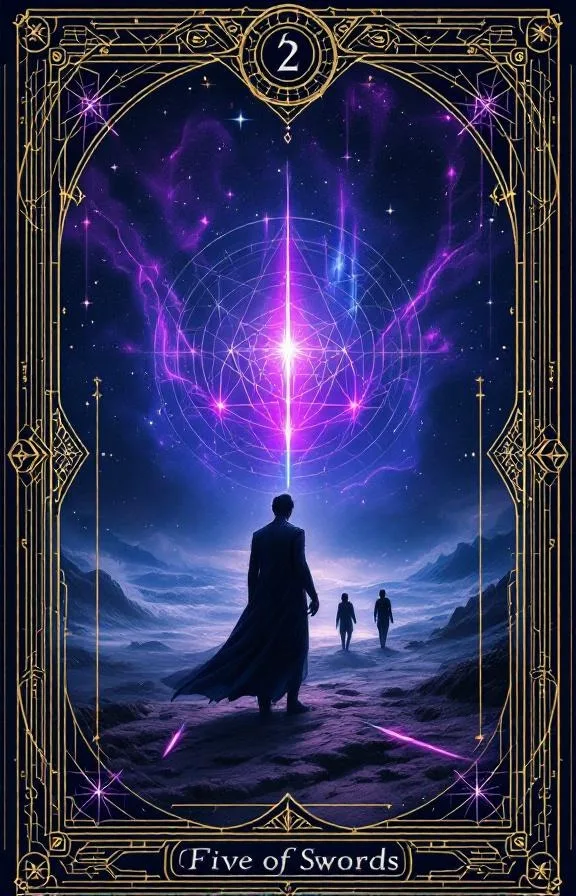
Nous testons différents styles artistiques — les cartes individuelles peuvent varier. Vos retours nous aident !
Cinq d'Épées — Signification de la carte de tarot
(Five of Swords)
Cinq d'Épées — Signification droite
Le Cinq d'Épées montre un personnage ramassant les épées des perdants, qui s'éloignent avec honte. Quelqu'un a gagné, mais à quel prix ? Cette carte pose la question de savoir si votre victoire en valait la peine — si avoir raison était plus précieux que le maintien de la relation. Parfois la sagesse consiste à laisser l'autre « gagner » pour préserver ce qui compte vraiment.
Cinq d'Épées — Signification inversée
The Five of Swords reversed often marks the aftermath of conflict — the morning after the battle when the adrenaline has faded and the cost becomes visible. Regret enters the picture. You may be replaying the argument, wishing you had chosen your words differently, realizing that the point you so fiercely defended was not worth the relationship damage it caused. This is the card of wanting to take it back. In its most constructive form, the reversal signals reconciliation — the willingness to set aside pride and attempt repair. Apologies are offered, not because you were necessarily wrong about the facts, but because you understand that being right at the expense of connection is its own kind of defeat. The swords are being returned. The retreating figures are turning back. However, the reversed Five can also indicate unresolved resentment — a conflict that was never properly addressed and now festers beneath the surface. The battle may appear to be over, but the emotional damage was never acknowledged, and it is quietly undermining the foundation of the relationship or situation. If you sense lingering tension that nobody is naming, this card asks you to bring it into the open before it calcifies into something permanent.
Mots-clés
Signification droite
- conflit
- défaite
- victoire à la Pyrrhus
Signification inversée
- réconciliation
- conséquences passées
- paix difficile
Symbolisme visuel
Personnage arrogant tenant des épées, deux figures défaites en arrière-plan, ciel agité ; défaite, conflit.
Symbolisme classique Rider-Waite — chaque élément visuel porte une signification psychologique plus profonde.
Amour & Relations
The Five of Swords in a love reading exposes the toxic pattern of turning a relationship into a courtroom — where being right takes precedence over being loving, where arguments are won and lost rather than resolved, where one partner consistently dominates while the other retreats into resentful silence. This is the card of the couple that fights to wound rather than to understand. If you are single, the Five of Swords warns against romantic pursuit driven by conquest rather than genuine connection. You may be attracted to the chase, the challenge of winning someone over, the intellectual thrill of outmaneuvering a romantic rival. But attraction built on competition creates relationships built on power dynamics rather than partnership. Ask yourself honestly: do you want this person, or do you want to win them? In existing relationships, this card is a mirror held up to communication patterns that have turned destructive. The arguments may have started as genuine disagreements, but somewhere along the way they became about dominance. Scorekeeping has replaced empathy. Past mistakes are weaponized. The silent treatment is deployed strategically. The Five of Swords says: someone in this dynamic needs to put down the swords first, and it might as well be you. The most painful reading of this card in love involves betrayal or deception — one partner deliberately undermining the other's trust, gaslighting, or pursuing connections outside the relationship while maintaining innocence. If this is your situation, the two retreating figures on the card may represent the self-respect you are losing by staying. Sometimes the wisest response to a Five of Swords dynamic is to walk away and let the hollow victor stand alone.
Carrière & Finances
The Five of Swords in a career reading is the unmistakable warning sign of a professional environment where winning has become more important than working well. This card surfaces in workplaces poisoned by internal competition — where colleagues undermine each other for promotions, where meetings are battlegrounds for dominance rather than forums for collaboration, where information is hoarded as currency and credit is stolen without shame. If you have recently "won" something at work — a promotion, a project lead, a favorable decision — the Five of Swords asks you to examine how that victory was achieved. Did you earn it through merit and collaboration, or did you outmaneuver others through politics, withholding, or taking advantage of someone else's vulnerability? The distinction matters, because victories achieved through the latter create professional debts that will be collected eventually. Colleagues have long memories. If you are on the receiving end — if you were the one outmaneuvered, passed over unfairly, or blindsided by someone else's ambition — the Five of Swords validates your frustration but also delivers uncomfortable wisdom: not every battle is worth fighting. Some professional environments are simply structured to reward aggression, and the most strategic response may be to leave rather than to try to beat the system at its own game. For leaders and managers, this card warns that a competitive culture has crossed from motivating to destructive. If your team members are fighting each other instead of solving problems together, the Five of Swords says the leadership model needs to change before the best people walk away — because high performers with options do not stay in toxic environments. They just leave, quietly, and take their talent with them. The core question of this card in any professional context: Is the cost of winning visible to you, or are you only counting the swords you collected?
Cinq d'Épées — Oui ou Non ?
No — The Five of Swords signals conflict, dishonesty, and hollow victories. Even if you get what you want, the cost will outweigh the gain. Step back and reconsider your approach.
Oui ou Non — Analyse approfondie
Cinq d'Épées oui ou non — signification en tarot
En tant que sentiments — Analyse approfondie
Cinq d'Épées comme sentiments — ce que cela signifie en tarot
En tant que personne — analyse approfondie
Cinq d'Épées comme personne — ce que cela signifie en tarot
Conseil — analyse approfondie
Cinq d'Épées comme conseil — ce que cette carte vous dit
Questions fréquentes
- What does the Five of Swords mean in a love reading?
- The Five of Swords in love indicates toxic conflict — arguments driven by ego rather than resolution. It warns against power struggles and manipulation, urging you to choose connection over being right.
- Is the Five of Swords a yes or no card?
- The Five of Swords is a No card. It represents conflict, deception, and victories that come at too high a price. The situation is not in your favor, and pushing harder will only cause more damage.
- What does the Five of Swords reversed mean?
- The Five of Swords reversed can signal the aftermath of conflict — reconciliation attempts, regret over harsh words, or choosing to walk away from a battle that is not worth fighting. It favors peace over pride.
Plus de cette couleur

Vérifié par Tomasz Fiedoruk
Tomasz Fiedoruk est le fondateur d'aimag.me et l'auteur du blog The Modern Mirror. Chercheur indépendant en psychologie jungienne et systèmes symboliques, il explore comment la technologie IA peut servir d'outil de réflexion structurée à travers l'imagerie archétypale.
En savoir plus sur l'auteurCe que révèlent 1 370 tirages
Parmi 1370 tirages sur aimag.me, Five of Swords apparaît proche de la base statistique de 1.28% par carte. Le moteur aléatoire traite chaque carte également ; le sens vous appartient.
Dans notre base, 78,5% de tous les tirages utilisent la simple croix Passé-Présent-Futur. Trois cartes. Pas plus. Les gens veulent de la clarté, pas de la complexité.
Le mardi est le jour de pointe du tarot dans nos données — +37% au-dessus de la moyenne hebdomadaire. Pas l'anxiété du lundi, pas la réflexion du dimanche. Mardi : quand la réalité de la semaine s'installe.
Données mises à jour : mai 2026 · Methodology
Prêt à regarder dans le miroir ?
Commencez une lecture gratuite et découvrez ce que les cartes vous révèlent.
Commencer une lecture