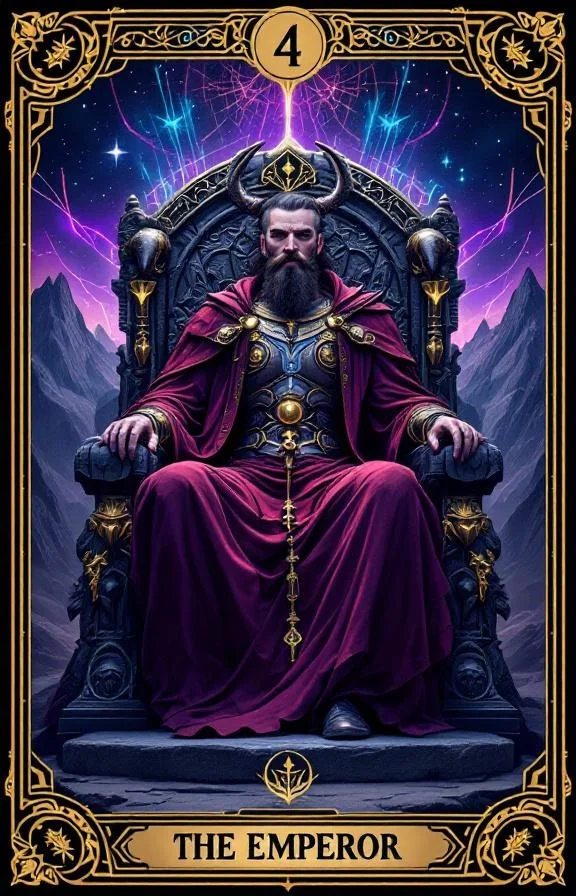
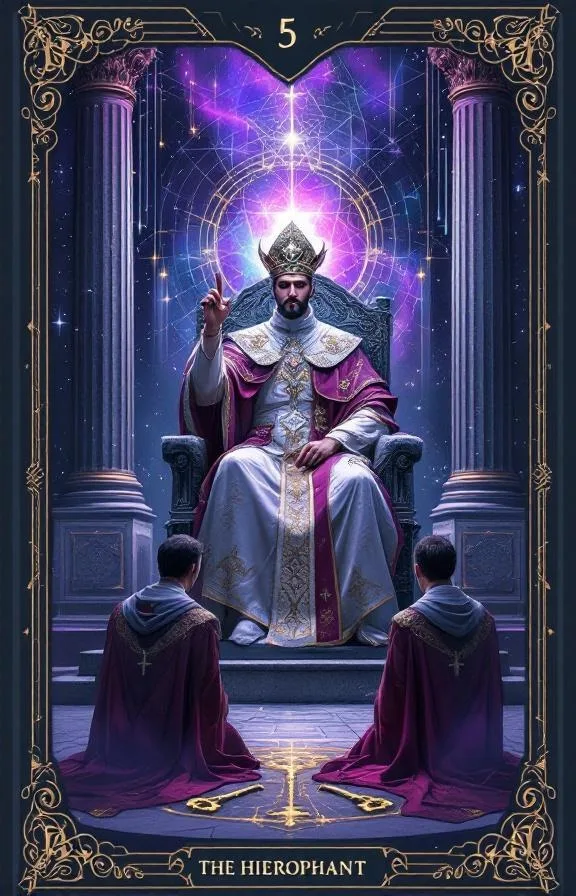
Chaque institution que vous avez jamais intégrée — une école, un lieu de travail, une famille, une religion — a été construite par deux forces agissant de concert. La première établissait les règles : qui commande, ce qui est permis, comment les ressources sont allouées, ce qui arrive quand quelqu'un transgresse. La seconde établissait le sens : pourquoi ces règles existent, quelle histoire l'institution se raconte sur elle-même, quelles valeurs elle prétend incarner. Des règles sans sens produisent l'obéissance, mais pas la loyauté. Du sens sans règles produit l'inspiration, mais pas la stabilité. L'Empereur et le Hiérophante sont ces deux forces prises forme humaine.
L'Empereur et le Hiérophante en un coup d'œil
| L'Empereur | Le Hiérophante | |
|---|---|---|
| Numéro | IV | V |
| Élément | Feu / Bélier | Terre / Taureau |
| Thème central | Structure, autorité, stabilité | Tradition, mentorat, croyances partagées |
Ensemble : L'architecture de l'ordre — à la fois ses échafaudages visibles et sa logique morale invisible.
La dynamique centrale
Le sociologue Max Weber a identifié trois types d'autorité légitime : l'autorité « traditionnelle » (ancrée dans la coutume et le statut hérité), l'autorité « charismatique » (fondée sur le magnétisme personnel d'un dirigeant), et l'autorité « rationnelle-légale » (l'autorité des systèmes et des lois qui fonctionnent indépendamment de toute personnalité).
L'Empereur et le Hiérophante réunis occupent le croisement de l'autorité traditionnelle et de l'autorité rationnelle-légale. L'Empereur bâtit la structure : l'organigramme, la chaîne de commandement, les frontières claires entre les comportements acceptables et inacceptables. Le Hiérophante fournit le récit légitimateur : la tradition, l'enseignement, le cadre moral qui explique pourquoi la structure mérite l'obéissance plutôt que la simple conformité. Dans l'imagerie Rider-Waite, l'Empereur siège sur un trône de pierre dans un paysage aride — son autorité est fonctionnelle, architecturale, délibérément austère. Le Hiérophante siège entre deux piliers dans un temple, flanqué d'acolytes — son autorité est cérémonielle, pédagogique, enracinée dans la transmission d'une sagesse reçue.
Ce que cette combinaison révèle, psychologiquement, c'est votre relation actuelle avec l'autorité elle-même — non pas une figure d'autorité précise, mais l'ensemble de l'appareillage de structure et de sens qui gouverne la façon dont vous organisez votre vie. La recherche sur le développement moral décrit une progression depuis l'obéissance pré-conventionnelle (suivre les règles pour éviter la punition) à travers la conformité conventionnelle (respecter l'autorité parce que c'est ce que font les bonnes personnes) jusqu'au raisonnement post-conventionnel (une pensée fondée sur des principes qui peut primer sur les règles établies quand elles entrent en conflit avec des valeurs plus profondes). L'Empereur et le Hiérophante ensemble indiquent souvent un moment où votre propre développement moral est mis à l'épreuve : suivez-vous les règles parce qu'elles ont du sens pour vous, ou parce que le coût de les remettre en question semble trop élevé ?
Il s'agit d'une association qui peut indiquer soit une grande stabilité, soit une grande rigidité, selon votre position par rapport aux structures qu'elle décrit. Si les structures dans votre vie sont véritablement soutenantes — si elles protègent ce qui doit l'être et enseignent ce qui doit l'être — cette combinaison reflète une période d'ancrage et d'appartenance institutionnelle. Si, en revanche, les structures se sont figées en pure convention — des règles qui ne servent plus les valeurs qu'elles étaient censées protéger — alors l'Empereur et le Hiérophante ensemble vous invitent peut-être à examiner ce que vous défendez et pourquoi.
En amour et en relations
Pour les célibataires, cette combinaison peut indiquer que votre approche des relations est façonnée — peut-être plus que vous ne le réalisez — par des modèles hérités. La recherche en psychologie relationnelle suggère que nous cherchons inconsciemment des partenaires qui ressemblent à l'image composite de nos premiers tuteurs, incluant leurs meilleures qualités et les plus blessantes. L'Empereur et le Hiérophante ensemble suggèrent que les « règles » que vous appliquez aux partenaires potentiels — vos critères, vos limites absolues, votre vision de ce à quoi une relation devrait ressembler — peuvent provenir moins de votre propre expérience que des modèles que vous avez absorbés en grandissant. Ce n'est pas forcément un problème, mais cela vaut la peine d'être examiné. Quelle voix entendez-vous quand vous évaluez un partenaire potentiel ?
Dans les relations établies, cette association décrit souvent un partenariat qui a développé un cadre commun solide — des valeurs partagées, des routines partagées, des attentes communes concernant les rôles et les responsabilités. La recherche sur les couples montre que ceux qui disposent d'un « système de sens partagé » fort — un récit sur qui ils sont ensemble, ce que leur partenariat représente et où il se dirige — sont significativement plus résilients sous le stress. L'Empereur et le Hiérophante ensemble reflètent ce type de solidité structurelle et narrative. Le risque, cependant, est que le cadre devienne plus important que les personnes qui y vivent. Quand « la façon dont nous faisons les choses » devient plus sacrée que « ce que nous ressentons l'un pour l'autre », la structure a pris le dessus sur sa raison d'être. Cette combinaison vous invite peut-être à vérifier si les règles de votre relation servent toujours la relation, ou si la relation a commencé à servir les règles.
En carrière et en finances
C'est la combinaison du professionnel institutionnel — la personne dont la carrière est imbriquée dans un cadre organisationnel plus large. Juristes, enseignants, administrateurs, cadres dirigeants, membres du clergé, fonctionnaires : quiconque évolue au sein d'un système d'autorité formelle et de protocole établi trouvera cette association pertinente. L'Empereur représente votre position au sein de la hiérarchie ; le Hiérophante représente votre alignement avec la mission et les valeurs affichées de l'institution.
Chaque institution fonctionne simultanément sur trois niveaux : les structures et processus visibles (ce que vous pouvez voir sur un organigramme), les valeurs officiellement déclarées (ce que la direction prétend défendre), et les hypothèses sous-jacentes qui guident réellement le comportement quotidien (ce que les gens font quand personne ne regarde). L'Empereur et le Hiérophante ensemble vous invitent à examiner ces trois niveaux de l'institution que vous servez actuellement. Les artefacts correspondent-ils aux valeurs ? Les valeurs correspondent-elles aux hypothèses ? S'il existe un écart entre ce que dit l'organisation et ce qu'elle fait, cette combinaison vous demande de le remarquer — et de décider ce que votre intégrité exige en retour.
Sur le plan financier, cette association tend vers la conservation plutôt que vers la spéculation. L'Empereur et le Hiérophante ensemble favorisent les stratégies établies, les investissements institutionnels et les approches dont les résultats sont prouvés. Ce n'est pas l'énergie du fondateur de startup ni de l'innovateur disruptif ; c'est l'énergie de la personne qui comprend que certaines des formes les plus fiables de création de richesse fonctionnent précisément parce qu'elles sont ennuyeuses, disciplinées et éprouvées par le temps.
Le message plus profond
Il existe une distinction nette entre ce qu'on pourrait appeler l'autorité rationnelle et l'autorité irrationnelle. L'autorité rationnelle est acquise par la compétence et exercée dans l'intérêt de ceux qu'elle gouverne — l'enseignant qui en sait plus que l'élève et met ce savoir au service de cet élève. L'autorité irrationnelle se maintient par le pouvoir et s'exerce dans l'intérêt de l'autorité elle-même — la bureaucratie qui existe pour se perpétuer, la tradition qui persiste parce qu'il est interdit de la questionner. L'Empereur et le Hiérophante ensemble contiennent le potentiel des deux. La question qu'ils vous laissent n'est pas de savoir si la structure et la tradition sont bonnes ou mauvaises — elles ne sont ni l'une ni l'autre, intrinsèquement — mais si les structures et traditions spécifiques dans lesquelles vous vivez actuellement servent la vie ou ne font que préserver la forme.
Où dans votre vie suivez-vous une règle qui avait autrefois du sens — et quand avez-vous demandé pour la dernière fois si elle en a encore ?
Curieux de savoir ce que L'Empereur et le Hiérophante signifient pour VOUS ? Essayez une lecture gratuite propulsée par l'IA et découvrez ce que les cartes reflètent de votre situation en ce moment.