
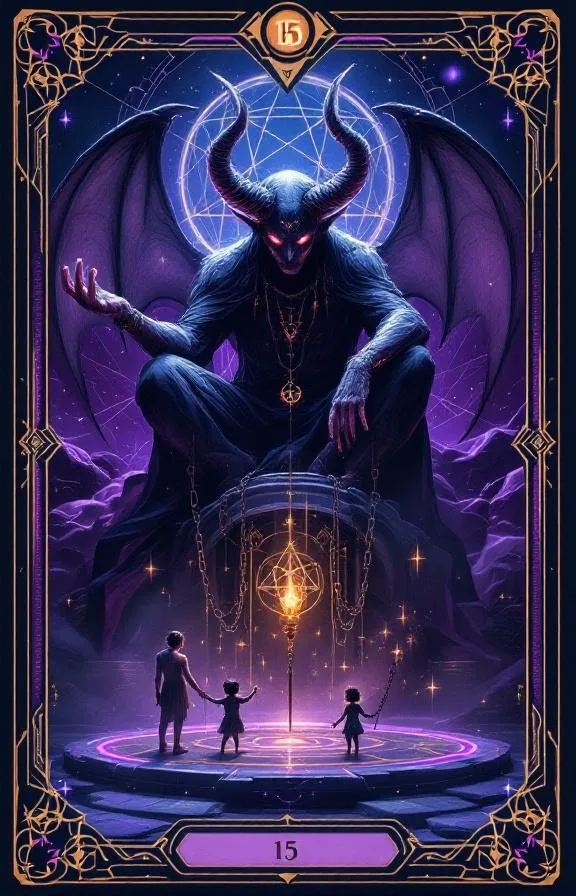
Imaginez un moine assis seul dans une cellule de pierre, et juste derrière la porte, quelque chose gratte. Ce n'est pas un monstre. C'est la partie de lui-même qu'il a enfermée il y a des années — l'appétit, la faim, le désir. Lorsque L'Ermite et le Diable apparaissent ensemble dans un tirage, ils mettent en scène l'une des confrontations les plus anciennes de la psyché : le chercheur de lumière contraint de regarder directement son propre ombre.
L'Ermite et le Diable en un coup d'œil
| L'Ermite | Le Diable | |
|---|---|---|
| Numéro | IX | XV |
| Élément | Terre / Vierge | Terre / Capricorne |
| Thème central | Solitude, sagesse intérieure, réflexion, guidance | Ombre, servitude, matérialisme, attachement |
Ensemble : La quête de sagesse mène directement à une rencontre avec les parts de vous-même que vous voulez le plus nier — et c'est précisément cette rencontre qui rend la sagesse réelle.
La dynamique centrale
Jung était sans ambiguïté à ce sujet : « On ne devient pas éclairé en imaginant des figures de lumière, mais en rendant l'obscurité consciente. » L'Ermite et le Diable forment peut-être la paire la plus jungienne de tout le tarot. Ils représentent le moment inévitable de tout véritable voyage intérieur où le retrait et la contemplation ne mènent pas à la transcendance, mais à une confrontation avec l'ombre — ces aspects de la personnalité qui ont été refoulés, niés ou projetés sur les autres.
Les deux cartes partagent l'élément Terre, ancrant cette rencontre dans le corps et le monde matériel. Ce n'est pas un exercice philosophique abstrait. Les chaînes du Diable sont faites d'habitudes réelles, de compulsions réelles, de schémas d'attachement réels. Peut-être est-ce cette relation à laquelle vous revenez malgré le fait qu'elle vous diminue. Peut-être est-ce cette substance, ce défilement d'écrans, ces dépenses, ce surmenage qui se déguise en discipline. La lanterne de L'Ermite ne fait pas de distinction dans ce qu'elle éclaire. Quand vous cherchez la vérité, vous la trouverez tout entière — y compris les vérités que vous avez construit votre solitude pour fuir.
Ce qui rachète cette paire difficile, c'est la qualité de conscience que L'Ermite apporte. Le psychanalyste Donald Winnicott distinguait le comportement compulsif exécuté inconsciemment du même comportement observé avec curiosité. La différence est immense. Quand vous pouvez regarder votre propre servitude sans honte — quand vous pouvez nommer la chaîne sans la tirer — vous avez déjà commencé à la desserrer. L'Ermite ne combat pas le Diable. Il s'assoit avec lui, lui demande son nom, et dans ce nommage, quelque chose se transforme.
Restez informé
Aperçus tarot hebdomadaires, significations des cartes et conseils IA.
En amour et dans les relations
Dans les relations, L'Ermite et le Diable ensemble signalent souvent une honnêteté douloureuse mais nécessaire sur les schémas d'attachement. Pour les couples, cela peut signifier affronter la codépendance, la possessivité, ou la façon dont le confort s'est discrètement transformé en contrôle. L'invitation n'est pas de faire exploser la relation, mais de l'examiner — de préférence avec un espace pour la réflexion individuelle. Parfois, la chose la plus aimante que vous puissiez faire pour un partenariat est de prendre du recul et de vous demander quels besoins vous essayez de satisfaire à travers l'autre que vous n'avez pas encore appris à satisfaire en vous-même.
Pour les célibataires, cette combinaison peut indiquer une période de bilan sur vos schémas relationnels. Qu'est-ce qui vous attire ? Qu'est-ce qui vous retient accroché ? L'Ermite vous demande d'être impitoyablement honnête, tandis que le Diable vous montre exactement où sont enterrés les hameçons. C'est un travail inconfortable, mais c'est la condition préalable à la création de liens qui sont choisis plutôt que contraints.
En carrière et finances
Professionnellement, cette paire vous demande si votre ambition vous sert ou vous asservit. Le discernement de L'Ermite, appliqué au domaine du Diable, peut révéler un surmenage habillé en dévouement, une complaisance envers les autres déguisée en collaboration, ou une situation de menottes dorées où le salaire vous maintient dans un rôle qui a depuis longtemps cessé de nourrir votre âme. La question n'est pas de savoir si vous devez partir, mais si vous avez été honnête avec vous-même sur les raisons pour lesquelles vous restez.
Sur le plan financier, l'influence du Diable suggère un attachement à la sécurité matérielle qui peut être disproportionné par rapport au besoin réel. Cela vaut la peine d'être examiné dans la solitude, loin du bruit de la comparaison et des attentes sociales. À quoi ressemblerait « assez » si personne ne regardait ?
Le message plus profond
L'Ermite et le Diable posent la question la plus courageuse de l'introspection : pouvez-vous aimer les parts de vous-même dont vous avez le plus honte ? Non pas les indulger, non pas les excuser, mais les reconnaître avec la même lumière constante que vous apportez à vos aspirations les plus élevées. L'ombre ne disparaît pas quand vous vous tournez vers elle. Mais elle cesse de gouverner votre vie.
Curieux de savoir ce que L'Ermite et le Diable signifient pour VOUS ? Essayez une lecture gratuite assistée par IA et découvrez ce que les cartes reflètent de votre situation en ce moment.