
Vous avez les compétences pour agir. Vous le savez. Et quelque part sous l'urgence, vous sentez qu'agir maintenant serait précisément la mauvaise décision. Un chirurgien qui s'est préparé à l'opération, puis réalise que le diagnostic doit être revu. Pas de l'incompétence. Une recalibration. Cet espace inconfortable entre la capacité et l'immobilité délibérée, c'est le territoire qu'occupent Le Mage et le Pendu ensemble.
Le Mage et le Pendu en un coup d'œil
| Le Mage | Le Pendu | |
|---|---|---|
| Numéro | I | XII |
| Élément | Air / Mercure | Eau / Neptune |
| Thème central | Volonté, compétence, manifestation | Abandon, nouvelle perspective, pause |
Ensemble : La capacité de créer rencontre la sagesse d'attendre — un paradoxe plus productif que chacune des deux forces seule.
Le paradoxe de l'attente capable
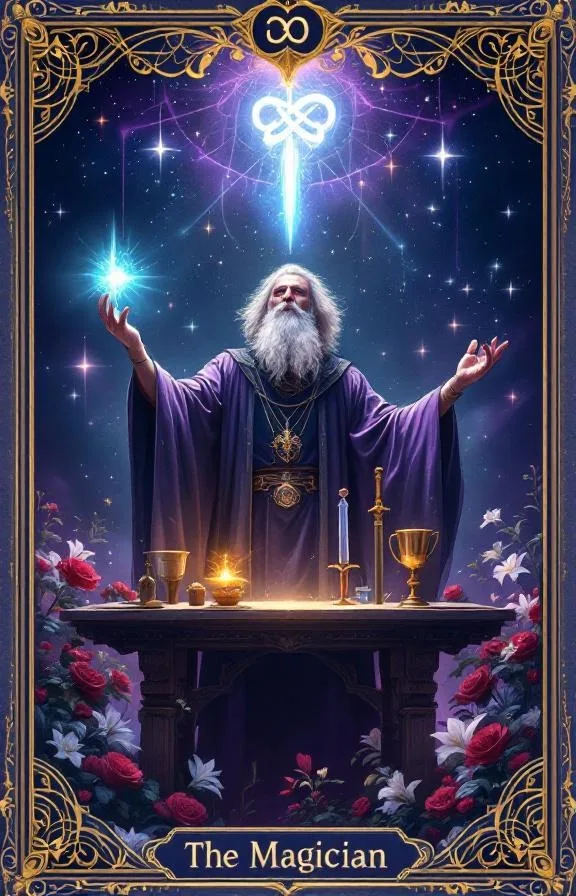
Le Mage est le flux personnifié. Les outils sur la table, une main tendue vers l'infini, l'autre dirigeant l'énergie vers la forme. Intention, talent et volonté convergent vers l'action. Tout est prêt. Tout est aligné.
Le Pendu fait pivoter l'ensemble du cadre de référence. Dans la mythologie nordique, Odin s'est suspendu à Yggdrasil pendant neuf jours, sacrifiant le confort pour un type de vision que la position verticale n'aurait jamais pu lui offrir. Le Pendu ne manque pas de pouvoir. Il a choisi de suspendre son usage parce qu'il pressent que ce qui paraît évident depuis son point de vue actuel est incomplet.
Le psychanalyste Wilfred Bion appelait cela la "capacité négative" — l'aptitude à demeurer dans l'incertitude sans se précipiter vers une clôture prématurée. S'inspirant du poète Keats, Bion soutenait que les insights les plus profonds n'arrivent pas lorsqu'on pousse plus fort, mais lorsqu'on tolère l'inconfort du non-savoir assez longtemps pour qu'une perspective véritablement nouvelle fasse irruption. Le Mage pousse. Le Pendu flotte. Ensemble : vous avez tout ce qu'il faut pour agir, mais l'action qui compte n'est pas celle que vous aviez prévue.
L'Air rencontre l'Eau. L'intellect qui catégorise rencontre la profondeur émotionnelle qui dissout les catégories. La rapidité de Mercure rencontre la diffusion de Neptune. Si vous avez tendance à faire — dresser des listes, exécuter des plans, résoudre les problèmes par l'effort — cette combinaison demande si le problème lui-même doit être redéfini avant qu'une solution puisse prendre.
En amour et relations
Dans les nouvelles relations ou les relations potentielles, votre approche habituelle — charme, initiative, intention claire — gagnerait à une pause inattendue. Non pas parce que vous faites quelque chose de mal. Parce que la personne en face de vous révélera quelque chose d'essentiel si vous cessez d'essayer de façonner le résultat. La connexion authentique commence par la volonté d'être présent sans agenda. Le Mage a toujours un agenda. Le Pendu vous invite à le poser, au moins temporairement, et à voir à quoi ressemble la relation quand personne ne tient le gouvernail.
Pour les partenariats établis, cette association apparaît quand l'un ou les deux partenaires ont travaillé dur pour réparer quelque chose — schémas de communication, disputes récurrentes, lacunes d'intimité — et l'effort lui-même est devenu une partie du problème. Parfois, la chose la plus puissante qu'une personne capable puisse faire dans une relation est d'arrêter de performer sa capacité et d'être simplement présente. Si vous avez été celui qui tenait tout ensemble par la seule force de la volonté, considérez ceci : lâcher le contrôle n'est pas la même chose que tout lâcher.
En carrière et finances
La pause stratégique. Vous avez les compétences et les ressources pour avancer sur le projet, le pitch, la négociation, le changement de carrière. Le Mage confirme que votre boîte à outils est pleine. Mais le Pendu soulève une question que les grands accomplisseurs résistent : et si le timing n'était pas le vôtre à décider ?
Ce n'est pas de la passivité. C'est de la patience stratégique — la reconnaissance que dans les systèmes complexes, la fenêtre d'action efficace s'ouvre parfois selon son propre calendrier. L'investissement, le lancement, la négociation que vous planifiez pourrait bénéficier d'une observation plutôt que d'une exécution immédiate. L'information dont vous avez besoin existe, mais elle n'est visible que depuis un angle que vous n'avez pas encore essayé.
Entre deux emplois ou en train d'envisager un changement de carrière ? Vos compétences (Le Mage) sont réelles, mais le rôle que vous visez n'est peut-être pas celui qui vous correspond vraiment. Le don du Pendu est la volonté de voir vos propres capacités depuis un angle totalement différent — et parfois cela signifie découvrir que ce en quoi vous excellez sert une finalité que vous n'aviez pas imaginée.
La pause entre les respirations
Le Mage se tient à sa table avec chaque élément à portée de main. Au-dessus de sa tête, le lemnisque de l'infini. L'incarnation de la disponibilité. Le Pendu pend à un arbre vivant, serein, une auréole autour de sa tête renversée, voyant ce que les gens debout ne peuvent pas. L'un incarne la volonté dirigée. L'autre incarne l'abandon qui rend la volonté signifiante.
Ensemble, ils disent que la vraie maîtrise inclut de savoir quand ne pas agir. La pause entre l'inspiration et l'expiration n'est pas un espace vide — c'est le moment où le prochain souffle trouve sa profondeur. Le Mage intègre de nouvelles informations. Le Pendu restructure le cadre quand ces informations ne s'y ajustent pas. Ce qu'ils vous laissent : que verriez-vous de votre situation si vous étiez prêt à retourner vos certitudes à l'envers ?
Curieux de savoir ce que Le Mage et le Pendu signifient pour VOUS ? Essayez un tirage gratuit guidé par l'IA et découvrez ce que les cartes reflètent de votre situation en ce moment.