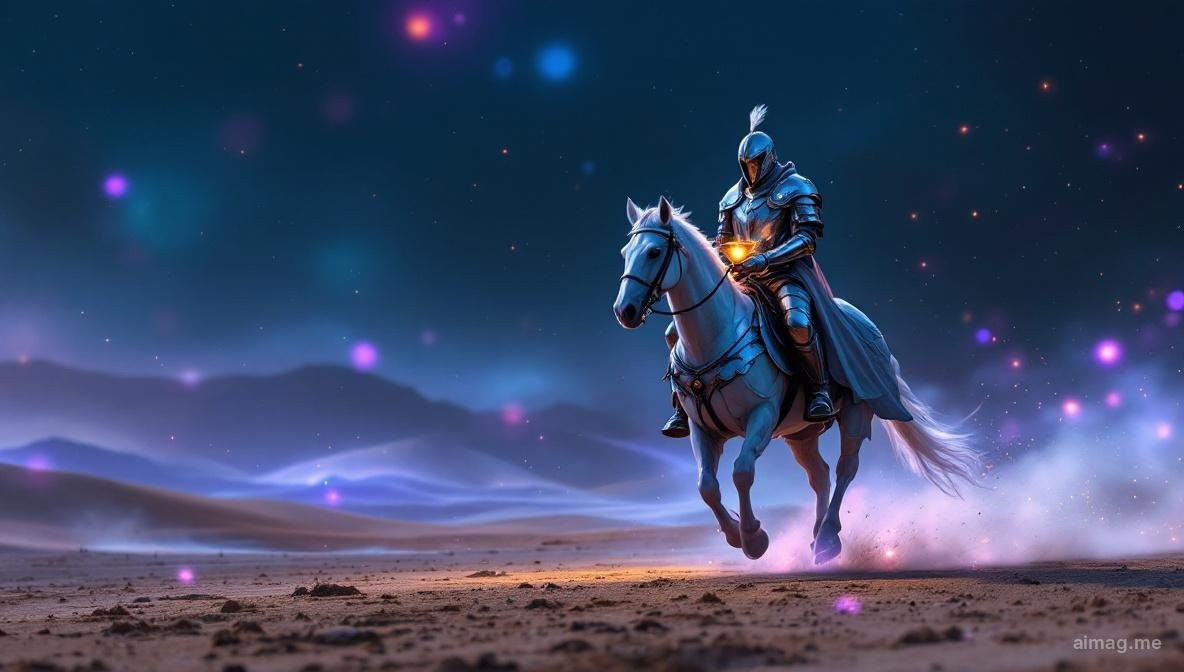
A knight rides slowly across a barren landscape. Not charging — there is no enemy, no urgency. He rides at the deliberate pace of someone on a pilgrimage rather than a campaign, holding a single golden cup before him with both the care of a priest carrying communion wine and the intensity of a lover bringing flowers to a doorstep. His armor gleams but his helmet is winged — a decorative touch no battlefield would require. Behind him, dry hills roll under a soft grey sky. Ahead, a distant stream suggests he is heading toward water, toward feeling, toward the destination that exists more in the heart than on any map.
The Knight of Cups is the romantic of the tarot deck, and I mean that in the literary sense as much as the emotional one.
In short: The Knight of Cups is the tarot's romantic idealist, a figure of Fire of Water who pursues emotional truth with the intensity of a quest and the sensitivity of a pilgrimage. He signals genuine declarations of love, creative proposals, or heartfelt offers approaching. The central question is always sustainability: knights excel at the pursuit but must learn to stay after the cup is delivered.
Knight of Cups at a Glance
| Attribute | Detail |
|---|---|
| Rank | Knight (Prince in some decks) |
| Suit | Cups |
| Element | Fire of Water |
| Keywords (Upright) | romantic idealism, emotional quest, charm, proposals, following the heart |
| Keywords (Reversed) | unrealistic expectations, moodiness, emotional manipulation, broken promises, jealousy |
| Yes / No | Yes |

What Does the Knight of Cups Mean?
If the Page of Cups represents the first stirring of emotional awareness — the fish rising from the cup — the Knight represents the decision to pursue that feeling, to ride toward it across whatever terrain lies between here and there. The Knight of Cups has received the message and has set out. He knows where his heart is pointing. He does not yet know what he will find when he arrives.
The elemental assignment of the Knight of Cups is Fire of Water — passion applied to emotion, active pursuit of feeling. This is an unusual combination. Fire wants to move, to act, to conquer. Water wants to flow, to feel, to merge. Together they create the specific energy of someone who chases emotional experience with the intensity of a knight on a quest but the sensitivity of a poet on a pilgrimage. The result is both beautiful and unstable — fire evaporates water, water extinguishes fire — and this tension lives in every reading of this card.
Arthur Edward Waite, in The Pictorial Key to the Tarot (1911), described the Knight of Cups as "graceful, but not warlike" and associated him with "the coming or approach of a matter" — an arrival, a proposal, a message carried with intention. The emphasis on approach rather than completion is important. The Knight is always en route. He has not yet arrived. The cup is being carried, not yet delivered.
Rachel Pollack, in Seventy-Eight Degrees of Wisdom (1980), deepens this reading by placing the Knight of Cups in the context of the Romantic movement — not romance in the Valentine's Day sense but Romanticism as a philosophical stance: the elevation of feeling over rationality, imagination over pragmatism, the individual quest over collective convention. She observes that the Knight of Cups, like the Romantic poets, is magnificent in pursuit and sometimes catastrophic in possession. The quest itself is where his genius lives.
Jung's concept of the "animus" in its positive aspect — the inner masculine principle that, when healthy, manifests as directed emotional courage — finds expression in the Knight of Cups. This is not the warrior's courage of the Knight of Swords or the pragmatic determination of the Knight of Pentacles. This is the specific bravery of someone willing to make themselves emotionally vulnerable in pursuit of what they feel to be true. That takes a kind of valor the world does not always recognize or reward.
In readings, I find the Knight of Cups appears when someone is about to make a significant emotional gesture — a declaration of love, a creative proposal, a heartfelt offer. The key question is always whether the gesture will be followed by the sustained engagement it promises. Knights are travelers. They are extraordinarily good at departure and pursuit. They are less reliable at staying.
The Chariot moves forward through will. The Knight of Cups moves forward through feeling. The difference matters: will can override obstacles, but feeling must flow around them. The Knight's journey is not a straight line. It follows the heart's topography, which has its own logic — a logic that sometimes confuses the people watching from outside but makes perfect sense to the knight himself.

Knight of Cups Reversed
Reversed, the Knight of Cups transforms from a romantic into a dreamer — and not the productive kind. The cup is still held aloft, but the horse has stopped moving, or worse, is wandering in circles. The quest has become an end in itself, a permanent state of emotional seeking that never arrives anywhere because arrival would require confronting reality, and reality is less beautiful than the imagined destination.
Unrealistic expectations are the most common face of the reversal. The reversed Knight measures every actual experience against an idealized version and finds the real one insufficient. The actual relationship compared to the fantasy relationship. The actual creative work compared to the imagined masterpiece. The actual life compared to the dreamed one. This comparison engine runs constantly and produces nothing but dissatisfaction.
Emotional manipulation is a darker dimension. The Knight of Cups' natural charm, reversed, becomes calculated — the person who says exactly what you want to hear not because they mean it but because they have learned that emotional language opens doors. The reversed Knight can be the smooth talker, the love-bomber, the charismatic figure who leaves a trail of confused and disappointed people behind their beautiful words. The cup they carry is empty, but the presentation is convincing.
Moodiness and emotional volatility — swinging between intense enthusiasm and sullen withdrawal — is the third pattern. Fire of Water, poorly managed, produces steam: dramatic, visible, and ultimately insubstantial. The reversed Knight feels everything at maximum volume but sustains nothing, moving from passion to disillusionment to passion with exhausting regularity.

Knight of Cups in Love and Relationships
Upright
In a love reading, the Knight of Cups is among the strongest signals of romantic pursuit. If you are single, this card suggests someone is coming toward you — literally or metaphorically — carrying genuine feeling and the intention to express it. Expect a declaration, an invitation, a gesture that makes the person's interest unmistakable. The Knight of Cups does not play it cool. He arrives with his heart visible.
For those in relationships, the Knight signals a renewal of romantic energy — the partner who plans the unexpected date, writes the letter they have been meaning to write, or makes the emotional gesture they have been putting off. This card is about emotional action, not just feeling. The Knight does not sit with his cup. He carries it forward.
The question the Knight always raises in love readings is sustainability. He is extraordinary at the beginning — the pursuit, the courtship, the grand gesture. The harder work comes after the cup is delivered: the daily maintenance of intimacy, the unglamorous persistence of genuine partnership. The Knight's challenge is to remain present after the quest is over.
Reversed
Reversed in love, the Knight of Cups can signal someone who promises more than they deliver — the person who sweeps in with intense romantic energy and disappears when the situation requires consistency rather than intensity. Beautiful beginnings, disappointing middles. All overture, no opera.
It can also indicate your own tendency to idealize potential partners or to pursue the feeling of being in love rather than the actual work of loving a specific, imperfect person. The reversed Knight is in love with love itself, which is a different thing entirely from being in love with someone.
Want to see what the Knight of Cups reveals about your romantic life? Try a free AI reading →
Knight of Cups in Career and Finances
Upright
Professionally, the Knight of Cups represents creative proposals, artistic ventures, and work driven by passion rather than pure calculation. This is the card of the designer who pitches an inspired concept, the writer who submits the personal piece, the entrepreneur whose business idea comes from genuine caring rather than market analysis alone. The Knight favors careers in creative fields, counseling, the arts, and any work where emotional intelligence is a competitive advantage.
Financially, the Knight suggests following intuition about investments or opportunities that feel right at a gut level. Not reckless — the Knight wears armor, after all — but guided by something deeper than spreadsheets. A financial decision approached with both heart and strategy.
Reversed
Reversed in career, the Knight indicates projects driven by enthusiasm but lacking follow-through, or professional decisions based entirely on feeling without adequate practical consideration. The artist who quits the steady job for the dream without a plan. The professional who confuses inspiration with execution.
Financially, the reversal warns against spending or investing based on emotional impulse rather than reality — the purchase that felt meaningful in the moment and regrettable a week later.
Knight of Cups in Personal Growth
The Knight of Cups, in personal growth, asks what emotional quest you are currently on — and whether you are genuinely riding toward something or merely enjoying the feeling of being in motion. There is a crucial difference between pursuing a heartfelt goal and romanticizing the pursuit itself, and the Knight embodies both possibilities simultaneously.
Robert Moore and Douglas Gillette, in King, Warrior, Magician, Lover (1990), describe the "Lover" archetype in its mature form as the capacity for deep feeling, sensual awareness, and empathic connection. In its immature form, the Lover becomes either the "Addicted Lover" (pursuing intensity for its own sake) or the "Impotent Lover" (so afraid of being hurt that all feeling is suppressed). The Knight of Cups upright is the Lover approaching maturity. Reversed, he slides toward addiction to the quest itself.
A practical exercise: identify one emotional truth you have been circling rather than directly approaching. The Knight's lesson is not "feel more" — most people feel plenty — but "carry what you feel toward its destination." If you love someone, say it. If a creative vision haunts you, begin it. If an apology is owed, make it. The cup is meant to be delivered, not carried forever. The beauty of the Knight is in the riding. The meaning of the Knight is in the arrival.
Temperance blends opposites with patient stillness. The Knight of Cups pursues emotional truth with active, forward motion. Both are needed: the stillness to know what you feel, and the courage to carry it across the landscape toward the person or place where it belongs.
Knight of Cups Combinations
- Knight of Cups + The Lovers — A romantic proposal or decisive moment in a relationship. The Knight's pursuit meets the Lovers' crossroads — a choice about love that will define the next chapter. Deeply romantic.
- Knight of Cups + The Emperor — Heart meets structure. The emotional quest encounters the demand for practical foundation. Potentially a tense combination: the Knight wants to follow feeling, the Emperor insists on plans and boundaries.
- Knight of Cups + Three of Cups — Emotional celebration in community. The Knight's journey leads to joyful reunion or shared creative expression. Social, warm, overflowing with positive feeling.
- Knight of Cups + Five of Cups — A romantic pursuit shadowed by past loss. The Knight rides forward but carries grief from a previous emotional experience. Can the new feeling survive the weight of the old one?
- Knight of Cups + Death — The end of one emotional chapter enables a completely new quest. The Knight who emerges after Death's transformation is pursuing something different than before — deeper, more authentic, less attached to the idealized version.
Frequently Asked Questions
Does the Knight of Cups represent a specific person?
Often, yes. The Knight of Cups frequently represents a person — typically someone who is emotionally expressive, romantic, artistic, and charming. This person may be a water sign (Cancer, Scorpio, Pisces) or simply someone who leads with their heart rather than their head. However, the Knight can also represent an energy within yourself — your own capacity for emotional pursuit and romantic idealism.
Is the Knight of Cups a good card for relationships?
Generally, yes — it is one of the most romantic cards in the deck. It signals genuine emotional pursuit, charm, and heartfelt intentions. The caution is sustainability: the Knight excels at beginnings and grand gestures but may struggle with the daily maintenance that long-term relationships require. Upright, the intentions are sincere. The question is whether the follow-through matches the promise.
What is the difference between the Knight of Cups and the King of Cups?
The Knight is in pursuit — riding toward an emotional destination, full of passion and idealism but not yet arrived. The King has arrived. He sits on his throne amid turbulent waters with calm mastery. The Knight feels intensely and acts on those feelings. The King feels deeply and holds those feelings with mature equilibrium. The Knight is the lover in pursuit. The King is the lover who has learned to stay.
What is the yes or no answer for the Knight of Cups?
Yes, with romantic and emotional energy. The Knight of Cups affirms what you are asking about, particularly if your question involves love, creative pursuits, or following your heart. The yes carries the quality of a proposal — something is being offered to you, or you are being called to offer something to another. Accept with open eyes.
The Knight of Cups rides across a dry landscape toward water, carrying a cup he has not yet delivered, and the whole scene is a portrait of emotional courage in motion — the willingness to pursue what you feel even when the terrain gives you no guarantee of arrival. That is the card's deepest teaching: the heart has its own direction, and following it is not weakness but a specific and demanding kind of bravery. If you are ready to see where your heart is leading, the reading is waiting. Try a free AI-powered reading at aimag.me/reading