The solstice is not magic. It is a calendar marker. But calendar markers matter because they create natural moments of comparison. You were somewhere six months ago. You are somewhere now. The longest day of the year floods everything with light and, in doing so, forces a kind of visibility that shorter days mercifully spare you from. On the summer solstice, the sun stays up so long that nothing can hide in early darkness. Your garden is visible. Your neglected corners are visible. The thing you built and the thing you avoided building are both standing there in sixteen hours of unbroken daylight.
This is why the summer solstice is such a powerful time for tarot. Not because of mystical solar energy (though if that framework resonates with you, excellent), but because the longest day is a natural metaphor for full illumination. And full illumination reveals everything, including what you were quietly hoping would stay in the shade a little longer.
In short: Summer solstice tarot spreads use the longest day as a mid-year checkpoint for honest self-assessment. A five-card Radiance Spread maps what is thriving, what has peaked, and what the brightness is hiding, while a four-card Mid-Year Balance compares January's intentions with June's reality and identifies the adjustment needed for the second half of the year.
The psychology of peak light
Carl Jung observed that the shadow is most sharply defined at the point of maximum light. This is not poetry. It is geometry. When the sun is directly overhead, the shadow beneath you is at its smallest but also its most concentrated and its most precise. The brighter the light, the harder the edges of the shadow. Jung meant this psychologically: the more clearly you see your strengths, achievements, and conscious identity, the more precisely you can locate the things you have pushed aside, denied, or refused to examine.
The summer solstice embodies this principle. It is the year's noon. Everything you have cultivated since January is in full sun. Your resolutions, your projects, your relationships, your self-image. Some of them look magnificent in this light. Some of them look different than you expected.
Shelley Taylor, the UCLA psychologist whose research on "positive illusions" became foundational in health psychology, showed that most people maintain slightly inflated views of themselves, their control over events, and their future prospects. These positive illusions are not pathological. They are, in Taylor's research, consistently associated with better mental health, greater motivation, and stronger social bonds. The person who slightly overestimates their abilities is, paradoxically, more functional than the person who sees themselves with perfect accuracy.
But Taylor also noted the limits. Positive illusions work until the gap between self-perception and reality becomes too wide. At that point, the illusion stops protecting you and starts preventing you from adapting. The summer solstice, with its relentless brightness, is a natural moment for checking the gap. How much of what you believe about your year so far is accurate? How much is a comfortable narrative that the long light is now exposing?
Daniel Kahneman, the Nobel laureate who spent decades cataloging the systematic ways human judgment goes wrong, coined the acronym WYSIATI: What You See Is All There Is. The mind takes whatever information is currently available and constructs a coherent story from it, without noticing what is missing. You assess your year based on what is visible to you right now, and you treat that assessment as complete. The summer solstice reading works against this bias by explicitly asking: what is the light showing you, and what is the light making you miss?
When to read
The window: The summer solstice falls on June 20 or 21 in the Northern Hemisphere (December 20 or 21 in the Southern Hemisphere). Read within three days of the solstice. The energy is about maximum light and the turning point, the moment when the year pivots from waxing to waning.
The intention: This is a mid-year reading. You are not starting something new. You are assessing what is at its peak, what the peak reveals, and how to carry the second half of the year with greater honesty. Before shuffling, sit for a moment with this question: "What does the longest day show me about where I actually am?"
The setting: If you can read outside, in natural sunlight, do it. The solstice is about light. Let the reading happen in it. If that is not practical, a well-lit room works. This is not a candlelit midnight reading. This is a clear-eyed noon reading.
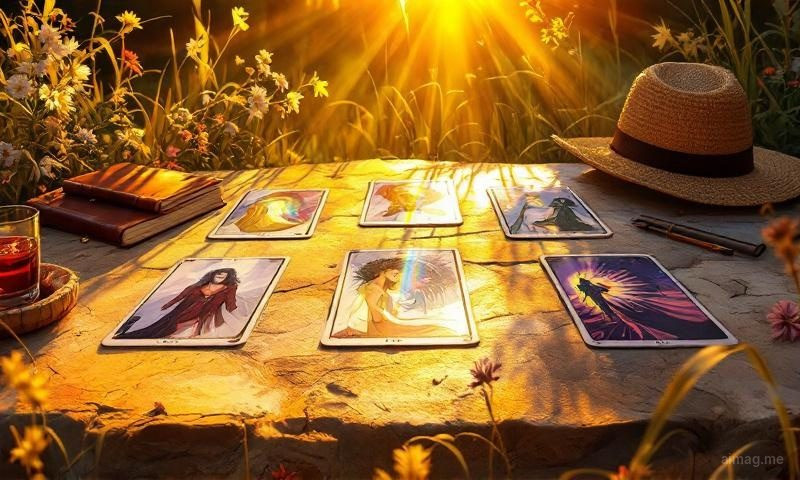
Spread 1: The Radiance Spread (5 Cards)
This is the primary summer solstice spread. It maps the relationship between what the light shows and what the light creates: illumination and shadow, peak and cost, and the integration of both.
| Position | Meaning |
|---|---|
| 1 | What is fully alive — the area of your life that is at its most vibrant right now |
| 2 | What is at its peak — the thing that has reached maximum expression and may not climb further |
| 3 | What the light reveals — something the solstice brightness is making impossible to ignore |
| 4 | The shadow cast by this brightness — what your current focus or success is causing you to neglect |
| 5 | How to honor both — how to integrate the light and shadow for the season ahead |
How to read it: Position 1 and Position 2 look similar but address different things. Position 1 is about vitality. What is alive, growing, energized? The Sun in this position is almost literal: something in your life is radiating genuine warmth and joy. The Three of Wands means a creative project or plan is actively expanding.
Position 2 is about culmination, which carries a more complex tone. A peak means the thing has gone as high as it is going to go. The Chariot here means your willpower and drive have carried you as far as they can. This is not failure. It is completion. But it requires you to notice the peak rather than continuing to push past it.
Position 3 is the solstice's gift and its challenge. The longest day shows things that shorter days obscure. This card names what has been there all along but is only now becoming impossible to avoid. The Eight of Swords means you can finally see that the constraints you felt were largely self-imposed. The Seven of Pentacles means you can finally see the actual results of the patient work you have been doing, and those results may surprise you in either direction.
Position 4 connects to Jung's shadow principle directly. Every strong light creates a hard shadow. If your career is the brightest thing in your life, the shadow might fall on your relationships. If your creative work is at its peak, the shadow might fall on your physical health or financial stability. This card names the neglected area with precision, not to punish you, but to inform you before the days begin to shorten.
Position 5 is the integration card. It does not ask you to fix the shadow or diminish the light. It asks how both can exist together honestly. Strength in this position means gentle persistence, holding the bright and the dark with equal composure. Temperance means active blending, finding the point where your accomplishments and your neglected areas can inform each other.
Spread 2: The Mid-Year Balance (4 Cards)
This spread is more practical and less symbolic. It treats the solstice as what it literally is: the middle of the year. A checkpoint. A moment to compare January's intentions with June's reality.
| Position | Meaning |
|---|---|
| 1 | January's intention — what you set out to do, become, or create at the start of the year |
| 2 | What exceeded expectations — where the year surprised you with more than you planned |
| 3 | What fell short — where reality did not match the vision, and why |
| 4 | Recalibration — the adjustment that will make the second half of the year more honest and effective |
How to read it: Position 1 is a mirror for your early-year self. You may not remember what you wanted in January. The card reminds you. The Ace of Wands means you started the year with raw creative fire. The Four of Pentacles means you started the year focused on stability and security. The Two of Cups means you started the year prioritizing connection.
Position 2 is where Kahneman's WYSIATI becomes useful. This card shows you something positive that happened outside your primary narrative. You have been tracking your main goals, measuring your main projects, and this card says: something else also grew, something you were not watching. Often the best things in a six-month period are things you did not plan.
Position 3 is honest without being cruel. Something fell short. The card names it specifically enough to be useful but without the judgment your inner critic would add. The Five of Cups here means you are mourning something you lost, but three cups are still standing. The Six of Swords means you are already moving away from what did not work, even if you have not acknowledged that transition consciously.
Position 4 is the spread's most actionable card. Recalibration is not "try harder." It is "adjust the aim." After six months of data, you know things you did not know in January. This card suggests how to use that knowledge. The Page of Wands means approach the second half with beginner's curiosity rather than veteran's fatigue. The King of Pentacles means bring more structure and less improvisation to what remains.
Cards that speak to the summer solstice
Certain cards carry solstice energy naturally. If they appear in your summer reading, pay extra attention.
The Sun. The most literal solstice card. When The Sun appears in a summer solstice spread, it amplifies the reading's theme: this is a moment of maximum visibility, maximum warmth, maximum exposure. Everything is seen. The question is whether you are comfortable being this visible.
Strength. The Strength card is about quiet power rather than force, and the summer solstice calls for exactly this quality. The longest day does not need to announce itself. It simply is. Strength in a solstice spread suggests that your power right now is not in what you are doing but in what you are able to hold without flinching.
The Chariot. Willpower, direction, triumph. But The Chariot also implies forward motion at high speed, and the solstice is a turning point. The Chariot in a solstice spread asks: are you driving toward something that is still ahead of you, or are you accelerating past the destination because you do not know how to stop?
Six of Wands. Victory, recognition, public success. This card at the solstice suggests that what you have built is being seen and acknowledged. The solstice question is: does the recognition match the reality? Or has the bright light created a version of your success that looks larger than it feels from the inside?

Working with the solstice shadow
The concept of shadow work becomes especially relevant at the summer solstice. Not because the shadow disappears in all that light, but because it becomes more defined. If you have been avoiding something, the solstice is the moment when avoidance becomes conspicuous.
Here is a practical exercise to pair with your solstice reading: after pulling your spread, write down the three things in your life that are going best. Then, for each one, write down what it might be costing you. Not in a pessimistic way. In an honest way. Your thriving career might be costing you sleep. Your deepening relationship might be costing you independence. Your creative project might be costing you attention to practical matters.
This is not about guilt. This is about information. The solstice light is generous enough to show you the full picture if you are willing to look at all of it.
Taylor's research is useful here. Your positive illusions about your year are probably serving you well. They are giving you energy and motivation. But the solstice reading creates a controlled moment where you can temporarily set those illusions aside, see the full picture in clear light, and then pick the illusions back up if you choose to. The difference is that now the choice is conscious.
The turning point
There is something bittersweet about the summer solstice that distinguishes it from every other seasonal marker. The longest day is also the day after which the light begins to diminish. You are celebrating the peak at the exact moment the peak ends. This is not sad. It is honest. And honesty, in small controlled doses, is what makes tarot useful rather than merely entertaining.
Your solstice reading captures you at this hinge. The cards show you what is fully illuminated and what the illumination costs. They show you where January's plans met reality and where the collision produced something better, or worse, or simply different than expected. They do not predict the second half of the year. They give you information for navigating it.
The days will shorten. The light will soften. The sharp shadows of the solstice will gradually blur into the gentler contrasts of autumn. But the clarity you found at the peak of light stays with you, because you wrote it down, because the cards made it specific, and because the longest day of the year gave you nowhere to hide from what you already knew.
Frequently asked questions
Do I need to read on the exact solstice day?
No. A window of roughly three days around the solstice carries the same energy. The solstice is an astronomical event, but its psychological usefulness is about the season, not the hour. If you read on June 18 or June 23, the themes of peak light, mid-year reflection, and shadow definition are equally relevant.
Can I use these spreads in the Southern Hemisphere?
Yes, but flip the calendar. Your summer solstice is in December. Read the Radiance Spread and Mid-Year Balance at your longest day, regardless of what month that falls in. If you are in the Southern Hemisphere reading this in June, you are at your winter solstice, which calls for a different kind of reading entirely: one focused on stillness, inner work, and what grows in the dark.
What if my reading feels mostly negative?
A solstice reading that surfaces difficult truths is doing its job. The longest day is not obligated to show you only pleasant things. If Position 4 of the Radiance Spread names a significant shadow, or Position 3 of the Mid-Year Balance shows something that fell well short, that is information you can use. The solstice gives you six months of remaining daylight to work with what the cards revealed. A full moon tarot spread later in the summer can help you process and release whatever the solstice brought to the surface.
How does a solstice reading differ from a regular mid-year review?
A regular review measures progress against goals. A solstice reading does that (the Mid-Year Balance), but the Radiance Spread adds a layer that spreadsheets cannot: it names what the brightness is hiding. A performance review tells you what you accomplished. A solstice reading tells you what you accomplished, what it cost, and what the success prevented you from seeing. That additional dimension is what makes the solstice reading worth doing even if you already have a perfectly good goal-tracking system.
Sixteen hours of light. That is what the solstice gives you, depending on your latitude. Sixteen hours in which nothing is hidden, nothing is implied, nothing is left to imagination. The garden and the weeds. The project and the procrastination. The relationship and the distance growing inside it. The tarot cards you pull on this day will not create the light. The light is already there. The cards will simply help you look at what it is showing you, name it with enough precision to be useful, and sit with the strange, honest feeling of being seen completely at the exact moment the year begins to turn toward the dark. That feeling, uncomfortable as it is, is the solstice's actual gift. Not the warmth, not the long evening, not the celebration. The visibility. What you do with it in the six months that follow is entirely up to you.