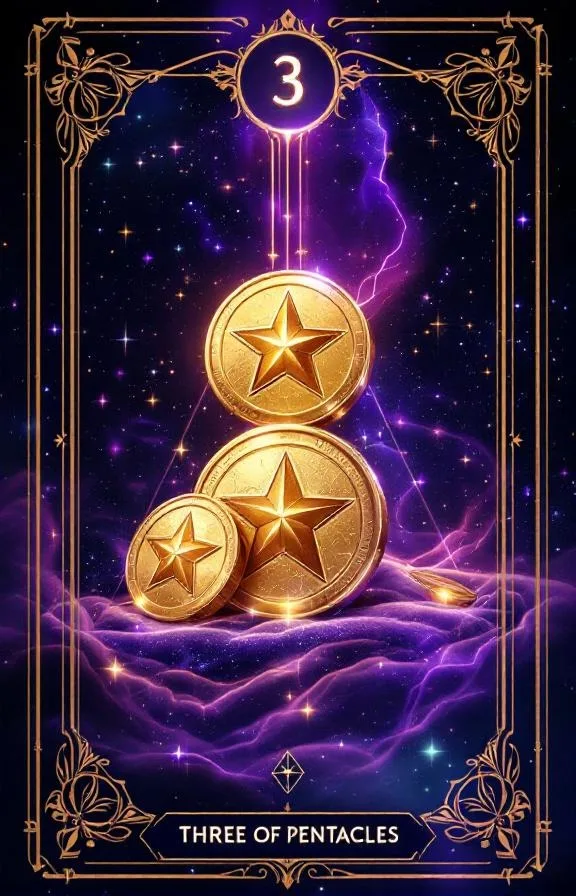
Manifestation has become one of the most searched terms in personal development, and one of the most misunderstood. The popular version — visualize what you want, feel the emotion of having it, and the universe will deliver — is not supported by psychological research. But the core impulse behind manifestation is valid and powerful: getting genuinely clear about what you want, understanding why you want it, and creating the internal conditions for sustained action. Tarot does not manifest your desires. It does something more useful — it forces you to articulate them.
In short: Tarot supports manifestation not through mystical attraction but through psychological mechanisms that research has validated: goal clarification (Edwin Locke), mental contrasting (Gabriele Oettingen), and the disruption of habitual thinking through random symbolic input. A 3-card "manifestation clarity" spread helps you identify your genuine desire, the obstacle in your way, and the action that bridges the gap.
The psychology of manifestation — what actually works
The word "manifestation" triggers eye-rolls among psychologically literate people, and that reaction is partially justified. The version of manifestation popularized by The Secret — the law of attraction, cosmic ordering, vibrational alignment — has no empirical support. Positive fantasizing about desired outcomes, without more, actually reduces the likelihood of achieving them. Gabriele Oettingen's research at New York University demonstrated this across dozens of studies: people who vividly fantasized about getting a job, losing weight, or recovering from illness consistently performed worse than control groups who did not engage in positive fantasy.
The reason is counterintuitive but robust: positive fantasy satisfies the brain's reward system prematurely. You feel the emotional payoff of achievement without doing the work, which reduces the motivational energy available for actual effort. Your mind has already experienced the reward. Why would it mobilize resources to pursue something it believes it already has?
But Oettingen did not stop there. She developed a technique called mental contrasting — part of the broader WOOP framework (Wish, Outcome, Obstacle, Plan) — that flips the script. Mental contrasting involves first imagining the desired outcome and then immediately confronting the internal obstacles that stand between you and that outcome. This sequence — fantasy followed by reality — creates a discrepancy signal in the brain that increases motivation and effort rather than dampening them.
Edwin Locke and Gary Latham's goal-setting theory, built on decades of research across hundreds of studies, provides the complementary mechanism: specific, challenging goals produce higher performance than vague, easy, or "do your best" goals. The specificity matters as much as the ambition. "I want abundance" produces nothing. "I want to save $10,000 by December by automating $800 monthly transfers" produces reliable behavior change.
Here is where tarot enters the picture — not as a magical amplifier but as a psychological tool that makes both mental contrasting and goal specification more effective.
Why tarot is uniquely suited for goal clarification
Most people cannot articulate what they genuinely want. This is not a trivial problem. When asked directly, people tend to produce goals that are vague ("I want to be happy"), borrowed from social expectations ("I want a promotion"), or so abstract they provide no actionable direction ("I want to find my purpose"). Kennon Sheldon's research on self-concordance — the alignment between stated goals and authentic values — shows that the majority of goals people consciously set are not genuinely their own. They are introjected: absorbed from parents, partners, culture, and social media, then internally relabeled as personal desire.
The tarot card draw introduces a cognitive disruption that bypasses this habitual goal-editing process. When you draw The Star while reflecting on what you want, you are not looking at an answer. You are looking at an image — a naked figure pouring water under a vast sky of stars — that activates associative networks your deliberate thinking consistently misses. The card does not tell you what to want. It creates a symbolic space in which suppressed, inarticulate, or socially unacceptable desires can surface.

This is the mechanism that makes tarot more effective for goal clarification than a blank journal page. The blank page asks: "What do you want?" Your conditioned mind answers with whatever it has been trained to say. The tarot card asks the same question through an unexpected image, and the conditioned mind's script does not apply. You have to generate a new response, and that new response is more likely to reflect something genuine.
The manifestation clarity spread — 3 cards for real intention setting
This spread is designed specifically for manifestation work. It is not predictive. It is clarifying. You are not asking the cards what will happen. You are using three positions to structure the psychological work of turning vague desire into specific, actionable intention.
Position 1: The Desire — What do I genuinely want right now? Position 2: The Obstacle — What internal barrier stands between me and this desire? Position 3: The Bridge — What action or shift would move me from obstacle to desire?
How to use this spread
Shuffle your deck while holding the question: "What am I genuinely trying to create in my life right now?" Do not narrow it to a specific domain yet. Let the cards reveal which domain matters most.
Reading Position 1 (The Desire): This card reflects not what you should want but what you do want. If you draw the Ace of Pentacles, the desire may be material — financial security, a new venture, physical health. If you draw the Three of Cups, the desire may be relational — community, celebration, belonging. If you draw The Magician, the desire may be creative — to make something real, to use all the tools available to you, to bridge vision and reality.
Sit with this card for two minutes before writing. Notice what emotion arises. That emotion is data. If the card produces relief, you have been suppressing this desire. If it produces anxiety, you want it but fear the wanting. If it produces excitement, the desire is already aligned with your energy and is ready for action.
Reading Position 2 (The Obstacle): This card reveals the internal barrier. External obstacles matter, but they are rarely the real problem. The real problem is almost always psychological: fear, self-doubt, conflicting desires, old stories about what you deserve.
If you draw the Eight of Swords, the obstacle is perceived imprisonment — you feel trapped, but the bindings are loose and the swords do not touch you. The barrier is the belief that you are trapped, not the trap itself. If you draw The Moon, the obstacle is confusion, illusion, or unconscious fears that distort your perception. If you draw the Five of Cups, the obstacle is grief — fixation on what has been lost that prevents you from seeing what remains.
Reading Position 3 (The Bridge): This is the action card — the Oettingen "Plan" element that transforms mental contrasting from passive insight into active strategy. This card does not predict what will happen. It suggests the quality of action that would be most effective.
If you draw the Knight of Pentacles, the bridge is steady, patient, methodical effort. Not dramatic leaps but daily consistency. If you draw The Star, the bridge is hope itself — the willingness to believe that effort will be rewarded even before evidence arrives. If you draw the Two of Wands, the bridge is planning and vision — looking at the map before taking the first step.
After reading all three cards, write a single sentence in this format: "I want [Desire], and the obstacle is [Obstacle], so I will [Bridge action] this week." This is your implementation intention. It is specific. It is time-bound. It connects desire to obstacle to action in a single cognitive structure.
Five cards for manifestation work — and why they appear
Certain cards appear with striking frequency in manifestation-focused readings. This is not mystical selection — it is psychological resonance. When you shuffle a deck while holding an intention about creating something in your life, certain images activate more strongly because they map onto the psychological states involved in intentional creation.
The Magician
The Magician is the manifestation card because it is literally the card of making real. One hand points to heaven (vision, intention, the ideal), the other points to earth (matter, reality, the concrete). On the table before the Magician sit all four elemental tools — cup, pentacle, sword, wand — representing emotional, material, intellectual, and creative resources. The Magician's message is not "the universe will provide." It is "you already have what you need. Use it."
In Locke and Latham's framework, The Magician represents task-specific self-efficacy — the belief that you possess the skills and resources to accomplish the goal. Their research shows that self-efficacy is one of the strongest predictors of goal achievement, independent of actual skill level. The Magician says: believe you can, then act on that belief.
Ace of Pentacles
The Ace of Pentacles represents the seed of material manifestation — a hand emerging from a cloud offering a golden coin above a garden gate. This is the moment when an abstract intention becomes a concrete opportunity. The card does not promise wealth. It indicates readiness — the conditions are right for planting, and the seed is being offered.
In manifestation work, this card often appears when the obstacle is not lack of opportunity but failure to recognize opportunity. The garden gate is open. The seed is in your hand. The question is whether you will plant it.
The Star
The Star is the card of hope after devastation — it follows The Tower in the Major Arcana sequence, representing the quiet restoration that follows destruction. In manifestation contexts, The Star addresses the psychological state that Oettingen's research identifies as critical: the ability to hold a positive vision of the future while simultaneously acknowledging present difficulty.
The Star is not naive optimism. The figure is naked, vulnerable, kneeling by water under a vast sky. This is hope that has passed through suffering and survived. In manifestation work, The Star indicates that your desire is genuine (it has survived the Tower's test) and that patient, sustained effort — represented by the slow pouring of water onto earth — will yield results.
Three of Wands
The Three of Wands shows a figure standing on a cliff, looking out over a vast landscape where ships sail toward distant shores. The figure has planted three wands behind them — the initial effort has been made — and now watches the results begin to unfold. This card represents the manifestation stage after action has been taken but before results have fully materialized.
This is the stage that most people abandon. The effort has been made, the implementation intentions have been activated, but visible results have not yet appeared. The Three of Wands says: the ships are sailing. The process is working. Your job right now is to maintain the vision and stay the course.
Nine of Cups
The Nine of Cups — often called the "wish card" — shows a figure sitting contentedly before a display of nine golden cups arranged on a curved shelf. This card represents emotional fulfillment and the satisfaction of genuine desire. In manifestation work, the Nine of Cups is less about getting what you want and more about recognizing that what you have may already be what you wanted.
This is the self-concordance check. Sheldon's research shows that achieving a non-concordant goal produces disappointment, not satisfaction. The Nine of Cups asks: if you got exactly what you are working toward, would you actually feel the way you expect to feel? If the answer is uncertain, the goal may need refinement, not more effort.
Manifestation techniques with tarot
Technique 1: Card visualization (goal embodiment)
Select a card that represents your desired outcome — not randomly, but deliberately. If your goal is creative expression, choose The Magician. If your goal is emotional fulfillment, choose the Nine of Cups. If your goal is new beginnings, choose The Fool.
Spend five minutes each morning looking at this card. But here is the critical difference from standard visualization: do not simply imagine having the outcome. Instead, practice Oettingen's mental contrasting by alternating between two states:
- Thirty seconds: Visualize the best possible outcome, using the card's imagery as a scaffold. Feel the emotion of achievement.
- Thirty seconds: Visualize the primary obstacle — the internal barrier you identified in Position 2 of the manifestation clarity spread. Feel the difficulty of that obstacle honestly.
This alternation — outcome, obstacle, outcome, obstacle — creates the motivational discrepancy that Oettingen's research shows drives action. Pure positive visualization relaxes effort. Mental contrasting energizes it.
Technique 2: Journaling with daily draws
Draw one card each morning for seven days. For each card, write responses to three prompts:
- What does this card show me about what I want? (Desire clarification)
- What does this card show me about what is in my way? (Obstacle identification)
- If this card were giving me one specific instruction for today, what would it be? (Implementation intention)
The third prompt is the most important. It forces you to translate symbolic insight into concrete behavior. "The Seven of Pentacles tells me to be patient" is not enough. "The Seven of Pentacles tells me to check on my investment portfolio today without making impulsive changes" is an implementation intention — specific, behavioral, and time-bound.
For deeper journaling practice, the tarot journaling guide provides a complete framework. Combining daily tarot spreads with manifestation prompts creates a consistent practice that compounds over weeks.
Technique 3: Intention setting with the Full Moon spread
The tarot and meditation connection is particularly relevant for manifestation work. Before a manifestation session, spend five minutes in silent meditation with your chosen intention card face-up before you. Allow the image to become the object of concentration. When thoughts arise about the goal, notice them without engaging, then return attention to the card image.
This practice accomplishes two things. First, it strengthens the neural association between the card's visual pattern and your goal, making the card increasingly effective as a trigger for goal-directed thinking. Second, it creates a brief period of non-reactive observation that allows unconscious material about the goal — fears, competing desires, forgotten resources — to surface naturally.
What manifestation is not — the critical distinction
Tarot-based manifestation is not magic. It does not bend reality to match your desires. It does not activate cosmic forces. It does not attract abundance through vibrational alignment. If someone tells you otherwise, they are selling something.
What tarot-based manifestation does is organize your psychological resources around a clearly defined intention. The cards provide a symbolic language for desires that your verbal mind struggles to articulate. The spreads provide a structure for the mental contrasting that Oettingen's research validates. The daily practice provides the repetition that Locke and Latham's goal-setting theory identifies as necessary for goals to influence behavior.
The difference between manifestation as magical thinking and manifestation as psychological practice is the same difference between wishing for rain and building irrigation. Both involve water. Only one gets your crops fed.
Tarot for self-reflection works because the cards externalize internal processes. Manifestation with tarot works for the same reason: it takes the private, fuzzy, emotionally charged process of wanting and gives it a visible structure you can examine, question, refine, and act on.
FAQ
Does tarot manifestation actually work? Tarot does not manifest outcomes through supernatural means. What works — and what research consistently supports — is the process of goal clarification, mental contrasting, and implementation intentions that tarot facilitates. Gabriele Oettingen's WOOP research and Edwin Locke's goal-setting theory both demonstrate that specific, psychologically engaged goal pursuit produces better outcomes than vague wishing. Tarot provides the symbolic structure that makes this engagement deeper and more emotionally resonant than a blank worksheet.
Which tarot card is best for manifestation? The Magician is most commonly associated with manifestation because it literally depicts the act of turning vision into reality — one hand pointing up (intention), one pointing down (action), all four elemental tools available. However, the "best" card depends on your specific goal. For material goals, the Ace of Pentacles. For emotional fulfillment, the Nine of Cups. For new beginnings after difficulty, The Star. The card that activates the strongest emotional response in you is the one most useful for your manifestation practice.
How often should I do the manifestation clarity spread? Once every two to four weeks is optimal. More frequently than that and you risk substituting reading-about-your-goal for acting-on-your-goal — a form of productive procrastination. Do the spread, extract your implementation intention, act on it for two weeks, then reassess. If the obstacle has shifted, the spread will reveal the new barrier. If the desire has changed, that information is equally valuable.
Can I use AI tarot for manifestation? Yes. The mechanism of manifestation clarity does not depend on physical cards. It depends on encountering unexpected symbolic imagery while holding a specific intention. An AI tarot reading provides the same cognitive disruption and associative activation as a physical deck. The key is your engagement with the imagery and your willingness to translate insight into specific, time-bound action.
Is manifestation just positive thinking? No, and this distinction matters. Positive thinking — simply imagining positive outcomes — actually reduces goal achievement according to Oettingen's research. Effective manifestation includes the obstacle: it requires honest confrontation with what stands in your way. The WOOP framework (Wish, Outcome, Obstacle, Plan) is effective precisely because it refuses to stay in the positive fantasy. Tarot supports this by providing cards in Position 2 (The Obstacle) that name difficult truths your conscious mind might prefer to avoid.
Clarity is the first step toward creation. Try a free AI tarot reading and discover what you are genuinely ready to manifest.