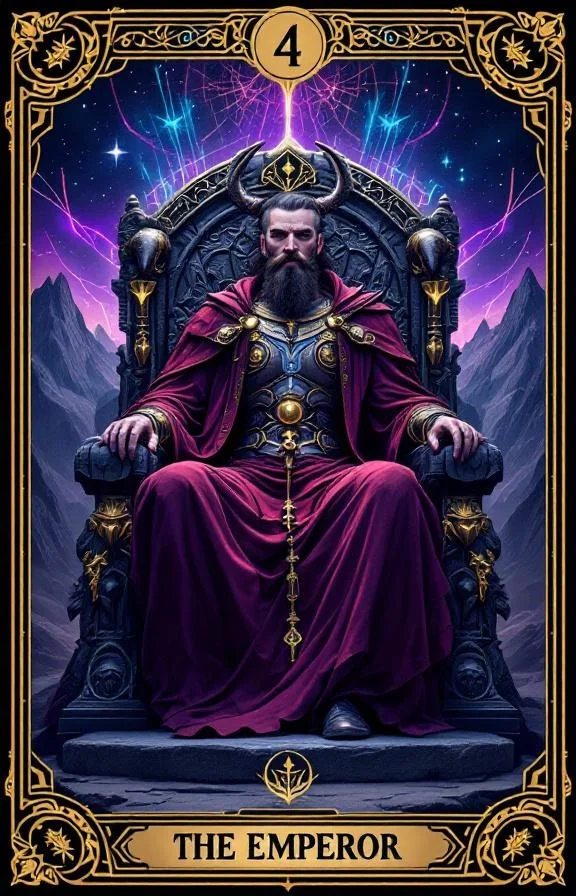
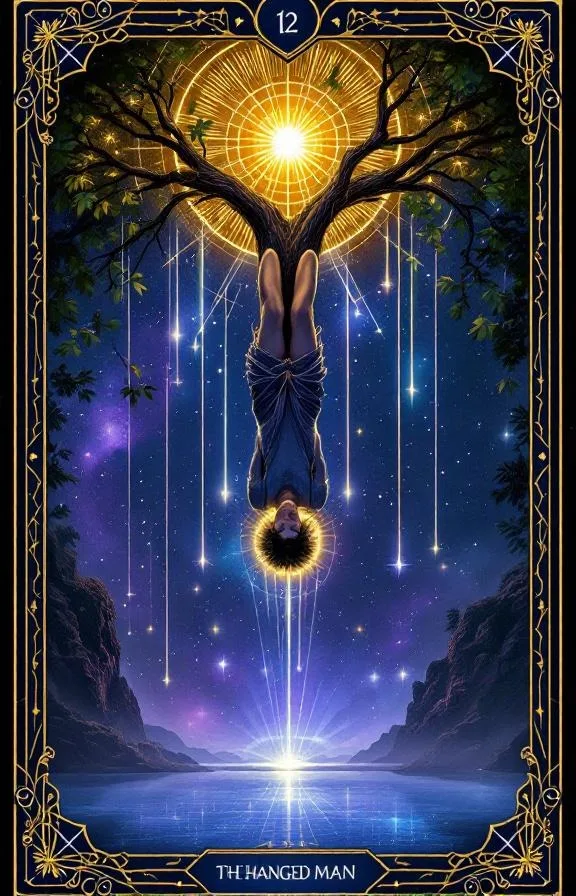
Consider the CEO who schedules every fifteen-minute block of her day, who has optimized her morning routine down to the second, who runs her company with the precision of a military campaign — and who wakes up one Tuesday morning with the quiet, devastating thought: "I have built exactly the life I planned, and I am not sure it is mine." That collision between mastery and doubt, between the throne and the tree, is the psychological territory The Emperor and The Hanged Man inhabit together.
The Emperor and The Hanged Man at a Glance
| The Emperor | The Hanged Man | |
|---|---|---|
| Number | IV | XII |
| Element | Fire / Aries | Water / Neptune |
| Core theme | Structure, authority, control | Surrender, new perspective, letting go |
Together: The force that builds meeting the wisdom that asks whether what has been built still serves its purpose.
The Core Dynamic
The psychiatrist Viktor Frankl, who survived Auschwitz and went on to develop logotherapy, made a distinction that is essential to understanding this pairing. Frankl observed that suffering without meaning is unbearable, but that suffering in service of something meaningful becomes endurable — even transformative. The Emperor represents the meaning-making function of the psyche: he organizes reality into categories, creates hierarchies of value, and knows exactly where everything belongs. The Hanged Man represents the moment when those categories stop working — not because they were wrong, but because the person inside them has outgrown them.
This is what the transpersonal psychologist Stanislav Grof described as a "psychospiritual crisis" — a period when an individual's existing framework for understanding themselves and the world undergoes involuntary dissolution. The Emperor does not dissolve willingly. He grips the arms of his throne. His crown is bolted on. And yet The Hanged Man does not fight the Emperor's grip. He simply inverts the field, offering a view from a direction the Emperor has never looked: downward, inward, through.
The elemental tension here is instructive. Fire and Water. The Emperor's fire is directive, assertive, outward-moving — it builds, commands, shapes. The Hanged Man's water is receptive, reflective, inward-moving — it yields, absorbs, transforms. When fire meets water in nature, you get steam: something neither purely solid nor purely fluid, but possessing the energy of both. This combination suggests a psychological moment where your established identity and your emerging awareness are producing exactly this kind of steam — uncomfortable, disorienting, and potentially the source of enormous power if you do not try to force it back into a familiar container.
In Love & Relationships
In partnerships, this pairing often surfaces when one person's need for control encounters the other's need for space — or when both needs exist within the same person. The Emperor in a relationship creates safety through predictability: clear expectations, defined roles, a shared structure that both partners can rely on. But the Hanged Man suggests that this very structure may have become a form of emotional avoidance — a way of organizing the relationship so thoroughly that there is no room left for the uncomfortable, unscripted moments where genuine intimacy actually lives.
The psychologist Sue Johnson, creator of Emotionally Focused Therapy, found that secure attachment is not built on control but on emotional accessibility and responsiveness. The Emperor can be present, reliable, and protective without being emotionally accessible. The Hanged Man asks him to be vulnerable — to let someone see him from the angle he has been hiding. For couples in established relationships, this combination may indicate that the relationship is structurally sound but emotionally suspended, waiting for someone to risk the first genuine disclosure. For those who are single, it may suggest that your criteria for a partner — your checklist, your standards — need to be held more loosely than you are comfortable with.
In Career & Finances
Professionally, this is the combination of the successful person in crisis — not crisis in the dramatic sense, but the quiet kind where everything looks fine from the outside while something fundamental is shifting inside. You may hold a position of authority and perform it well, yet find yourself increasingly disconnected from the reasons you pursued it. The management theorist Peter Drucker famously wrote that "there is nothing so useless as doing efficiently that which should not be done at all." The Emperor does things efficiently. The Hanged Man asks whether they should be done at all.
This combination may also appear when a professional situation requires you to relinquish control in order to gain something more valuable: a sabbatical, a role change, a willingness to be a beginner again after years of expertise. The concept of "beginner's mind," drawn from Zen Buddhism and popularized in Western psychology by Shunryu Suzuki, is relevant here. The Emperor has an expert's mind — full of knowledge, strategies, proven methods. The Hanged Man has a beginner's mind — empty enough to see what the expert's accumulated assumptions have made invisible.
Financially, this pairing counsels patience over action. If you are inclined to restructure your portfolio, force a deal, or make a major financial decision driven by the anxiety of inaction, this combination suggests waiting. Not forever — but long enough to be sure the decision comes from clarity rather than from the discomfort of not deciding.
The Deeper Message
The mythologist Joseph Campbell observed that the hero's journey always contains a phase of descent — a period of inversion, ordeal, or voluntary surrender that precedes the return with new knowledge. The Emperor represents the hero before the descent: competent, established, in command. The Hanged Man is the descent itself. Together, they do not predict failure or loss. They suggest something more psychologically precise: the possibility that what feels like losing your grip may actually be the beginning of understanding what was worth holding in the first place. What might you discover about your own authority if you stopped defending it long enough to question it?
Curious what The Emperor and The Hanged Man mean for YOU? Try a free AI-powered reading and see what the cards reflect about your situation right now.