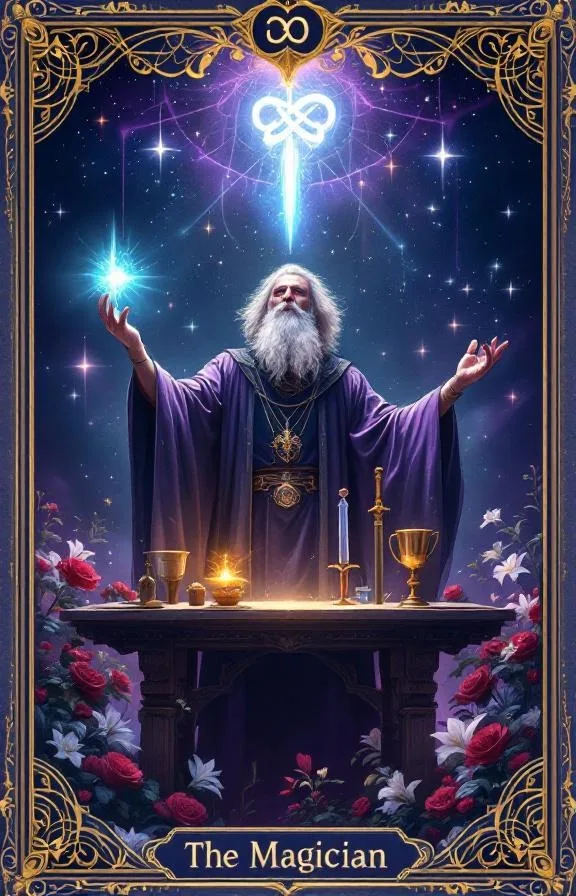
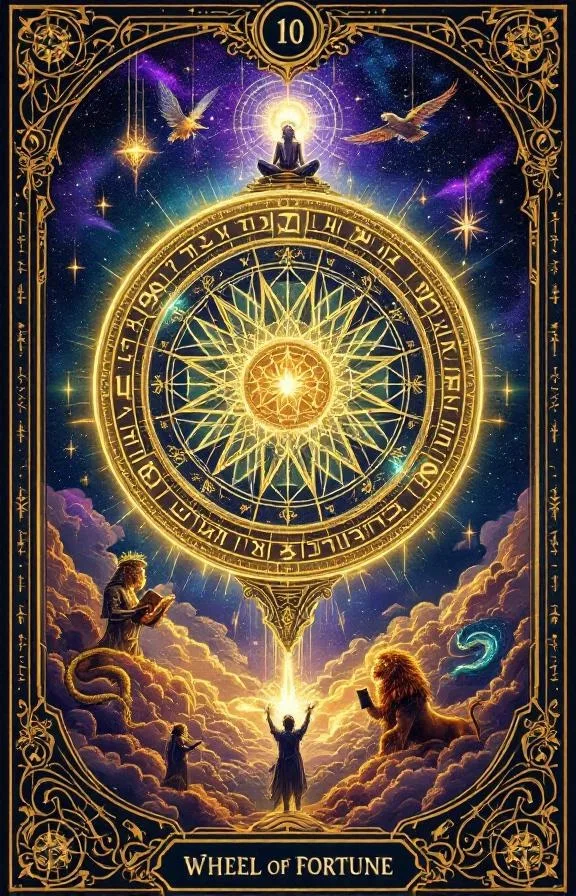
Every poker player knows the difference between a good hand and a good player. A good hand is luck. A good player is the person who wins regardless of the hand — not always, not every time, but consistently enough that luck starts to look like something else entirely. That tension between what you can control and what you cannot is one of the oldest questions in psychology, and it is precisely the question The Magician and the Wheel of Fortune hold between them.
The Magician and Wheel of Fortune at a Glance
| The Magician | Wheel of Fortune | |
|---|---|---|
| Number | I | X |
| Element | Air / Mercury | Fire / Jupiter |
| Core theme | Willpower, skill, manifestation | Cycles, change, turning points |
Together: Personal agency meets external circumstance — and the question becomes how skillfully you respond to forces you did not choose.
The Core Dynamic
The Magician stands for what psychologist Julian Rotter called an internal locus of control — the belief that your outcomes are primarily determined by your own actions, skills, and decisions. He has his tools. He has his intention. The relationship between effort and result feels clear, almost mechanical: do the work, produce the outcome. This is an enormously useful psychological orientation. Research consistently shows that people with an internal locus of control tend to be more motivated, more persistent, and more resilient in the face of setbacks.
The Wheel of Fortune represents the opposite pole: the external locus of control, the recognition that life contains forces — timing, chance, systemic structures, other people's decisions — that operate independently of your will. Jupiter's influence here is expansive and indifferent. The Wheel turns. You are on it. Whether you are currently rising or falling has less to do with your merit than with where you happen to be in a cycle that precedes and exceeds you.
Neither card, taken alone, tells the whole truth. Pure internal locus of control becomes the delusion that you can manifest your way past structural reality. Pure external locus becomes passivity, fatalism, learned helplessness. The psychologist Martin Seligman spent decades studying exactly this spectrum, and his conclusion was nuanced: the healthiest orientation is neither pure agency nor pure surrender, but what he called "flexible optimism" — the capacity to act decisively where you have influence while accepting uncertainty where you don't.
This is precisely what The Magician and the Wheel of Fortune together describe. They suggest a moment where your skills are real and your preparation is genuine, but the outcome will also depend on factors outside your control. The question is not whether you are ready — The Magician confirms that you likely are. The question is whether you can hold your readiness lightly enough to adapt when the Wheel delivers something different from what you planned.
In Love & Relationships
In matters of connection, this pairing highlights the fundamental paradox of love: you can do everything right and still not control whether it works. You can be emotionally available, communicative, generous, self-aware — all Magician virtues — and the other person's timing, readiness, or life circumstances may simply not align. The Wheel reminds you that relationships exist within larger patterns that no amount of personal skill can fully orchestrate.
For new connections, this combination may indicate a meeting that feels significant precisely because of its timing. Research on relationship formation shows that situational factors — proximity, shared novelty, even the physiological arousal of a novel environment — play a larger role in creating attachment than people expect. The Magician and the Wheel together suggest that the person entering your life may do so through circumstances you didn't engineer. Your role is not to force the connection but to be skillful enough to recognize and nurture it when it arrives.
In established relationships, this pairing can surface during periods of external change — a job loss, a move, an unexpected shift in family circumstances — that tests the partnership's adaptability. The Magician's contribution here is practical resourcefulness. The Wheel's contribution is acceptance that the relationship is entering a new phase, one that cannot be navigated using the same strategies that worked in the last one.
In Career & Finances
Professionally, The Magician and the Wheel of Fortune describe the entrepreneur's dilemma in its purest form: you have built something with genuine competence, and now the market, the timing, or the broader economic cycle will determine whether that competence translates into success. This is not a discouraging message. It is a realistic one.
This combination favors preparation over prediction. Rather than trying to forecast exactly when opportunity will arrive, it counsels building the skills and positioning that allow you to capitalize when the Wheel's rotation puts you in the right place. Louis Pasteur's famous observation — "chance favors the prepared mind" — captures this dynamic with precision. The Magician prepares the mind. The Wheel provides the chance.
Financially, this pairing suggests a period of transition that you can influence but not entirely control. If investments are shifting, if income is fluctuating, The Magician asks you to deploy your resources with intelligence and intention. The Wheel asks you to build enough flexibility into your financial structure that a sudden turn — in either direction — doesn't break the system. The best financial planning, like the best poker playing, accounts for variance.
The Deeper Message
The deepest teaching of The Magician and the Wheel of Fortune is not about luck versus skill. It is about the mature recognition that life requires both — and that the ratio between them is never fixed. There will be seasons when your effort is the decisive factor, and seasons when forces larger than your will reshape the landscape regardless of what you do. Wisdom is not choosing one orientation over the other. Wisdom is knowing which season you are in.
What would you do differently if you trusted both your competence and the timing of your life?
Curious what The Magician and Wheel of Fortune mean for YOU? Try a free AI-powered reading and see what the cards reflect about your situation right now.
