If you are a Cancer, you already know something about yourself that most personality systems take pages to explain: you feel everything. Not in the vague, greeting-card sense of being "sensitive." You feel the temperature of a room when you walk in. You feel what someone means underneath what they say. You feel the emotional residue of a conversation three days later, still processing, still turning it over, still wondering whether you said the right thing or whether the other person is secretly hurt.
Cancer is the zodiac's emotional memory bank. Born between June 21 and July 22, ruled by the Moon, belonging to the Water element, and carrying the Cardinal quality — which means you do not merely feel. You act on what you feel. The crab carries its home on its back, armored on the outside, impossibly soft within. That paradox — fierce protection wrapped around deep vulnerability — is exactly what makes Cancer one of the most psychologically rich signs to read through tarot.
The card that represents Cancer is not what most people guess. Not a Cups card. Not The Moon, despite Cancer being Moon-ruled. It is The Chariot — the card of directed willpower, emotional mastery, and the kind of strength that comes not from suppressing feelings but from harnessing them.
In short: The Chariot is Cancer's primary tarot card, representing the ability to harness opposing emotional forces through sheer willpower rather than suppressing them. Supporting cards include the Queen of Cups, The Moon, and The High Priestess, mapping Cancer's full range from fierce emotional protection to deep intuitive knowing. The Shell and Sea Spread helps Cancer explore what the armor is guarding and what the tides are carrying.
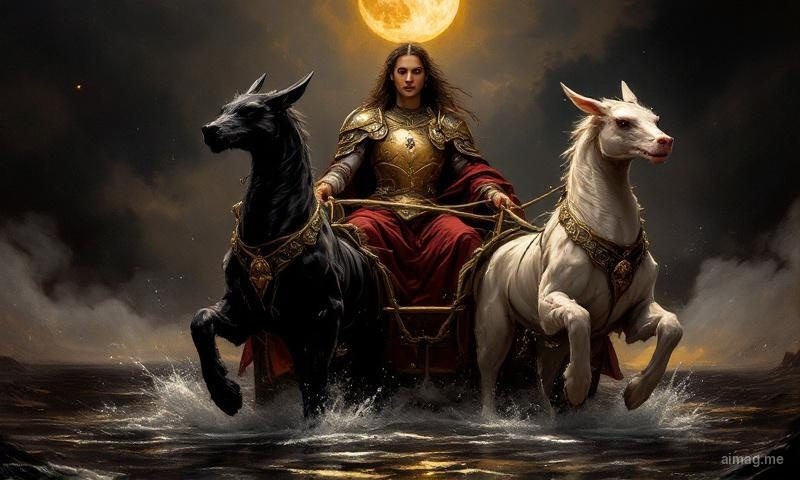
The Chariot — Cancer's main tarot card
Here is the question that catches people off guard: what tarot card is Cancer? The answer — The Chariot — seems wrong at first. Card VII of the Major Arcana depicts a figure in armor riding a chariot pulled by two sphinxes or horses, one black and one white. The image suggests willpower, conquest, directed force. Where is the nurturing? The emotional depth? The soft interior of the crab?
All there. You just have to understand what The Chariot is actually about.
The Chariot does not depict brute force. It depicts mastery of opposing forces — the ability to take two contradictory impulses and direct them toward a single purpose without destroying either one. The charioteer does not whip the sphinxes into submission. Most traditional depictions show no reins at all. The vehicle moves through sheer force of will, through the rider's ability to hold tension without collapsing into one side or the other.
This is Cancer's deepest skill. You hold the tension between needing people and needing to protect yourself from people. Between wanting to nurture and wanting to withdraw. Between being the strongest person in the room emotionally and being the most easily wounded. The Chariot says: you do not resolve these contradictions. You ride them. You make them carry you forward.
Emotional intelligence — the ability to recognize, understand, and manage your own emotions while simultaneously reading and responding to others' emotions — is one of the strongest predictors of both leadership effectiveness and relationship satisfaction. Cancer embodies this capacity by instinct. The Chariot is its visual form: not the absence of internal conflict, but the mastery of it.
The crab's hard shell is The Chariot's armor. The soft interior is the heart that makes the ride worth taking. Cancer does not fight despite feeling everything. Cancer fights because of feeling everything — because the things worth protecting are too precious to leave undefended.
The supporting cards — Cancer's emotional constellation
No sign is captured by a single card. Cancer's psychological complexity unfolds across several tarot archetypes that together map this sign's full inner terrain.
Queen of Cups — emotional intelligence mastered
If The Chariot is Cancer's will, the Queen of Cups is Cancer's wisdom. She sits at the water's edge, holding a closed cup — ornate, beautiful, sealed. She does not spill her emotions for display. She contains them. She knows what she feels, she knows what you feel, and she chooses carefully what to share and with whom.
This is Cancer at its most mature: emotionally literate without being emotionally reactive. The Queen of Cups does not get swept away by feelings. She reads them the way a sailor reads the sea — with respect, with knowledge, and with the understanding that you can navigate water without becoming it.
For Cancer, this card is the aspiration. When you are being your best self — present, perceptive, containing multitudes without leaking — you are the Queen of Cups.
The Moon — the unconscious, cycles, what hides beneath
The Moon is Cancer's ruling planet expressed in tarot, and it represents the dimension of Cancer that most people find hardest to understand from outside: the interior world. The Moon card shows a terrain of illusion and intuition — a path between two towers, a pool from which a crayfish emerges, a dog and a wolf howling at a moon that illuminates without fully revealing.
Cancer lives in this territory. Your moods cycle. Your inner world is rich, populated, and not always rational. You know things without being able to explain how. You pick up on dynamics others miss entirely. The Moon validates this way of knowing — not as confusion or weakness, but as a legitimate form of perception operating below conscious analysis.
The term for this is "implicit processing" — the brain detecting patterns and generating accurate intuitions before the conscious mind assembles the evidence. Cancer has this in abundance. The Moon says: trust it, but also understand that not every shadow is a threat. Some of what you sense in the dark is your own fear projected outward.
The High Priestess — intuition as knowledge
The High Priestess sits between two pillars — one black, one white — with a veil behind her concealing deeper mysteries. She does not act. She knows. She holds the scroll of hidden wisdom and waits for the right moment to reveal what she understands.
For Cancer, The High Priestess represents the part of you that simply knows — about people, about situations, about the emotional undercurrents driving decisions long before anyone acknowledges them consciously. This is not mysticism. Early relational experiences create internal working models — unconscious templates for understanding safety, threat, and connection — that run automatically throughout life. Cancer's deep attunement to emotional atmospheres is, in part, a finely calibrated threat-detection and safety-assessment system that processes relational information with extraordinary speed and accuracy.
The High Priestess says: what you know intuitively is real knowledge. It deserves the same respect as what can be measured and quantified.
Four of Cups — emotional withdrawal as protection
The Four of Cups shows a figure sitting under a tree, arms crossed, three cups before them and a fourth being offered by a hand from a cloud. The figure does not look at the offered cup. Turned inward. Closed off. Somewhere else.
This is Cancer in protective mode. When the world has been too much — too loud, too demanding, too emotionally unsafe — Cancer retreats. Shell goes up. Drawbridge rises. Phone goes unanswered. This is not rudeness or apathy. It is a necessary recalibration, a stretch of emotional hibernation during which Cancer processes what has accumulated and decides what is safe to let back in.
The Four of Cups is Cancer's reminder that withdrawal is sometimes wisdom — but also that the offered cup, the thing you are too guarded to notice, might be exactly what you need.
Cancer in love — depth, devotion, and the fear of being left
Cancer does not date casually. Even when Cancer thinks it is being casual, it is already building emotional architecture around the other person — noting preferences, memorizing stories, constructing a model of who they are that is more detailed and accurate than the other person's self-image.
This is extraordinarily attractive and occasionally suffocating.
The fear of abandonment is not a disorder for Cancer. It is a background hum — a low-frequency signal shaping decisions about when to open up, when to pull back, and how much vulnerability is safe. Cancer understands anxious attachment intuitively, even when it does not fit the clinical pattern. The sensitivity to signs of withdrawal, the tendency to give more than is returned in the hope of securing the bond — these impulses run deep.
In love, Cancer's tarot cards tell a specific story. The Ace of Cups represents what Cancer offers: overflowing emotional availability, the capacity for total devotion, the willingness to build a world around another person. The Queen of Cups represents how Cancer loves best — with depth, perception, and containment. The Four of Cups represents what happens when Cancer gets hurt: withdrawal, shell, refusal to accept what is being offered because the last offering caused pain.
Cancer loves through action more than words. Cooking for someone is a love language. Making a home feel safe is a love language. Remembering what someone said three months ago and acting on it without being asked — that is Cancer's most characteristic form of devotion, and one of the most powerful expressions of care another person can receive.

Cancer at work — the nurturer who struggles with self-promotion
Cancer excels in roles that require emotional attunement: teaching, counseling, healthcare, social work, human resources, creative direction, hospitality. Any profession where understanding what people need — often before they articulate it — is a core skill, Cancer will outperform.
The struggle is visibility. Cancer does excellent work quietly. Builds teams by making individuals feel seen and supported. Creates environments where other people thrive. Then watches as someone louder takes credit, because self-promotion feels inauthentic and slightly embarrassing.
The King of Cups is Cancer's career aspiration card — the figure who has mastered emotional depth and learned to operate effectively in the external world. The King leads with emotional intelligence. He makes decisions that account for human feeling without being destabilized by it. For Cancer in a career context, this card is an invitation: your emotional skills are not soft skills. They are your most valuable professional asset. Use them openly.
The home-office setup is not a cliche for Cancer. It is a genuine need. Cancer works best from a space that feels safe, personal, and controllable. Open-plan offices, performative corporate sociability, the lack of boundaries between workspace and personal space — these drain Cancer in ways more extroverted signs barely register.
Cancer's shadow — what the shell hides from you
Every sign has a shadow, and Cancer's is the hardest to confront because it hides inside the very qualities Cancer values most.
Emotional manipulation. Cancer's extraordinary ability to read emotions can become a tool for control. Knowing exactly what someone feels means knowing exactly what to say to make them feel guilty, obligated, or responsible for Cancer's emotional state. Rarely conscious. Almost never malicious. But it is a survival strategy — a way of ensuring connection by making the other person feel too guilty to leave. And it corrodes trust, replacing genuine intimacy with obligation.
Martyrdom. Cancer gives, and gives, and gives — then resents that nobody gives back with equal intensity. The pattern is predictable: Cancer over-invests emotionally, does not communicate what it needs in return, accumulates resentment silently, and then explodes or withdraws. The other person is left bewildered because they never knew the debt was being tallied.
Passive aggression. The shell is not just protection. It can be a weapon. Cancer's silence, withdrawal, and emotional unavailability can be deployed strategically to punish without ever stating what is wrong. "I'm fine" becomes the most aggressive sentence in Cancer's vocabulary.
Inability to let go. Cancer's extraordinary memory — emotional, sensory, relational — means past wounds stay vivid long after they should have faded. Cancer can describe a slight from ten years ago with the emotional intensity of yesterday. This is not a processing flaw. It is a feature of Cancer's deep emotional encoding. But it means forgiveness takes deliberate effort, and releasing what once felt like home — a relationship, a place, a version of yourself — is genuinely one of Cancer's hardest tasks.
The Moon illuminates these shadow patterns by asking Cancer to distinguish between genuine intuition and fear-based projection. Not every silence is rejection. Not every change is abandonment. Not every feeling requires action.
The Shell and Sea Spread — a Cancer tarot spread
This five-card spread is designed for Cancer energy — whether you are a Cancer Sun, Moon, or Rising, or working through themes of protection, vulnerability, emotional boundaries, and the relationship between inner world and outer presentation.
Layout: Draw five cards and place them in this pattern:
| Position | Card | Meaning |
|---|---|---|
| 1 — The Shell | Center | What you are protecting right now — the defense mechanism currently active |
| 2 — The Soft Interior | Below center | What is vulnerable beneath the shell — the feeling you are guarding |
| 3 — The Tide Coming In | Left | What is approaching you emotionally — what wants to reach you |
| 4 — The Tide Going Out | Right | What you need to release — the emotion or memory ready to leave |
| 5 — The Moon Above | Above center | Your intuition's guidance — what your deepest self already knows about this situation |
How to read it: Start with Card 1 and ask honestly what you are defending against. Then Card 2 — the soft center the shell protects. Often, Cancer's defenses are disproportionate to the actual vulnerability, or they guard something that no longer needs guarding. Card 3 reveals what is trying to reach you — an opportunity, a person, an emotion — that the shell may be blocking. Card 4 identifies what the tide is ready to carry away if you let it. Card 5 connects you to the lunar wisdom Cancer carries naturally — the part of you that already knows the answer if you stop overthinking long enough to listen.
This spread works particularly well during Cancer season (late June through late July), at the New or Full Moon, or whenever you feel yourself retreating into the shell and are not entirely sure why.
Frequently Asked Questions
What tarot card is Cancer?
The Chariot (card VII of the Major Arcana) is Cancer's primary tarot card. This connection surprises many people who expect a more obviously emotional card, but The Chariot represents Cancer's core strength: the ability to harness opposing emotional forces through willpower and directed intention. The hard exterior of the chariot mirrors the crab's shell, while the internal mastery needed to drive it reflects Cancer's emotional intelligence.
Which tarot cards are most important for a Cancer tarot reading?
Beyond The Chariot, the most significant cards for Cancer are the Queen of Cups (emotional mastery and intuitive wisdom), The Moon (the unconscious, cycles, and lunar influence), The High Priestess (hidden knowledge and intuition), and the Four of Cups (emotional withdrawal and the need for recalibration). Together these cards map Cancer's full emotional and psychological range.
How can Cancer use tarot for self-development?
Cancer benefits most from tarot as a tool for separating intuition from anxiety — two experiences that feel identical from the inside. Regular readings help Cancer externalize internal emotional states, making them easier to examine with some distance. The Shell and Sea Spread above is built for this purpose, helping Cancer identify what it is protecting, what it is hiding from, and what its deepest self already understands about the situation.
Is Cancer's sensitivity a strength or a weakness in tarot?
Unambiguously a strength. Cancer's natural emotional attunement makes tarot feel intuitive and immediate rather than intellectual and distant. Where other signs may need to work at connecting emotionally with card imagery, Cancer does it automatically. The only caution is projection — Cancer's tendency to read its own fears into the cards rather than letting the cards show something unexpected. A good practice: note your first reaction to a card and then ask, "Is this what the card is saying, or is this what I am afraid of?"
Cancer, you already possess the instrument tarot requires: the ability to feel deeply, to remember precisely, and to know things that cannot be proven but turn out to be true anyway. Your cards — The Chariot, the Queen of Cups, The Moon, The High Priestess — are not gentle cards. They are cards of power. Emotional power. The kind that does not announce itself but shapes every room you enter, every relationship you build, every home you make safe for the people fortunate enough to be allowed inside the shell.
Your depth is not a burden. It is your defining capacity. The tarot gives it a vocabulary.
Explore your Cancer cards in a personalized AI reading at aimag.me/reading