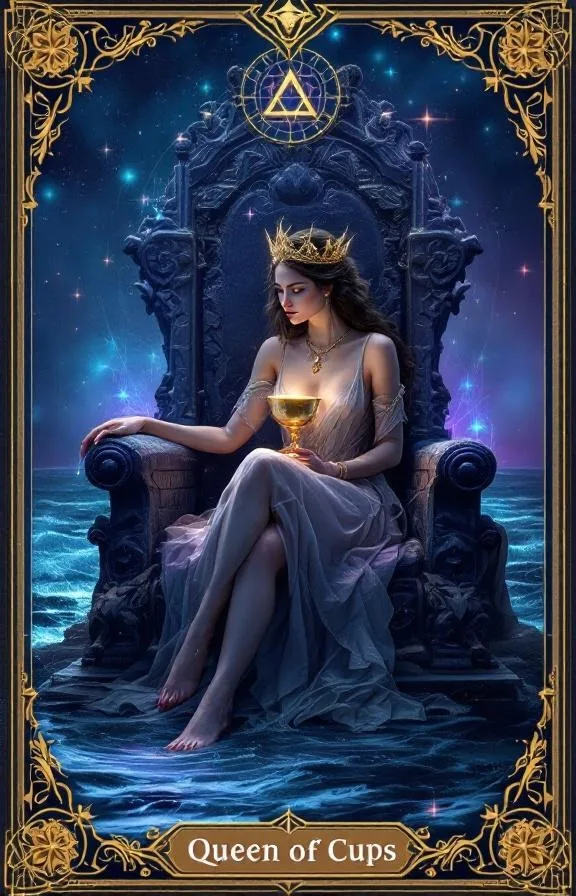
She placed a small amethyst cluster next to her tarot deck. No ceremony, no special arrangement — just a rough purple stone about the size of a walnut, tucked beside the cards on her nightstand where they always sat. She had been doing this for three weeks. On the fourth week, she forgot. And the reading felt different. Flatter. Like listening to a familiar song through cheap earbuds after weeks of hearing it on good speakers.
That's an anecdote, not evidence. Worth stating outright. But anyone who has worked with crystals alongside tarot cards will tell you something similar: the combination changes the quality of attention you bring to a reading. Whether that shift originates in the stone, in your nervous system, or in the ritual itself matters less than the fact that it happens consistently enough for thousands of practitioners across centuries to build entire systems around it.
This guide maps those systems. Specific crystals for specific suits. Pairings for major arcana cards that have been used by readers for decades. And practical methods for incorporating stones into your reading practice without turning your tarot table into a geology exhibit.
In short: Crystals paired with tarot cards create a ritual container that sharpens intuitive focus. Specific stones align with specific suits, major arcana cards, and reading intentions — carnelian for fiery Wands work, rose quartz for Cups readings about love, obsidian for the raw transformation of the Death card. The mechanism is debatable. The practical results are not. This guide gives you exact pairings and explains how to use them.
Why crystals and tarot work together
The simplest explanation is psychological. Dr. Christopher French, who heads the Anomalistic Psychology Research Unit at Goldsmiths, University of London, has spent decades studying why people experience real effects from practices that lack conventional scientific mechanisms. His research on crystal healing found that participants who held crystals during meditation reported genuine physical sensations — tingling, warmth, improved focus — regardless of whether the crystal was real or a convincing glass fake. The expectation of the experience, the belief in the tool, produced measurable subjective changes.
That finding doesn't debunk crystal work. It explains why it works. The crystal becomes an anchor for intention. A physical object you can hold, see, and assign meaning to. When you sit down with your tarot deck and place a specific stone beside it — chosen deliberately, for a reason you can articulate — you are performing an act of focused preparation that most readers skip entirely. You are telling your brain: we are doing something specific now. Pay attention.
Tarot already operates in this territory. The cards are physical symbols that externalize internal psychological material. You shuffle, you draw, you interpret — and the act of interpreting pulls latent thoughts and feelings into conscious awareness. Adding a crystal extends that symbolic vocabulary. The rose quartz doesn't need to emit measurable energy to make your love reading deeper. It needs to remind you, every time you glance at it, that this reading is about love. That reminder alone restructures your attention.
Crystals for each tarot suit
Each tarot suit corresponds to an element, and each element has a natural affinity with certain mineral families. These aren't arbitrary pairings. They follow an internal logic: the crystal's traditional associations should mirror the suit's elemental energy.
Wands (Fire) — carnelian, citrine, tiger's eye
Wands represent action, will, creative force, and passion. The element is fire. You want stones that feel activating.
Carnelian is the primary crystal for Wands work. It ranges from deep orange to reddish-brown, and historically it was carried by warriors and orators — people who needed courage and momentum. Place it beside your deck when you are reading about projects, ambitions, or creative direction. The energy of carnelian matches the forward drive of the Wands suit almost perfectly.
Citrine brings a different flavor of fire. Where carnelian pushes, citrine brightens. It corresponds to the more joyful, optimistic cards in the Wands suit — the Three of Wands (vision and expansion), the Six of Wands (recognition), the Ace of Wands (new creative spark). Natural citrine is pale yellow, almost champagne-colored. The deep orange "citrine" sold in most crystal shops is heat-treated amethyst, which is fine for ritual work but worth knowing about.
Tiger's eye grounds fire energy. Useful when your Wands reading is about strategic action rather than raw inspiration. The Knight of Wands charges ahead blindly. Tiger's eye says: charge ahead, but watch your footing.
Cups (Water) — rose quartz, moonstone, aquamarine
Cups deal with emotions, relationships, intuition, and the inner world. Water element. These crystals should feel receptive rather than projective.
Rose quartz is the obvious choice, and sometimes the obvious choice is obvious because it's correct. For any reading about love — romantic, platonic, self-directed — rose quartz sitting beside your spread creates an immediate emotional context. It softens the harder Cups cards, too. The Five of Cups (grief, loss) read beside rose quartz carries a quieter message: yes, something was lost, but you are still capable of love.
Moonstone connects to the Cups suit's more mystical register. The High Priestess energy within the Cups — the Two of Cups as soul recognition, the Page of Cups as intuitive messages. Moonstone has a milky iridescence called adularescence that shifts as you move it in light. That shifting quality mirrors how emotional truth feels. Never quite solid. Always revealing new facets.
Aquamarine is underrated in tarot work. It carries a clarity that the other water stones lack. If you are doing a Cups reading and want honest emotional insight rather than comfort, aquamarine cuts through sentimentality without being cold. It is the difference between a friend who hugs you and a friend who tells you the truth while handing you a glass of water.
Swords (Air) — clear quartz, lapis lazuli, fluorite
Swords are the suit of mind, communication, conflict, and truth. Air element. The crystals here should sharpen rather than soothe.
Clear quartz is the most versatile crystal in any practice, but it earns a specific place with Swords because of its amplification properties. It does not color a reading — it intensifies it. A Swords reading beside clear quartz will give you sharper messages. That can be uncomfortable. The Ten of Swords amplified by clear quartz does not pull punches.
Lapis lazuli has been prized for five thousand years, since Mesopotamian priestesses used it in divination rituals. Its deep blue flecked with gold pyrite connects to truth-telling — the core function of the Swords suit. The Ace of Swords is breakthrough clarity. Lapis lazuli placed beside an Ace of Swords is redundant in the best possible way: truth upon truth upon truth.
Fluorite is the study crystal. It comes in purples, greens, and blues, often banded in layers. For complex Swords spreads — multi-card readings about decisions, legal matters, communication problems — fluorite helps organize mental chaos. Think of it as a filing cabinet for your intuition.
Pentacles (Earth) — black tourmaline, jade, pyrite
Pentacles cover the material world: money, health, career, physical reality. Earth element. These stones should feel solid, grounding, and real.
Black tourmaline grounds readings about practical concerns. It is one of the few crystals that feels heavy even when small. If your Pentacles reading is about financial anxiety, debt, or career instability, black tourmaline beside your spread acts like an anchor. It will not change the reading's message, but it changes how you receive that message — from a centered place rather than a panicked one.
Jade has been associated with prosperity across Asian cultures for millennia. Not the get-rich-quick kind of prosperity. The slow, accumulated kind — savings, investments, property, generational wealth. It pairs well with the longer-arc Pentacles cards: the Nine of Pentacles (achieved abundance), the Ten of Pentacles (legacy), the King of Pentacles (mastery of the material world).
Pyrite — fool's gold — might seem like a joke pairing, but it is perfect for Pentacles readings about ambition and financial goals. Its metallic golden appearance signals abundance without being precious. Pyrite says: wealth is achievable, it is real, and you do not need to be born into it. The Page of Pentacles studying beside a chunk of pyrite is an aspirational image worth sitting with.
Crystals for the major arcana
Pairing crystals with all twenty-two major arcana cards would give you a reference chart nobody actually uses. Here are six pairings that experienced readers consistently return to — cards where a specific crystal meaningfully shifts the reading experience.
The Fool + aventurine. The Fool is the leap. Aventurine is known as the "stone of opportunity" — green, slightly sparkly, associated with luck and new ventures. The combination supports readings where someone is about to begin something genuinely unknown. Aventurine does not promise the leap will succeed. It promises the leap is worth taking.
The High Priestess + labradorite. This is the pairing that converts skeptics. Labradorite's surface looks like ordinary grey rock until light hits it at the right angle and suddenly you see flashes of blue, gold, green — hidden fire inside dull stone. That is the High Priestess in mineral form. She guards hidden knowledge. Labradorite reveals it in flashes. Place labradorite beside the High Priestess and sit with the card longer than you normally would. Something usually surfaces.
Death + obsidian. Volcanic glass. Formed when lava cools so rapidly that crystalline structure cannot develop. Death is transformation — the end of one form and the birth of another. Obsidian embodies that exact process, frozen in stone. It is also one of the most psychically protective stones in traditional crystal work, which matters because Death card readings often bring up genuine fear. The obsidian does not eliminate that fear. It contains it.
The Star + celestite. After the Tower destroys, the Star heals. Celestite is a pale blue crystal that looks like solidified sky. It corresponds to hope, divine connection, peace after crisis. This pairing is particularly effective in readings about recovery — from illness, from loss, from any of the Tower moments life delivers. The combination almost glows when placed together.
The Moon + selenite. Named for Selene, the Greek moon goddess. Selenite is translucent, white, and fibrous — it literally looks like captured moonlight. The Moon card deals with illusion, the subconscious, fears that distort perception. Selenite beside the Moon does not dispel those illusions. It illuminates them gently enough that you can examine them without flinching.
The Tower + smoky quartz. The Tower is the card most people dread. Sudden upheaval, structures collapsing, ego death. Smoky quartz is the grounding stone — dark, translucent, heavy. It absorbs chaotic energy. When the Tower appears in a reading, placing smoky quartz beside it is the crystal equivalent of taking a deep breath before you process what just happened. It does not make the Tower's message less disruptive. It makes you less likely to spiral.
Crystals by reading intention
Sometimes you are not reading about a specific suit or card. You have an intention — love, career, growth, protection — and you want a crystal that supports the entire reading's direction.
Love readings: rose quartz, rhodonite
Rose quartz is the default. It works. For readings that go deeper than "will they call me back" — questions about self-worth in relationships, patterns of attraction, attachment styles — rhodonite adds a dimension rose quartz lacks. Rhodonite is pink marbled with black veins. Those black veins are manganese oxide, the result of the crystal healing from internal fractures during formation. A stone that carries its own scars visibly while remaining beautiful. For readings about love after heartbreak, there is nothing more fitting.
Career readings: citrine, pyrite
Citrine for creative careers. Pyrite for financial goals. Together for readings where both matter — which is most career readings, honestly. Place citrine on the left of your spread (creative input) and pyrite on the right (material output). The spatial arrangement sounds arbitrary, but it gives your eye a path to follow while interpreting.
Spiritual development: amethyst, selenite
Amethyst has been the default spiritual crystal for so long that it risks feeling generic. It is not generic. High-quality amethyst — deep purple, translucent — placed beside cards like the Hermit, the High Priestess, or the Hanged Man creates a resonance that is hard to describe and immediately recognizable when you experience it. Selenite clears the channel. Use it at the start of a spiritual development reading, then set it aside. Let amethyst carry the reading itself.
Protection and clearing: black tourmaline, obsidian
For readings about toxic relationships, psychic boundaries, or situations where you feel energetically compromised. Black tourmaline absorbs negative energy (or at minimum, anchors the intention of clearing it). Obsidian reveals hidden threats — pair it with the Seven of Swords and watch what comes up in your interpretation. Together, they create a perimeter around a reading that allows honesty without overwhelm.
How to use crystals in your tarot practice
The mechanics are simpler than most guides make them.
Step one: cleanse. Before using a crystal with tarot, clear its energy. Running water works for most stones (not selenite — it dissolves). Moonlight overnight. Sage or palo santo smoke if that is part of your practice. Sound cleansing with a singing bowl. Pick one method and use it consistently. The consistency matters more than the method.
Step two: choose deliberately. Do not grab whichever crystal is nearest. Before you sit down to read, take ten seconds to identify your intention. Then pick a stone that matches. This tiny act of deliberate choosing is where most of the magic happens. It forces you to articulate what you are actually asking before the cards come out.
Step three: placement. Three options that work:
- Beside the deck before shuffling (programs the overall reading)
- On a specific card after drawing (amplifies that card's message)
- In your non-dominant hand while interpreting (keeps the intention physically present)
Experiment. Some readers arrange crystals in a grid around their spread. Others hold a single stone and never put it down. There is no wrong method. There is only your method, developed through repetition.
Step four: close the reading. When you are done interpreting, pick up the crystal before you pick up the cards. Hold it for a moment. This creates a clear boundary between the reading space and your regular consciousness. Then put both away — stone and deck — and move on with your day.
Do you need expensive crystals?
No. A five-dollar tumbled stone from a local metaphysical shop carries the same symbolic weight as a two-hundred-dollar museum specimen. The crystal is a tool for focusing intention. Your intention does not care about price tags.
Frequently asked questions
Can I use multiple crystals in one reading?
Yes, but more is not automatically better. One well-chosen stone often produces a clearer reading than five competing energies arranged around your spread. If you do use multiple crystals, make sure each one has a specific purpose. "Rose quartz for the emotional dimension, pyrite for the career question" is intentional. A pile of pretty rocks with no framework is decoration.
How do I know which crystal is right for a specific reading?
Start with the suit correspondences above. If your reading is dominated by Cups cards, reach for a water-element stone. If a single major arcana card dominates the spread, pair a crystal to that card specifically. Over time, you will develop personal associations that override any guide — and that is exactly how it should work. A guide gives you a starting framework. Your experience refines it. Within six months of consistent practice, you will pick up a stone before a reading and know it is right without being able to explain why.
Do crystals actually have energy, or is this all placebo?
That depends entirely on your framework. From a strict materialist perspective, crystals are minerals with specific lattice structures and no measurable ability to influence human consciousness. From an energetic or spiritual perspective, everything in the physical world carries vibrational frequencies, and certain minerals resonate with certain intentions. Here is what actually matters for your tarot practice: the question is unanswerable, and answering it is unnecessary. If placing amethyst beside your tarot deck produces more insightful readings, the mechanism is irrelevant. A carpenter does not need to understand metallurgy to swing a hammer. Use the tools that work. Discard the ones that do not. Let the philosophers argue about why.
Explore all tarot card meanings, try a free tarot reading, or discover your personal connection through your birth card.