There is a team I consulted with last year — a design agency, twelve people — that prided itself on its harmony. No arguing in meetings. No raised voices. Decisions made by consensus. The founder described the culture as "ego-free." She said it with visible pride.
The work was mediocre.
Not bad. Mediocre. Every project came out looking like a compromise, because that is exactly what it was. Nobody pushed for bold ideas because bold ideas create friction. Nobody challenged the client brief because challenging things makes people uncomfortable. Nobody said "this is not good enough" because that would disrupt the peace. So the peace was preserved and the work suffered and everyone smiled through it and went home feeling vaguely dissatisfied without being able to name why.
Conflict avoidance does not eliminate conflict. It buries it. And buried things rot.
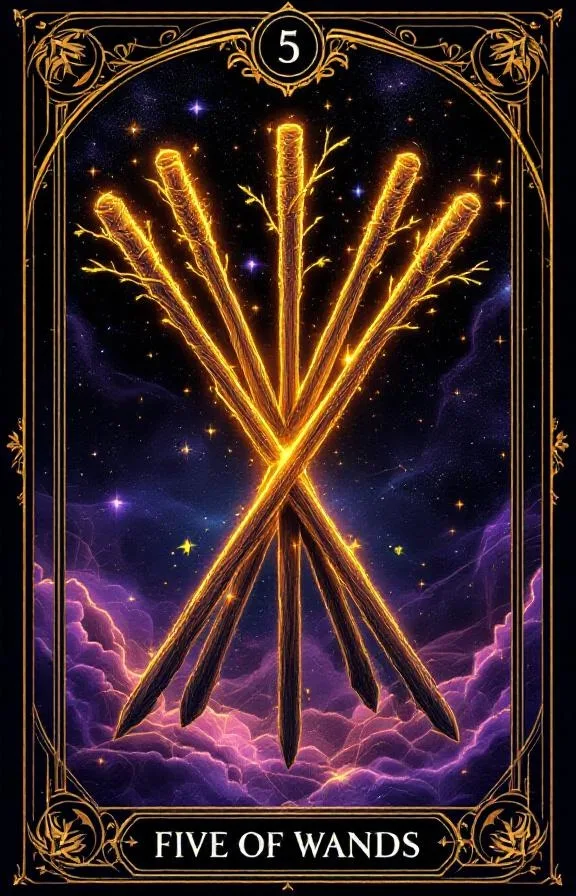
In short: The Five of Wands reversed represents conflict that has been suppressed rather than resolved — the false peace that comes from everyone agreeing not to disagree. In Muzafer Sherif's famous Robbers Cave experiment, two groups of boys were brought into fierce competition and then gradually reconciled through shared goals. The key finding was that resolution required confrontation first. Groups that skipped the conflict phase and jumped straight to cooperation never developed genuine trust. The Five of Wands reversed is the card of skipping that phase.
Why the Five of Wands appears reversed
The upright Five of Wands shows five figures brandishing wands in what appears to be a chaotic scuffle. It is disorganized, energetic, competitive. Most people read it as conflict, but a more precise reading is creative friction — the messy, uncomfortable process through which different perspectives collide and something better emerges.
Reverse it and the wands go down. But here is the crucial question: why did they go down? Did the conflict resolve into genuine understanding? Or did everyone just get tired of fighting and agree to pretend the disagreement never happened?
The Five of Wands reversed almost always points to the second option.
This is the workplace where feedback is called "negativity." The friendship group where bringing up a problem is labeled "drama." The family where generations of pain go unaddressed because "we don't talk about those things." The surface is calm. Underneath, resentments accumulate like sediment in a riverbed, raising the water level millimeter by millimeter until the flood.
And here is the uncomfortable truth that most people resist: the flood is not the problem. The flood is the symptom. The problem is the years of sediment that were allowed to accumulate because everyone agreed that peace was more important than honesty. By the time the flood arrives, the damage is exponentially worse than it would have been if the first layer of sediment had been addressed when it appeared.
There is a second, less common reading: internal conflict that cannot find external expression. You are at war with yourself — two incompatible desires, two contradictory beliefs — and because the battle is invisible, nobody around you knows it is happening. You present a unified front while being torn apart inside. This version of the card is lonelier. The suppressed argument is with yourself, and you are both sides.
Five of Wands reversed in love and relationships
In love, this card almost always means you are not fighting about the thing you need to fight about.
The dishes. The way they chew. The fact that they were late again. These are the fights you are having — small, repetitive, exhausting, and ultimately pointless. Because the real fight — about feeling unvalued, about the imbalance of emotional labor, about the future you cannot agree on — never happens. The small fights are proxies. They discharge enough tension to keep the relationship functional while the core issue remains unaddressed.
Sherif's research showed that superficial cooperation between conflicting groups collapsed at the first real stress. The boys who had not genuinely resolved their differences could share a meal but could not share a crisis. Relationships running on suppressed conflict work the same way. They manage the daily routine. But when something genuinely difficult happens — job loss, illness, a move — the unresolved issues surface with compound interest.
If you pulled this card about a potential relationship, pay attention. It can indicate someone who seems agreeable but is actually conflict-avoidant. They will never start a fight with you. That sounds appealing until you realize they will also never tell you when something is wrong, never express genuine disagreement, never give you the friction that real intimacy requires. Intimacy without conflict is performance. Good relationships are not defined by the absence of arguments but by the quality of them.
For people who just ended a relationship, the Five of Wands reversed can point to the inner turmoil of unfinished business. Things you should have said but did not. Conversations that ended with "it's fine" when it was not fine. The card suggests that the conflict did not end with the relationship — it just moved inside.
Five of Wands reversed in career and finances
This is the meeting where everyone nods and nobody believes.
A manager proposes a plan. The team has concerns. Nobody voices them. The plan proceeds, fails, and the post-mortem reveals that multiple people saw the problem coming but assumed someone else would speak up, or feared the consequences of being the dissenter.
The Five of Wands reversed in career readings is devastating because it points to organizational dysfunction, not individual failure. You might be performing well within a system that is performing badly, and the system's sickness is precisely its inability to tolerate productive disagreement. Companies that cannot argue well cannot innovate. Period.
Financially, the card can indicate competition you are refusing to acknowledge. A colleague gunning for your position while you pretend everything is collegial. A market shift you are ignoring because engaging with it would require uncomfortable changes. The reversed Five does not create conflict — it hides it. And hidden competition is more dangerous than open competition because you cannot strategize against a threat you refuse to see.
There is a specific financial pattern worth naming here. The entrepreneur who underprices because charging what they are worth would invite scrutiny, criticism, or comparison. The employee who does not negotiate because negotiation is a form of conflict. The business owner who avoids collections because asking for money you are owed creates tension. In each case, the avoidance has a direct dollar cost. The Five of Wands reversed does not merely suppress emotions — it suppresses income. That is a price people pay without ever writing it on the balance sheet.
Five of Wands reversed as personal growth
Sherif's Robbers Cave experiment is cited in every social psychology textbook, but the detail most people miss is this: the boys who went through genuine conflict and genuine resolution ended up closer than groups who never conflicted at all. Conflict, properly navigated, is not the enemy of connection. It is one of its prerequisites.
The Five of Wands reversed challenges you to examine your relationship with disagreement itself. Were you raised in a family where conflict meant danger? Where raised voices preceded slammed doors or worse? If so, your nervous system learned to interpret all conflict as threat, regardless of context. A respectful disagreement with a colleague triggers the same alarm bells as a screaming parent. Your body does not distinguish between them.
This is not a flaw. It is an adaptation that once kept you safe. But adaptations outlive their usefulness. The Five of Wands reversed shows up when your conflict-avoidance pattern has stopped protecting you and started imprisoning you — when the cost of peace exceeds the cost of friction.
Growth through this card means learning to tolerate discomfort without interpreting it as danger. It means saying "I disagree" and sitting with the silence that follows. It means understanding that some relationships will only deepen if you are willing to risk a rupture. And it means — perhaps hardest of all — giving yourself permission to be angry. Anger is information. Suppressed anger is a slow poison.
Most people think of conflict avoidance as passive. It is not. It is one of the most active, energy-consuming things a person can do. Every suppressed objection requires monitoring. Every swallowed frustration requires containment. Every fake smile requires performance energy. By the end of a day spent avoiding conflict, you are more exhausted than someone who had three arguments and resolved them. The Five of Wands reversed is not rest. It is invisible labor.
How to work with Five of Wands reversed energy
Practice micro-disagreements. Start absurdly small. When someone recommends a restaurant, say you would prefer somewhere else. When a meeting goes in a direction you question, raise your hand and say so. These are not acts of aggression. They are acts of presence. They say: I exist, I have preferences, I am willing to express them even if it creates a moment of tension.
Name the real issue. Whatever fight you keep having — the recurring one, the one that goes in circles — write down what it is actually about. Not the surface topic. The underneath thing. "We fight about dishes" becomes "I feel like I am the only one maintaining this household." "We argue about money" becomes "I am afraid we have fundamentally different values." Naming the real issue does not guarantee resolution. But it makes resolution possible, which is more than avoidance ever offers.
Set a boundary with consequences. The Five of Wands reversed thrives in environments where boundaries are stated but not enforced. "I've told you this bothers me" means nothing if the behavior continues with no consequence. A boundary without enforcement is a suggestion. Decide what you will do — not what you want them to do — if the line is crossed again.
Frequently asked questions
Is the Five of Wands reversed a good card if I have been dealing with a lot of conflict?
It can be, but with a significant caveat. If genuine conflict has resolved into genuine peace, the card is affirming that resolution. If the conflict has simply been abandoned or suppressed — if people stopped fighting because they gave up rather than because they worked it through — the card is warning that the ceasefire is temporary.
Does this card mean someone is being passive-aggressive toward me?
Frequently, yes. Passive-aggression is the behavioral signature of suppressed conflict. When direct expression feels unsafe or unacceptable, frustration leaks out sideways — in sarcasm, in backhanded compliments, in strategic forgetfulness. The Five of Wands reversed often names this dynamic.
How do I know if I am avoiding conflict or just being peaceful?
Honest self-inquiry helps. Peaceful people can disagree when it matters — they choose their battles but they do choose some. Conflict-avoidant people cannot disagree even when it matters, or they agree in the moment and seethe privately afterward. The test is simple: when you go along with something you disagree with, do you feel relieved or resentful? Relief suggests genuine peace. Resentment suggests suppression. The body does not lie about this, even when the mind tries to.
Explore Five of Wands' full meaning, see what it reveals as feelings, or discover Five of Wands as a person. Ready for deeper insight? Try a free reading.