She had the apartment. A converted loft in a neighbourhood that was featured in three different "best places to live" lists last year. Floor-to-ceiling windows, Italian espresso machine, a closet organized with the precision of a museum archive. Her Instagram looked like an advertisement for a life most people would trade theirs for.
Her rent was paid by her ex-boyfriend. Not officially — officially, she was subletting from a friend of a friend at a rate that did not exist in that zip code. But the friend of a friend was his cousin, and the below-market rent was a quiet arrangement that kept her geographically and emotionally tethered to a relationship she had supposedly ended eight months ago.
She told me about this at a dinner party, casually, like it was a clever hack. I did not ask the obvious question. She answered it anyway. "I know what you're thinking. But it's temporary. I'm saving to get my own place." She had been saving to get her own place for two years.
In short: The Nine of Pentacles reversed exposes the gap between the appearance of self-sufficiency and its reality. It shows up when material comfort depends on someone else's resources, when overwork has hollowed out the life it was supposed to build, or when external markers of success have replaced internal satisfaction. Edward Deci and Richard Ryan's self-determination theory explains why this hollow: autonomy, competence, and relatedness are basic psychological needs, and the reversed Nine sacrifices autonomy for comfort every time.
Why Nine of Pentacles appears reversed
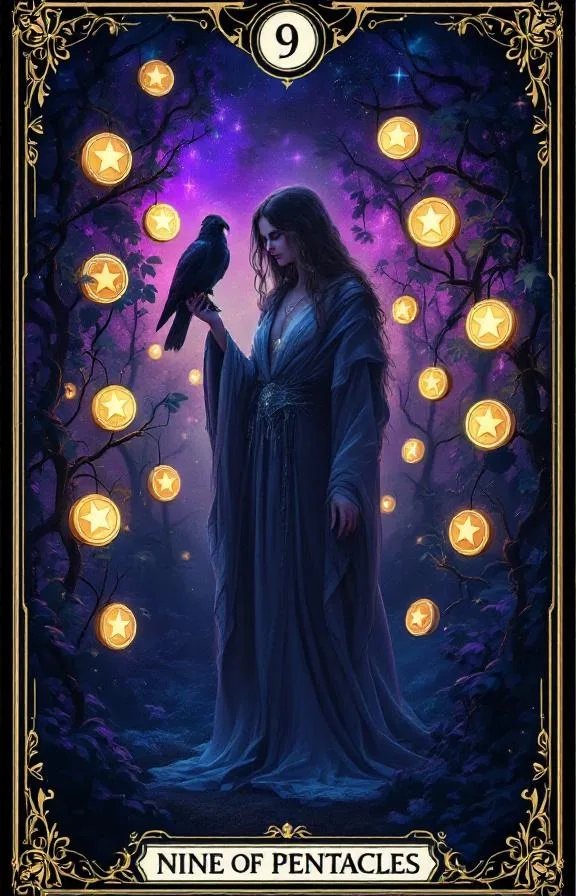
The upright Nine of Pentacles is one of the most enviable cards in the deck. A person standing alone in a lush garden, surrounded by abundance they created through their own sustained effort. Financial independence, aesthetic refinement, the deep satisfaction of knowing you built this. The falcon on the wrist is trained — even wildness bends to this person's patient discipline.
Turn it upside down and the garden is someone else's. Or it is yours but you are too exhausted to enjoy it. Or you are standing in a beautiful space feeling like a fraud because you know exactly how fragile the arrangement is.
Deci and Ryan identified three ingredients for genuine psychological well-being: autonomy (acting from your own volition), competence (feeling effective), and relatedness (meaningful connection). The Nine of Pentacles reversed typically represents a failure of autonomy. The material results might be present — the nice things, the comfortable life — but they are funded, maintained, or controlled by someone else. What looks like independence is actually dependence wearing expensive clothes.
There is another version of this reversal that has nothing to do with other people. It is the person who achieved genuine financial independence through a schedule that destroyed everything else. Seventy-hour weeks. No friendships that are not also networking opportunities. A refrigerator full of takeout containers. The garden is real, but the gardener has not sat down in it once.
And then there is the imposter version. The person whose Nine of Pentacles is entirely constructed — financed by debt, maintained by anxiety, and one unexpected expense away from collapse. The car is leased. The wardrobe is credit. The apartment is aspirational, meaning it costs thirty percent more than any financial advisor would approve. From the outside: abundance. From the inside: a constant, low-grade terror that the whole arrangement will be exposed.
Nine of Pentacles reversed in love and relationships
This card reversed in a love reading almost always involves a power imbalance related to money or resources. One partner earns significantly more, owns the home, or controls the financial decisions. The other partner has quietly traded autonomy for comfort, and the resentment is building in both directions — the provider feels taken for granted, the dependent feels controlled.
The arrangement might have started innocently. One person was between jobs. One person's income naturally covered more of the expenses. But over time, the temporary imbalance became structural. Now it shapes who gets to make decisions, who feels entitled to opinions about spending, and who carries the invisible weight of gratitude they did not ask to owe.
If you are single, the Nine of Pentacles reversed sometimes indicates choosing partners based on what they can provide rather than who they are. This is not gold-digging in the cartoonish sense. It is subtler — gravitating toward people who offer stability, status, or access because your own foundation feels shaky. The card asks whether you would still be attracted to this person if they had nothing to offer you except themselves. The answer might be uncomfortable. The question is still worth asking.
A related pattern: using singleness as a performance of independence that is actually isolation. "I don't need anyone" as a lifestyle brand. The Nine of Pentacles reversed in this mode is the person who has decorated their solitude so beautifully that nobody — including themselves — notices it is lonely.
There is also the workaholic version: you have built an impressive life but there is no room in it for another person. Your schedule is your partner. Your ambition is your intimacy. The Nine of Pentacles reversed in a love context can simply mean that you have optimized for achievement at the expense of connection, and the loneliness is starting to register.
Nine of Pentacles reversed in career and finances
Living beyond your means. That is the blunt reading, and it is often accurate. Credit card debt funding a lifestyle designed to signal success. Lease payments on a car that costs more per month than the promotion you are chasing will add to your salary. The Instagram version of your career doing significantly better than the spreadsheet version.
The financial warning here is not about spending in general — it is about spending that serves an audience. Deci and Ryan's framework distinguishes between intrinsic motivation (doing something because it satisfies you internally) and extrinsic motivation (doing something for external rewards or to avoid punishment). The Nine of Pentacles reversed is spending driven by extrinsic motivation. You are not buying the thing because you want it. You are buying it because you want to be the kind of person who has it.
Career-wise, this card can indicate a golden cage. The salary is excellent. The benefits are generous. The work is soul-crushing. You stay because the financial comfort has become a dependency, and the thought of taking a pay cut to do something meaningful triggers genuine panic. The pentacles are real, but they are bars on a window.
Nine of Pentacles reversed as personal growth
Most people will not admit what this card asks them to admit: that some of their independence is performative. The curated appearance of having it together, of needing no one, of being self-made — how much of that story survives close examination?
This is not about shame. Everyone depends on structures, people, and systems they did not build. The problem the Nine of Pentacles reversed identifies is not dependence itself — it is unacknowledged dependence. The person who insists they are self-sufficient while their parents pay their health insurance. The entrepreneur who credits their success to hustle while ignoring the trust fund that eliminated their risk.
Deci and Ryan found that when people pursue goals primarily for extrinsic reasons — money, status, image — they report lower well-being even when they achieve those goals. The Nine of Pentacles reversed is often this exact finding, lived out in real time. You got the thing. You feel nothing. Or worse, you feel the pressure to get the next thing because the satisfaction from the last one evaporated before the credit card statement arrived.
The growth here is unglamorous but transformative: figure out what you actually want, separate from what you want to be seen having. They are almost never the same list.
Deci and Ryan found that people who shift from extrinsic to intrinsic goal pursuit report increased well-being even before they achieve the new goals. The reorientation itself is therapeutic. Knowing what you genuinely value — not what the algorithm values, not what your social circle rewards, not what your parents expected — is a form of wealth that the reversed Nine has been ignoring. It cannot be photographed or posted. It does not generate envy. It also does not require maintenance, refinancing, or someone else's approval to sustain.
How to work with Nine of Pentacles reversed energy
Audit your dependencies. Not with judgment — with curiosity. Make a list of every resource you rely on that you do not fully control. The income that comes from one client, one employer, one partner. The living situation that depends on someone else's goodwill. The lifestyle that requires next month to be as good as this month or better.
Then pick one dependency and start building an alternative. Not overnight. The Nine of Pentacles upright represents years of patient cultivation, and you do not reverse a reversal with a weekend project. But you can open the savings account. You can have the conversation about splitting expenses more equitably. You can start the side project that might eventually replace the golden cage.
Stop performing abundance. This is harder than it sounds because the performance has probably become automatic. You reach for the expensive option without thinking because that is who you are now. But who you are now is in debt, or exhausted, or quietly miserable in a beautiful apartment that belongs to someone else's generosity. The Nine of Pentacles reversed asks you to trade the appearance of luxury for the reality of autonomy, even when the reality looks less impressive from the outside.
Practice small acts of genuine self-sufficiency. Cook a meal instead of ordering one. Fix the thing instead of replacing it. Walk instead of taking a car. These sound like austerity measures but they are actually autonomy exercises — small demonstrations that your comfort does not require someone else's involvement or a credit card's permission. The Nine of Pentacles upright built her garden one plant at a time over many seasons. The reversal of the reversal begins the same way: one small, self-generated act of abundance that nobody else can take away from you.
Frequently asked questions
Does the Nine of Pentacles reversed always mean financial problems?
No. Sometimes it points to emotional dependence rather than financial — relying on someone else for validation, self-worth, or a sense of identity. The "pentacles" in this context are not literal coins but anything of value that you have outsourced to another person instead of developing within yourself.
Can this card indicate overwork?
Yes, and this is one of its most important meanings. The Nine of Pentacles reversed frequently appears for people who have achieved material success at the cost of health, relationships, or simple enjoyment of life. The garden exists but you never sit in it. Everything you built is technically yours but functionally inaccessible because you are always working.
How is this different from the Seven of Pentacles reversed?
The Seven of Pentacles reversed is about impatience with a process that is still developing — you planted the seeds but you are frustrated with how slowly they are growing. The Nine of Pentacles reversed assumes the garden already exists (or appears to exist) and questions its foundation. Are you actually self-sufficient, or does your comfort depend on arrangements you cannot sustain? The Seven asks about patience. The Nine asks about honesty.
Explore Nine of Pentacles' full meaning, see what it reveals as feelings, or discover Nine of Pentacles as a person. Ready for deeper insight? Try a free reading.