My cousin has started learning six instruments. Guitar at fourteen. Piano at sixteen. Ukulele at nineteen. Drums at twenty-two. Bass at twenty-four. Violin last Christmas, because she watched a movie where the main character played violin and decided that was the missing piece. She owns all six instruments. She can play roughly thirty seconds of a recognizable song on each one.
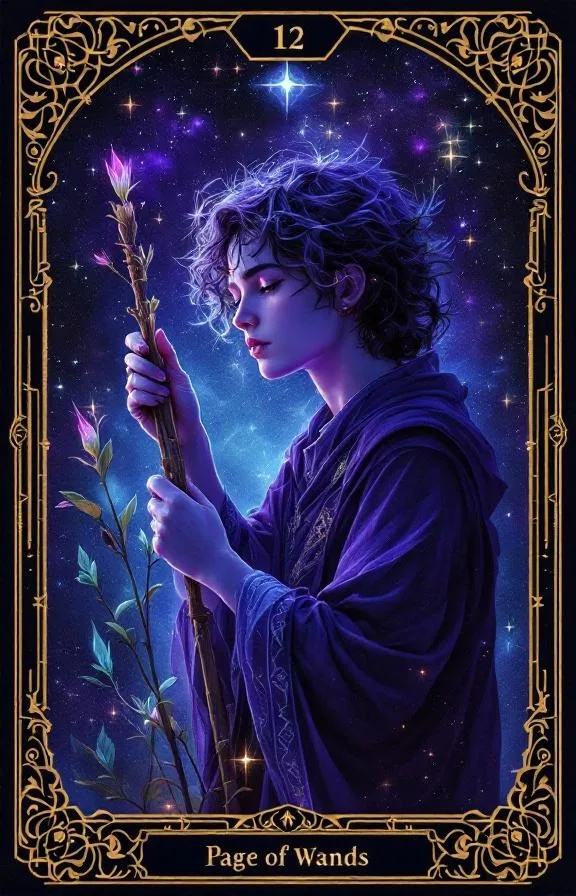
She is not lazy. That is what people misunderstand about the Page of Wands reversed. She gets genuinely excited. The first two weeks are electric — she watches tutorials at midnight, buys the equipment, tells everyone about her new passion. Then the excitement meets friction. The calluses hurt. The chord transitions are awkward. The thing that was supposed to be fun starts requiring discipline, and discipline is where the spark dies.
The instruments are not the point. The pattern is the point. Each one was supposed to be the thing that finally stuck, the passion that defined her. And each one failed that test — not because the instrument was wrong, but because the test itself is impossible to pass when you abandon the exam at the first hard question.
Six instruments, thirty seconds each. That is the Page of Wands reversed.
In short: The Page of Wands reversed represents creative enthusiasm that cannot sustain itself past the initial thrill — projects abandoned at the first sign of difficulty, curiosity that stays shallow, and potential that remains permanently unrealized. Jean Piaget's research on cognitive development shows that genuine learning requires moving from "assimilation" (fitting new experiences into existing frameworks) into "accommodation" (restructuring those frameworks when they prove inadequate). The Page of Wands reversed gets stuck in assimilation — absorbing the surface excitement of new things without ever doing the harder work of accommodation that produces real skill.
Why Page of Wands appears reversed
The upright Page of Wands is the spark. Raw enthusiasm. Beginner's energy at its most infectious. The person who gets an idea and immediately starts telling everyone about it, eyes lit up, talking too fast, already imagining the finished product before they have taken the first step. That energy is beautiful and genuinely necessary — nothing begins without it.
Reversed, the spark is still there, but it cannot sustain flame. The enthusiasm ignites, burns hot for a moment, and then goes out. Not because the idea was bad. Because the space between "this is exciting" and "this is hard" is where the Page of Wands reversed lives permanently.
Piaget observed that children go through a specific process when encountering something that does not fit their existing understanding. First they try to assimilate — to make the new thing fit what they already know. When that fails, they must accommodate — restructure their understanding to incorporate the new information. This second step is uncomfortable, effortful, and absolutely essential for real learning.
The Page of Wands reversed skips accommodation. Every time. It assimilates the excitement of a new pursuit, enjoys the dopamine of beginning, and then abandons ship the moment the pursuit demands genuine cognitive restructuring. The result is a collection of beginnings with no middles and no endings.
Page of Wands reversed in love and relationships
In relationship readings, this card usually describes someone who is exciting at the start and absent by the third month.
They come on strong. Intense eye contact. Elaborate plans. Grand gestures early. They make you feel like the most interesting person in the world for exactly as long as you remain novel. Once the relationship moves past the discovery phase — once they have heard your stories, mapped your quirks, and the mystery recedes — the enthusiasm drains visibly. They do not leave dramatically. They just become less present. Shorter texts. Fewer plans. The slow fade.
If you are the person pulling this card, the question is uncomfortable but necessary: do you fall in love with people, or with the feeling of falling in love? Those are different things. The first requires showing up when it is boring. The second only requires novelty.
For established relationships, the Page of Wands reversed can indicate a partner who keeps proposing new activities, trips, or changes to the relationship structure — not because the ideas are genuine improvements, but because novelty is their substitute for depth. "We should take a cooking class." "We should move to a new city." "We should try something different." The underlying message: I am bored, and I do not know how to be interested in something I already have.
Page of Wands reversed in career and finances
The professional graveyard of the Page of Wands reversed is littered with half-finished projects.
The business plan that made it to page twelve. The online store that launched with four products and never got a fifth. The course that has three modules completed out of twelve. The freelance career that lasted two client projects before the person decided they were actually meant to be a photographer. Then a podcaster. Then a consultant.
This is not about capability. People carrying this energy are often genuinely talented — the problem is that their talent is distributed across so many abandoned pursuits that none of them ever reach the threshold of competence where effort starts producing real returns. Malcolm Gladwell's much-debated ten thousand hours aside, there is a minimum investment of time and effort below which any skill remains superficial. The Page of Wands reversed consistently operates below that minimum.
Financially, this can show up as impulsive spending on new hobbies, courses, or equipment that gets used twice and then collects dust. The art supplies in the closet. The gym membership from January. The domain name purchased for a website that was never built. Each purchase felt like an investment in the future. Each turned out to be a donation to the past.
The financial pattern deserves attention because it reveals something the career pattern obscures: the Page of Wands reversed does not just abandon projects. It pays for the privilege of abandoning them. Every unfinished course has a receipt. Every discarded hobby has an equipment budget. Over years, the accumulated cost of beginnings-without-endings adds up to a significant amount of money spent on a person you never became.
Page of Wands reversed as personal growth
The deepest issue here is not discipline. It is fear.
Most people who identify with the Page of Wands reversed think their problem is follow-through. They believe they need more willpower, better habits, stricter routines. And while those things might help at the margins, they miss the core issue: abandoning things before they get difficult is a strategy for avoiding failure. You cannot fail at guitar if you never get past the beginner stage. You cannot be rejected from the gallery if you never finish the painting. You cannot bomb the business if you never actually launch it.
Staying a permanent beginner is safe. It hurts in a low-grade, chronic way — the ache of unrealized potential — but it never delivers the acute pain of having tried your best and discovered it was not enough. The Page of Wands reversed chooses the dull ache over the sharp one every time.
Piaget would add another layer. Accommodation — the restructuring of mental frameworks — is inherently destabilizing. It requires admitting that your current understanding is insufficient. For someone whose identity is built on being quick, clever, and naturally talented, that admission feels like a threat. Better to move on to something new, where you can be a natural again for a few weeks, than to stay with something long enough to feel genuinely incompetent.
The growth work is to pick one thing and stay with it past the point where it stops being fun. Past the plateau. Past the frustration. Into the territory where effort compounds and skill begins to emerge from repetition. It will feel wrong. It will feel like you are wasting time on something you are clearly not meant for. That feeling is not information about the activity. It is the Page of Wands reversed trying to protect you from accommodation.
There is a moment — usually around the six-week mark of any new pursuit — where the novelty has completely worn off and the competence has not yet arrived. That dead zone is where the Page of Wands reversed habitually quits. Everything before that point was enthusiasm. Everything after it would be skill. But the zone itself is purgatory: boring, effortful, and devoid of the dopamine that made the beginning so intoxicating. Learning to survive that zone is the entire developmental challenge of this card.
How to work with Page of Wands reversed energy
Pick one unfinished project. Not the most exciting one — the most achievable one. Something you can complete in a defined timeframe. Give yourself a deadline, share that deadline with someone who will hold you to it, and finish the thing. The completion itself is the medicine. Not the quality of the output. The act of seeing something through from beginning to end.
When you feel the pull toward a new shiny idea — and you will — write it down in a notebook and agree with yourself that you will evaluate it after your current project is complete. You are not killing the idea. You are simply postponing it. This small act of delay is remarkably powerful because it separates genuine inspiration from impulsive avoidance. Ideas that survive a waiting period are worth pursuing. Ideas that lose their appeal after two weeks were never as important as they felt.
Examine your relationship with being bad at things. Can you tolerate sucking at something for six months while you learn? If that sentence made you uncomfortable, you have found the nerve the Page of Wands reversed is pressing on.
Frequently asked questions
Does the Page of Wands reversed mean I should not start new things?
It means you should finish something before you start the next thing. The card is not against new beginnings — it is against the pattern of using new beginnings as an escape from the middle stages of existing commitments.
Can the Page of Wands reversed represent a specific person?
Often, yes. It can indicate a young or young-at-heart person who is full of ideas but short on execution — the friend who always has a new plan, the partner who promises change and then loses interest, the colleague who pitches brilliantly but vanishes during implementation. It can also describe a child or teenager who has not yet learned the connection between effort and outcome.
What if the Page of Wands reversed appears alongside the Ace of Wands?
This combination is worth paying attention to. The Ace suggests a genuine new opportunity or creative spark, while the Page reversed warns that your pattern of abandonment will likely sabotage it unless you consciously choose a different approach this time. The opportunity is real. Whether you do anything lasting with it depends on whether you can break the cycle. Surrounding cards — especially Pentacles — can indicate whether the necessary discipline and practical support are available.
Explore Page of Wands' full meaning, see what it reveals as feelings, or discover Page of Wands as a person. Ready for deeper insight? Try a free reading.