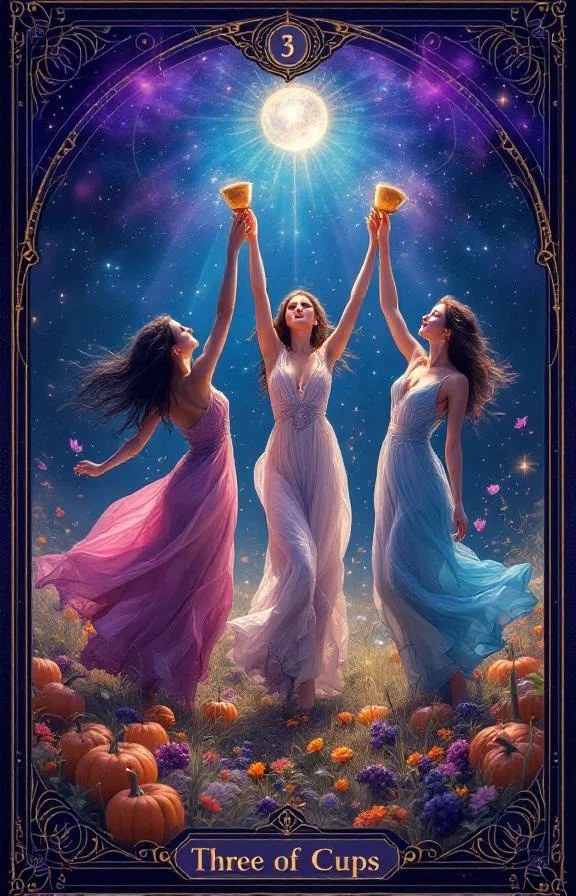
The most common skeptical question about tarot goes like this: "If the cards are random, how can they mean anything?"
Fair question. It deserves an honest answer — one grounded in cognitive science, not a retreat into mysticism.
Here is the short version: randomness is not the same as meaninglessness. And for self-reflection, randomness may actually be the feature that makes the whole system work.
In short: Random tarot draws feel accurate because your brain is wired for pattern-matching — the same apophenia and projection mechanisms behind Rorschach inkblots. Your fast, automatic thinking responds to the card before your rational mind can curate the reaction, surfacing genuine psychological material. The randomness bypasses your editorial control, which is exactly what makes a reading useful for self-reflection rather than confirmation bias.
The Rorschach Principle
In 1921, Swiss psychiatrist Hermann Rorschach published a set of standardized inkblots as a diagnostic tool. The blots were deliberately ambiguous — symmetrical shapes with no intended representational content. What patients saw in them was not determined by the blots. It was determined by the patients.
 That is the core insight: when the external stimulus carries no fixed meaning, internal content becomes visible.
Show someone a photograph of a dog, and they say "dog." No projection happening — the meaning comes from the image. Show someone an inkblot, and they might see a butterfly, a monster, a dancing woman, two figures arguing. The diversity of responses is informative precisely because the stimulus is not.
Tarot works on the same principle. A 78-card deck is not a random inkblot — each card has a rich symbolic tradition — but no card's meaning is fixed or exhaustive. The same card can legitimately represent many different things depending on context, framing, and the person looking at it. That combination of symbolic richness and interpretive openness makes tarot an excellent projective surface.
What "Random" Actually Means Here
When a digital or physical tarot draw is called "random," it means the specific card was not selected with your situation in mind. The universe did not pick the Seven of Cups because it is cosmically accurate for your Tuesday.
 But random does not mean the interpretation is arbitrary. Your mind engages with the card immediately and involuntarily. Pattern-matching fires before you consciously decide to interpret anything. Associations surface, feelings arise, memories activate. None of that is random. That is your psychology doing exactly what it was built to do.
The random draw ensures you are not starting from a card you chose. You are starting from a card that surprised you. And surprise — the gap between expectation and what actually appeared — is one of the most productive states for genuine learning.
Apophenia as a Feature, Not a Bug
Apophenia is the tendency to perceive meaningful patterns in information that is statistically random or unrelated. Psychological literature often describes it as pathological, especially in extreme forms. But mild, functional apophenia is not a disorder. It is the cognitive engine that drives creativity, storytelling, language acquisition, and — yes — self-reflection through symbolic systems.
 Every metaphor you use is apophenia at work. When you say "I feel stuck," you are applying physical immobility to a psychological state. Nothing is literally stuck. But the mapping is generative — it lets you think about an emotional state using the resources of embodied experience.
When you see yourself in the cards, the same process runs. The Hermit's lantern and solitary cliff do not literally describe your Tuesday morning. But the pattern of isolation-in-service-of-insight might map meaningfully onto something you are living through right now. Your mind is doing useful work, not making an error.
The question is not whether apophenia is happening — it always is, in every mind, as a basic feature of consciousness. The question is whether the symbolic system you are working with is rich enough to produce productive mappings.
Jung's Synchronicity: A Psychological (Not Mystical) Reading
Carl Jung introduced synchronicity to describe "meaningful coincidence" — two events that are not causally connected but feel significantly related. In his 1952 essay, he proposed that certain coincidences carry psychological significance that cannot be reduced to cause and effect.
Synchronicity gets presented as mystical more often than Jung intended. His actual position was subtler and more psychological. He was interested in why certain coincidences feel significant to the people who experience them, and what that significance reveals about the observer's psychological state.
From a cognitive science perspective, what Jung called synchronicity can be unpacked through:
- Confirmation bias — we notice and remember coincidences that align with our current preoccupations
- The Baader-Meinhof phenomenon (frequency illusion) — once something enters our awareness, we encounter it everywhere
- Emotional amplification — heightened feeling makes external events feel more personally significant
None of this debunks synchronicity as an experience. It explains why the experience is real and psychologically meaningful without requiring an occult mechanism. When a card you drew this morning shows up in three unrelated contexts before noon, your psychological state is the common thread — not the universe selecting your cards.
For tarot, the implication matters: the feeling of synchronicity in a reading is real data about your psychological state, not evidence of predictive accuracy.
Two Systems of Thinking and the Moment of Drawing
Daniel Kahneman's framework of fast and slow thinking — from Thinking, Fast and Slow — maps directly onto why random card draws generate insight.
The fast system is automatic, associative, and emotional. It runs continuously below conscious awareness. It produces your immediate reaction to a card — the feeling that arises before you have read a single word of interpretation.
The slow system is deliberate, analytical, and conscious. It handles step-by-step reasoning. It drives the interpretive work that follows the initial gut response.
The interesting moment in a tarot reading is the handoff between the two.
Your fast system responds to the card immediately — before you can manage or curate that response. The image activates associations, emotional memories, and intuitive judgments that bypass your editorial control. This is the most psychologically unfiltered moment in the process.
Your slow system then begins the interpretive work: reading the description, weighing what it means for your situation, sorting through the resonances and non-resonances.
The insight in a good reading often lives in the tension between these two responses. When your gut reaction contradicts the analytical interpretation, or when it strongly confirms it, that convergence or divergence tells you something real. It reveals the gap between what you consciously believe and what you intuitively sense.
This is why the first step of working with a card productively is always to notice and record your immediate reaction before reading any interpretive text.
Why This Makes AI-Assisted Readings More Interesting, Not Less
One concern people raise about AI-powered tarot tools like aimag.me/reading is that an algorithm "cannot understand" what the cards mean.
That concern misidentifies where meaning gets generated. The AI does not need to understand your life to be useful. It needs to provide a structured interpretive vocabulary that gives your meaning-making mind something substantive to work with.
When you receive an interpretation, you are not passively receiving truth. You are actively filtering: this resonates, this does not, this surprises me, this feels off in a way worth examining. That filtering — the engagement between the interpretation and your own knowing — is where the actual insight happens.
A close friend who knows your history can offer more targeted interpretations than a general framework. But a general framework, applied consistently and engaged with actively, still generates real reflection. Research on journaling, bibliotherapy, and symbolic thinking backs this up.
Meaning-Making as Adaptive Behavior
Evolutionary psychologists and cognitive scientists have proposed that the human drive to find meaning in patterns, narratives, and symbols is not a flaw but an adaptive behavior that has served the species for hundreds of thousands of years.
The mind that reads ambiguous data as potentially significant and acts on that reading survives encounters with predators. The mind that demands certainty before acting often does not. The result: we are built to find meaning in ambiguity — aggressively, automatically, and often accurately.
The problem is that this same drive gets hijacked by anxiety. When you are stressed or uncertain, meaning-making can become meaning-forcing: the desperate attempt to impose a coherent narrative on chaos, to resolve ambiguity prematurely rather than sitting with it.
Structure helps here. A good question (see the companion article on decision fatigue and question framing) channels the meaning-making drive toward productive territory. A good interpretive framework provides enough scaffolding to support the inquiry without predetermining the outcome. And the randomness of the draw prevents you from manufacturing the meaning you expected.
The card that challenges your preferred narrative is the most valuable one.
Random Number Generators and the Question of True Randomness
A technical note that illuminates something worth understanding: in digital tarot tools, the "random" draw comes from a pseudorandom number generator (PRNG) — an algorithm that produces number sequences appearing random but technically deterministic, seeded by values like the current time to the millisecond.
True mathematical randomness is extraordinarily hard to achieve computationally. What we use is sufficient randomness: distributions that pass statistical tests for uniformity and independence, with no pattern a user could predict.
From a psychological standpoint, the technical distinction is irrelevant. What matters is that you have no way to anticipate or influence which card appears. The unpredictability is real from the perspective of the person engaging with the system. Your reaction to the card is not shaped by prior knowledge of what it will be.
The "randomness" that matters for psychological purposes is the randomness experienced by the observer — not the metaphysics of whether true indeterminacy exists.
The Uncertainty Advantage
There is a second reason randomness is genuinely valuable for self-reflection: we are often wrong about what we need to think about.
When you choose your topic of reflection, you choose from what is already conscious — already at the top of your awareness. The truly unconscious material, by definition, is not available for conscious selection.
A random draw bypasses that editorial control. You get the Seven of Cups when you expected something grounding and definitive. You are pushed to think about confusion, fantasy, and multiplicity of desire when you showed up ready to think about practical action. That mismatch might be exactly where you need to spend time.
It may not always be. Sometimes a draw feels genuinely irrelevant and you should trust that. But the experience of irrelevance is also data — it can reveal where your resistance lives.
Three Ways to Engage Randomness Productively
1. Lead with your reaction, not the interpretation
When a card appears, notice your first response before reading any interpretive text. Relief? Disappointment? Confusion? Surprise? That first reaction is a pure projective response — the most unfiltered data point the draw produces. Write it down before interpretation overwrites it.
2. Work with the gap
If the card feels entirely wrong for your situation, the gap is worth exploring. Ask: "Why does this feel irrelevant? What would have felt more appropriate?" Your expectation of a different card tells you something real about what you are looking for.
3. Return to the same question across multiple sessions
Single draws are interesting. Patterns across time are informative. If you ask a similar question over several weeks and similar cards or themes keep surfacing, the pattern has emerged from your engagement, not from any single random draw. The spreads in the aimag.me card library include options designed for tracking themes over time — including dedicated relationship tarot spreads that map dynamics between two people across multiple draws.
Bibliotherapy, Journaling, and Symbolic Systems: What the Research Shows
Tarot is not the only symbolic system used therapeutically. Bibliotherapy — reading as therapeutic intervention — has a substantial evidence base. Studies show that engaging with fictional narratives increases empathy, reduces anxiety, and produces genuine shifts in self-understanding. The mechanism matches what happens in tarot: the reader projects onto characters and situations, then withdraws insight that is genuinely their own.
Expressive writing research has consistently shown that structured reflection on emotionally significant events produces measurable benefits: improved immune function, reduced anxiety, better mood, and stronger integration of difficult experiences. The key finding: benefit comes not from writing freely but from constructing a coherent narrative — finding pattern and meaning in what happened.
Tarot functions as a structured prompting system for exactly this kind of narrative construction. The card provides a symbolic frame. The interpretation provides vocabulary. The reader constructs the meaning. Not mysticism — a variant of a well-understood, well-researched psychological process.
What distinguishes tarot from journaling is the randomness of the prompt. In journaling, you choose your own starting point. In a card reading, the starting point is chosen for you. As argued throughout this article, that involuntary quality is not a weakness. It is one of the system's most valuable features.
A Practice: The Contrary Card Exercise
This exercise works specifically with the productive discomfort of unexpected draws.
Setup: Ask a question you feel fairly certain about — one where you have a strong intuition about the answer. Draw a card.
If the card confirms your intuition: useful data. But spend equal time with the question "what would I be missing if this card were the only truth here?"
If the card surprises or contradicts you: this is the more productive scenario. Write down your immediate reaction unfiltered. Then ask: "If I take this card seriously as a response to my question, what would I need to acknowledge that I am currently avoiding?"
The goal is not to override your own judgment with the card's message. The goal is to let the unexpected draw open territory your own thinking would have closed off.
The Honest Scientific Picture
To be clear: tarot does not have predictive validity in any scientifically rigorous sense. No peer-reviewed mechanism explains how a random card draw could reliably predict future events.
But that is not what self-reflection tools are for. Journaling, therapy, meditation, and tarot are not evaluated by predictive power. They are evaluated by whether they help you see yourself more clearly and engage with your life more deliberately.
On those measures, the cognitive science of projection, apophenia, and meaning-making provides a solid account of how a random draw generates useful psychological material. The tool works, and we have a decent explanation of why.
If you want to go deeper, Psychology Today's coverage of pattern recognition offers a readable overview, and Kahneman's Thinking, Fast and Slow remains the best entry point into the underlying cognitive science.
Randomness is not the enemy of meaning. In the right context, it is the condition that makes genuine meaning-making possible. The card that surprised you is often the card you needed.
See what a random draw reveals. Start a reading at aimag.me/reading and notice your first reaction before you read the interpretation.
Related Reading
- The projection effect: why you see yourself in the cards — the cognitive science of apophenia and projective psychology in more depth
- AI tarot reading: self-reflection, not prediction — why randomness plus AI interpretation creates a genuinely useful reflective tool
- What your recurring cards are telling you — when the same card draws repeatedly, the pattern reveals more than any individual random draw
- Shadow work: what your discomfort with a card reveals — the randomness that matters most is the card that triggers an unexpected emotional reaction